Article | Marc Chagall Paris Auction October 2026
Chagall's Paris
Three works on offer in our Paris auction reveal just how important the city was for the artist.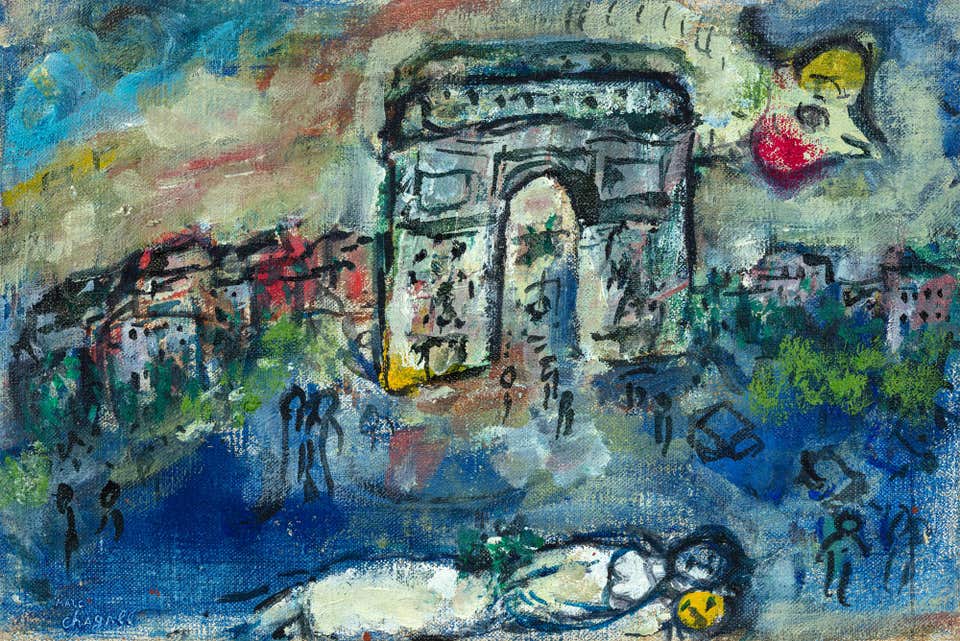
MARC CHAGALL, Amoureux à l'Arc de Triomphe, 1966. Vente Art Moderne & Contemporain et Design.
Paris has long stood as a source of inspiration for artists, and for us, it’s no different as Phillips increases its presence in the city with the introduction of the Vente Art Moderne & Contemporain et Design this October. As the art world descends on the City of Lights this month, it’s worth taking a step back to consider the impact the city has had on artists. For Marc Chagall in particular, the city became his adopted hometown, a place he felt more comfortable personally and artistically than anywhere else. He lived in Paris for three separate stints, arriving early in the 20th century, interrupted by the two world wars, returning in 1948 and remaining until his passing in 1985. The three beautiful Chagall works on offer at Phillips Paris this season are each striking, but perhaps none is more emblematic of the artist’s love for the city as Amoureux à l’Arc de Triomphe.
By 1966, when this work was executed, Chagall was permanently rooted in Paris. Depicting one of the city’s most iconic architectural structures, its personal nature and expressivity are heightened by symbolic imagery from the artist’s distinctive visual lexicon. The enormous rooster seen flying above the arch acts as an alter-ego for the artist, and the two intertwined figures below can be seen to represent his life’s great loves — Bella Rosenfeld, his first wife and muse who tragically passed towards the end of World War II, and Valentina “Vava” Brodsky, who he married in the summer of 1952. Across this swirling sea of blues and vibrant accents, we encounter the multitudes of Chagall’s “Amourex” — his dear wives, the city of Paris, and the art of painting.
“No academy could have given me all I discovered by getting my teeth into the exhibitions, the shop windows, and the museums of Paris”
—Marc Chagall
In this postwar period, Paris represented a familiar, resurgent form of inspiration for the artist, as he later wrote, “The Paris of which I dreamed in America, I rediscovered enriched by new life, as if I had to be born again, dry my tears and start crying again. Absence, war, suffering were all needed for that to awaken in me and become the frame for my thoughts and my life.” In the earlier work, Bouquet d’arums, we meet Chagall at just such a period of profound happiness in the years just following his return to France, which launched with his inclusion in the French pavilion in the 1948 Venice Biennale.
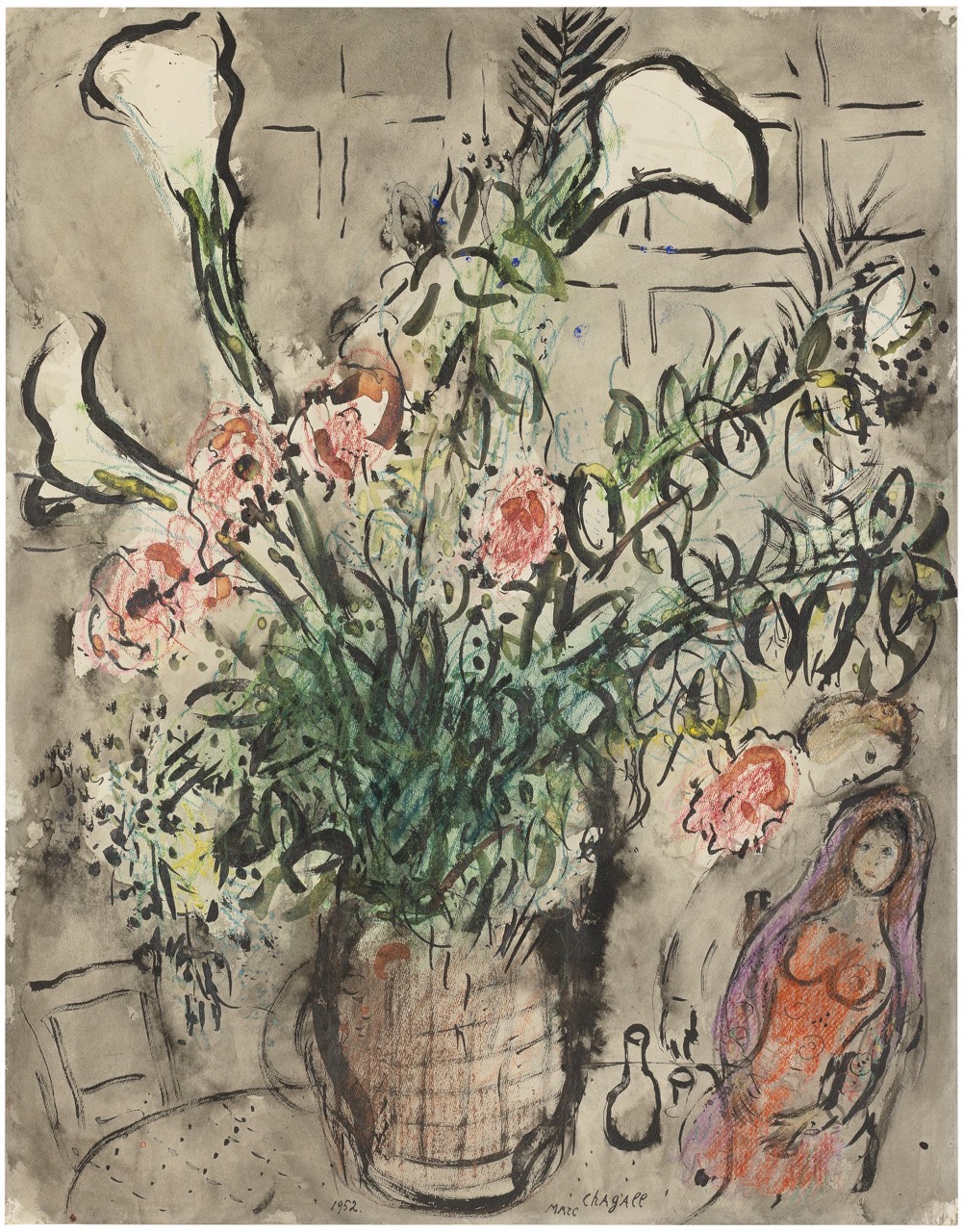
MARC CHAGALL, Bouquet d'arums, 1952. Vente Art Moderne & Contemporain et Design.
This work presents two important visual themes for the artist, flowers and lovers, at a time when his life was blooming with both, seaside with Brodsky whom he married the same year this work was executed. In Chagall’s hands, gouache, pastel and inks present rich contrasts, imparting the sensory experience of the dewy flowers as much as their image. The exuberance of new love and fresh start in France after the war remains present in this image, even though it was realized four years after his return.
“If I create from the heart, nearly everything works; if from the head, almost nothing.”
—Marc Chagall
While exiled in New York, Chagall — who never fully mastered the English language — maintained close ties with émigrés from France, including Fernand Leger, Marcel Duchamp, and André Breton. For as much as Parisian creativity remained important to him in these years, Le cheval à la lune from 1943 sees the artist exploring his Russian roots as well. Belonging to a series of gouaches responding to his set and costume designs for a production at the Palacio de Bellas Artes of Mexico of Sergei Rachmaninoff’s opera Aleko, based on the narrative poem Gypsies by Alexander Pushkin, this work shows Chagall in collaboration with several displaced Russian artists — including choreographer Léonide Massine — who were all working with the inspiration of Mexican art and artists, including the Surrealist painters Leonora Carrington, Remedios Varo and Esteban Frances.
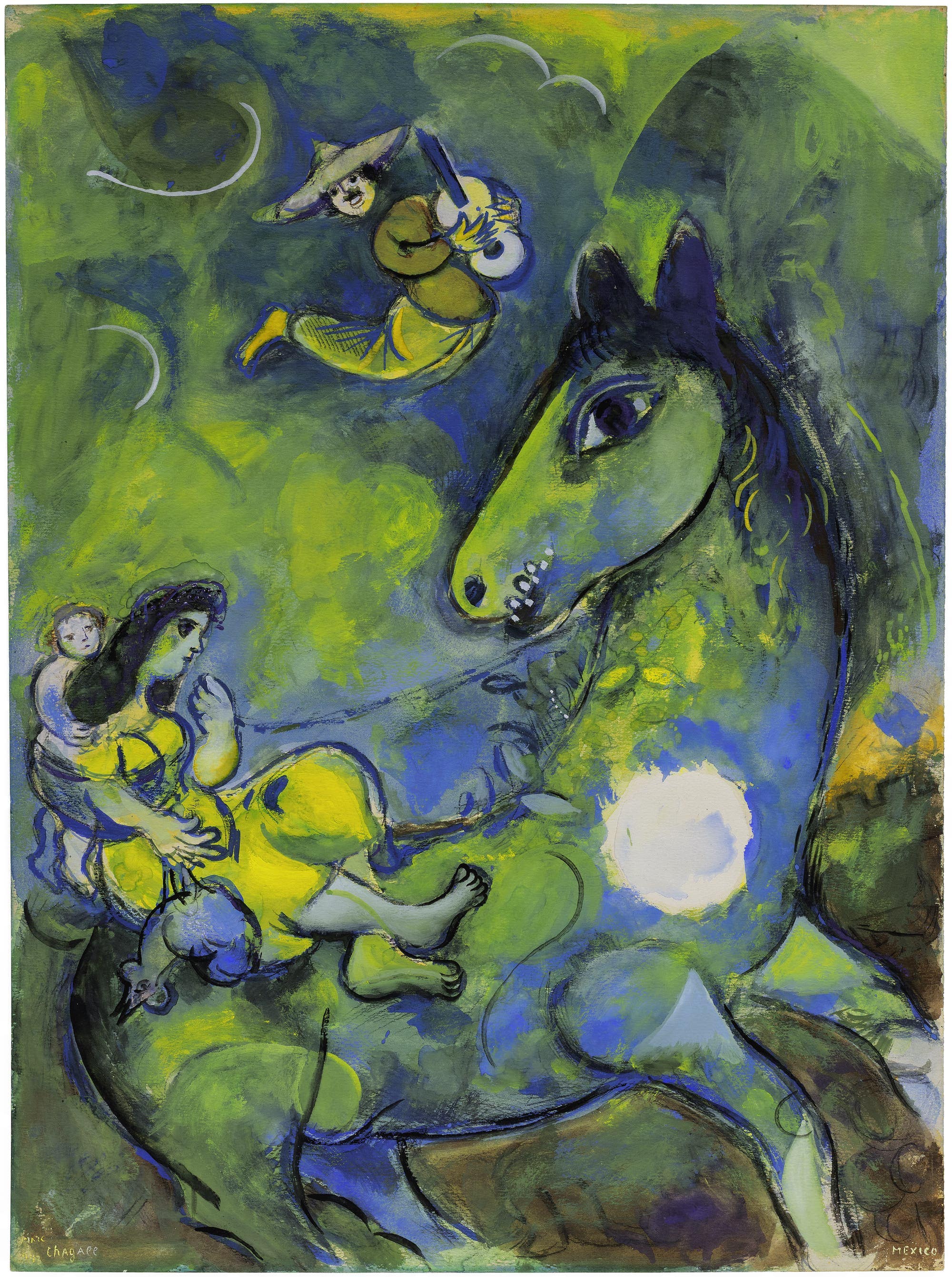
MARC CHAGALL, Le cheval à la lune, 1943. Vente Art Moderne & Contemporain et Design.
This multicultural sensibility is on full display in the thematic elements of the work — from the guitar-wielding Trovador soaring above, to the more universal themes of mother and child, and the art historical reference inherent to equestrian depictions. The story of the opera, of a nobleman who flees high society to live among nomadic peoples, is also resonant with the displaced nature of the collaborators involved. Seen in the context of Chagall’s later works after his return to Paris, one captures a complete glimpse of how each era of the artist’s life gave him fruitful imagery to continue to explore, from his native white nights to his adopted Parisian light.