Article | Harry Winston Opus I V Independent Watchmaking Phillips Geneva Watch Auction Xxiv November 2026
The First Five: How Harry Winston’s Opus Series Changed Independent Watchmaking
A quarter of a century ago, the Harry Winston Opus began giving barely known independent watchmakers creative freedom and credit for their work through. With a unique Opus One Tourbillon coming to The Geneva Watch Auction XXIV, we revisit the people, ideas, and encounters behind the series’ first five collaborations.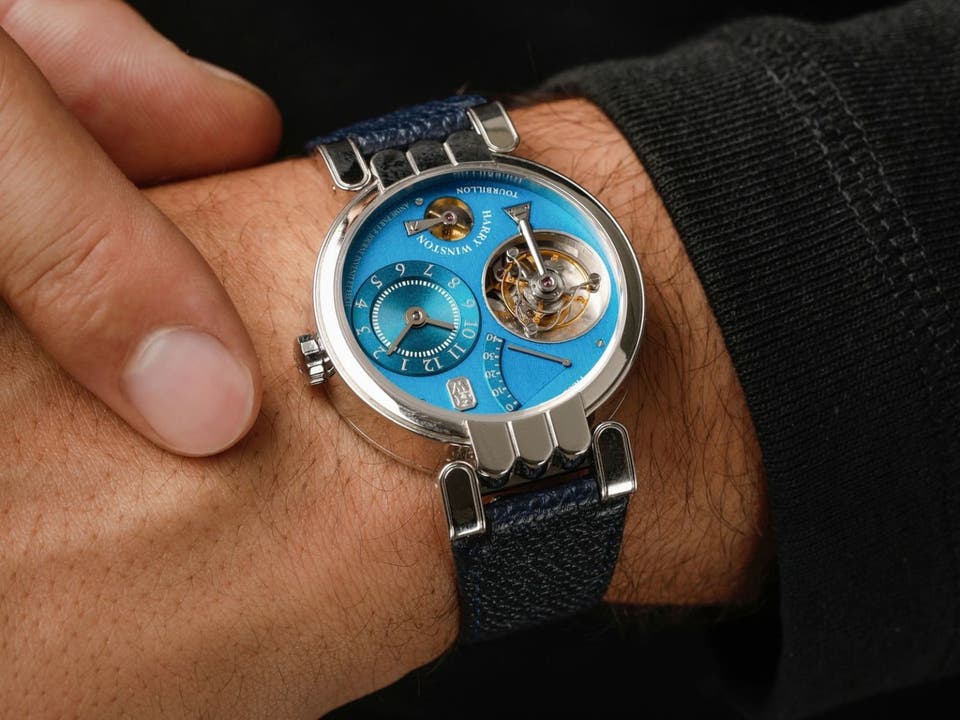
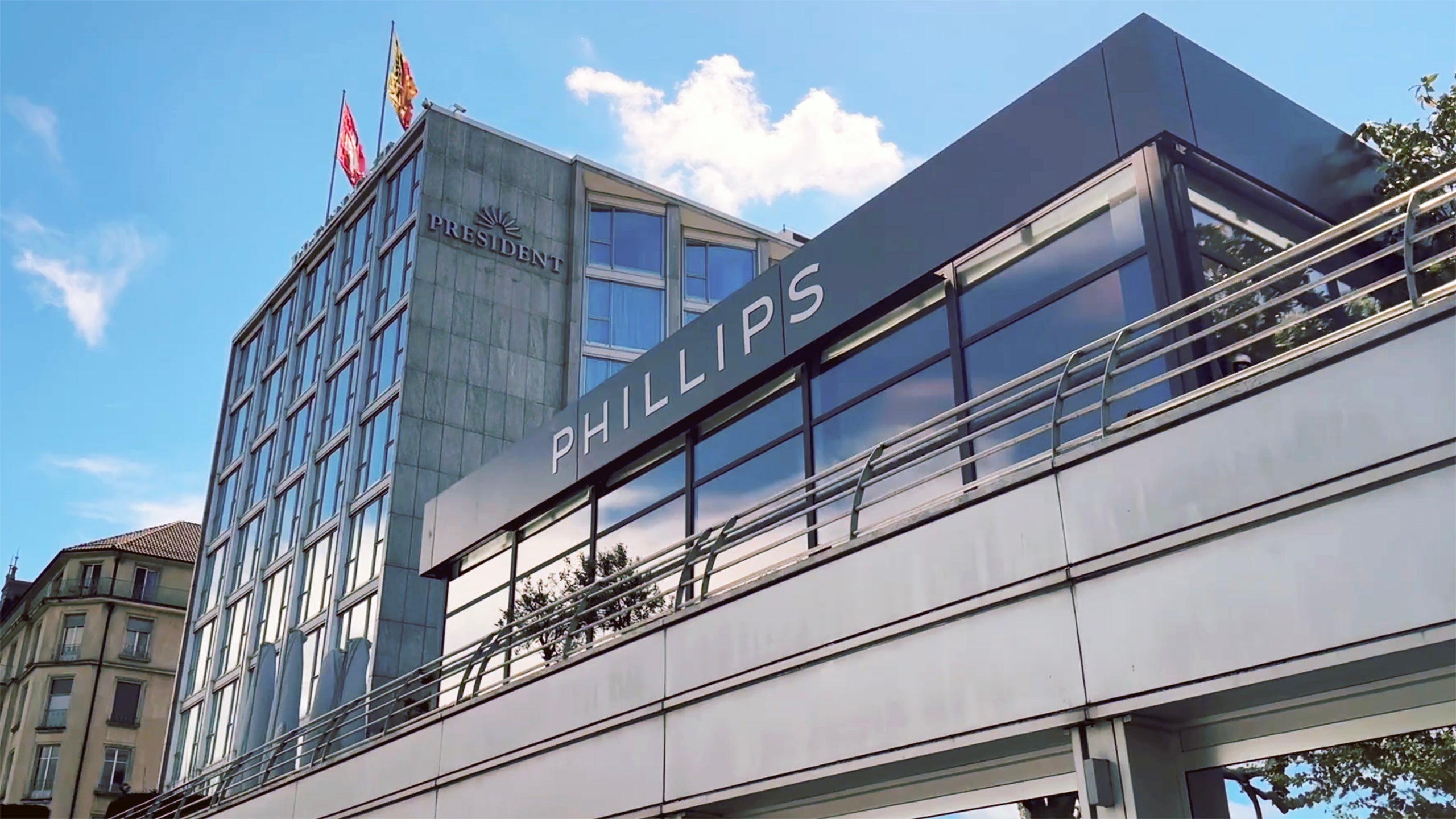
Phillips in Association with Bacs & Russo is delighted to present The Geneva Watch Auction: XXIV, a live auction taking place on 7–8 November 2026 at the Hotel President in Geneva. Featuring more than 220 exceptional luxury timepieces from leading makers including Patek Philippe, Rolex, Audemars Piguet, Cartier, and F.P. Journe, the sale includes the Harry Winston and François-Paul Journe Opus One Tourbillonfeatured in this story.
Watchmakers and movement constructors can spend years developing a complication for a major maison and yet receive no public credit for it. The finished watch carries the name of the brand that commissioned the work, while the person whose skill and creativity made it possible often remains unknown to the buyer.
Harry Winston changed that dynamic with the Opus. Launched in 2001, the series invited then barely known independent watchmakers to co-create small editions bearing their names alongside the New York jeweler’s. For the first five projects, François-Paul Journe, Antoine Preziuso, Vianney Halter, Christophe Claret, and Felix Baumgartner each brought their own approach to mechanics, design, and the display of time.
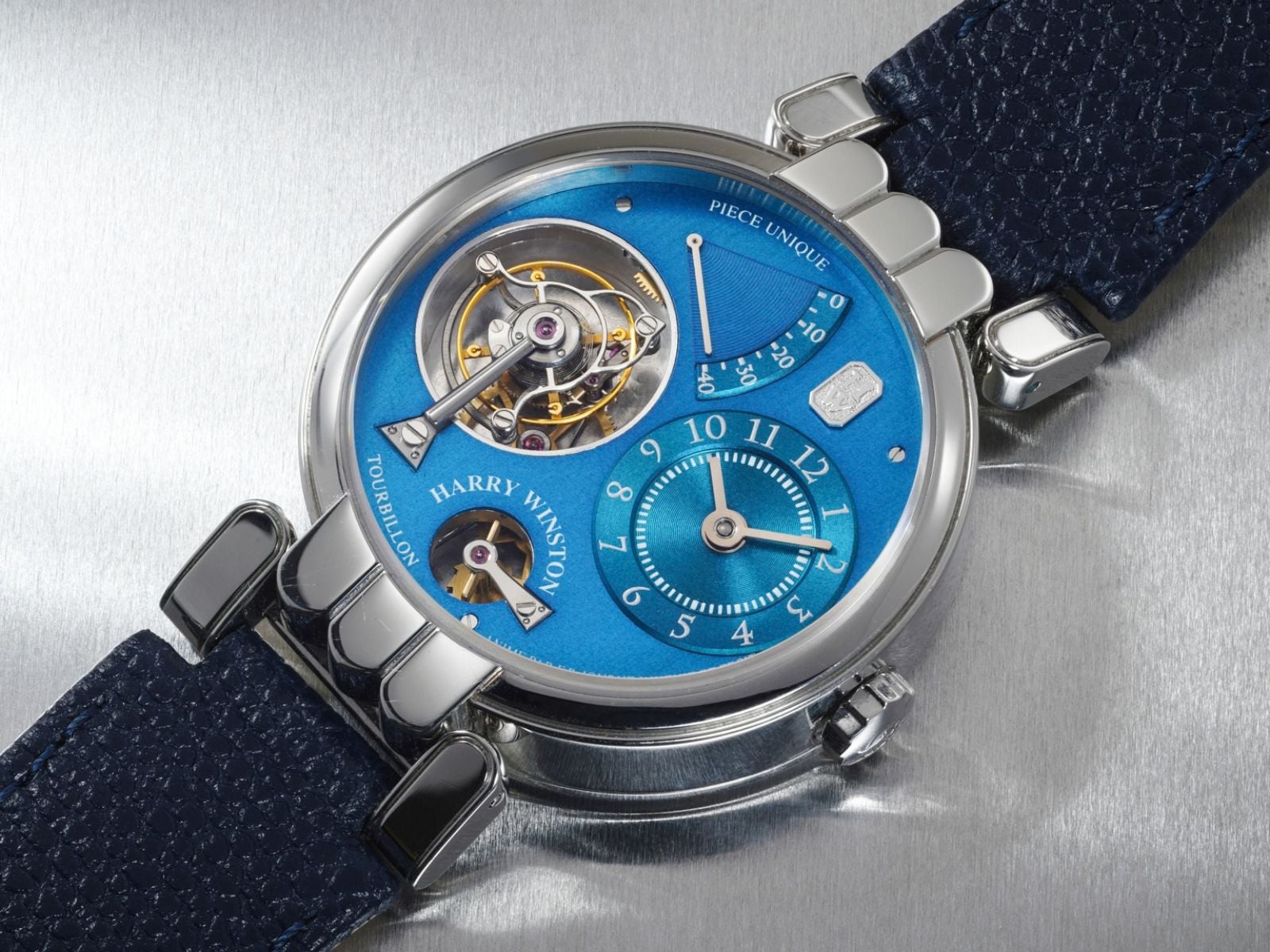
Lot 107: A 2001 Harry Winston and F.P. Journe Opus One Tourbillon Ref. 200/MTFPJ38P in platinum, included in The Geneva Watch Auction XXIV. Estimate: CHF 400,000–800,000
There were tourbillons, a hidden perpetual calendar, a mechanical digital display, a reversible minute repeater, and rotating cubes that told the time. Some looked comfortably at home in a jeweler’s window; others looked as though they had landed from outer space.
The turquoise-dial Opus One Tourbillon in The Geneva Watch Auction XXIV takes us back to the beginning of this watchmaking story, to a time when Journe had already developed impressive movements for his own watches – the collaboration with Harry Winston would open the door to a much wider audience.
Credit Where Due
Max Büsser arrived at Harry Winston in 1998 as managing director of its watch division, after seven years at Jaeger-LeCoultre. He was 31. With just seven employees, the operation was, by his account, close to bankruptcy. New York’s instruction was straightforward: save it or close it.
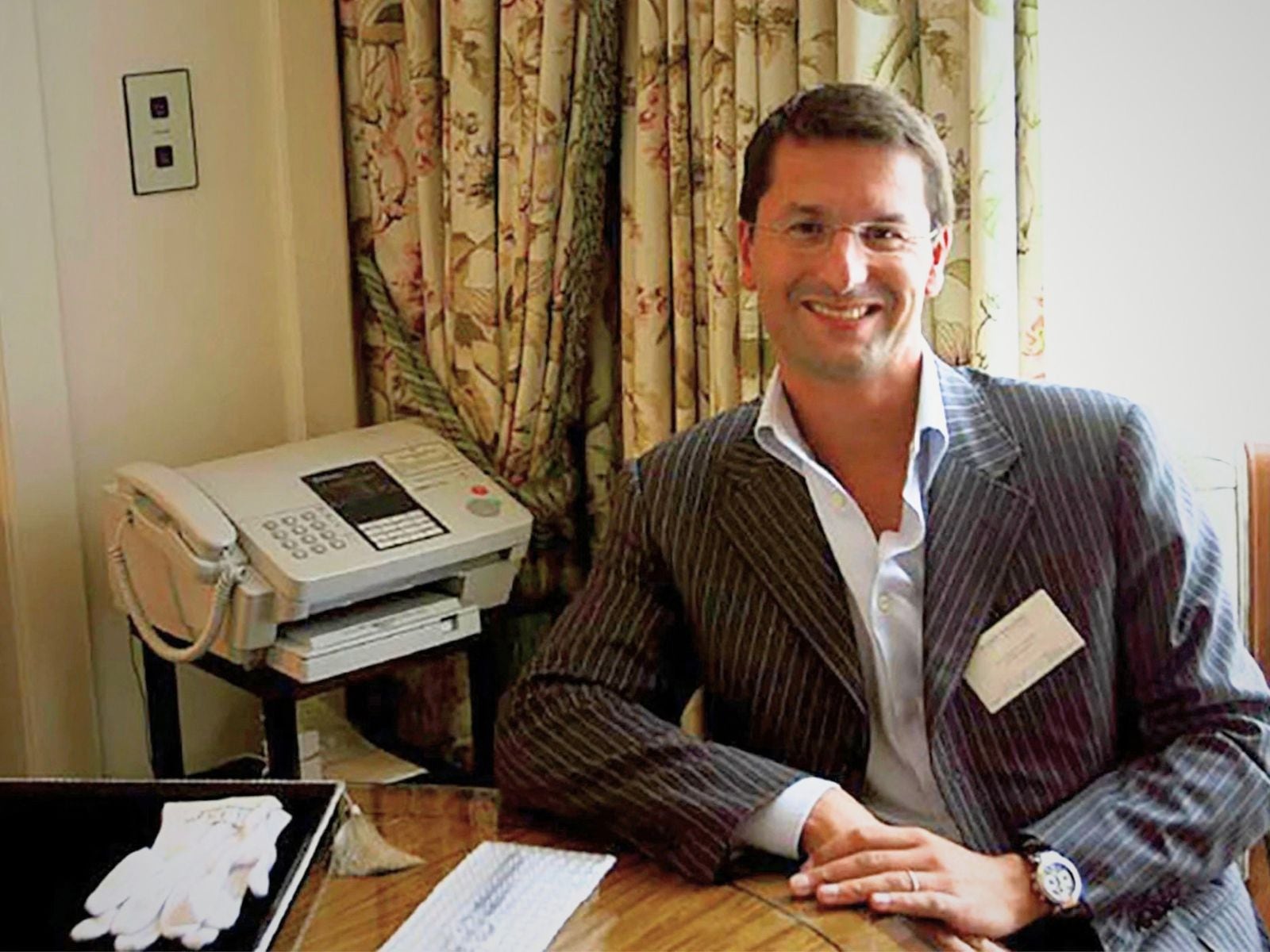
Max Büsser in the mid-2000s, while Managing Director of Harry Winston's watch division.
His proposition to Ronald Winston, Harry’s son and the company’s chairman, was equally direct: rare diamonds should be accompanied by rare movements.
To find them, Büsser began visiting independent watchmakers around Switzerland. These were small outfits, often built around someone whose appetite for making watches considerably exceeded the market’s appetite for buying them. “It was not a business for them. It was their life,” recalls Büsser.
Journe was among them. Having recently launched a brand under his own name, he was, Büsser remembers, still trying to showcase his abilities to a wider audience. Much of his earlier work had been for other companies, under confidentiality agreements. He could hardly point to those watches as his own.
“We were patrons: the guys had free rein, we just put the Harry Winston signature lugs on.”
—Max Büsser
“I created the Opus Series to help a friend, François-Paul Journe,” says Büsser. Working with Harry Winston would give Journe a well-known partner and a project he could openly claim as his own. The house had clients, a sales network, and a name established well beyond watchmaking.
The independents brought inventive ideas and the ability to turn them into working watches. With Ronald Winston’s support, Büsser gave them unusually broad creative freedom.
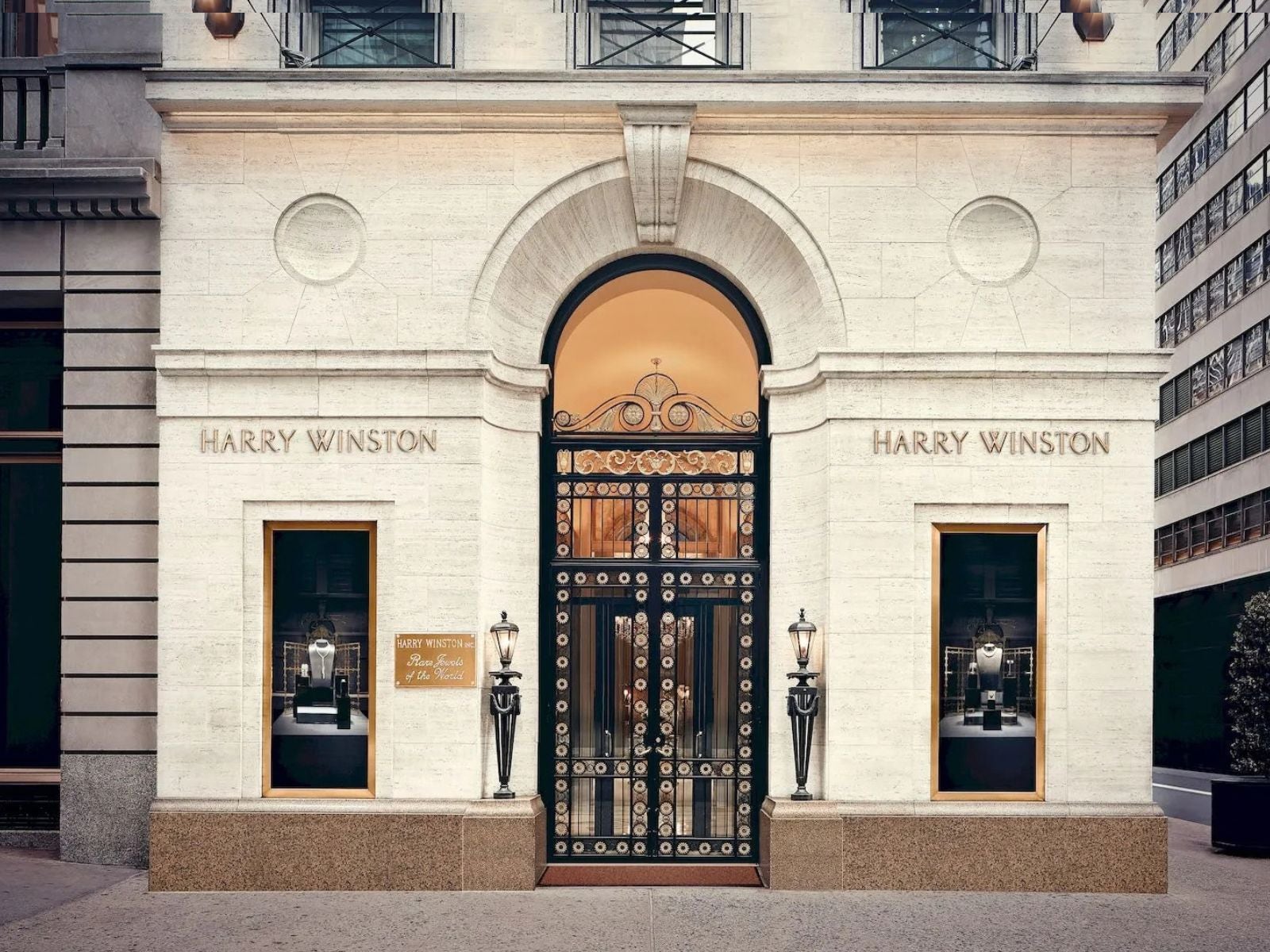
The entrance to Harry Winston’s Fifth Avenue boutique. Harry WInston
“We were patrons: the guys had free rein, we just put the Harry Winston signature lugs on,” Büsser explains.
Those lugs matter. Their three projecting ribs recall the stone arch over the entrance to Harry Winston’s Fifth Avenue boutique. And they provided a family resemblance even as the watches beneath them grew further apart in design.
Journe’s Opening Act
Opus I appeared in 2001 as three models, using movements from Journe’s Tourbillon Souverain, Chronomètre à Résonance, and Octa Réserve de Marche.
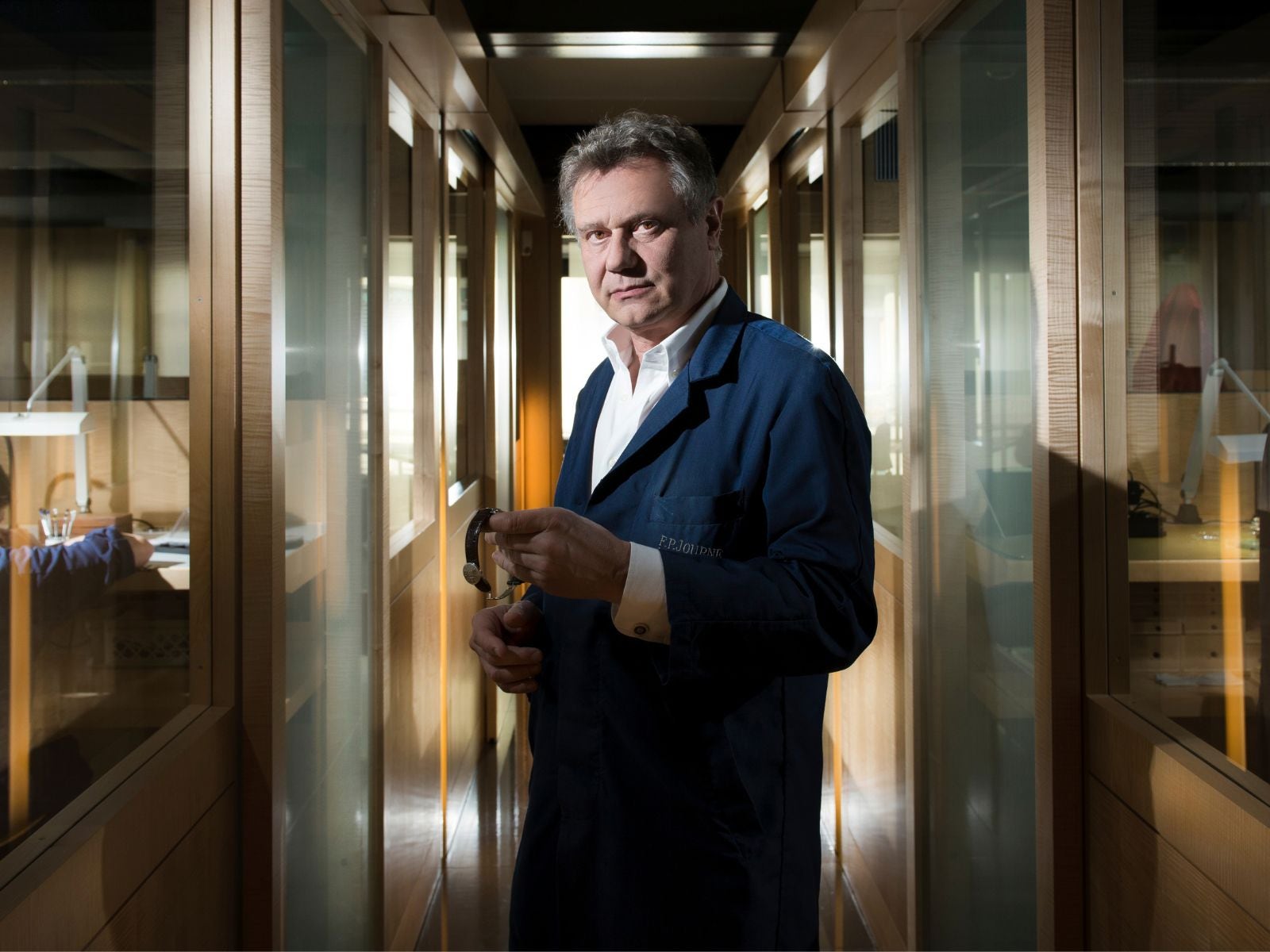
François-Paul Journe. F.P.Journe
These supplied, respectively, a tourbillon with remontoir d’égalité, two time displays regulated by resonance-synced balances, and automatic winding with a large date and power-reserve display. Six examples of each of the three Opus I models were made, all in platinum, with different dial and gem-setting configurations making each watch unique.
“I thought it would be a good experience to collaborate with a house on a human scale and with independent people,” Journe recalls. With some understatement, he describes the project, completed within a tight time frame and under some stress, as “an adventure.”
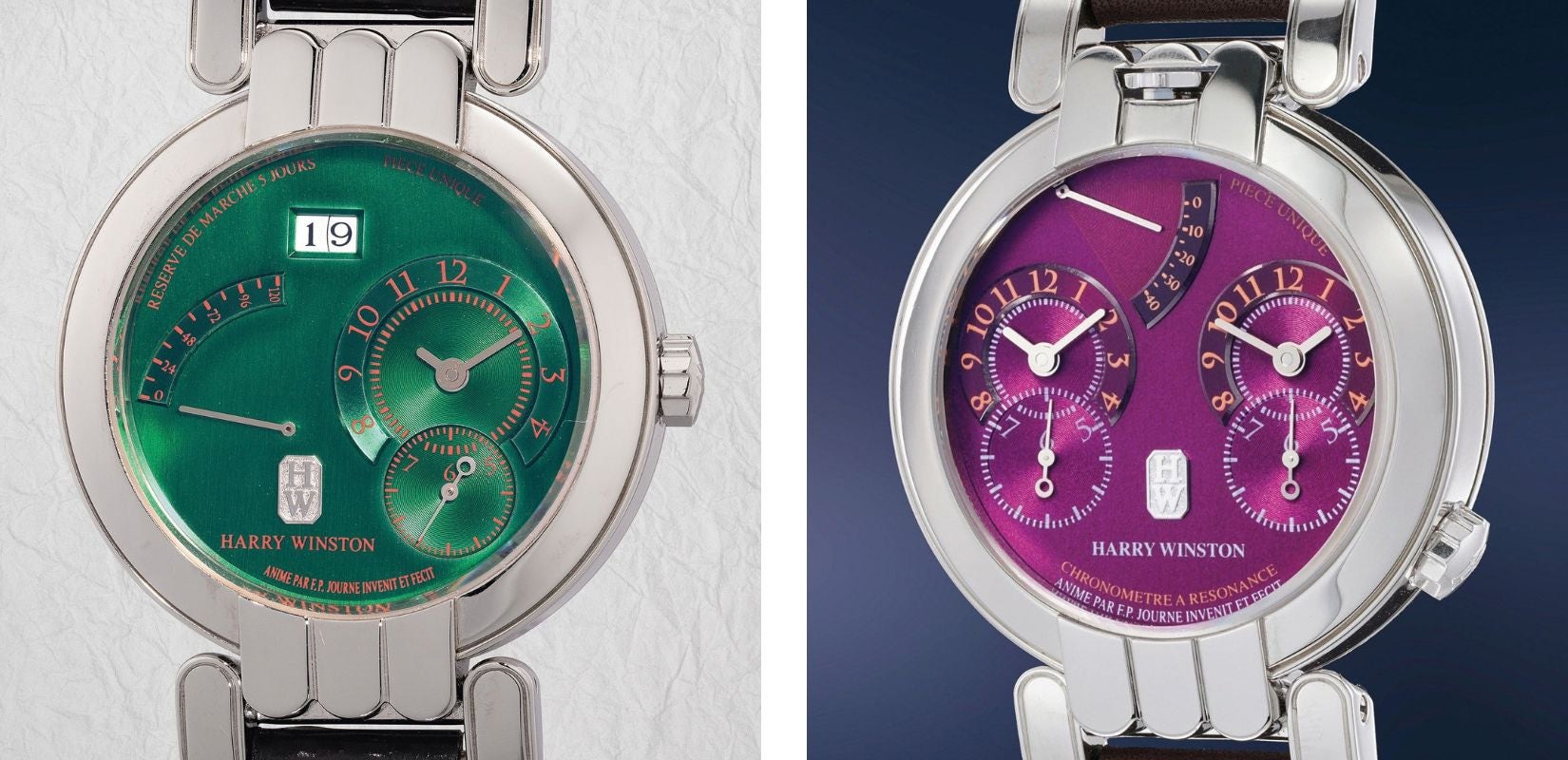
A Harry Winston Opus I Réserve de Marche (left) and Opus I Chronomètre à Résonance (right), both in platinum.
Using existing movements helped meet that timetable. The Frenchman supplied the mechanisms; Harry Winston imagined the watches in a fresh guise.
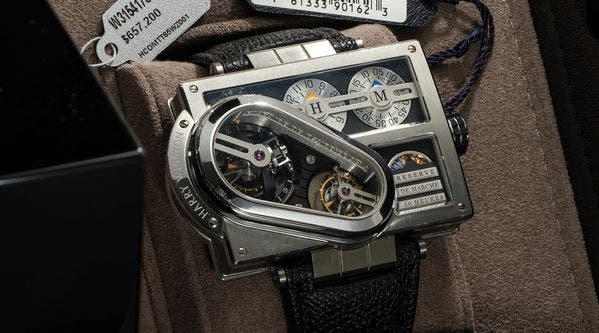
Each Opus I model retained the dial arrangement of its corresponding Journe watch. On the Tourbillon, the rotating cage occupies the left side, the hours and minutes sit to the right, and the power reserve is above. The Harry Winston version has straight baton hands and raised, applied scales for the time and power reserve.
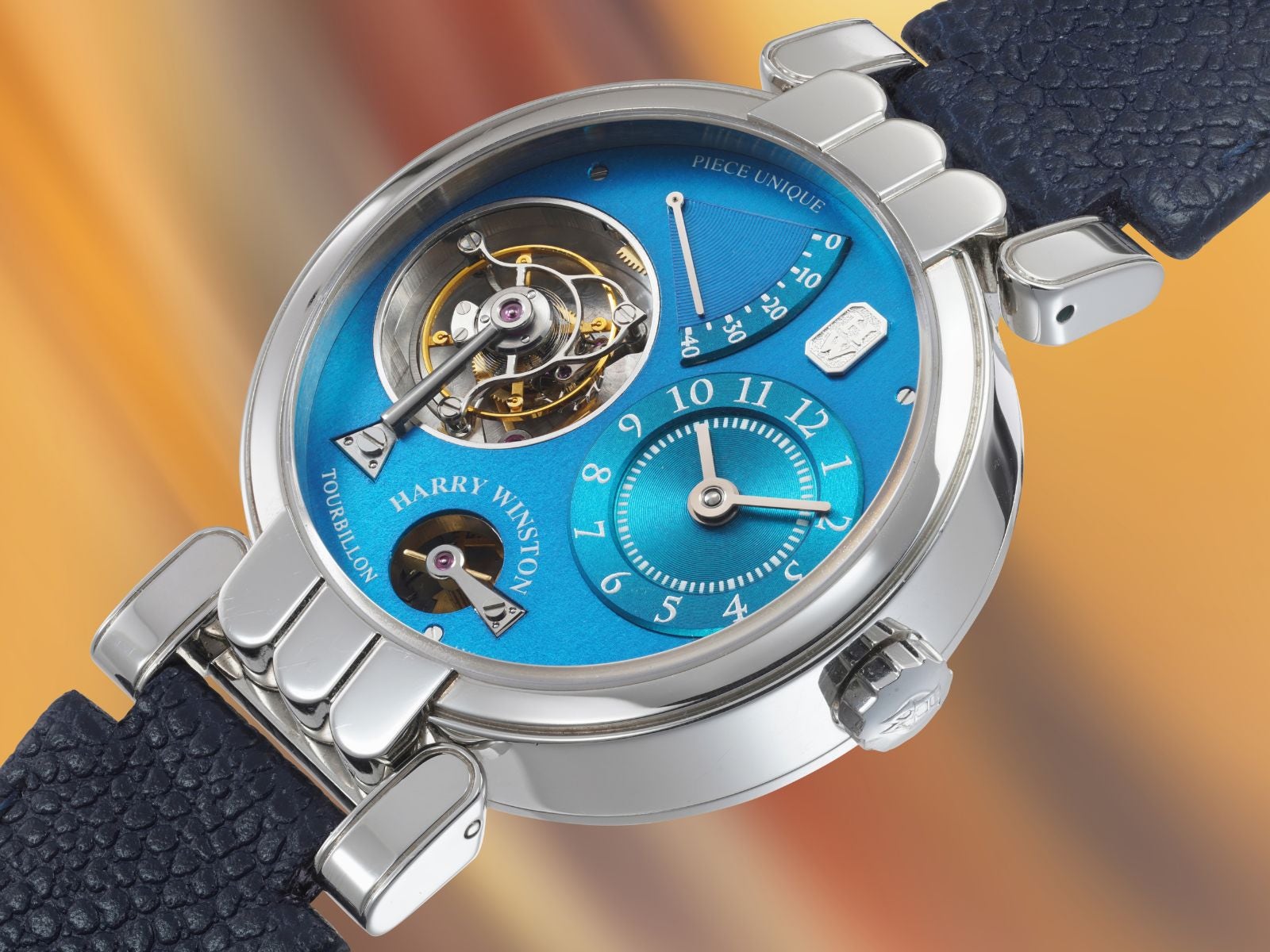
Lot 107: A 2001 Harry Winston and F.P. Journe Opus One Tourbillon Ref. 200/MTFPJ38P in platinum, included in The Geneva Watch Auction XXIV. Estimate: CHF 400,000–800,000
The case made another difference. Like the original Tourbillon Souverain, the Opus I Tourbillon measured 38mm across, but its thicker profile and substantial, articulated lugs gave it a stockier appearance.
Inside was the manually wound Caliber 1498, with brass plates and bridges. Its remontoir d’égalité uses a small spring, regularly recharged by the mainspring, to deliver more consistent power to the escapement as the watch unwinds.
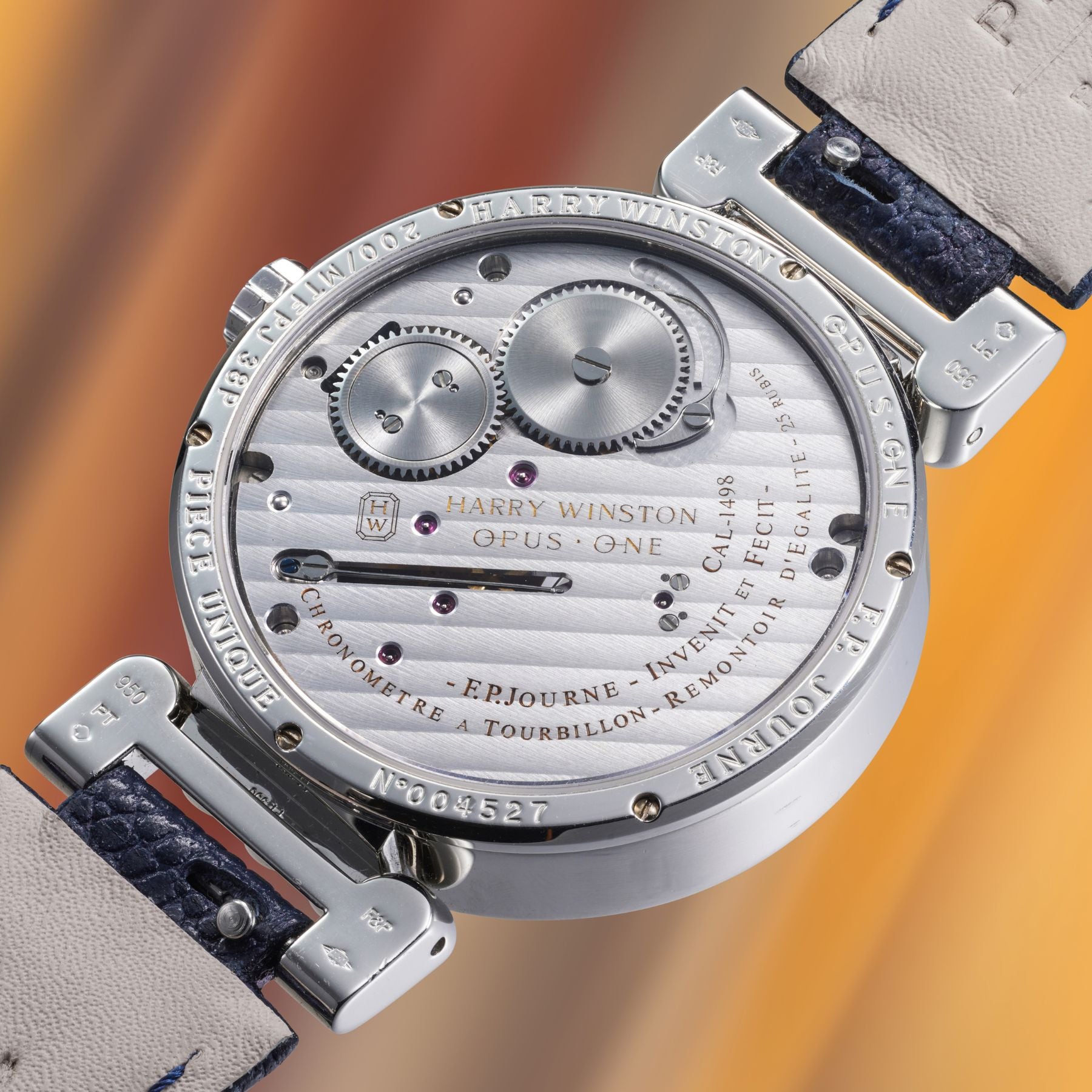
Lot 107: A 2001 Harry Winston and F.P. Journe Opus One Tourbillon Ref. 200/MTFPJ38P in platinum, included in The Geneva Watch Auction XXIV. Estimate: CHF 400,000–800,000
The six Tourbillons had blue, black, pink, silver, gray, or turquoise dials. The blue and black versions were diamond-set – another direct link to Harry Winston’s jewelry business. Lot 107 is the unique turquoise example, reference 200/MTFPJ38P, made in 2001.
It also records an early stage in Journe’s production, before his move to rose gold movement plates. For the first Opus, existing mechanisms gave the partnership a firm starting point. The following projects would venture further into new designs.
Preziuso’s Cast of Characters
Geneva-born watchmaker Antoine Preziuso already knew Harry Winston. He had worked on watches for the house during the 1990s, well before Büsser approached him for Opus II. Their early design discussion took place over lunch, with sketches drawn on the restaurant’s paper tablecloth.

Antoine Preziuso. Antoine Preziuso
The request was for two groups of tourbillon watches, ready for Basel in 2002. Preziuso remembers it took a year to complete 24 pieces. He jokes that he worked part-time: at least 12 hours out of every 24.
He wanted a watch with a face and an expression. New York, and the entrance to the Fifth Avenue boutique, supplied his visual references. Engraved rays decorate the bridges above a baseplate finished with perlage, while the bridge at twelve o’clock emphatically forms the HW initials. Blued screws and hands interrupt the silver-toned surfaces, and a broad mirror-polished bridge crosses the tourbillon at six o’clock.
“I also wanted the movement to become the actor of the watch,” he says.
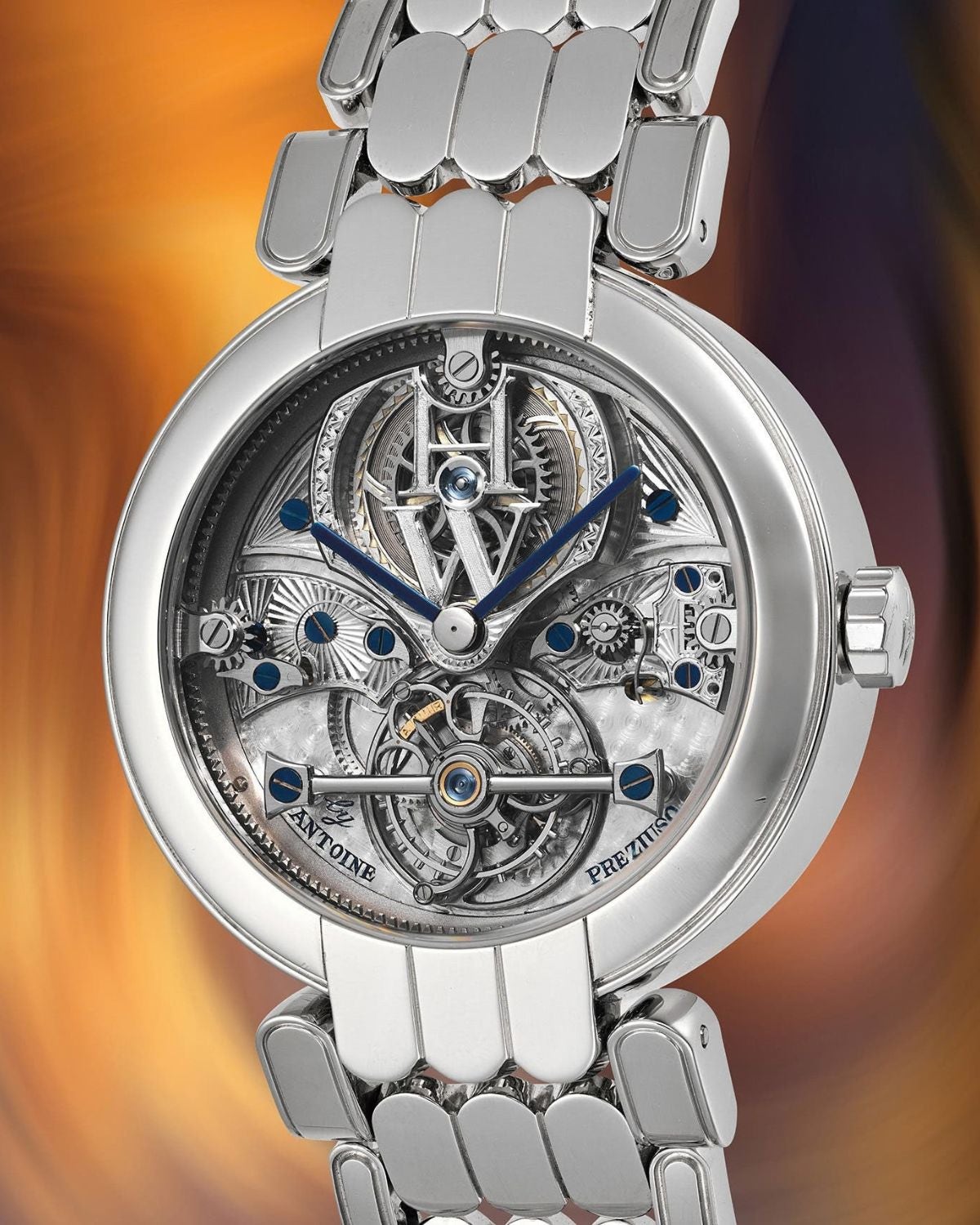
Front of the Harry WInston Opus II Perpetual Tourbillon Ref. 200MTQPAP38 in platinum.
Opus II came in two versions, both with a tourbillon, a 110-hour power reserve, and a 38mm platinum case. One added a perpetual calendar behind a hinged back, with retrograde day and date indications. The wearer had to open the cover to consult it. Eleven examples of each version were made, along with one unique diamond-set piece.
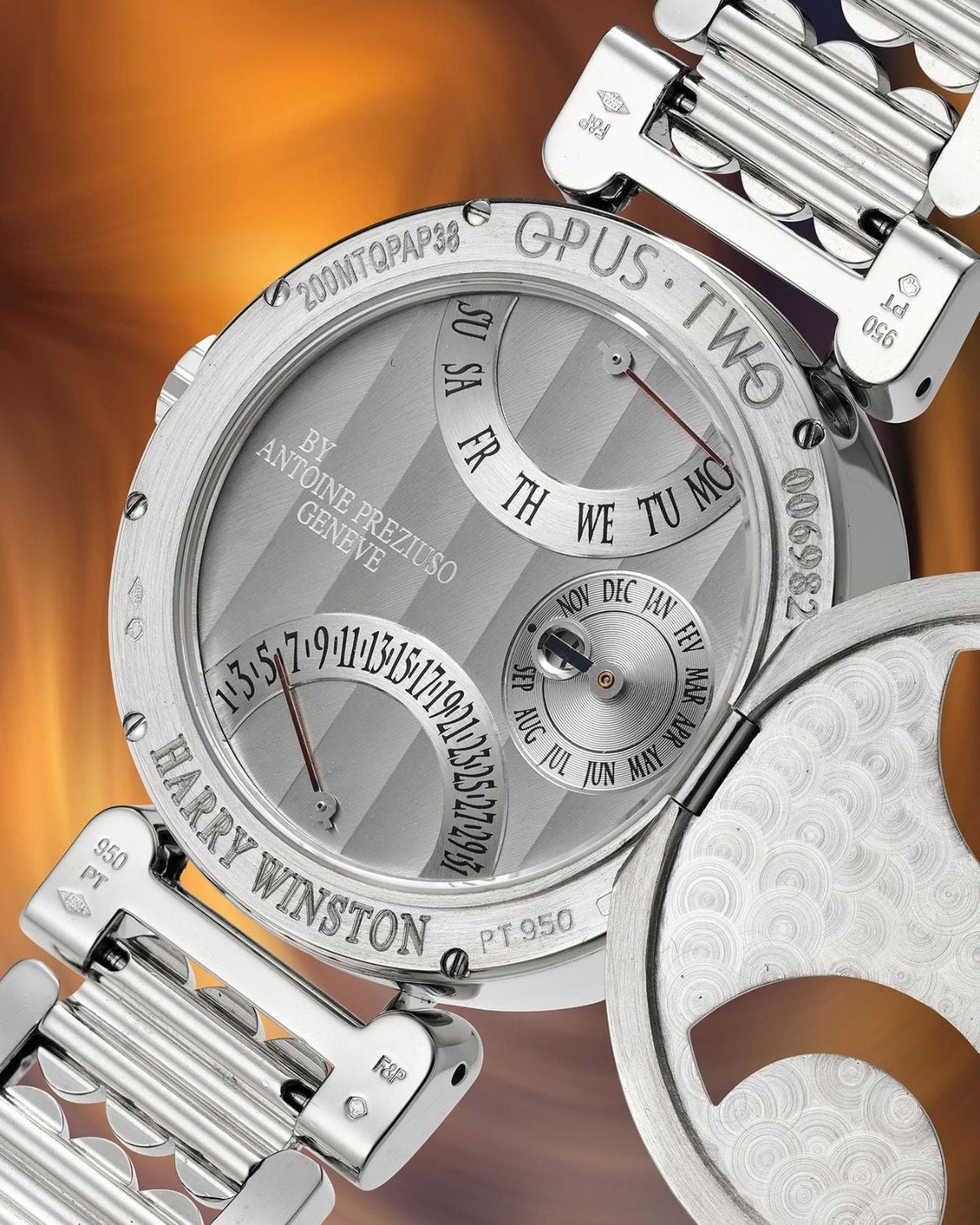
Back of the Harry WInston Opus II Perpetual Tourbillon Ref. 200MTQPAP38 in platinum.
At the Basel presentation, Preziuso remembers looking behind him to see who everyone was waiting for. It was him. The watchmaker was expected to explain the watches to the press and collectors. Public recognition, in this case, began with a slightly surprised man arriving at a booth.
Halter’s Strange Starship
Vianney Halter’s connection to Harry Winston began with a movie. At the age of ten, he watched the 1959 film The World, the Flesh and the Devil, in which Harry Belafonte offers Inger Stevens a large diamond. Harry Winston’s name appeared on screen. To Halter, it belonged to a world he thought he would never enter.
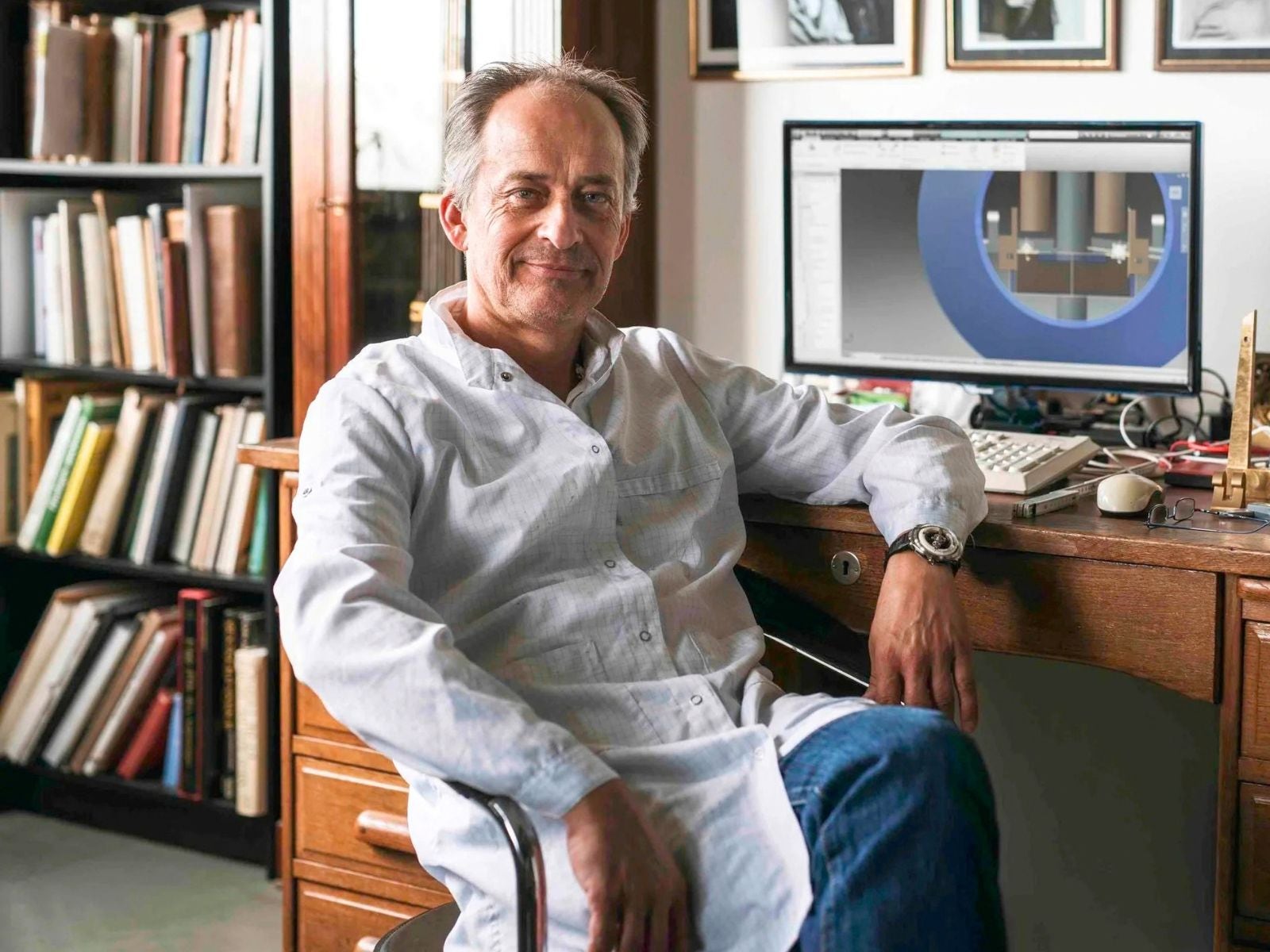
Vianney Halter. Time Æon Foundation
Decades later, Büsser invited him to design Opus III. His sketches drew inspiration from “calculating machines, old and new, mixed with the shape of a strange starship.”
Approval required a trip to Halter’s workshop in Sainte-Croix. Büsser wanted Ronald Winston to meet the man before judging the drawing. Winston arrived tired from traveling and initially told Büsser that he liked Halter but disliked his watches. Then Halter presented the design.
After a long silence, Winston said, “This is remarkable.” He even ordered an Antiqua from Halter for himself.
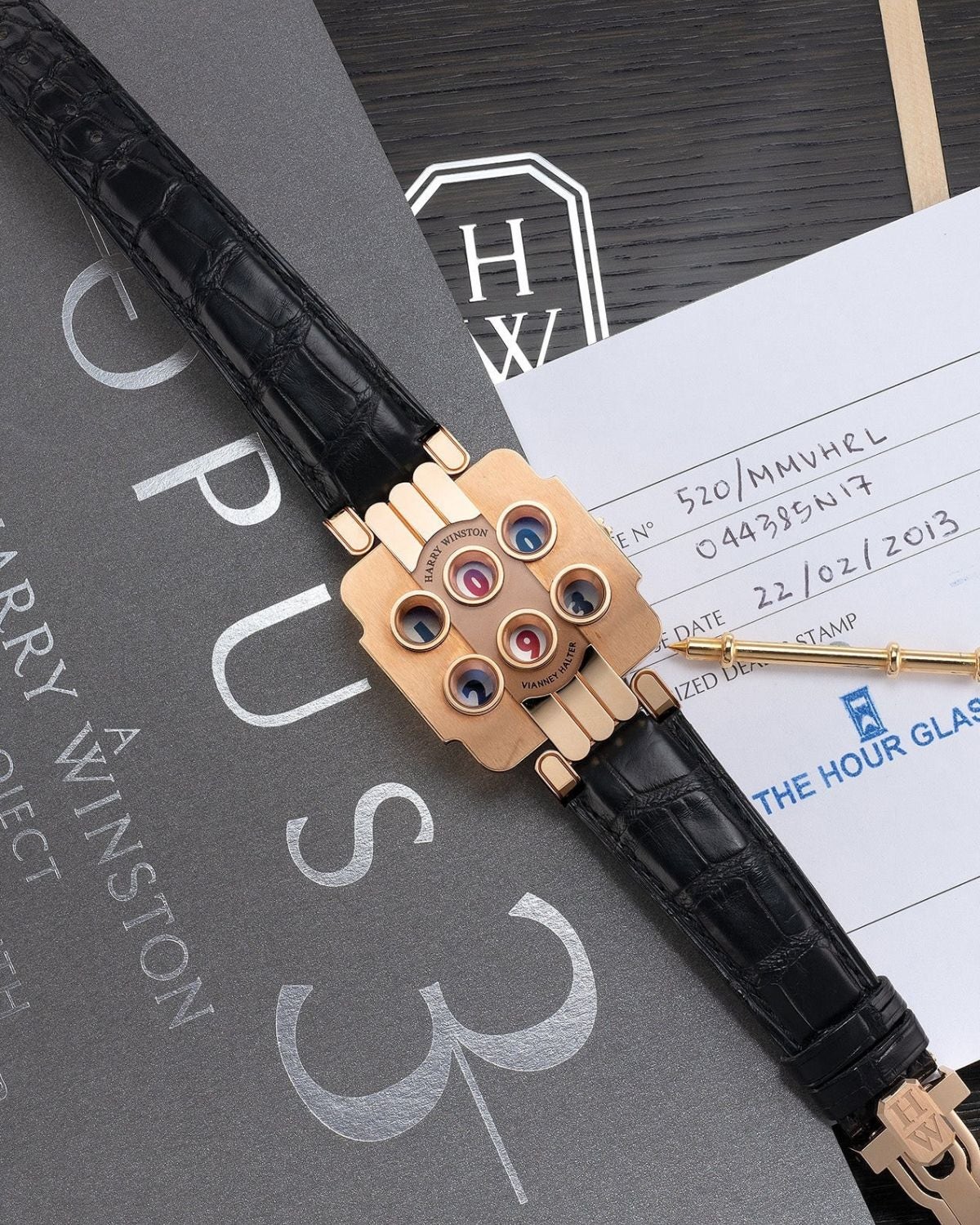
The Harry Winston Opus 3 Ref. 520/MMVHRL in 18k pink gold, No. 17 out of 25.
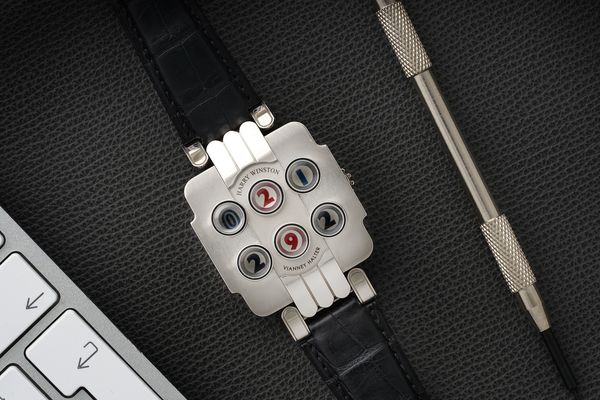
Launched in 2003, Opus III placed six circular windows across a broad, sculpted case. The upper outer windows show the hours in blue; the lower outer windows show the minutes in black. The two central windows display the date in red. Reading it means joining separated digits, rather than following hands around a dial.
Just before each new minute, the tens-of-hours window temporarily gives a countdown – or count-up – of the final four seconds: 56, 57, 58, and 59. Then the minute changes. That brief performance makes the passing minute visible.
Behind the display, several numbered discs occupy overlapping layers and must move at precisely the right moments. The mechanism has to store enough energy for the jumps and release it reliably, while keeping the watch running.
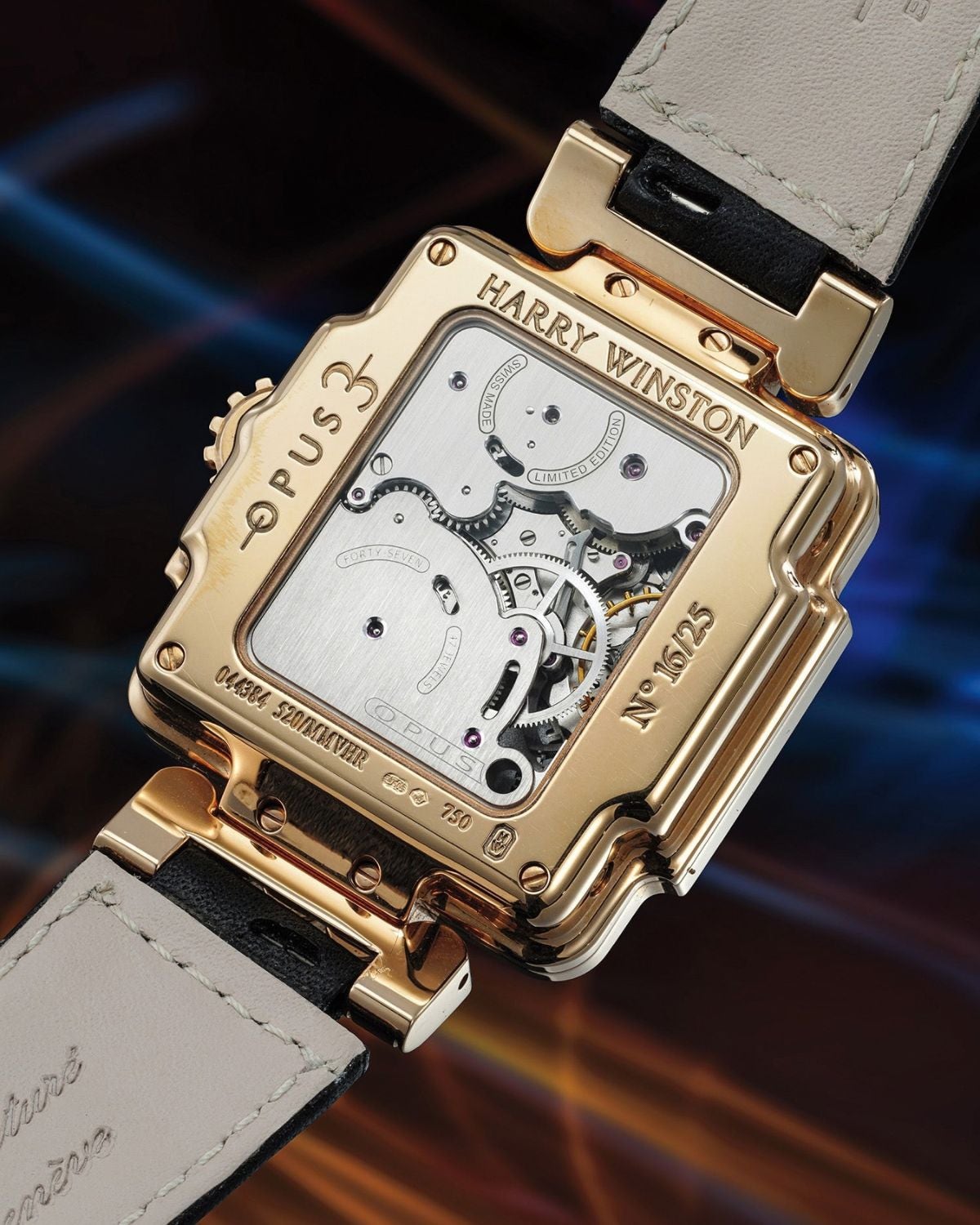
Back of the Harry Winston Opus 3 Ref. 520/MMVHRL in 18k pink gold, No. 16 out of 25.
Translating the display into a dependable production watch proved far harder than approving the drawing. The first pieces were finally delivered in 2010, following years of development and further work by Renaud & Papi.
Halter later said that he had created it “without any business or strategy intention.” His interests supplied the design; the engineering had to catch up. Opus III exposed how far that freedom could take a project, including beyond its intended timetable.
Claret’s Two Faces
For Christophe Claret, Opus IV offered public recognition for work usually performed behind another company’s name. His manufacture already supplied complicated movements to established houses.
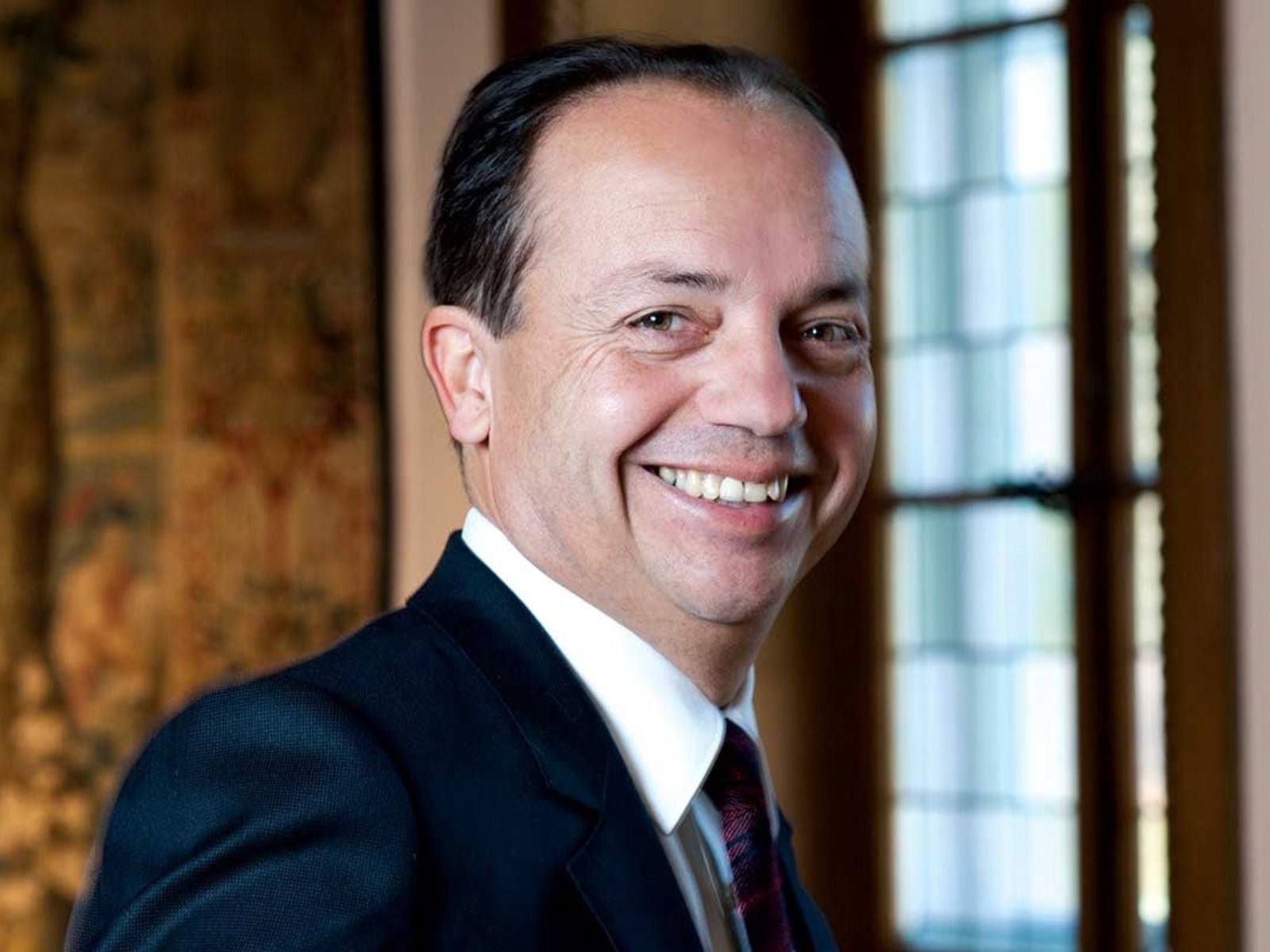
Christophe Claret. Christophe Claret
“We were the watchmakers in the shadows, and the collaboration with Harry Winston was interesting because it allowed us to step out of the shadows,” he says.
Presented in 2004, his watch had two faces and a reversible case that allowed either side to be worn facing up. One side exposed a tourbillon and much of the mechanism, including the minute repeater’s hammers.
The repeater used cathedral gongs, which extend farther around the movement than conventional gongs to produce a longer-lasting sound.
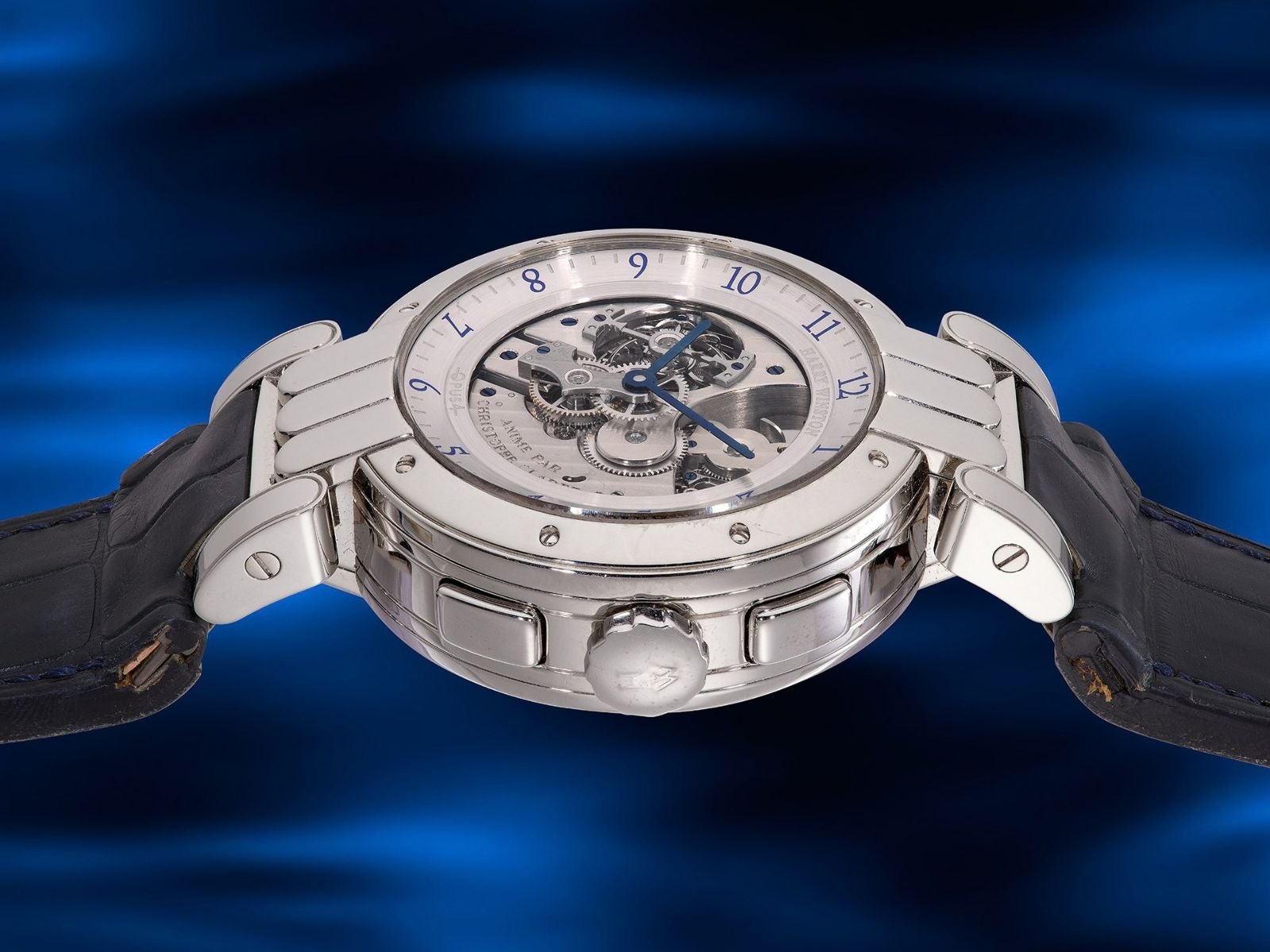
One side of the Harry Winston Opus IV Ref. OPUMTR44PP001 in platinum.
The other side turned toward the night sky. A large moon-phase display occupied a blue field, accompanied by the date. Hours and minutes could be read on both faces, all housed within a 44mm platinum case.
Claret describes the challenge as creating “two faces with two different emotions: one very technical, and one very romantic, with the night.”
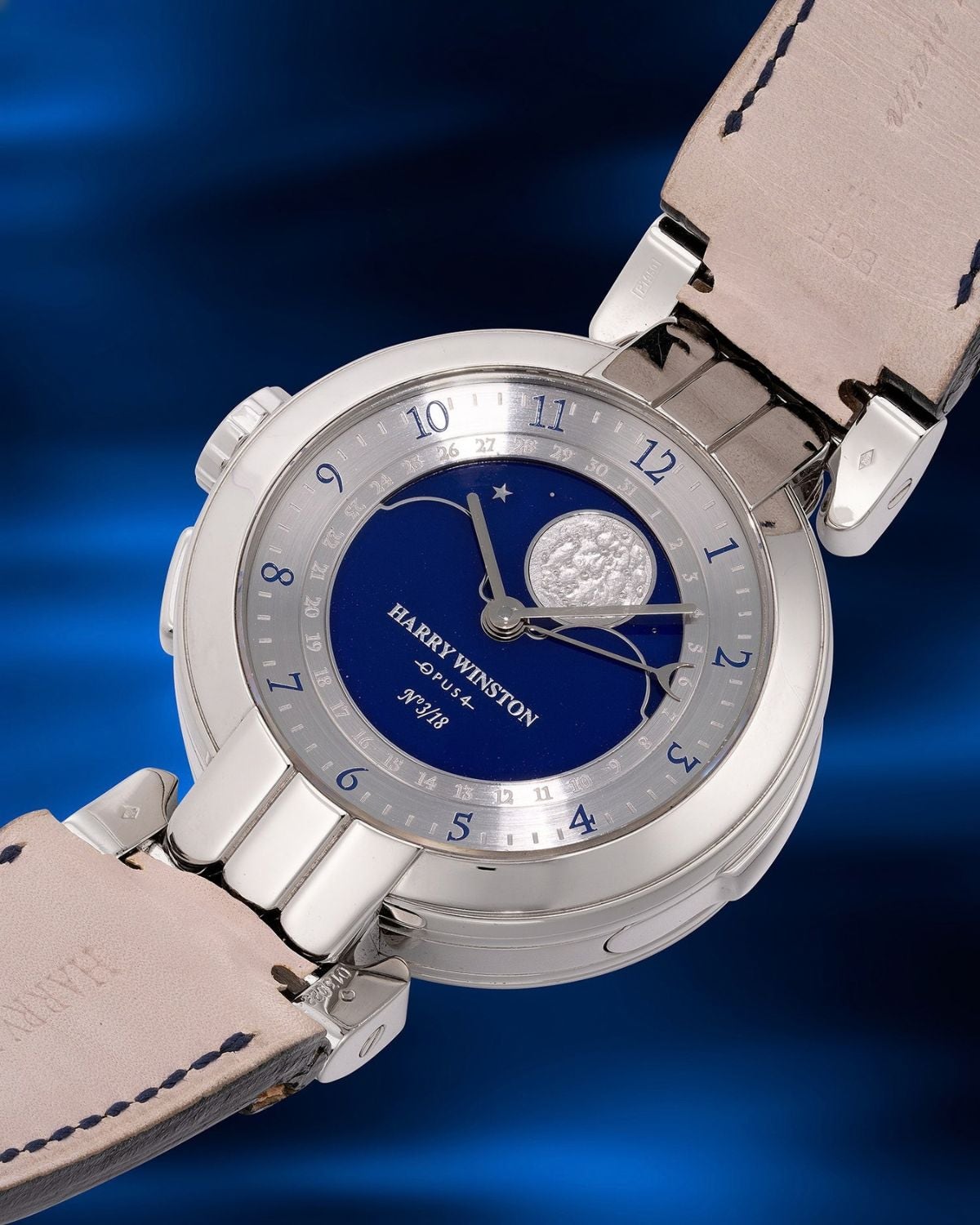
The other side of the Harry Winston Opus IV Ref. OPUMTR44PP001 in platinum.
He also recalls waking to sketch movements he had dreamed about – a detail that gives the watch’s nocturnal face another context.
Twenty watches were made: 18 in platinum and two diamond-set examples, bringing Harry Winston’s sparkle to Claret’s complications.
Baumgartner’s Time Ship
The fifth partnership began at Basel in 2003, when Felix Baumgartner’s brother Thomas brought a steel prototype of Urwerk’s UR-103 to the Harry Winston booth. Büsser called his team over to look, then met the brothers after the fair – their Geneva workshops were only about 800 meters apart.
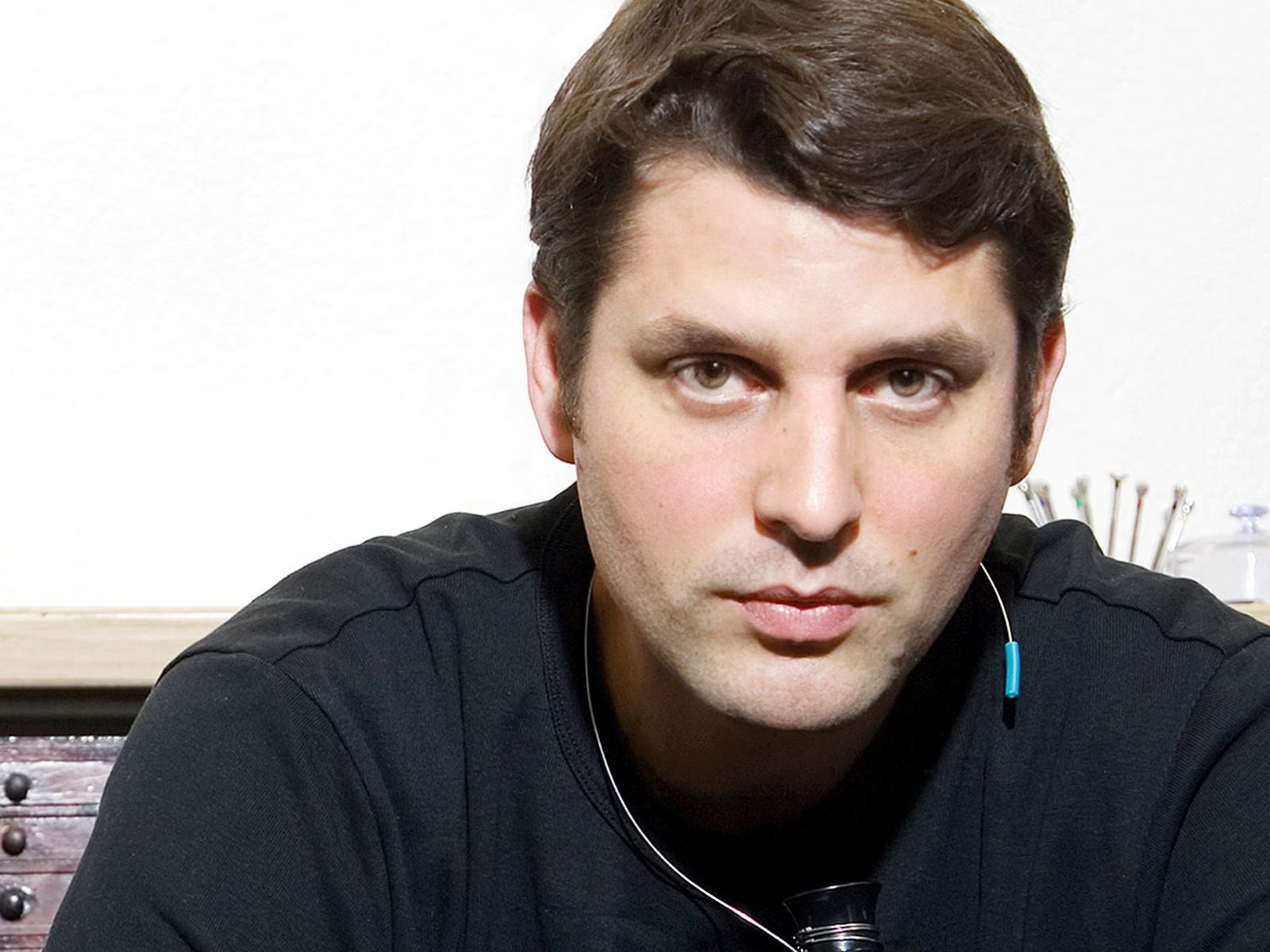
Felix Baumgartner. Time Æon Foundation
Felix later returned with two proposals. Büsser chose the one that became Opus V because of its three-dimensional display.
Launched in 2005, it used three rotating cubes, each carrying four hour-numerals, on a satellite carousel. The active hour travels across a minute scale with a long retrograde pointer.
At the end of the hour, the pointer returns to its starting position and the next cube takes over. The twelve hours are distributed among the three cubes, which rotate to present the correct numeral when their turn comes around.
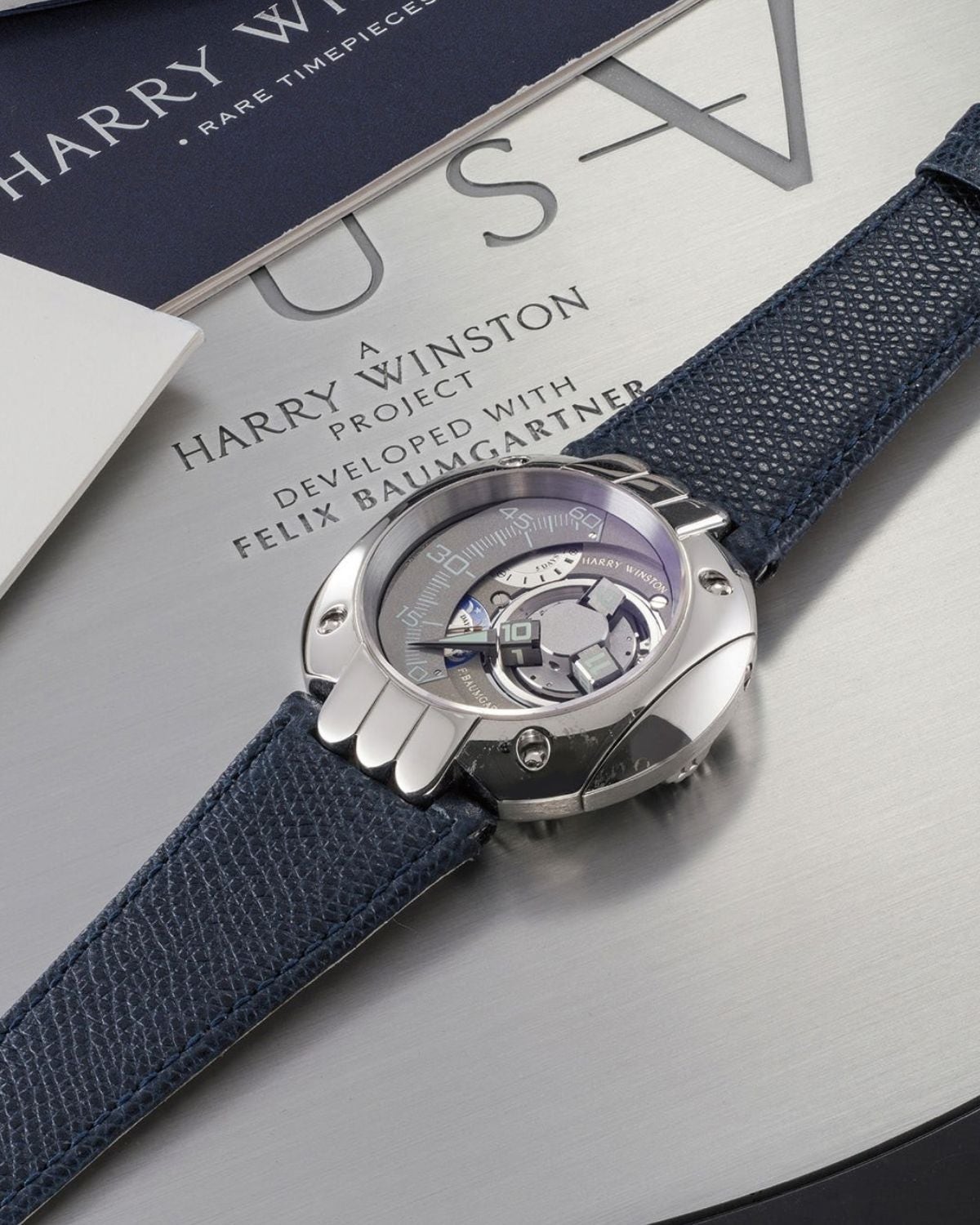
The Harry WInston Opus V in platinum.
The rotating cubes give the display a sculptural depth, framed by the broad 50mm case. A power-reserve indicator and day/night display accompany it. On the back, a service indicator records accumulated running time, and a fine-adjustment control allows the rate to be altered.
Baumgartner saw a difference between Harry Winston’s polished jewelry world and Urwerk’s more raw, technical character. “Bringing these two universes together was the challenge of Opus V,” he says. The retrograde minute mechanism and the bearing around the carousel demanded new development. Büsser remembers him working day and night for a year.
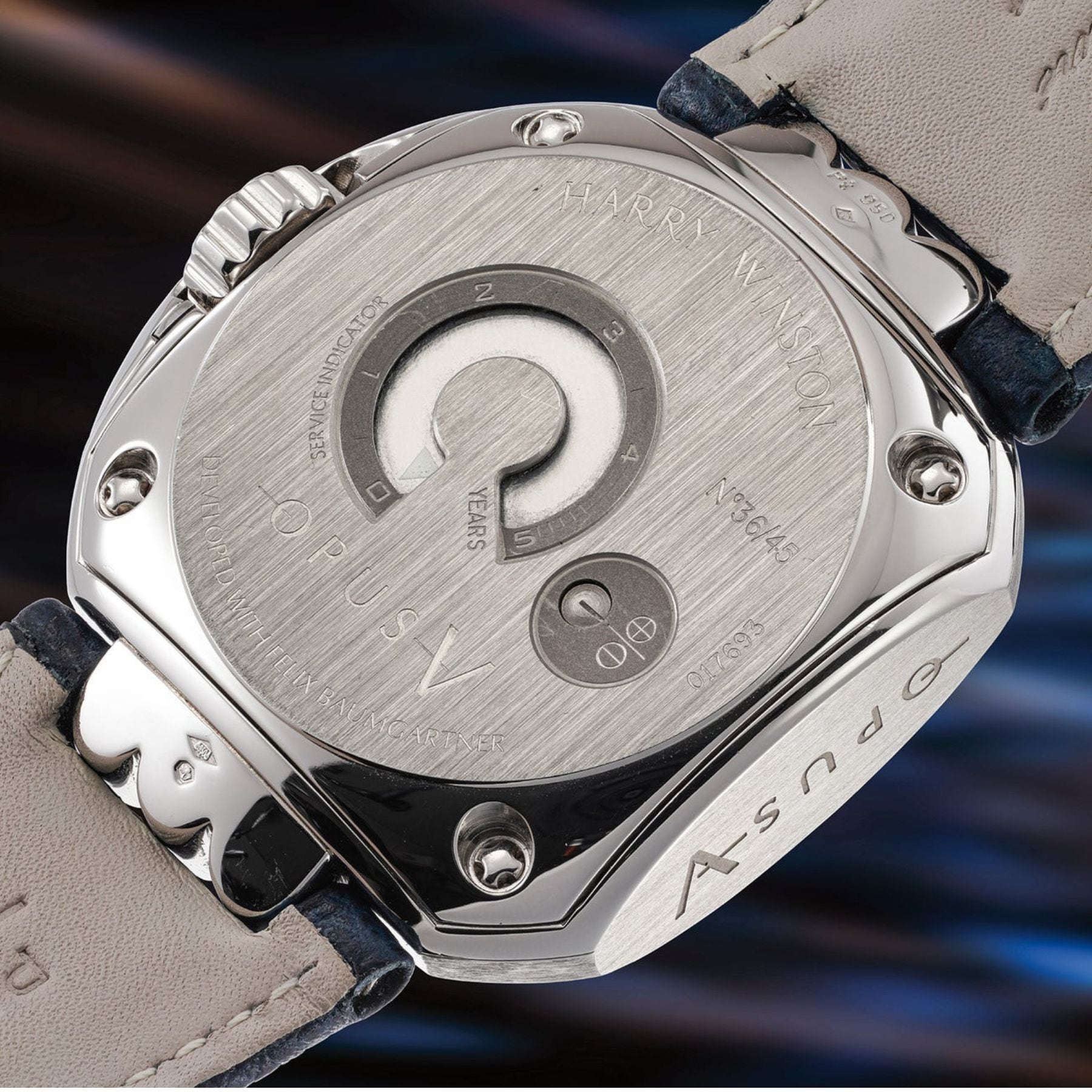
Back of the The Harry WInston Opus V in platinum.
The edition reached 100 watches, including platinum, pink gold, and diamond-set versions. Harry Winston’s familiar lugs remained, but the hands and dial of Opus I had given way to orbiting cubes and a retrograde pointer. Baumgartner had a name for it: “Time Ship.”
After The Fifth
Büsser left Harry Winston in 2005 to found MB&F. The Opus series had shown him the pleasure of working with people whose ideas came first, and the value of giving those people credit. At MB&F, he would, of course, develop his own concepts with collaborators named openly for their contributions. The series continued after his departure, reaching Opus XIV in 2015.
But those first five Opus projects established a model for collaboration: a major luxury house giving independent watchmakers creative freedom, a platform, and public credit for their work. Collectors could discover their work, hear their ideas, and connect a complicated watch to the talented individual who had made it possible. Journe, Preziuso, Halter, Claret, and Baumgartner received recognition for the expertise that brands had so often kept – still so often keep – behind the scenes.
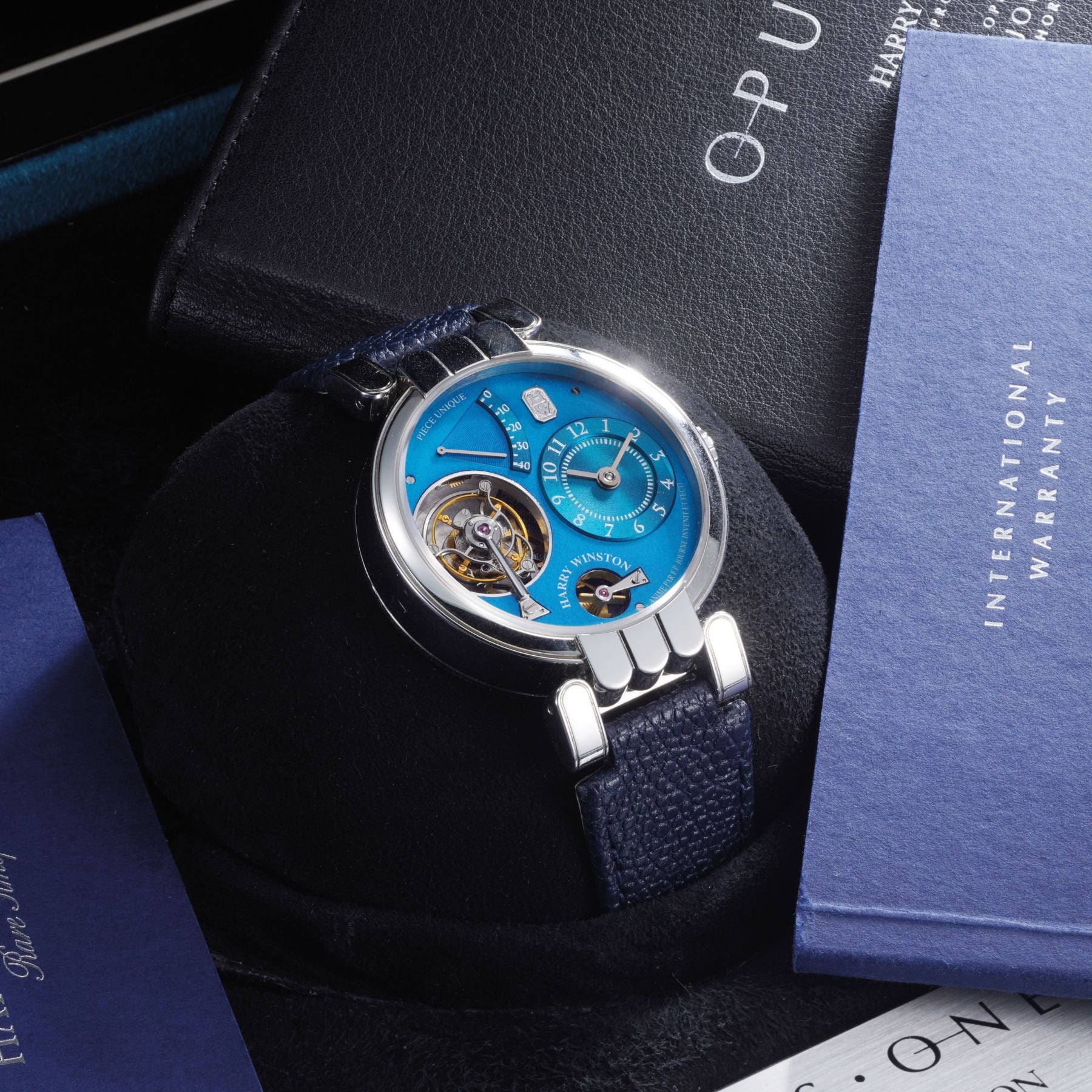
Lot 107: A 2001 Harry Winston and F.P. Journe Opus One Tourbillon Ref. 200/MTFPJ38P in platinum, included in The Geneva Watch Auction XXIV. Estimate: CHF 400,000–800,000
Lot 107 of The Geneva Watch Auction XXIV, that history is written into the watch itself. Both names appear on the movement and caseback, crediting the watchmaker alongside the house that gave his work a larger stage. Twenty-five years later, those signatures still express the idea that set the Opus in motion.
You can learn more, place a bid, and view the entire Geneva Watch Auction: XXIV catalog here.