Article | Franck Muller Franck Geneve Early Watches Phillips Geneva Watch Auction Xxiv November 2026
Franck Muller Before Franck Muller: The Franck Genève Years
Before his name became associated with tonneau cases and oversized numerals, Franck Muller was making classically styled, complicated wristwatches for private clients, signing them Franck Genève. A unique perpetual calendar minute repeater with a case by Jean-Pierre Hagmann takes us back to those early workshop years.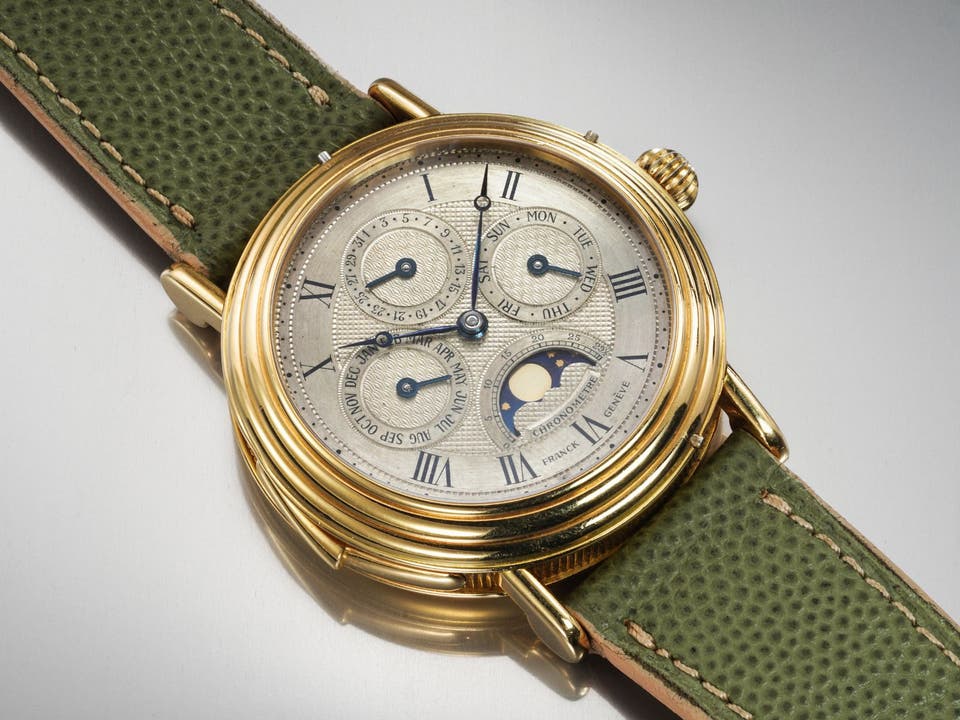
Phillips in Association with Bacs & Russo is delighted to present The Geneva Watch Auction: XXIV, a live auction taking place on 7–8 November 2026 at the Hotel President in Geneva. Featuring more than 220 exceptional luxury timepieces from leading makers including Patek Philippe, Rolex, Audemars Piguet, Cartier, and F.P. Journe, the sale includes the unique Franck Muller/Franck Genève perpetual calendar minute repeater featured in this story.
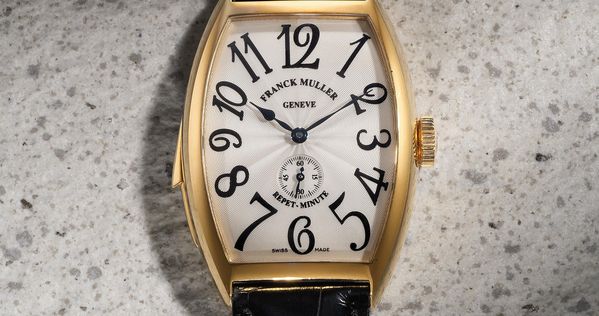
For anyone whose mental picture of a Franck Muller watch involves a sizable tonneau case and large, exuberant numerals, the watch shown here might require a second look.
Its round 37.5mm yellow gold case frames a silvered, engine-turned dial with Roman numerals, calendar registers, and a moon-phase display. A slider along the case flank activates the mechanism that chimes the hours, quarters, and remaining minutes. And down at 6 o’clock is the signature: “Franck Genève.”
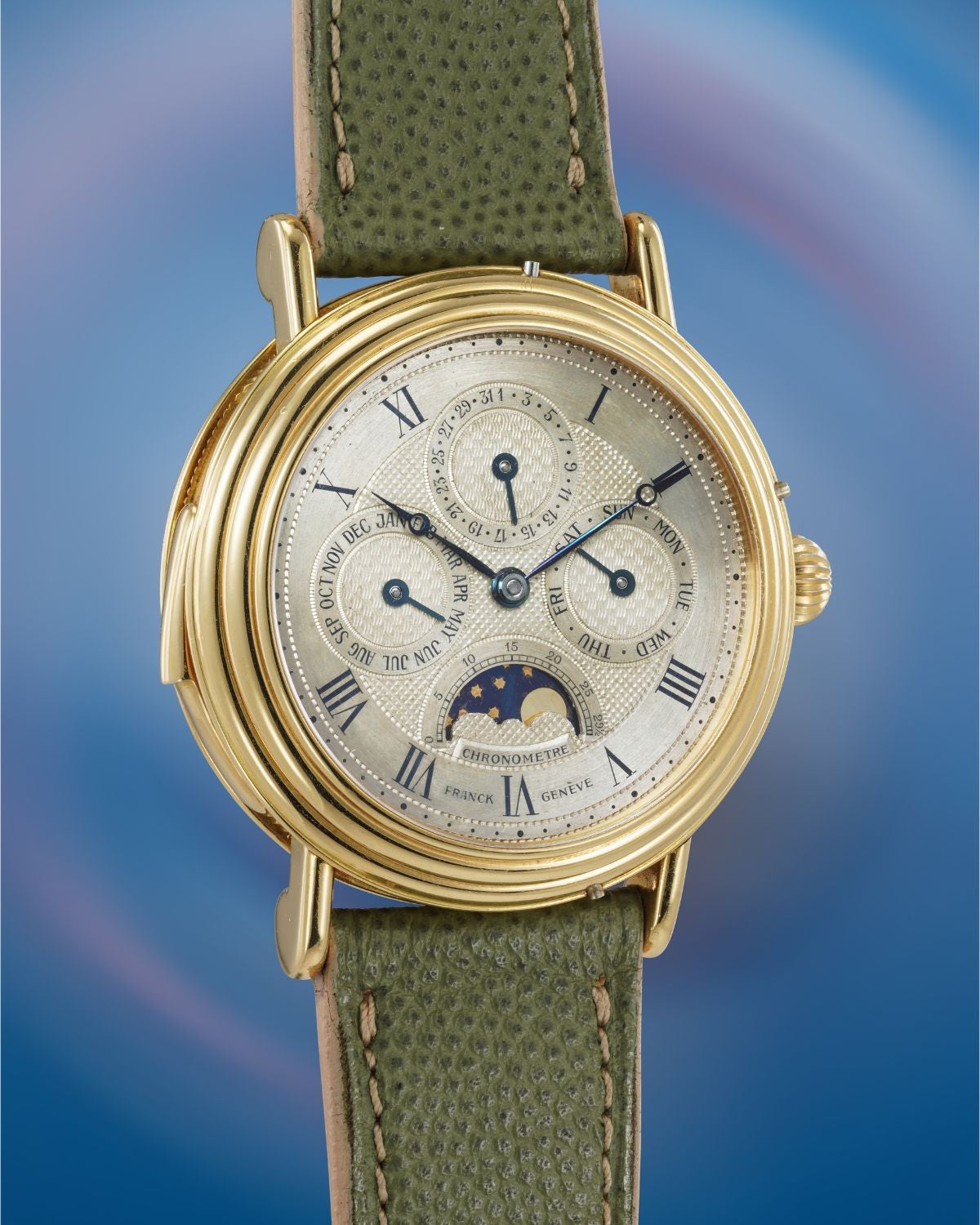
Lot 105: A circa 1992 unique Franck Muller perpetual calendar minute repeater, numbered 1 and signed “Franck Genève,” in 18k yellow gold, included in The Geneva Watch Auction XXIV. Estimate: CHF 100,000–200,000
Made circa 1992, this unique perpetual calendar minute repeater comes from Muller’s early years as an independent watchmaker, creating complicated wristwatches in small numbers for private clients. His first name, coupled with the location of his workshop, was enough to identify the person responsible.
By then, he had spent over a decade restoring historical timepieces, developing his own mechanisms, and finding collectors willing to commission them. This watch was made as the company bearing Franck Muller’s full name was only just getting underway.
Learning by Restoring
Born in 1958 in La Chaux-de-Fonds, Muller moved to Geneva with his family as a young child. He enjoyed taking mechanical objects apart and putting them back together, but as a teenager had another use in mind for his capable hands: a career in mosaics.
At Geneva’s Plainpalais flea market, he met watch expert Nathan Schmulowitz, who encouraged him to try watchmaking instead. Schmulowitz worried about who would look after the complicated mechanical timepieces of the past as inexpensive quartz watches put the Swiss industry under pressure.
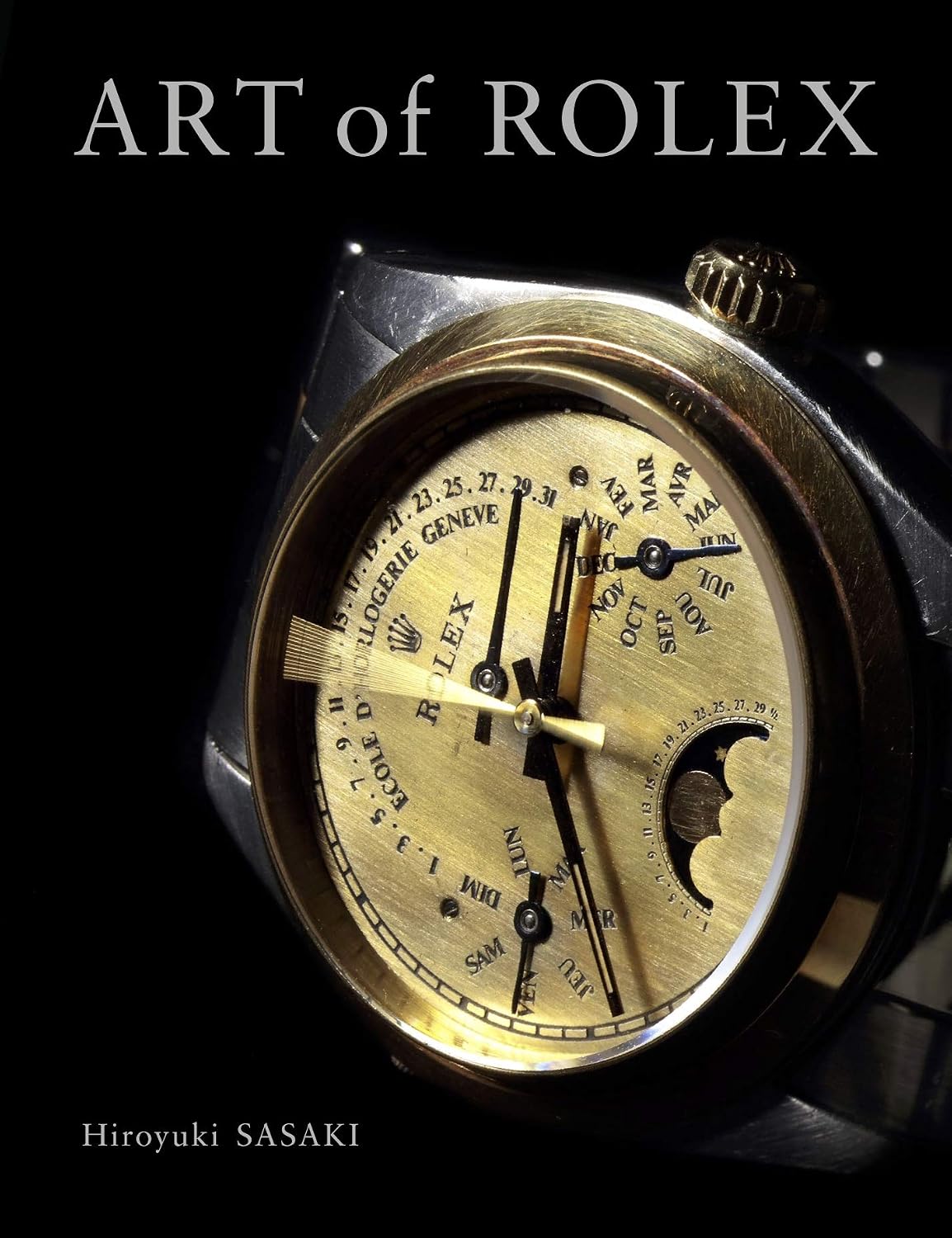
Franck Muller’s Rolex that he converted into a retrograde perpetual calendar, pictured on the cover of Art of Rolex by Hiroyuki Sasaki (Bijutsu Shuppan-sha, 2019). Amazon Japan
Muller took his advice and enrolled at Geneva’s watchmaking school. A teenager who had struggled academically had found something he could excel at: he graduated at the top of his class.
The Rolex (pictured above) that he received in 1978 for his school results did not escape his attention: with considerable ingenuity, Muller ended up converting it into a retrograde perpetual calendar, then selling it to buy tools.
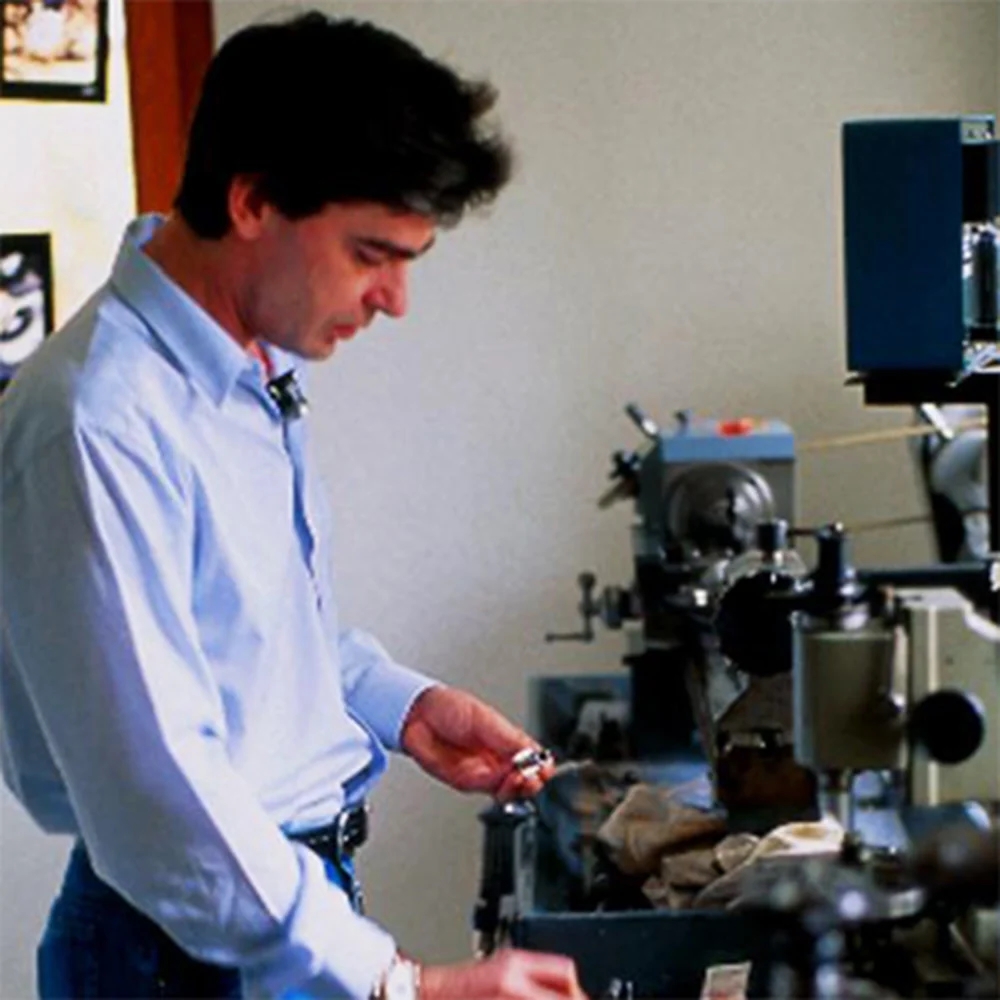
A young Franck Muller in his workshop. World Commerce Corporation
After completing his studies, he worked on antique timepieces for collectors and auction houses while sharing a workshop with Svend Andersen. The Danish-born watchmaker became an important early mentor and would later co-found the Académie Horlogère des Créateurs Indépendants (AHCI).
Their restoration work included watches from the Patek Philippe collection, now housed in the brand’s museum. Missing parts had to be reconstructed, sometimes with the help of historical documentation.
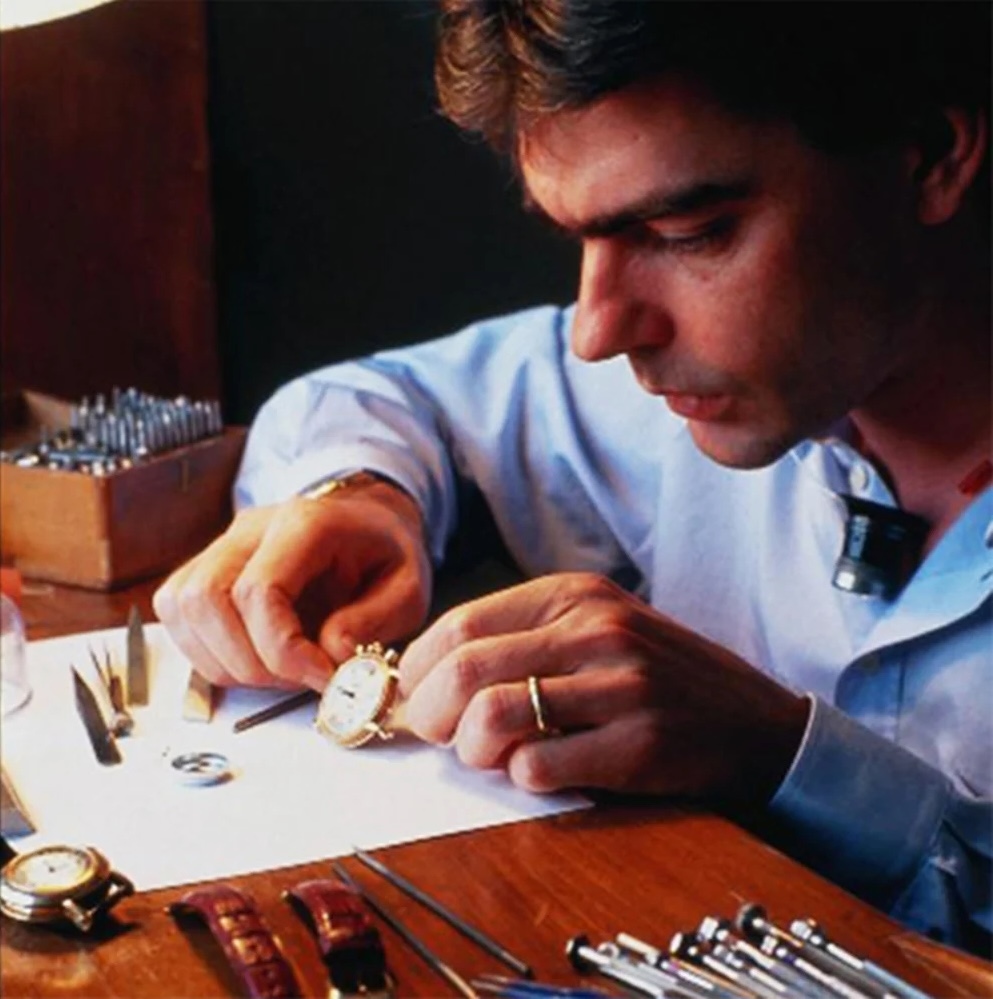
A young Franck Muller in his workshop. World Commerce Corporation
Restoration also gave Muller a keen understanding of complicated pocket watches and the collectors who pursued them. But, in his eyes, a pocket watch tended to stay in a safe while a wristwatch could be worn – he duly began considering how to bring perpetual calendars, minute repeaters, and tourbillons to the wrist.
His Own Watches
By 1983, Muller had established his own workshop and begun making complicated watches for private customers. Production was small: he later recalled ordering only three or four cases a year.
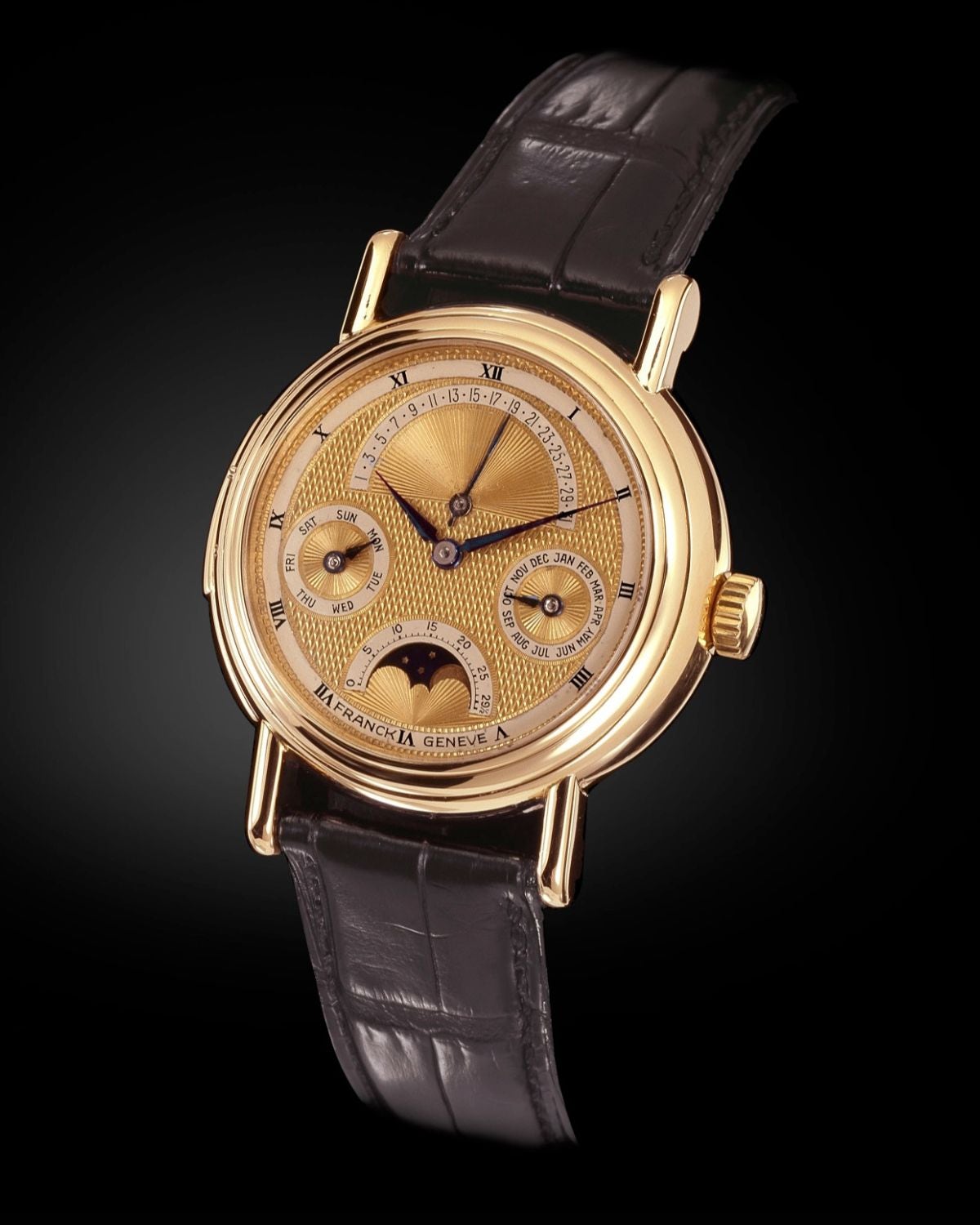
A Franck Genève wristwatch, dated 1983 in Franck Muller’s archives, with a retrograde date, day and month indications, and moon phases on an engine-turned gold dial. Franck Muller
The Franck Muller archives date the watch pictured above to that year. Its layout uncannily recalls his previous Rolex conversion: a retrograde date across the upper dial, day and month registers to either side, and moon phases below. Here, those displays are part of an engine-turned gold dial signed Franck Genève at 6 o’clock. Meanwhile, what looks like a slider on the left caseband suggests that its complications also venture into repeater territory.
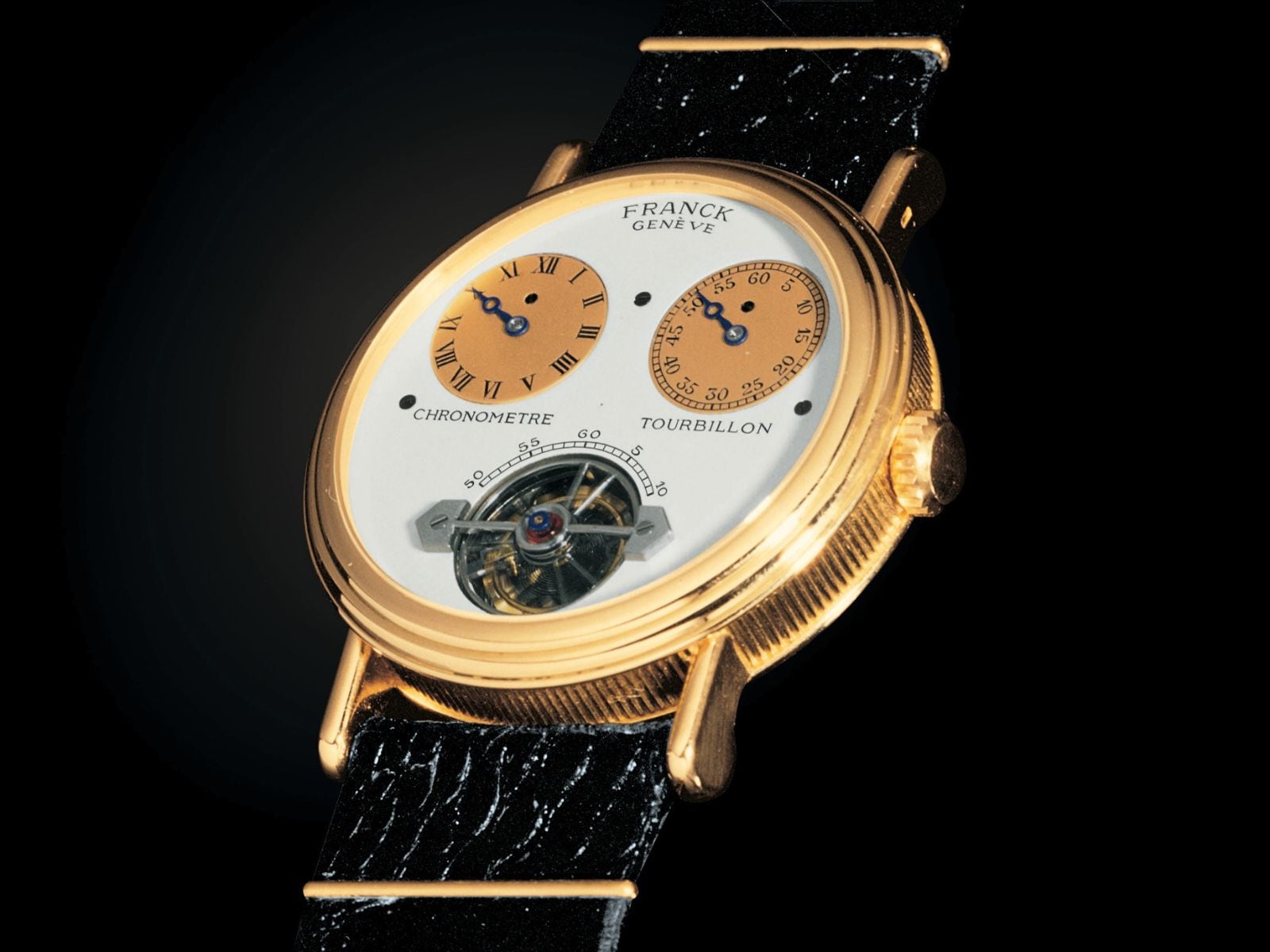
A 1986 Franck Genève jumping-hour tourbillon chronometer, with a regulator-type dial and a case by Jean-Pierre Hagmann. Franck Muller
In 1986 came a jumping-hour tourbillon chronometer with a regulator-type dial. The hours and minutes occupy separate displays in the upper half of the dial, leaving the lower portion open to show the rotating tourbillon carriage. An early Franck Muller catalogue describes nearly 18 months of work on this unique watch and bills the combination as a world premiere. Its dial, too, carries the first-name signature Franck Genève.
For this early tourbillon, Muller turned to Jean-Pierre Hagmann, now regarded as one of the great case makers of the past century, whose clients also included Patek Philippe. Here, a stepped bezel, curved lugs with prominent rounded ends, and a coin-edge caseband give the watch a distinctive profile.
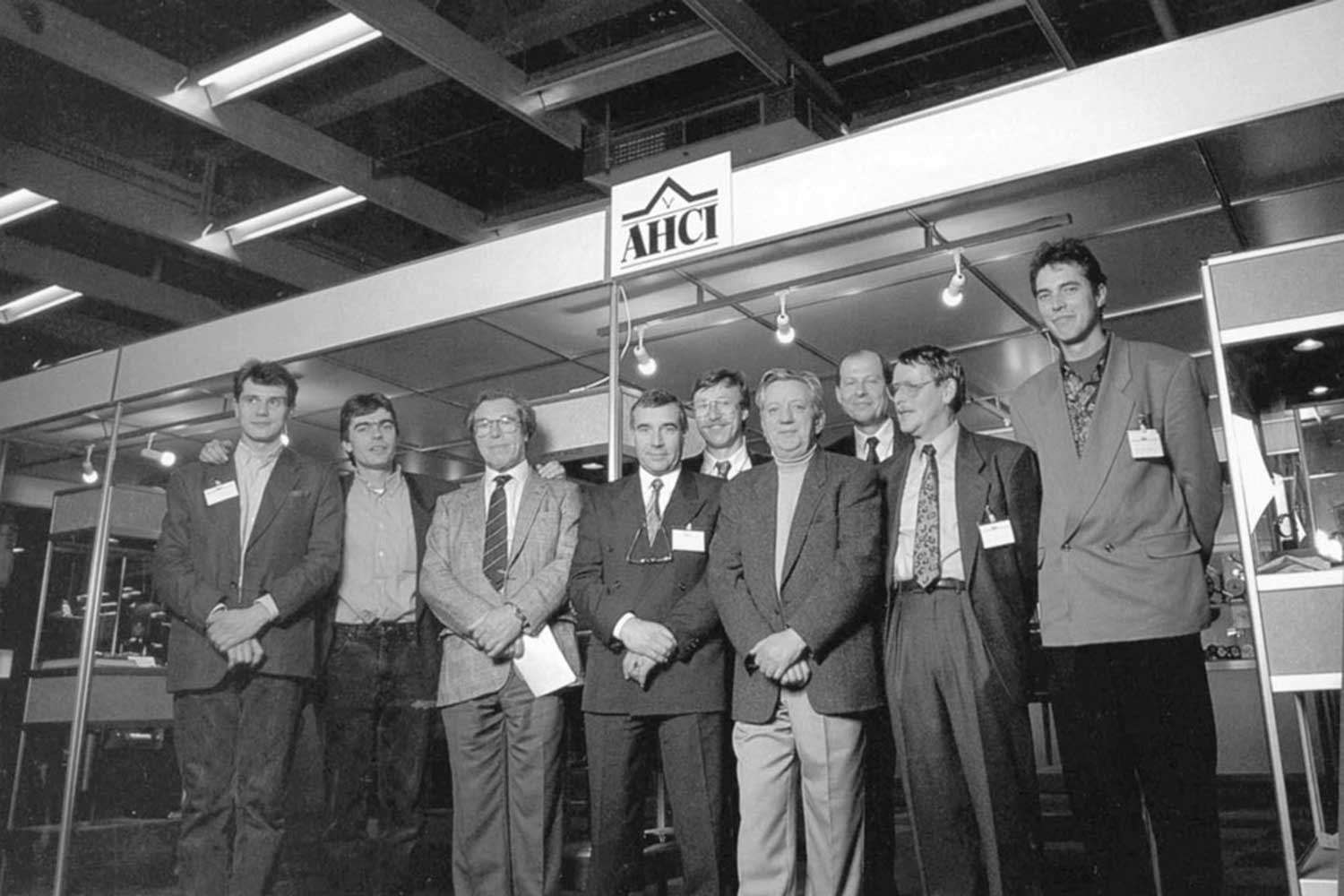
The AHCI stand at the 1987 Basel fair, with Franck Muller second from left, between François-Paul Journe and George Daniels. Lederer Timepieces
A photograph from the AHCI’s first-ever stand at the 1987 Basel fair puts faces to the emerging independent watchmaking scene in which Muller was honing his craft. The Swiss stands second from left, between François-Paul Journe and George Daniels, with his former mentor Svend Andersen second from right next to Bernhard Lederer.
Compounding the Challenge
It is worth remembering how adventurous Muller’s work was. Combining tourbillons, chiming mechanisms, and perpetual calendars in wristwatches was a demanding undertaking even for established manufacturers, let alone a young watchmaker producing a handful of pieces each year. Such combinations are more familiar today, which can make it easy to overlook the ambition behind them.
The world-time minute repeater, presented in the same catalogue as a 1990 world premiere, took that ambition in another direction: a watch that could show and sound the local time as well as display the hour elsewhere.
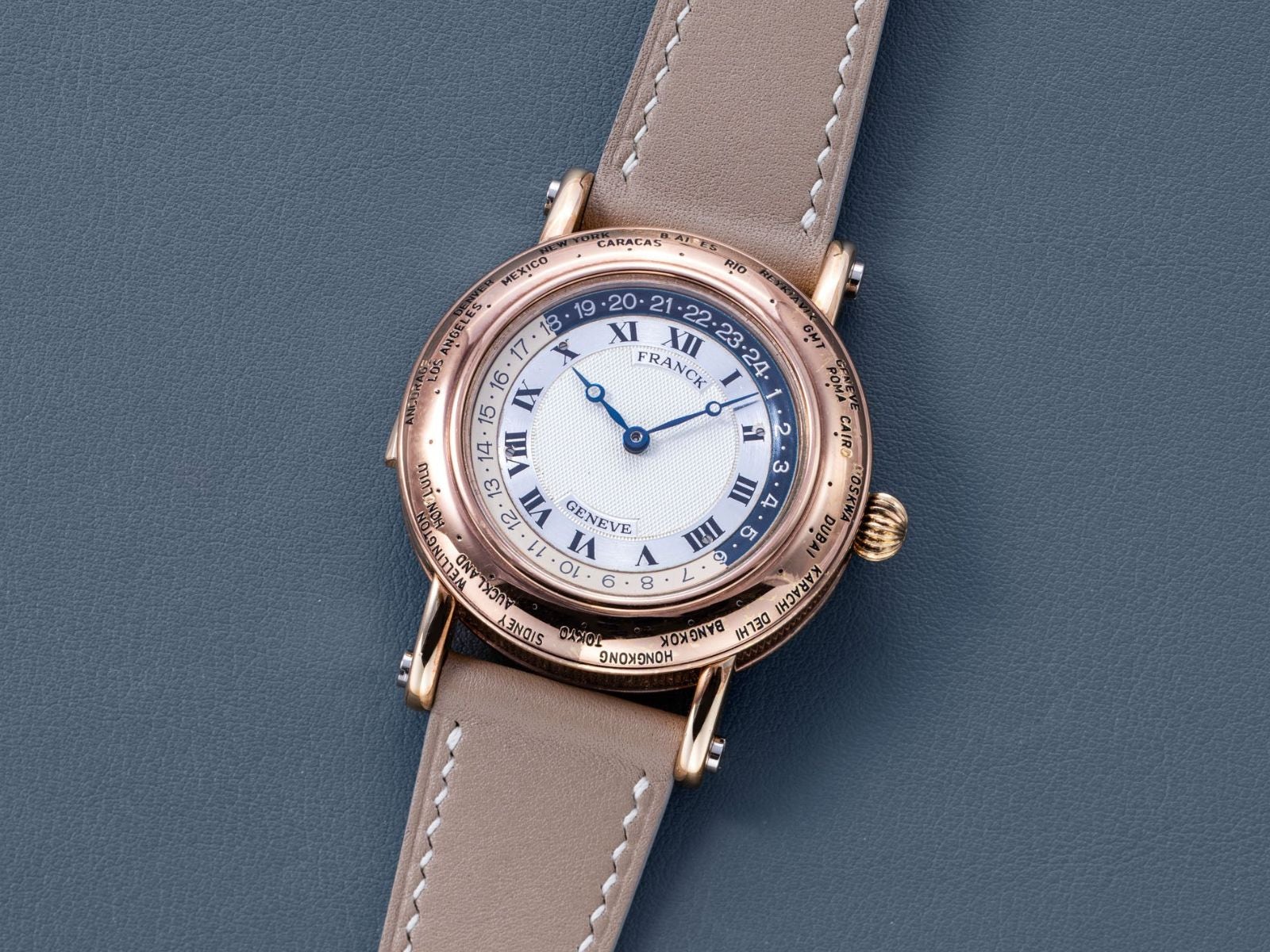
A Franck Genève world-time minute repeater, described as a 1990 world premiere in an early Franck Muller catalogue. Image courtesy of The Hour Glass; watch from a private collection.
On the example illustrated here, Roman numerals surround a gorgeous engine-turned center, with a contrasting day-night 24-hour ring and a bulbous bezel engraved with city names allowing the wearer to consult the time in other locations. Operating the repeater slider makes the watch sound the local hours, quarters, and remaining minutes.
There is more to admire when you turn it over: elaborately engraved, gilded bridges fill the display back, punctuated by pink rubies and silver-toned gears, screws, and the repeater’s hammers. The gongs follow the movement’s perimeter, while a long regulator pointer sits above the balance, beside a scale marked “Fast” and “Slow.”
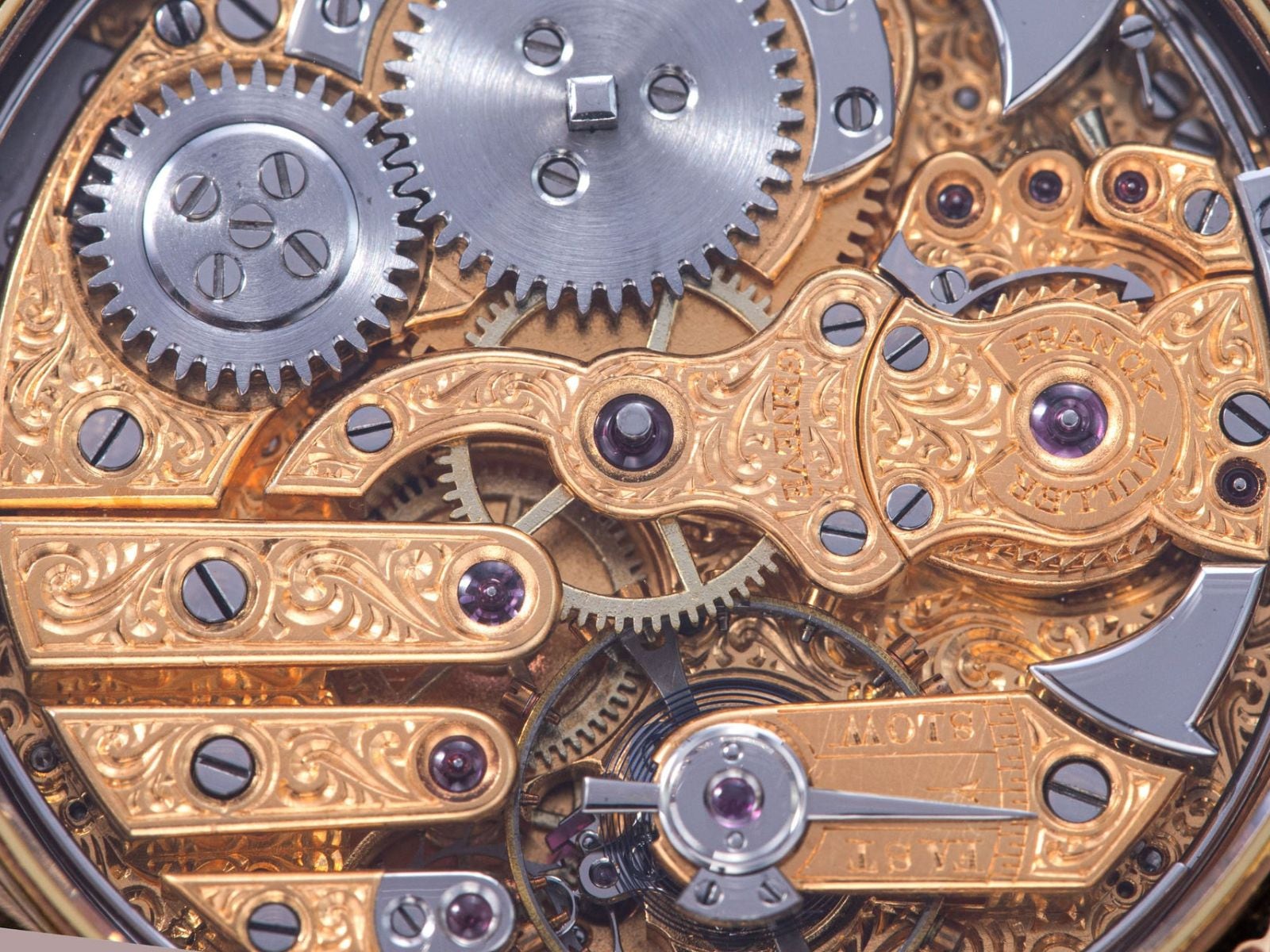
Back of a Franck Genève world-time minute repeater, described as a 1990 world premiere in an early Franck Muller catalogue. Image courtesy of The Hour Glass; watch from a private collection.
Among the bridges is another engraved detail worth a second examination: the name Franck Muller. On the dial, he is Franck Genève; on the movement, he uses his full name.
Two Faces, Two Names
With the Janus, presented in 1991 and named after the two-faced Roman god, the two signatures move onto two dials: Franck Genève on the front, Franck Muller on the reverse. The watch combines world time with a single-button chronograph, operated through a pusher incorporated into the crown.
Visually, the engine-turned center, Roman numerals, contrasting day-night 24-hour ring, and city bezel echo the world-time minute repeater.
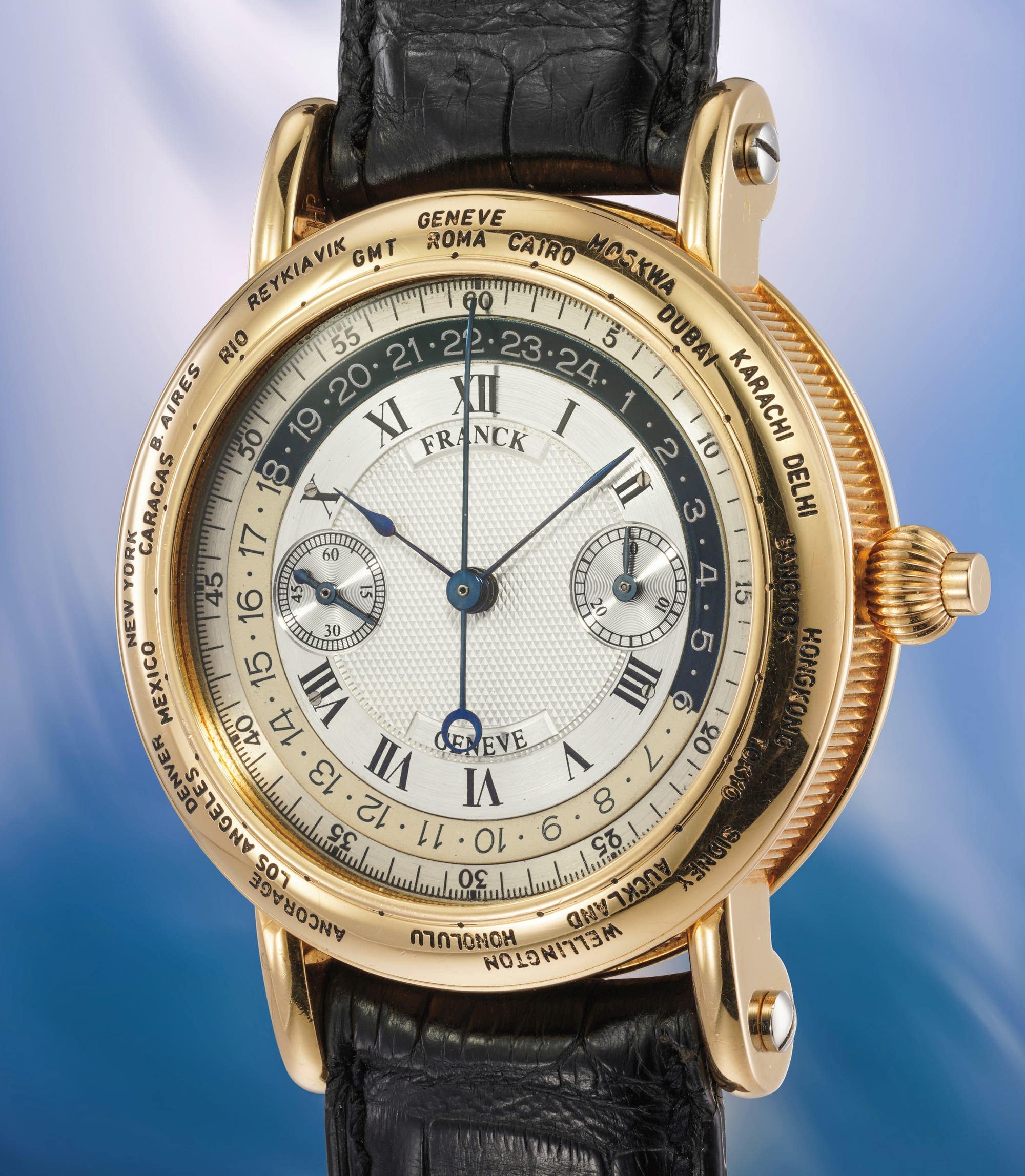
A double-faced Janus in yellow gold, signed Franck Genève on the front and Franck Muller on the reverse, circa 1991.
On the front, the wearer can read the local time, consult the world-time display, and follow the chronograph. On the back, a second chronograph seconds hand allows elapsed time to be read against additional scales.
This unique yellow gold example previously sold by Phillips has a particularly packed reverse, with pulsometer, telemeter, and tachymeter scales.
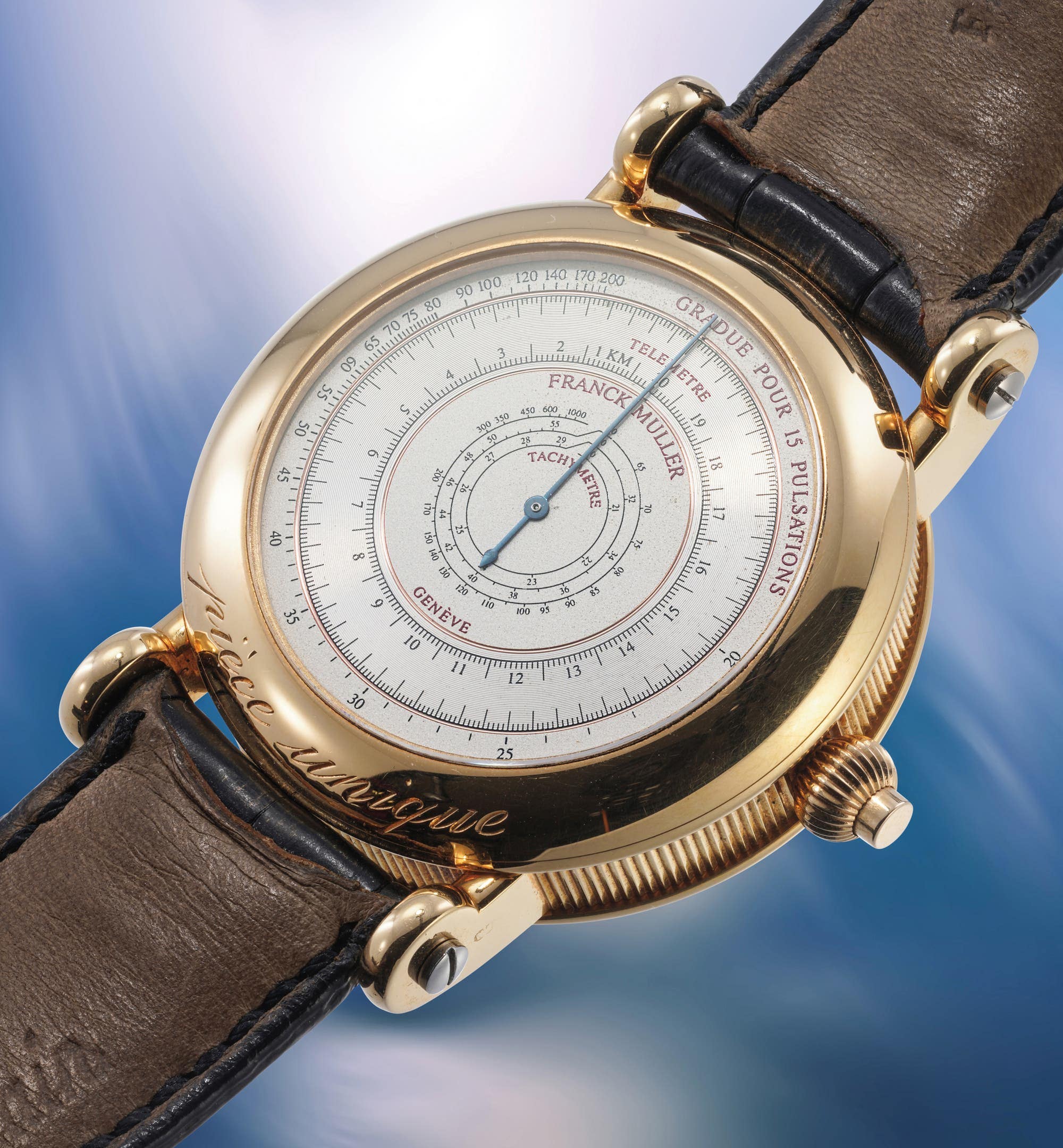
The double-faced Janus in yellow gold, signed Franck Genève on the front and Franck Muller on the reverse, circa 1991.
Muller used a vintage movement as the starting point, adding the world-time mechanism and the second chronograph display. His supply of early-20th-century calibers is believed to have allowed for just 11 Janus watches. For the case, he returned to Hagmann.
But the use of the full-name signature did not mean that Franck Genève immediately disappeared…
Still Franck Genève
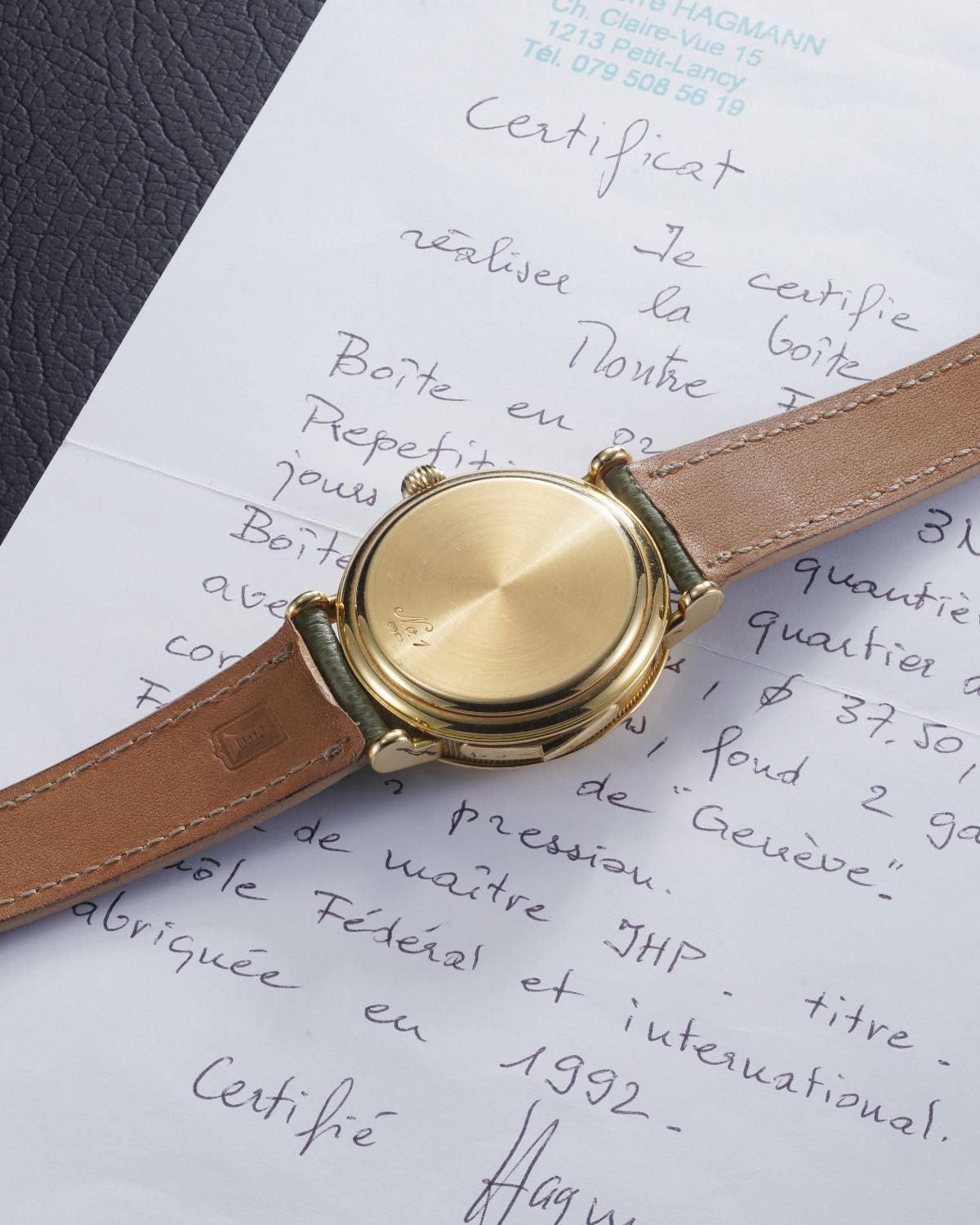
Franck Genève was still emblazoned on the dial of the unique circa 1992 perpetual calendar minute repeater coming to Geneva. Inside the solid caseback, another familiar signature appears: Hagmann’s initials.
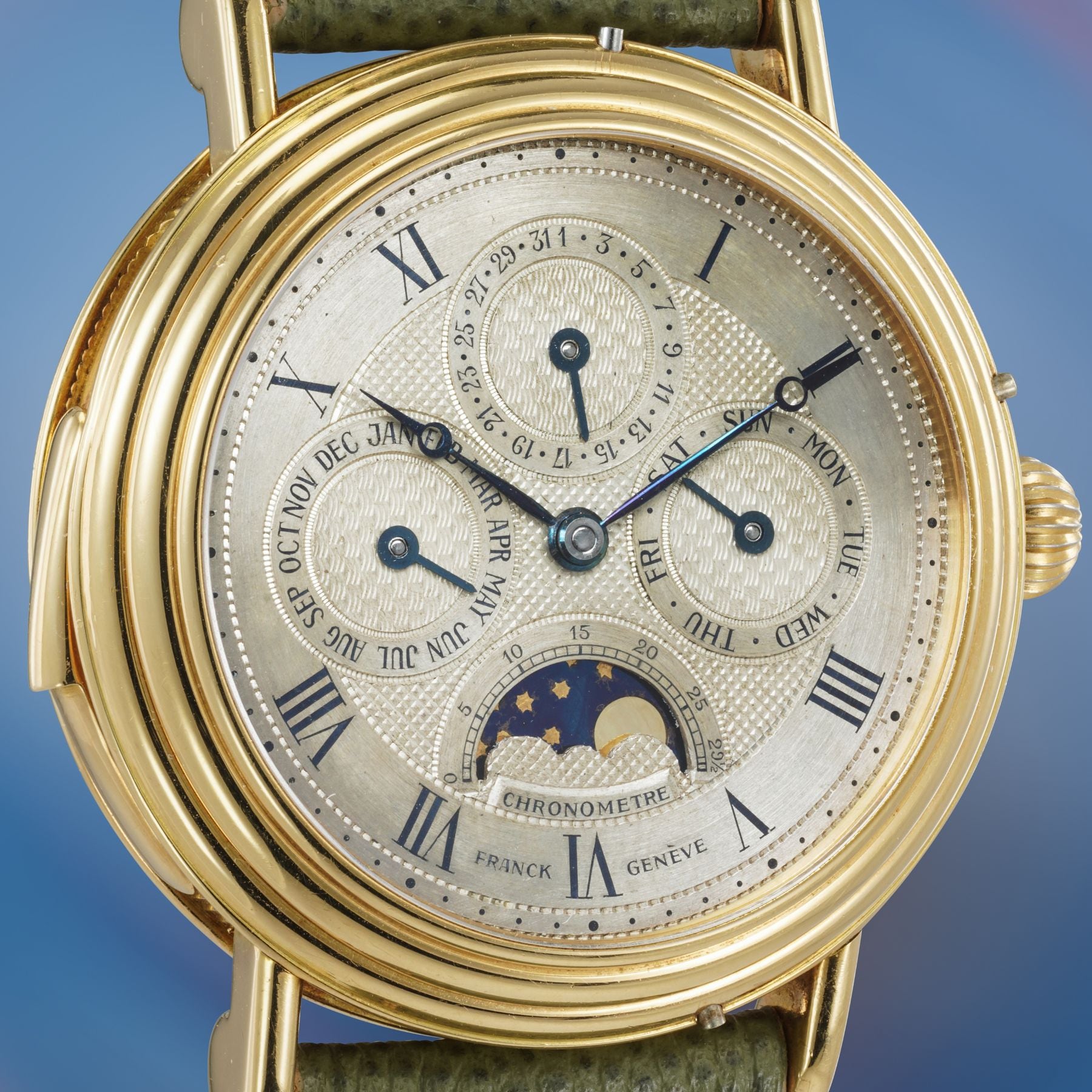
Lot 105: A circa 1992 unique Franck Muller perpetual calendar minute repeater, numbered 1 and signed “Franck Genève,” in 18k yellow gold, included in The Geneva Watch Auction XXIV. Estimate: CHF 100,000–200,000
There is plenty going on within the Roman numerals on the chapter ring. The date sits under 12 o’clock, the day at 3, the month at 9, and the moon phase at 6. Blued hands stand out against the silvered dial, with different engine-turned patterns giving the central field and calendar registers their own textures.
What’s more, Hagmann gave the yellow gold case a particularly handsome profile. Three polished steps rise around the bezel above a coin-edge caseband, while the lugs curve down toward the wrist, finishing in prominent rounded ends. There is a clear family resemblance to the 1986 tourbillon.
Lot 105: A circa 1992 unique Franck Muller perpetual calendar minute repeater, numbered 1 and signed “Franck Genève,” in 18k yellow gold, included in The Geneva Watch Auction XXIV. Estimate: CHF 100,000–200,000
Hagmann’s contribution is documented beyond the stamp, too: his handwritten certificate accompanying the watch confirms that he manufactured the case in 1992.
Building the Franck Muller Brand
In 1991, Muller and another case maker – entrepreneur Vartan Sirmakes – co-founded Technowatch, later renamed Franck Muller Watchland, the company behind the Franck Muller brand. Each invested CHF 75,000.
The partnership gave each man a defined role: Muller concentrated on creating the watches; Sirmakes handled the finances and management, helping build the business that would bring them to a much broader audience. Production rose from around 300 watches in 1993 to nearly 3,000 the following year. A decade later, the company would be making 50,000 watches a year.
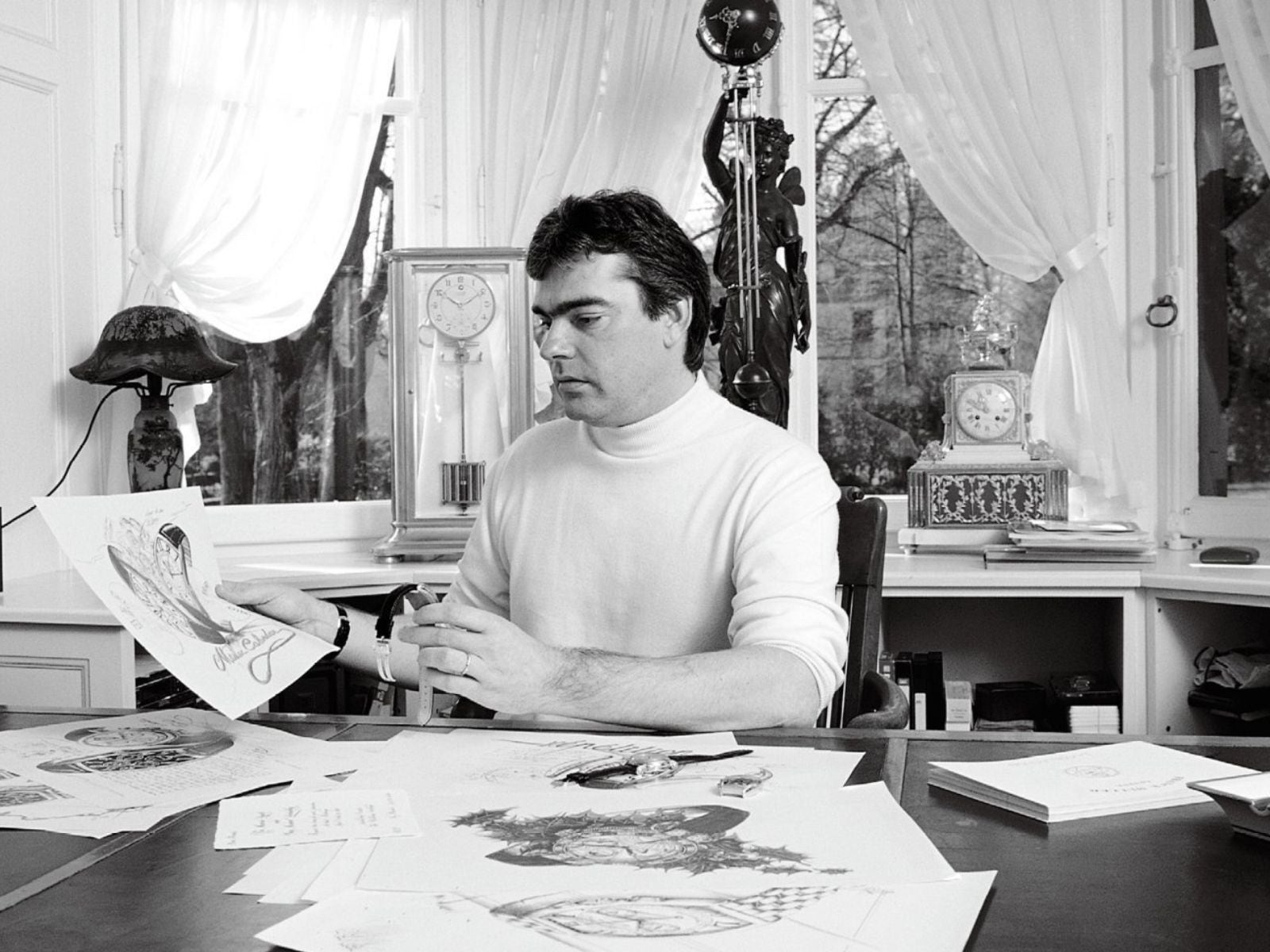
Franck Muller at his desk in the early 1990s, studying designs for the Cintrée Curvex. World Commerce Corporation
Complicated watchmaking remained a key tenet; subsequent creations included the Revolution 3 triple-axis tourbillon and the Aeternitas Mega 4, with 36 complications – the world’s most complicated wristwatch at the time.
The curved tonneau case known as the Cintrée Curvex became Franck Muller’s signature. Hagmann even had a hand in that: he designed and made the first example in 1991, for a perpetual calendar minute repeater. As such, the artisan behind Muller’s early round cases also helped shape the look that would make the Franck Muller brand recognizable the world over.
The watch appearing in The Geneva Watch Auction XXIV comes from this period of overlap. As the new company took shape and his full name began to take precedence on the dial, Muller was still making the sort of watch on which he had built his reputation: a complicated private commission, housed in a case by Hagmann. On the dial, he was still simply “Franck Genève.”
You can learn more, place a bid, and view the entire Geneva Watch Auction: XXIV catalog here.