Article | Banksy Artist Provocateur Contemporary Art Auction London October 2026
Banksy: Artist Provocateur
On the art historical precedents of one of the most defining artists of our times.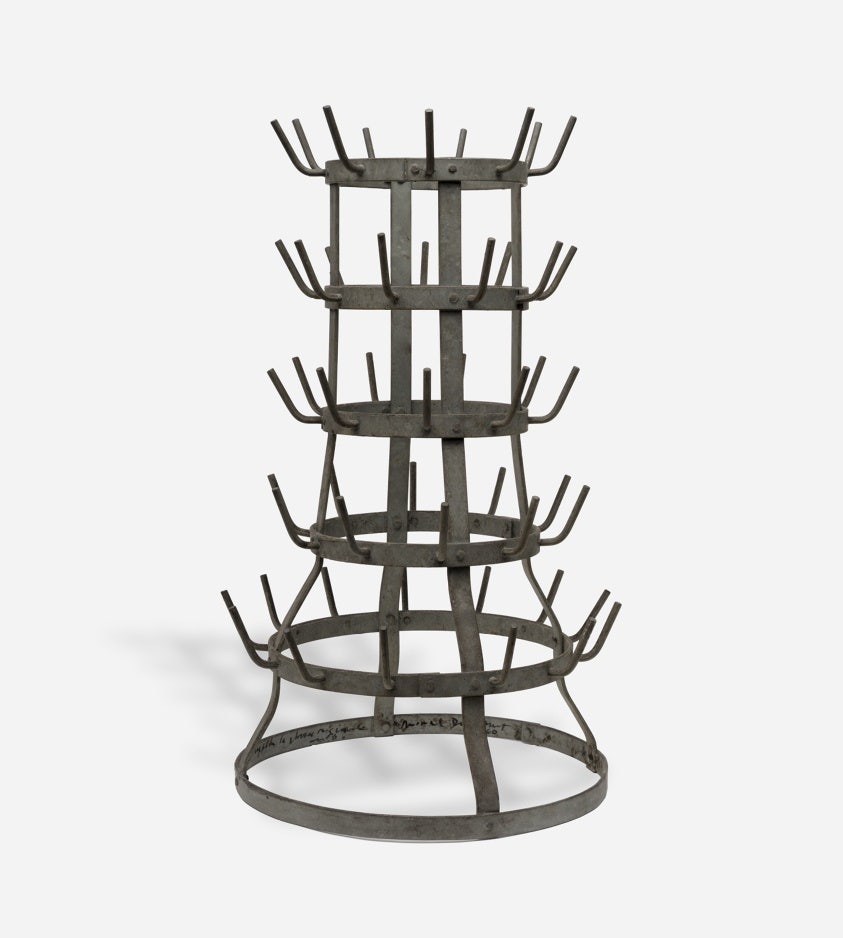
MARCEL DUCHAMP, Porte-Bouteilles, 1914. Image: The Art Institute of Chicago / Art Resource, NY/ Scala, Florence. Artwork: © 2026 Association Marcel Duchamp / ADAGP, Paris / Artists Rights Society (ARS), New York.
Throughout history, certain artists have possessed a rare understanding of how to speak directly to culture, provoking audiences into debate through works that refuse to be ignored. Unlike any other living artist, Banksy’s visual commentary has the uncanny ability to pierce through the noise of contemporary visual culture, holding a mirror to society and encouraging it to reflect upon itself.
Offered for the first time at auction this October at Phillips, Banksy’s 2019 work Keep Ou T is a prime example of the artists ability to capture our attention through recognizable signifiers, reclaimed media, and his iconic stenciled motifs. Exhibited to great fanfare at the Royal Academy of Arts — itself a rarity for the artist, who is notoriously critical of institutions — Keep Ou T presents a customs arch, allegedly salvaged from Heathrow Airport. Across its shutters, we encounter a stenciled rat, who has himself reclaimed the letter “T” to break open a padlock. Addressing the outcome of the 2016 Brexit referendum, Keep Ou T is among the works that see Banksy at his most cunning and direct.
For as fresh as this work feels, Keep Ou T has a precedent in art history. One thinks of Guy Debord and the situationists, whose practice of détournement — the use of existing media, commercial signs, or cultural artifacts to subvert their original political or economic meanings — is reminiscent of Banksy's reclamation of an airport customs arch. But there is perhaps no artist who more clearly sets the stage for a work like Keep Ou T than Marcel Duchamp, whose readymades continue to provoke debate to this day.
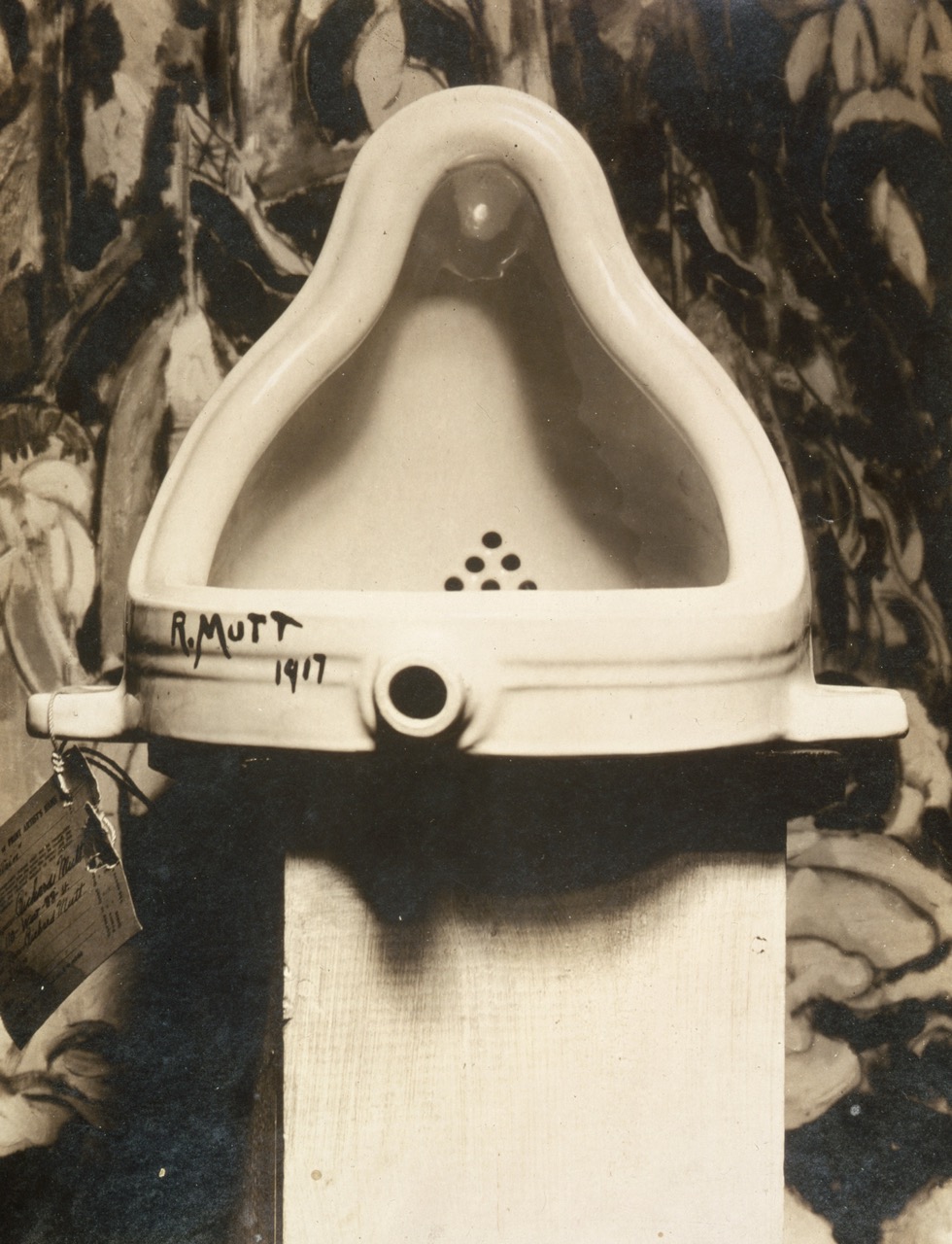
MARCEL DUCHAMP, Fountain, 1917. Photograph by Alfred Stieglitz. Image: wiki-commons. Artwork: © 2026 Association Marcel Duchamp / ADAGP, Paris / Artists Rights Society (ARS), New York
Banksy carries forward Duchamp’s legacy of cultural rebellion. Just as Duchamp's repertoire for his readymades was the familiar and routine, privileging the conceptual intent of the artist, Banksy brings a similar irony to the debate that dominated the political campaign leading up to the 2016 vote. Like Duchamp, Banksy's work is instantly recognizable, its meaning informed by its placement within a fine art context. But going a step farther, Banksy adds his own visual signifiers to heighten the connotations viewers draw from the work.
Upon further reflection, the associations go even deeper. Duchamp challenged the art world with his readymades by establishing the idea as the primary driver of an artwork, but Banksy extended this by taking his work to the street. Both drew on recognizable objects and used satire — in Duchamp's case, epitomized by his scandalous work Fountain, and in Banksy's case, using existing urban spaces to showcase his work, using the medium of street art occupying existing urban spaces.
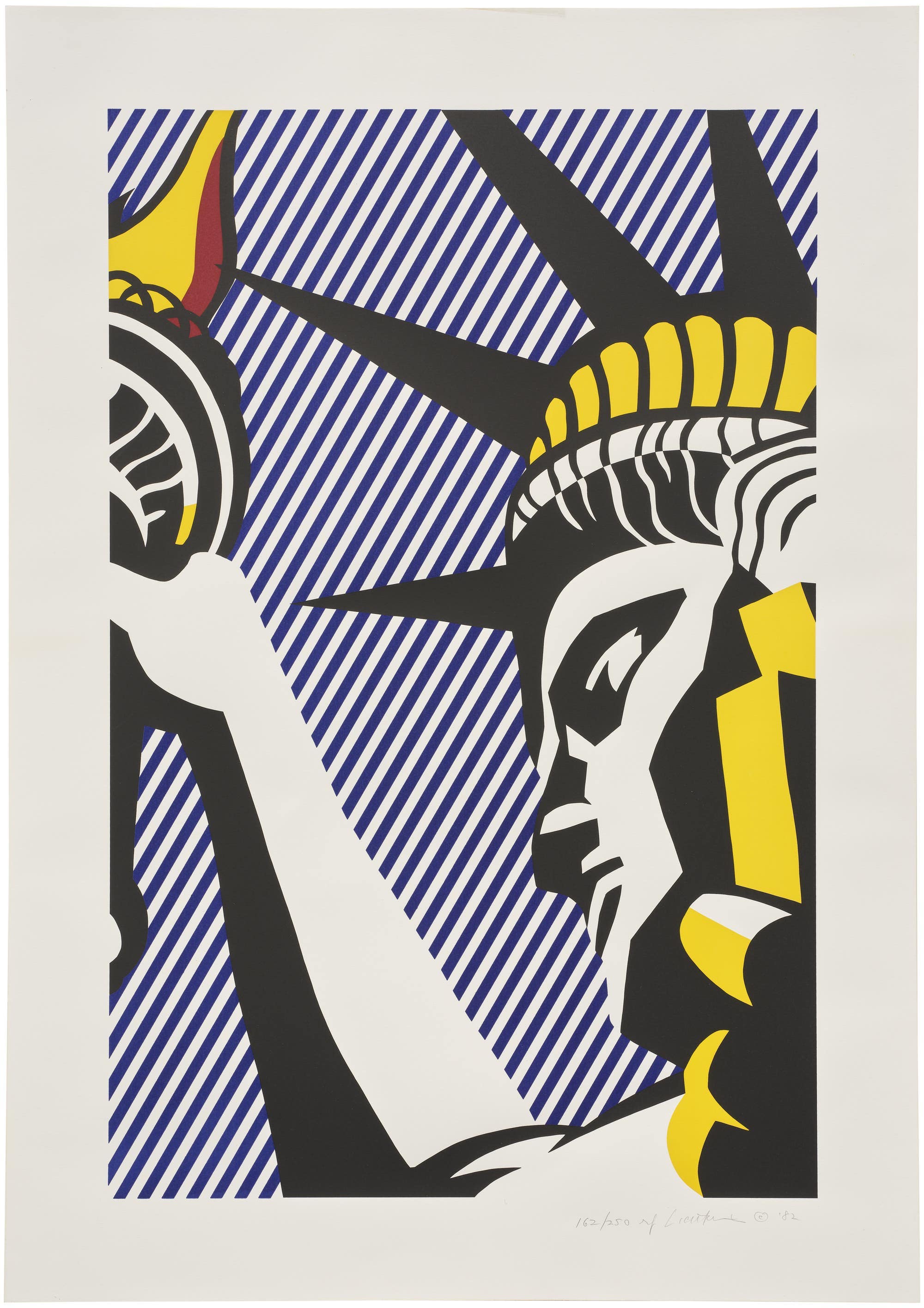
ROY LICHTENSTEIN, I Love Liberty, 1982. © Estate of Roy Lichtenstein / Artists Rights Society (ARS), New York.
Beyond Duchamp, Banksy’s work resonates with the tradition of Pop Art as well. Consider for example Lichtenstein’s fusing so-called 'high' and 'low' culture in a sharp commentary of consumer culture. In Banksy's hands, Lichtenstein's Ben-Day dots or Warhol's silkscreen becomes the stencil, again appropriating aesthetics of popular culture for social critique.
These artists all play with themes of identity and authorship. For Duchamp, his female alter-ego Rrose Sélavy challenges the mythical, singular identity of the “master artist.” For Warhol and Lichtenstein, mechanization and modern production processes also challenge narratives of the artist as the lone hero. Banksy on the other hand similarly confronts ideas of authorship by maintaining strict anonymity.
Collector’s Digest: Banksy, Keep Ou T
- Offered for the first time at auction, Banksy’s Keep Ou T made its first public appearance in the Royal Academy of Arts annual Summer Exhibition in 2019. Extensively featured in the British media once unveiled, this occasion marked the second and the final time to date that the street artist exhibited in the show.
- Retaining anonymity and evading the hand of authority, Banksy continues to capture the contemporary zeitgeist and imagination through art on the street. In April this year, the artist covertly installed the major sculpture in central London. The marching figure was poised to step off the edge of its plinth, blinded by a billowing flag.