Article | The Enduring Influence Of Sigmar Polke
The Enduring Influence of Sigmar Polke
"You can’t exist in a vacuum, you are rooted in time." - Sigmar Polke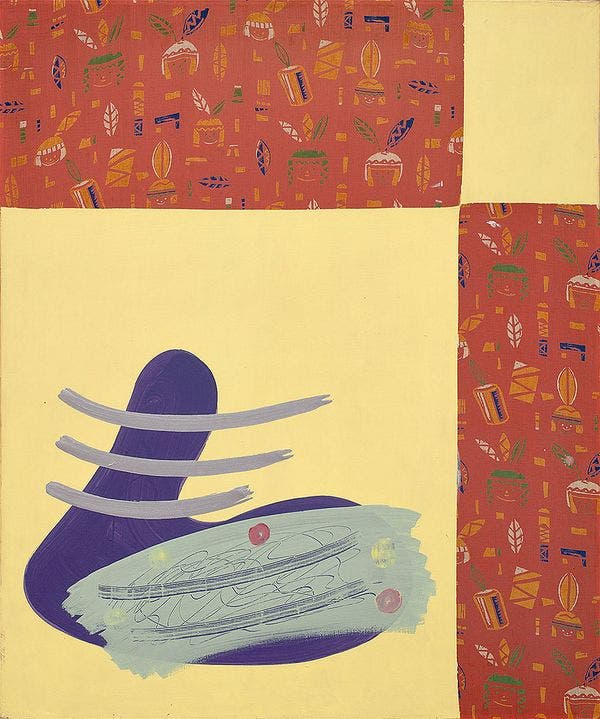
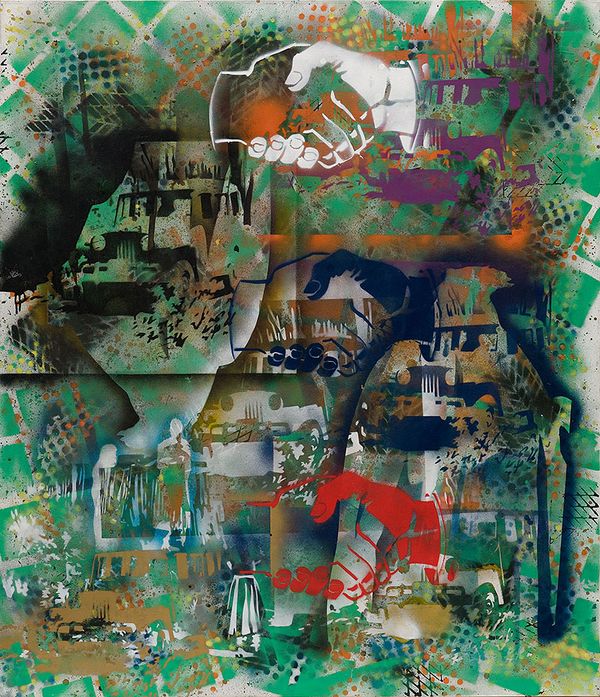
Sigmar Polke, Ohne Titel, 1995. 20th Century & Contemporary Art Evening Sale.
One of the most excitingly enigmatic and experimental artists to have come out of the post-war period, German-born Sigmar Polke has cast a formidable shadow over the shifting landscape of contemporary art, a touchstone for many of his contemporaries and an important reference point for subsequent generations of emerging artists. Characterized by his sharp wit and wildly irreverent approach to a wide range of materials and mediums, Polke’s enduring legacy rests primarily on his ability to destabilize the image itself and to mobilize it as a powerful strategy of socio-political and aesthetic critique, a means of launching a “debate with existing reality.”
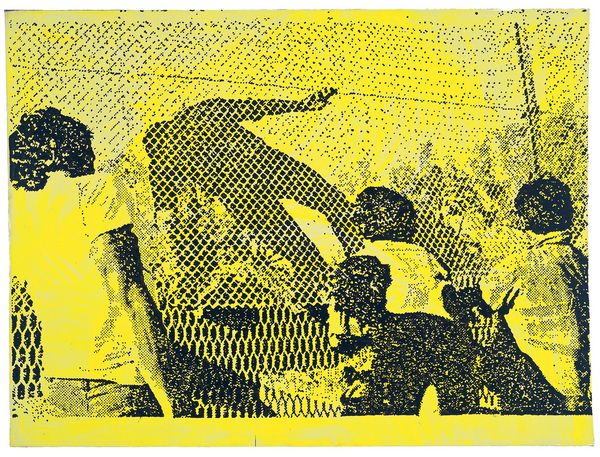
Sigmar Polke, Amerikanisch-Mexikanische Grenze, 1984, Museum Frieder Burda, Baden-Baden. Image: © The Estate of Sigmar Polke, Cologne / DACS, London 2022.
Since Polke’s death in 2010, his work has been the subject of numerous major exhibitions that have shed new light on his practice and its fundamental importance to understanding the currents of late 20th century and early 21st century art. Alongside the landmark 2010 exhibition Alibis: Sigmar Polke 1963 – 2010 organized by The Museum of Modern Art in New York in collaboration with Tate Modern in London which presented an exhaustive survey of the artist’s prodigious output, there have been more focused examinations of particular periods in his career, notably the Hamburger Kunsthalle’s three-part Sigmar Polke: We Petty Bourgeois! and the Kunsthalle Düsseldorf’s Living with Pop: A Reproduction of Capitalist Realism. While these have all highlighted Polke’s ongoing relevance for the ways in which we frame conversations around art and artmaking today, the newly opened Productive Image Disruption: Sigmar Polke and Current Artistic Positions at the Kunsthalle Düsseldorf has taken this a step further, pairing Polke with a selection of contemporary artists to look more directly at the ways in which the image – and its disruption – is not only a defining feature of Polke’s varied practice, but also a central tenant of contemporary art.
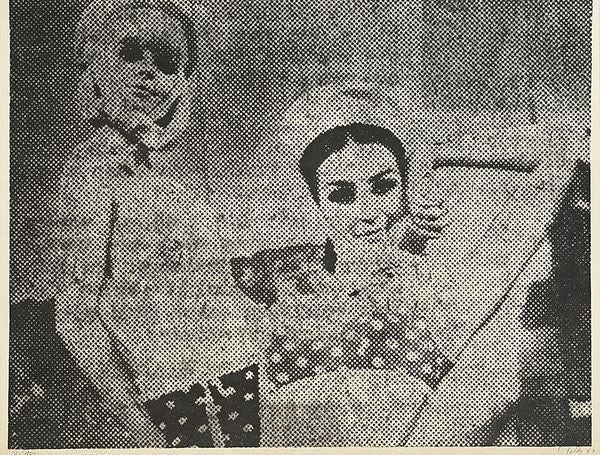
Sigmar Polke, Girlfriends, 1967, The Museum of Modern Art. New York. Image: © The Museum of Modern Art, New York/Scala, Florence. Artwork: © The Estate of Sigmar Polke, Cologne / DACS, London 2022.
Turning to the mass-produced and widely circulated images of his time, Polke became fascinated by the power of advertising to harness the image in the transmission of capitalist ideology. Exploring ways of at once addressing and wittily distorting these messages, Polke hit upon his breakthrough Rasterbilder, composed of the enlarged and hand-painted dots taken from half-tone newspaper printing processes. Icons of mid-century painting, these works have been hugely influential in grounding and guiding debates around the role of the image and its obfuscation in contemporary painting, directly shaping his student Albert Oehlen’s approach to new technologies and his “uncanny evocation of multiple velocities, the skillful grafting of speed and slowness onto a single canvas.” Like Oehlen, Julian Schnabel also found great inspiration in Polke’s irreverent appropriation of found materials, a prominent feature that he shares with American artist Richard Prince’s most controversial work.
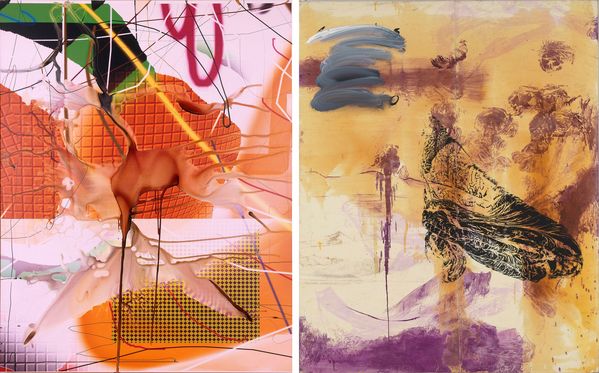
Left: Albert Oehlen, U.D.O. 9’, 2001 – 2005, Galería Juana de Aizpuru, Madrid. Image: Album/Scala, Florence, Artwork: © Albert Oehlen. All Rights Reserved, DACS 2022. Right: Julian Schnabel, Untitled, 1991, Whitney Museum of American Art. Image: Whitney Museum of American Art / Licensed by Scala, Artwork: © Julian Schnabel / ARS, New York / DACS 2022.
Throughout the 1960s and beyond, Polke’s relentless experimentation quickly extended to other media as well, including mass-produced fabric, an in-depth investigation of historical pigments, toxic chemicals, Xerox printing, and double-exposure effects. Creating multi-layered works from diverse and sometimes improbable materials, Polke’s work provides an important aesthetic and conceptual touchstone for a host of young contemporary artists, as the current Kunsthalle Düsseldorf exhibition aptly demonstrates. While Phoebe Collings-James' multi-media practice intersects with Polke’s confounding of linear narrative and straightforward reading of a work, Trevor Paglen’s investigation into the nature of representation and coded linguistic systems clearly resonates with Polke’s own project to use the material of everyday post-war culture to explore his own historical moment. Similarly, Avery Singer’s complex visual landscapes and innovative use of cutting-edge digital technology offer compelling comparisons to Polke’s sustained interest in the transmission and transformation of images, both engaging in a form of “postmodern play” by creating a “layering and overlapping of borrowed images, so that their meanings come unfixed and enter a state of flux.”
In our world of manipulated images, fake news, and the metaverse, Polke’s humorously critical approach to the image, and his centralizing of a conceptual approach to the problem of image-making worked out in material terms itself seems strikingly contemporary, As The Museum of Modern Art curator of Alibis: Sigmar Polke 1963 – 2010 Kathy Halbreich has highlighted, the “entwining and complications of sight and vision were the central preoccupations of Polke’s career. He turned inside out the notion of painting as a window onto the world,” asking his viewers and future generations of artists to see past the familiar to the aesthetic and critical potential buried in the blurred, manipulated, and obfuscated image, and the pleasure of visual interference. Breaking new ground throughout his career, Polke redefined the conceptual and aesthetic terrain for generations of future artists, his legacy profoundly apparent across some of the most exciting work being made today.
Sigmar Polke, Ohne titel (DDR-Emblem), 1978, Sprengel Museum, Germany. Image: Scala, Florence/bpk, Bildagentur fuer Kunst, Kultur und Geschichte, Berlin, Artwork: The Estate of Sigmar Polke, Cologne / DACS, London 2022.
Discover More from 20th Century & Contemporary Art >
Recommended Reading