Article | Jaeger Lecoultre Gustav Klimt Atmos Phillips New York Fall 2026 Online Auction
Art, Craft, and Extraordinary Mechanics: Jaeger-LeCoultre’s Gustav Klimt Atmos
How La Grande Maison brought together Klimt’s The Kiss, intricate decorative arts, and the temperature-powered wonder of the Atmos clock.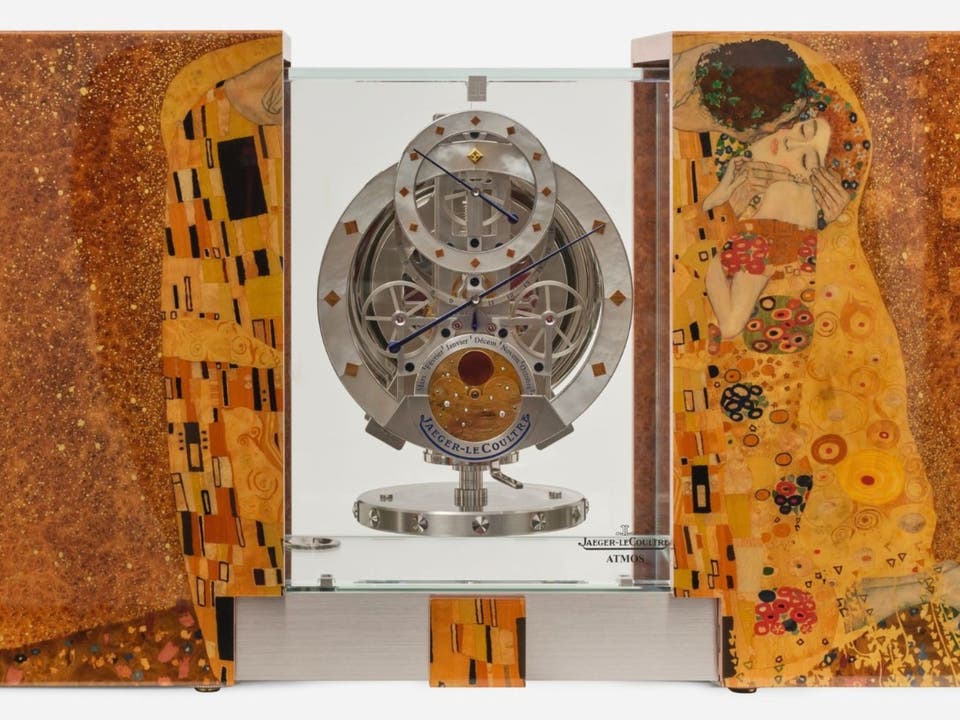
Phillips in Association with Bacs & Russo is delighted to present The New York Sessions, Fall 2026, an online auction running from 1–9 October. Featuring more than 80 exceptional timepieces from leading makers including Patek Philippe, Rolex, A. Lange & Söhne, Audemars Piguet, and F.P. Journe, the sale includes all the lots featured in this story.
At first glance, it could almost be mistaken for a decorative objet d’art. The cabinet is covered in intricate wood marquetry inspired by Gustav Klimt’s The Kiss, with the embracing couple picked out against a richly patterned backdrop of natural woods and gold leaf.
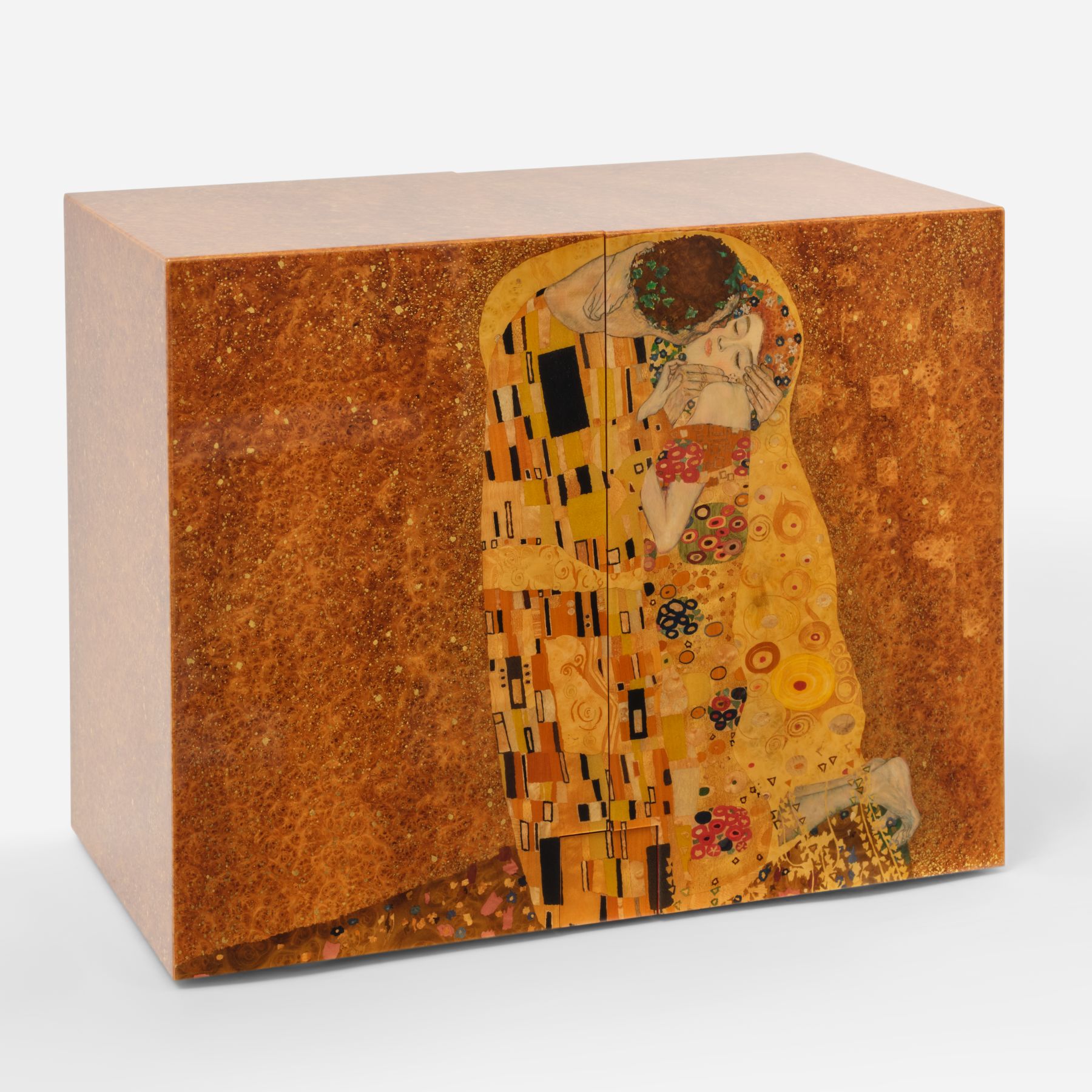
Lot : 39A 2012 Jaeger-LeCoultre Atmos Marqueterie “Gustav Klimt” Ref. Q5543302, included in the Phillips New York Sessions, Fall 2026. Estimate: USD $70,000–140,000
Press a concealed button, however, and the cabinet opens to reveal something equally impressive within: a Jaeger-LeCoultre Atmos clock.
Made in 2012 in a limited edition of just 10 pieces, the Jaeger-LeCoultre Atmos Marqueterie “Gustav Klimt” brought together one of the most celebrated paintings of the early 20th century, centuries-old decorative techniques, and a famed clock mechanism that requires no conventional winding or external electrical supply.
No. 6 of that outstanding series is included in The New York Sessions, Fall 2026, where it comes to auction having undergone a full service and restoration at Jaeger-LeCoultre in 2025.
Living on Air
While Jaeger-LeCoultre may be best known for watches such as the Reverso, Memovox, and Geophysic, the Atmos represents another long-running chapter in La Grande Maison’s history.
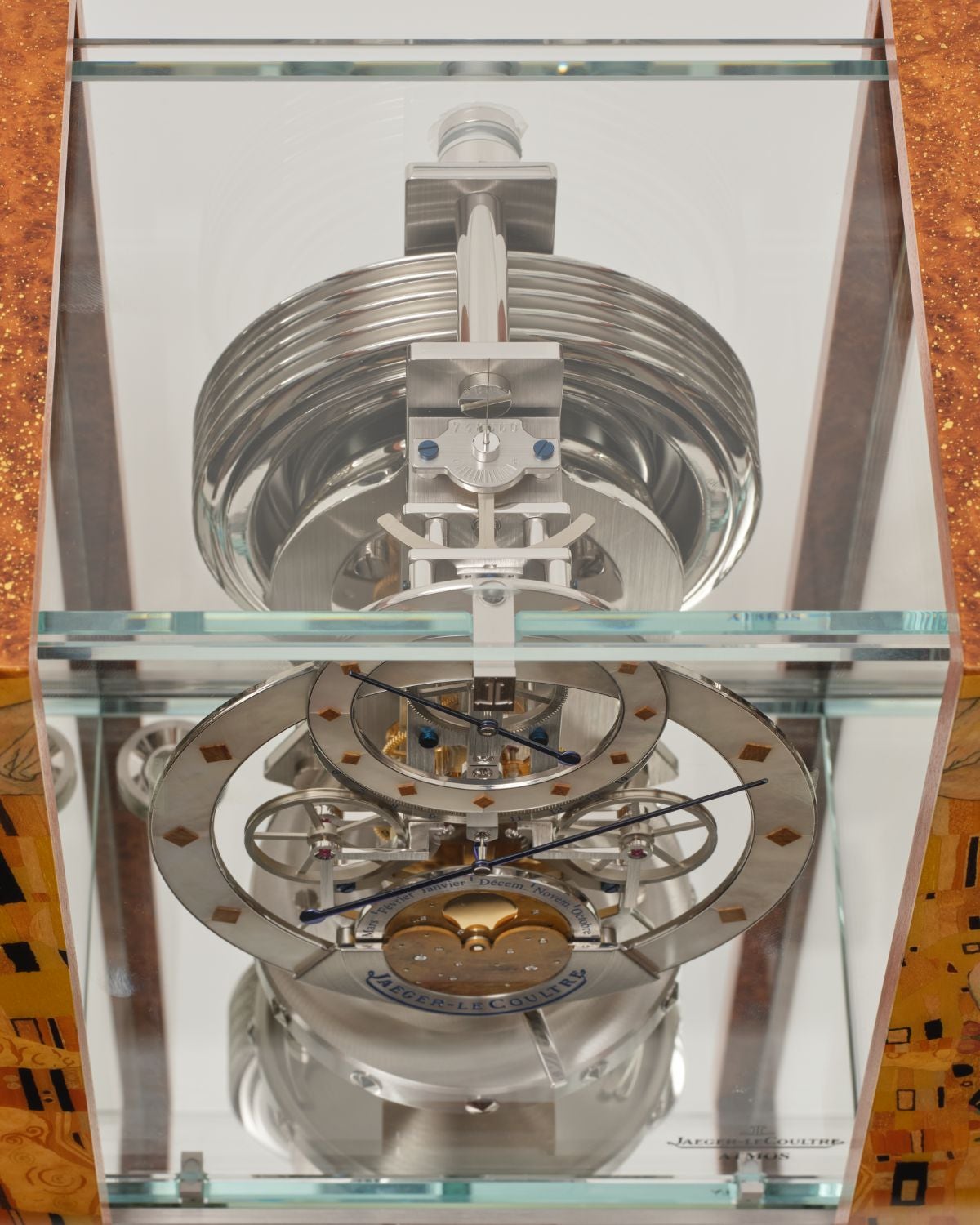
Lot : 39A 2012 Jaeger-LeCoultre Atmos Marqueterie “Gustav Klimt” Ref. Q5543302, included in the Phillips New York Sessions, Fall 2026. Estimate: USD $70,000–140,000
Its origins go back to 1928, when Neuchâtel engineer Jean-Léon Reutter developed the first Atmos clock. Jaeger-LeCoultre took over production of the Atmos 1 in 1935 and subsequently developed the ethyl-chloride system that would underpin later generations of the clock.
The principle behind it is still fascinating: a hermetically sealed capsule responds to changes in ambient temperature, expanding as the temperature rises and contracting as it falls. This movement winds the mainspring, effectively allowing the clock to draw its energy from the air around it. A temperature variation of just 1°C can provide approximately 48 hours of running time.
To run on such slight changes in temperature, the Atmos needs to be exceptionally energy efficient. Suspended from a fine steel-alloy wire, its ring-shaped balance oscillates just twice per minute and, according to Jaeger-LeCoultre, uses around 250 times less energy than the balance of a conventional wristwatch.
A Golden Embrace
For this 2012 edition, Jaeger-LeCoultre turned to perhaps Gustav Klimt’s best-known work, The Kiss.
Begun around 1907 and completed in 1909, The Kiss belongs to the Austrian artist’s celebrated Golden Period. It depicts a couple embracing on the edge of a flower-covered meadow, their bodies enveloped by richly patterned robes and surrounded by a field of gold. Geometric forms dominate the man’s garment, while the woman’s dress is filled with softer floral motifs.
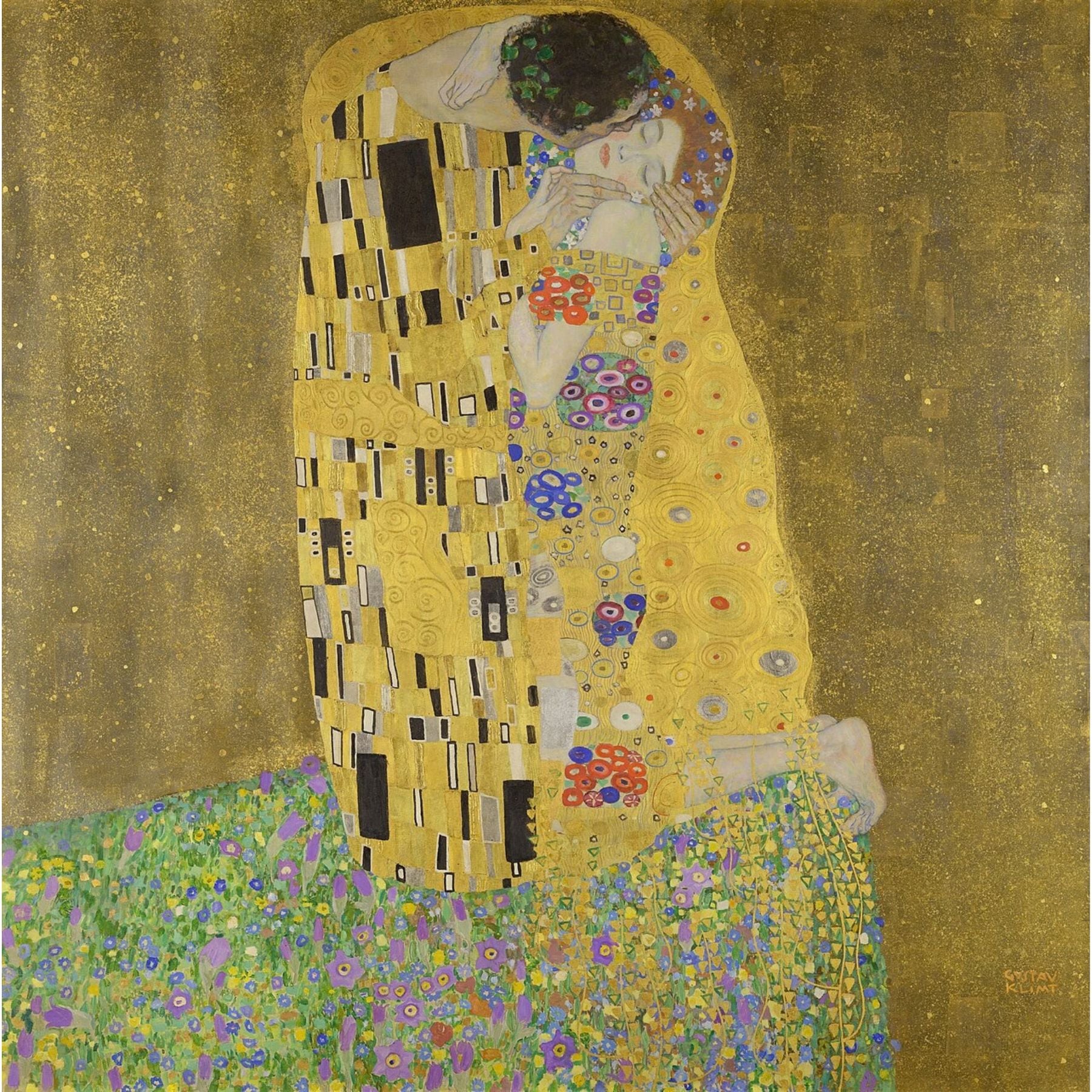
Gustav Klimt, The Kiss (1907–1908). Public domain. Image: Google Art Project.
Gold was central to Klimt’s work during this period. Inspired in part by Byzantine mosaics and Japanese art, he incorporated gold leaf and other metals directly into his paintings. In The Kiss, gold leaf covers the man’s robe and appears throughout the woman’s dress, while the background contains gold, silver, and platinum.
When The Kiss was first exhibited at the 1908 Kunstschau in Vienna, it received an enthusiastic response. The Austrian state acquired the painting for the Moderne Galerie during that first presentation, before Klimt had completed the work.
Painting in Wood
A century later, Jaeger-LeCoultre set itself the task of translating Klimt’s complex painted composition into marquetry.
The cabinet of the Atmos Marqueterie “Gustav Klimt” comprises more than 1,200 individually cut pieces. Different woods – including boxwood, lemonwood, maple, pearwood, walnut, and several varieties of burl – were selected for their contrasting tones and textures, while certain pieces were covered in different shades of gold leaf. The work required several hundred hours to complete.
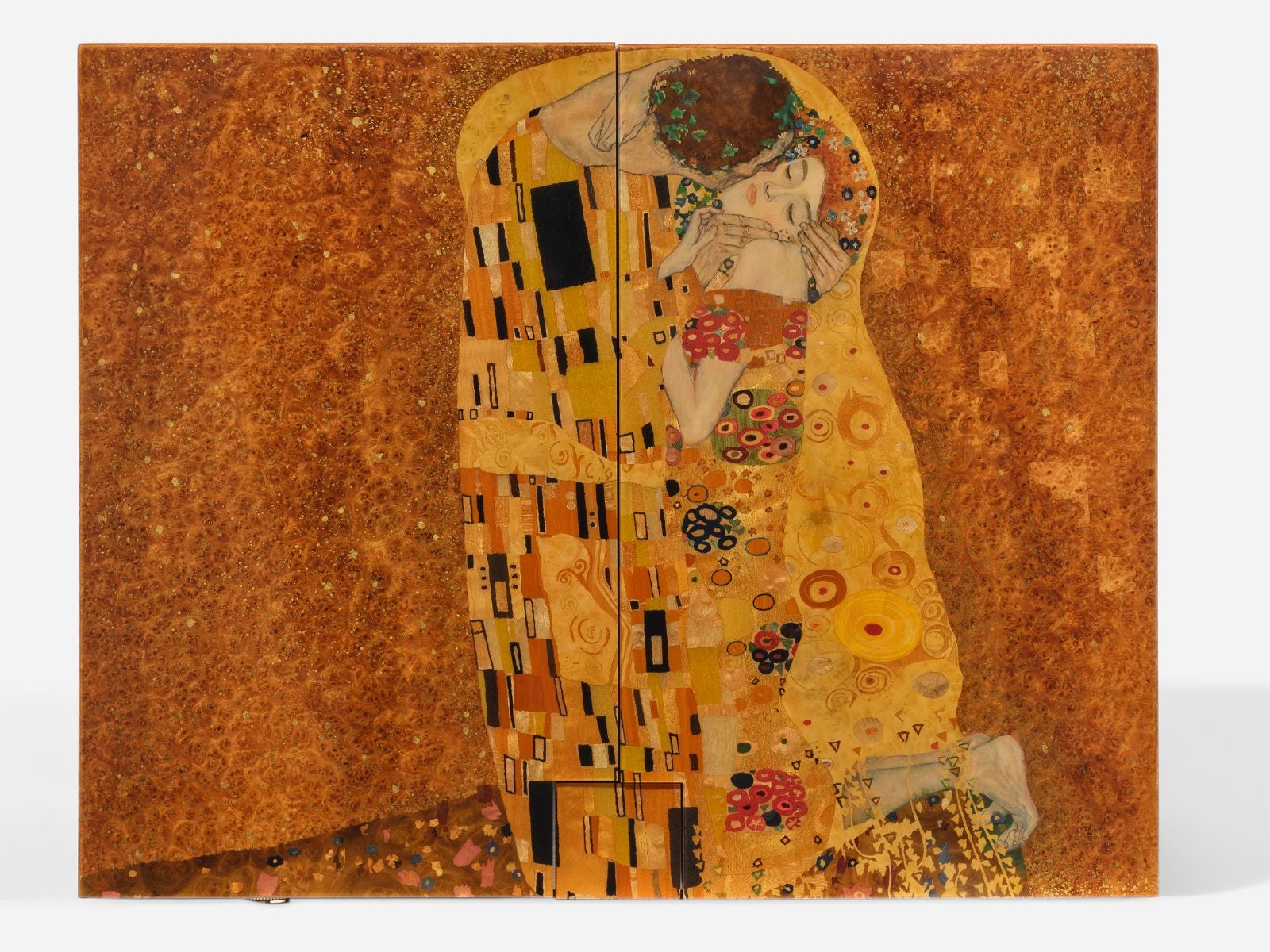
Lot : 39A 2012 Jaeger-LeCoultre Atmos Marqueterie “Gustav Klimt” Ref. Q5543302, included in the Phillips New York Sessions, Fall 2026. Estimate: USD $70,000–140,000
The cabinet also plays an active part in how you experience the clock. A hidden button activates a mechanical opening system, separating the marquetry panels to reveal the Atmos within its glass enclosure.
It is a neat piece of theater. Closed, the cabinet puts Klimt’s imagery first. Open, the composition divides to frame the clock at its center.
Details Within
The decorative treatment continues inside the cabinet. The clock’s open dial features mother-of-pearl rings punctuated by petrified-wood indexes, with the hours displayed on a subdial at 12 o’clock and the minutes indicated by a central hand. Both hands are blue-varnished. A cushion-cut yellow sapphire marks 60 minutes.
Between the hour and minute displays, a suspended, numbered ring provides a 24-hour indication, read against a small blue pointer. Below it, at 6 o’clock, the month and moon-phase display introduces another contrast in materials: a golden moon appears against a petrified-wood disc adorned with brilliant-cut diamonds, while the months are marked on a surrounding silver-toned ring.
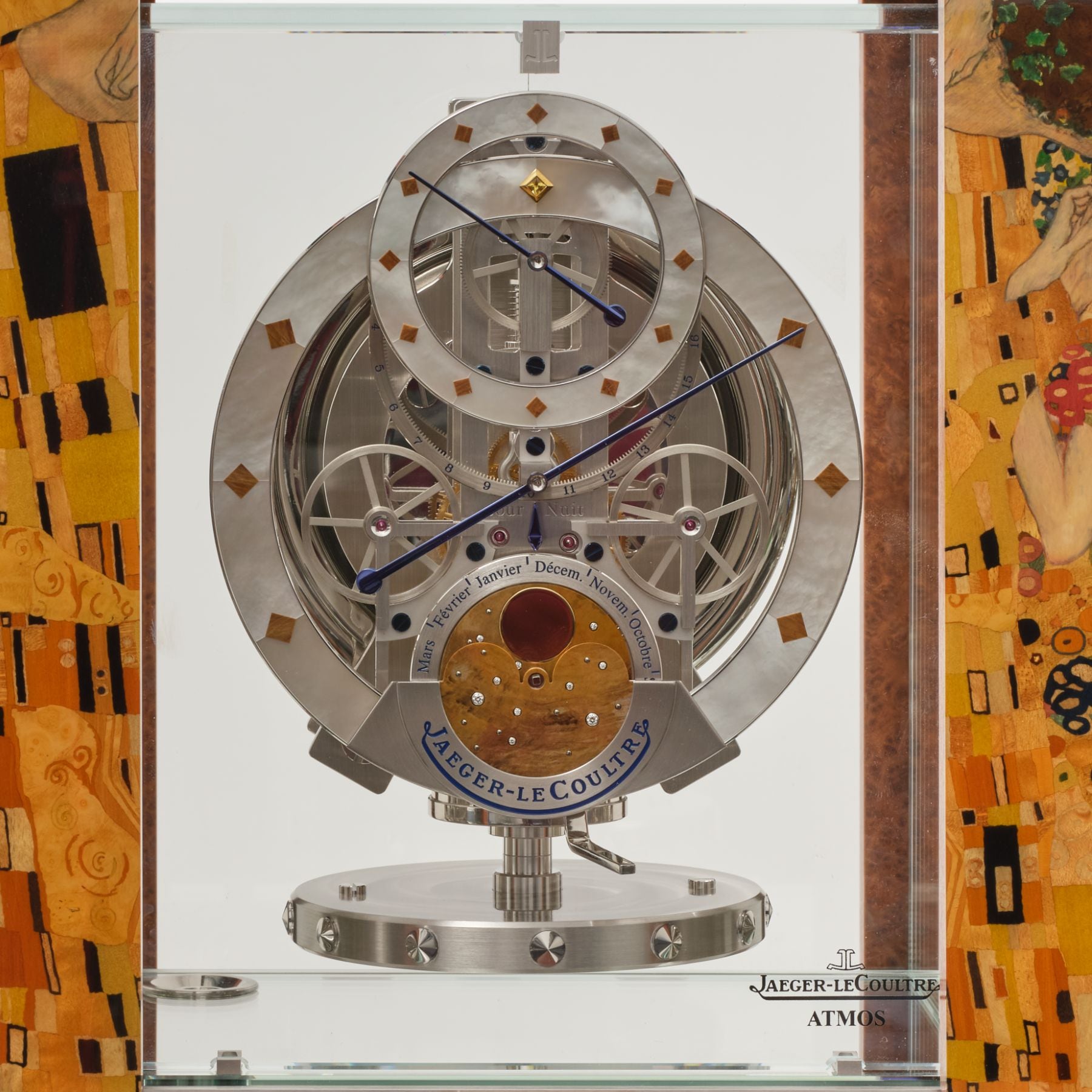
Lot : 39A 2012 Jaeger-LeCoultre Atmos Marqueterie “Gustav Klimt” Ref. Q5543302, included in the Phillips New York Sessions, Fall 2026. Estimate: USD $70,000–140,000
Behind these elaborate displays is Jaeger-LeCoultre’s 30-jewel Calibre 582.
The ensemble illustrates the possibilities that the Atmos has offered Jaeger-LeCoultre over the decades. Its mechanism may have been conceived a century ago, but its architecture has provided the Vallée de Joux manufacture with a platform for decorative crafts and adventurous design.
And in this case, for a creation inspired by The Kiss, what could be more fitting than a clock that thrives on a little atmosphere?
You can learn more, place a bid, and view the entire New York Sessions, Fall 2026, catalog here.