188
艾佛.史蒂格列斯
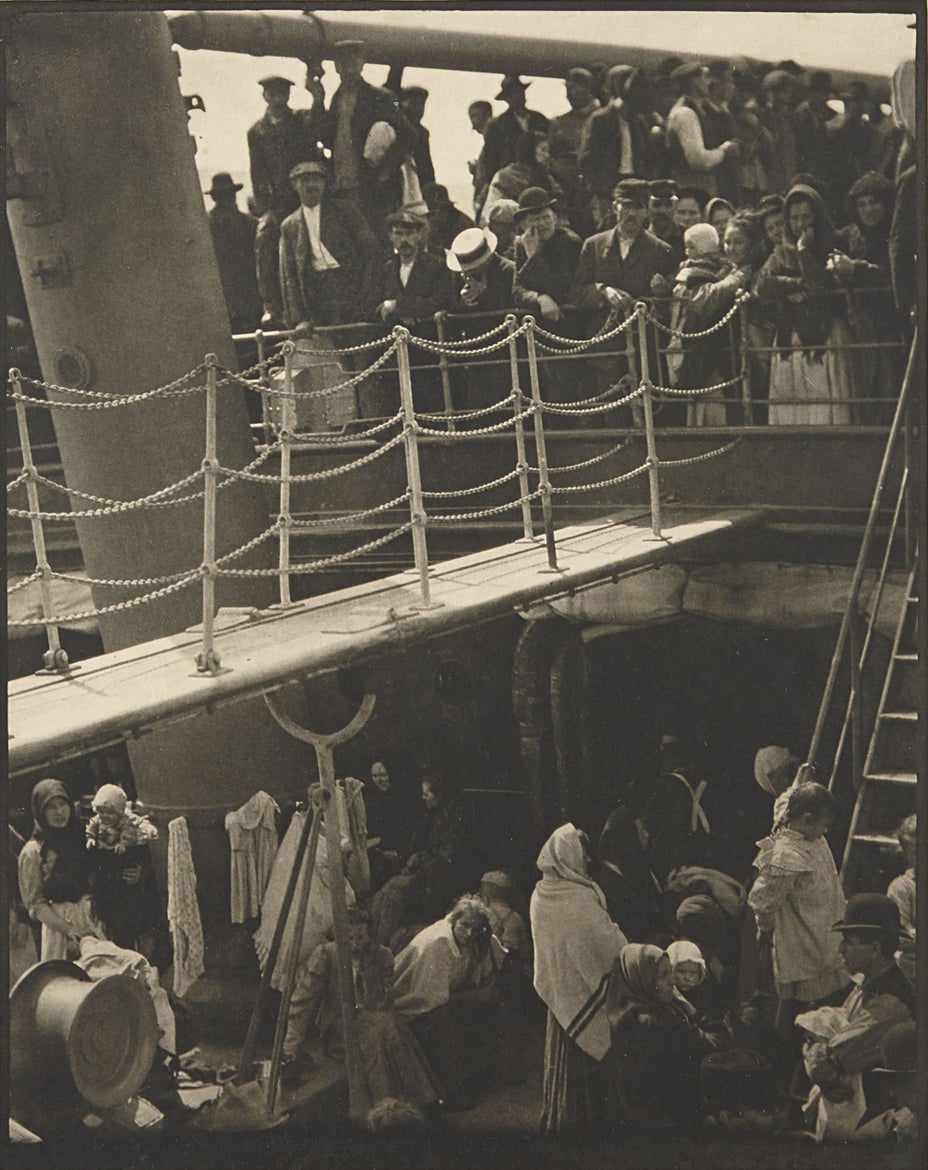
The Steerage
估價
$70,000–90,000
1907
Large format photogravure on Japanese tissue, printed 1915-1916.
13 1/8 x 10 3/8 in. (33.3 x 26.4 cm)
Signed, titled and dated in pencil on the overmat; printed credit, title and medium on a Brooklyn Institute of Arts & Sciences collection label affixed to the reverse of the mount.
完整圖錄內容
Alfred Stieglitz’s The Steerage, taken in 1907, stands at a major professional crossroad whose outcome had a deep impact on the artist. As the patriarch of American Photography at the turn of the last century, Stieglitz had initially extolled the tenets of Pictorialism, the art movement that championed the simulation of painterly effects in photography. As a result, many of the photographs taken by the leading photographers at the time, from Edward Steichen to Gertrude Käsebier, were marked by gentle lighting, soft lenses, and deeply atmospheric staged compositions that were strongly Impressionistic. The Steerage, however, became Stieglitz’s fulcrum pivoting away from Pictorialism.
Taken during a trip to Europe with his wife, Stieglitz captured the un-staged scene as he wondered away from the posh, cushy folds of First Class and meandered into the steerage. “I saw shapes related to each other,” Stieglitz later remembered. Accordingly, the image is Modernist in its composition: a strong diagonal line slices through the frame, causing a jarring bifurcation of the scenes unfolding. Also gone is the central focal point that typified most Pictorialist photographs. The Steerage is marked by the formerly-repudiated lynchpins of photography: clarity, linearity and tonality. After revisiting the image a number of years following the negative date, Stieglitz reproduced the image on a number of occasions and lauded its significance as his first Modernist masterpiece.
Taken during a trip to Europe with his wife, Stieglitz captured the un-staged scene as he wondered away from the posh, cushy folds of First Class and meandered into the steerage. “I saw shapes related to each other,” Stieglitz later remembered. Accordingly, the image is Modernist in its composition: a strong diagonal line slices through the frame, causing a jarring bifurcation of the scenes unfolding. Also gone is the central focal point that typified most Pictorialist photographs. The Steerage is marked by the formerly-repudiated lynchpins of photography: clarity, linearity and tonality. After revisiting the image a number of years following the negative date, Stieglitz reproduced the image on a number of occasions and lauded its significance as his first Modernist masterpiece.