Property from a Private East Coast Collection
18
約瑟夫.奧夫曼
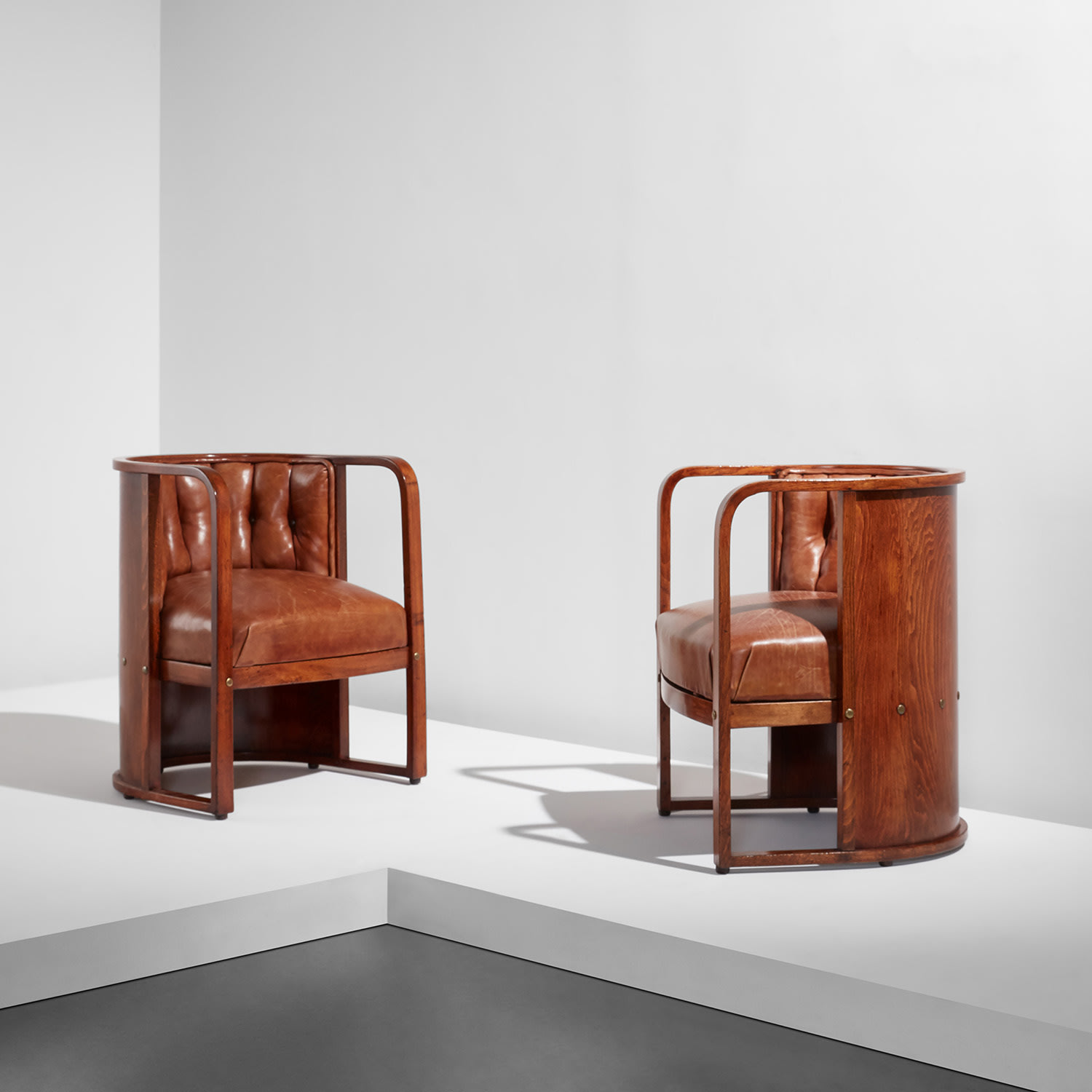
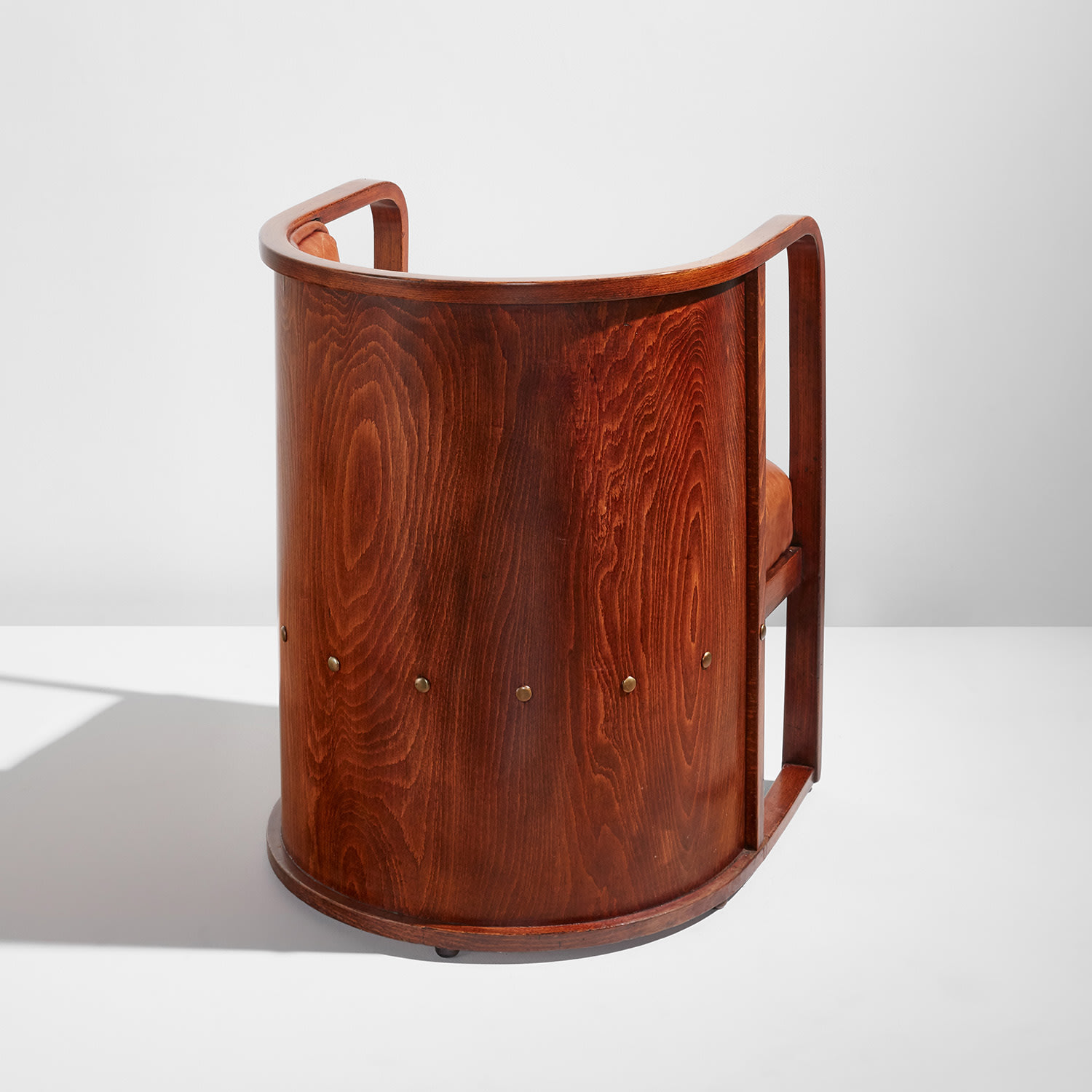
Pair of armchairs, model no. 421
估價
$6,000 - 8,000
成交價
$9,450
拍品詳情
circa 1907
Beech, beech-veneered wood, brass, leather upholstery.
Each: 28 x 21 3/4 x 21 1/2 in. (71.1 x 55.2 x 54.6 cm)
Produced by Jacob & Josef Kohn, Vienna, Austria. Underside of each with firm's paper label.
專家
完整圖錄內容
圖錄文章
Phillips would like to thank Dr. Christian Witt-Dörring for his assistance cataloguing the present lot.
A founder of the Wiener Werkstätte, Josef Hoffmann foregrounded the integrity of good, rational design as one of the most critical principles of the collective. Born out of the pioneering Vienna Secession group, the Werkstätte, established in 1903, united applied artists to produce quality works of craftsmanship, in disciplines as varied as furniture, jewelry, stationery and textiles. Early works by the collective tended toward the stylized floral motifs of contemporaneous Jugendstil architecture, itself a stylized interpretation of the French Art Nouveau movement. Hoffmann rationalized the organic contours of Art Nouveau into geometric configurations and patterns, which would become a defining characteristic of Wiener Werkstätte production.
The present model of Hoffmann’s armchairs exemplifies his celebration of form. A template he returned to frequently, the barrel armchairs curve around their sitter, achieving a streamlined and compact effect. While the curvilinear form introduces a geometric fluidity without relying on the fanciful profiles of Art Nouveau, the leather upholstery promises comfort in its gentle sumptuousness. Widely employed in public commissions and private residences alike, a version of the barrel armchair furnished the famed Cabaret Fledermaus in Vienna.
A founder of the Wiener Werkstätte, Josef Hoffmann foregrounded the integrity of good, rational design as one of the most critical principles of the collective. Born out of the pioneering Vienna Secession group, the Werkstätte, established in 1903, united applied artists to produce quality works of craftsmanship, in disciplines as varied as furniture, jewelry, stationery and textiles. Early works by the collective tended toward the stylized floral motifs of contemporaneous Jugendstil architecture, itself a stylized interpretation of the French Art Nouveau movement. Hoffmann rationalized the organic contours of Art Nouveau into geometric configurations and patterns, which would become a defining characteristic of Wiener Werkstätte production.
The present model of Hoffmann’s armchairs exemplifies his celebration of form. A template he returned to frequently, the barrel armchairs curve around their sitter, achieving a streamlined and compact effect. While the curvilinear form introduces a geometric fluidity without relying on the fanciful profiles of Art Nouveau, the leather upholstery promises comfort in its gentle sumptuousness. Widely employed in public commissions and private residences alike, a version of the barrel armchair furnished the famed Cabaret Fledermaus in Vienna.
文學