16
米娜.申德爾
Untitled
完整圖錄內容
Schendel repeatedly uses a series of leitmotifs — letters, geometric figures, phrases and images — in different mediums throughout her work, which together reflect an innovative visual lexicon. Entertaining a preference for unusual materials such as rice paper, fabrics and aqueous inks, she produced works of art with breathtaking delicacy. These artistic tools and careful methodology create an aesthetic unity in her oeuvre that reflects a freedom whereby the artist explored many different paths in order to achieve her creative goals.
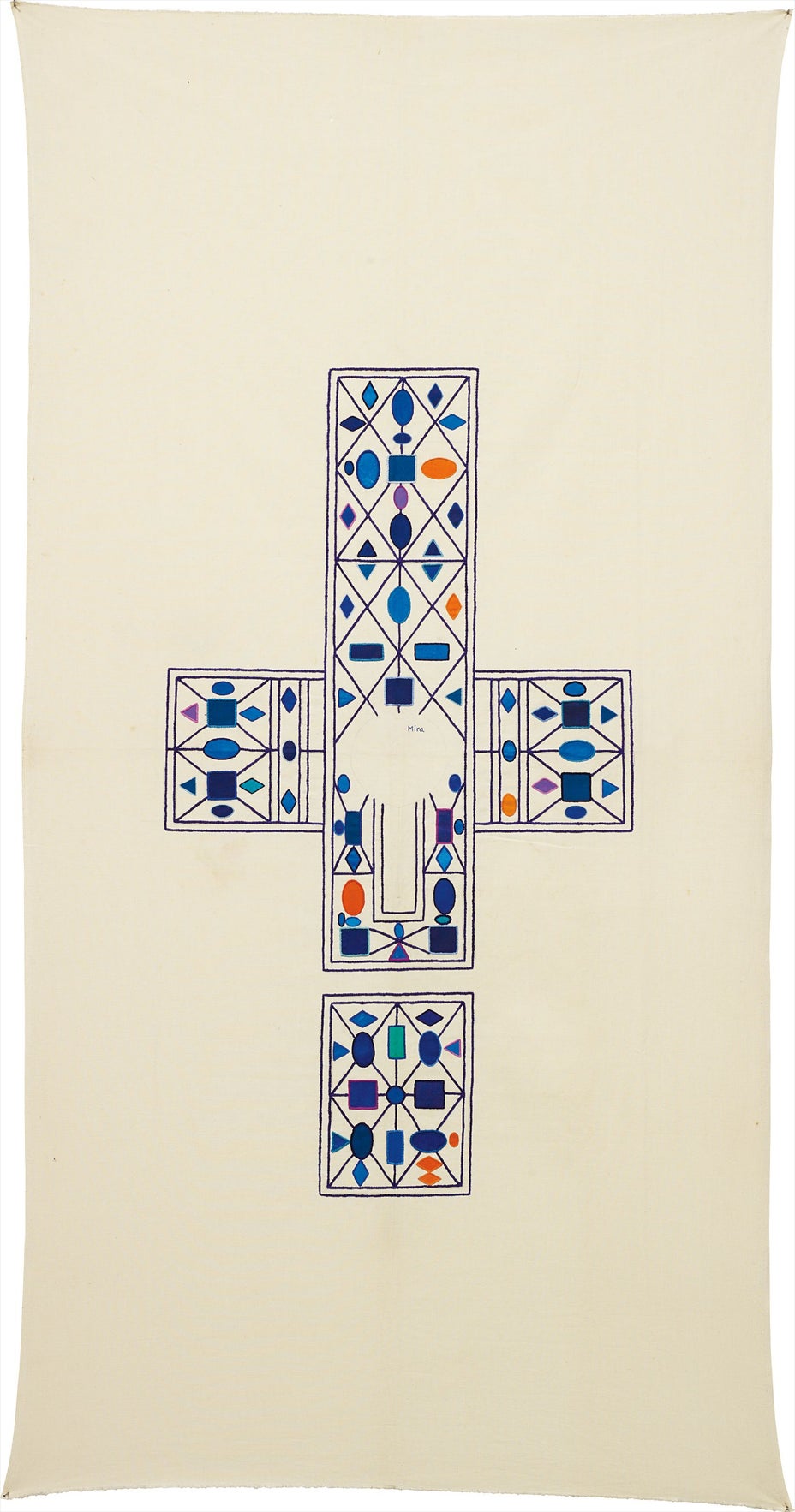
During the 1970s Schendel deepened her study of spirituality and philosophy, and she incorporated more vibrant colors into her previously largely monochromatic palette. This shift is reflected in the present lot, where Schendel utilized the technique of embroidery with brightly colored thread and pigments to create geometrical forms that together form the shape of a cross or a cathedral navel. Schendel left behind an exquisite legacy that goes beyond the materiality of making art, allowing us to understand the relationship between language, time and human thought processes.
米娜.申德爾
Brazilian | B. 1919 D. 1988Born in Zurich and of Jewish heritage, Mira Schendel escaped Switzerland during World War II to settle in Sarajevo and Rome, finally immigrating to Brazil in 1953. In the 1960s, she began to produce her iconic monotipas, delicate drawings on luminescent rice paper. She rejected the notion of painting as a primary medium, abandoning the genre in the 1970s for almost a decade. Schendel worked mostly with paper and objects made of unusual materials such as Plexiglas, fabrics and aqueous inks.
Recurring themes in her work include letters, geometric figures and phrases reflecting a radical lexicon, often juxtaposing elements from two languages (visual and numerical). Many of her works hover in the space between drawing and writing, creating a certain visual poetry that is completely her own. Schendel's works go beyond the materiality of making art and allow viewers to understand the relationship between language, time and human thought processes.