242
理查德.阿維頓
The Beatles
完整圖錄內容
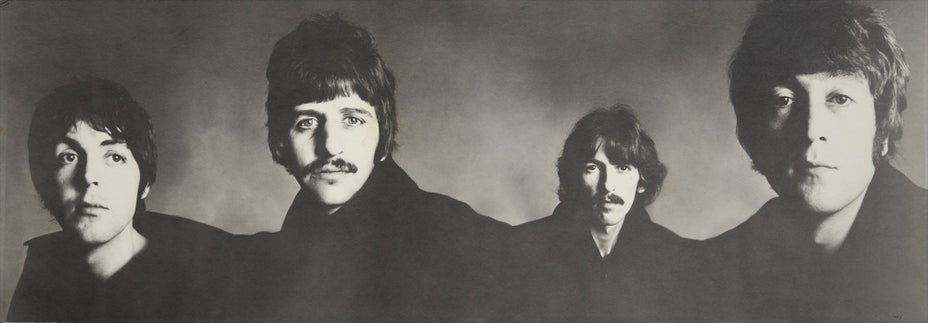
Avedon chose to individually photograph the famed musicians against a gray background as opposed to his more heavily utilized white seamless. “A gray background does seem to refer to something… a sky, a wall, some atmosphere of comfort and reassurance – that a white background doesn’t permit. With the tonal background, you’re allowed the romance of a face coming out of the dark.” By using the gray background, which he also selected for portraits of Marilyn Monroe and Andy Warhol, Avedon gives the viewer an even more intimate reading of the portrait, with sharp focus on the expression of faces which were familiar on a global scale.
Moreover, the use of the consistent background allowed Avedon to later join the individual pictures into a single composite image that presented the Beatles as a seamless unit, side by side, shoulders connected. It is this impressive product of post-production that we see here in the present lot. The pictures from the LOOK sitting are thus as much a testament to the inspired, innovative and exciting sound of the Beatles as they are to Avedon and his studio’s mastery in the darkroom. While the January 9, 1968 cover of LOOK featured a psychedelic John Lennon in full, vibrant color, the composite group image was highlighted in a special pullout portfolio that showcased Avedon’s creative approach.
The print on offer is believed to be the earliest gelatin silver, composite print of the Beatles in existence. It was gifted from Richard Avedon to Nat Weiss, the Beatles’ lawyer, merchandising manager in the United States, and early promoter of their music. Weiss’ ties to the band were strengthened by his close friendship with Brian Epstein, legendary Beatles manager who is credited with the early discovery of the band. Further, it was Epstein’s company, NEMS Enterprises that owned the rights to the poster version of the present lot, which was available for purchase through LOOK in the United States, The Daily Express Newspaper in England and Stern throughout Europe.
This image is exceptionally rare to the market in this format and its unique provenance beautifully ties together the photographer and his subject.
理查德.阿維頓
American | B. 1923 D. 2004From the inception of Richard Avedon's career, first at Harper's Bazaar and later at Vogue, Avedon challenged the norms for editorial photography. His fashion work gained recognition for its seemingly effortless and bursting energy, while his portraits were celebrated for their succinct eloquence. "I am always stimulated by people," Avedon has said, "almost never by ideas."
Indeed, as seen in his portraits — whether of famed movie stars or everyday people — the challenge for Avedon was conveying the essence of his subjects. His iconic images were usually taken on an 8 x 10 inch camera in his studio with a plain white background and strobe lighting, creating his signature minimalist style. Avedon viewed the making and production of photographs as a performance similar to literature and drama, creating portraits that are simultaneously intensely clear, yet deeply mysterious.