3
理察·阿維頓
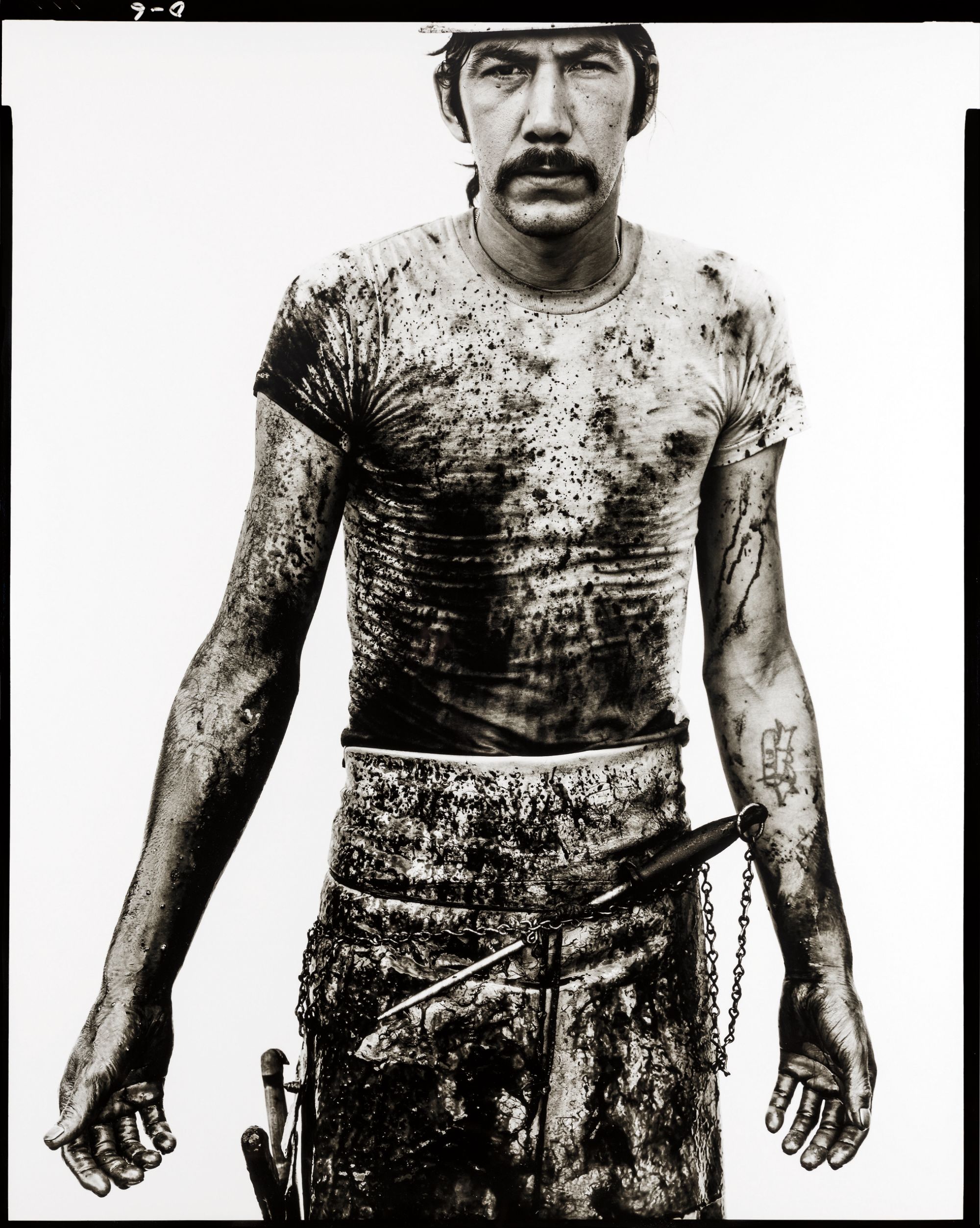
Blue Cloud Wright, slaughterhouse worker, Omaha, Nebraska, August 10, 1979
Frame: 156.1 x 124.4 cm (61 1/2 x 48 7/8 in.)
完整圖錄內容
Over the course of five years, Avedon and his team travelled from the Rockies, to south of the Mexican border, to the Great Plains and the Sierra Nevada. They visited 17 states and 189 towns, used 17,000 sheets of film and photographed 752 people, resulting in 123 portraits. In her 2003 memoir Avedon at Work, Laura Wilson describes how ‘right from the start, he [Avedon] chose men and women who worked at hard, uncelebrated jobs, people whose lives were often ignored or overlooked’. And these portraits, she argues, ‘reflect Avedon’s single-minded pursuit of his own vision, his exploration of the human condition, its ambiguity and desperateness.’
Avedon would pose the subjects in front of a large sheet of white paper hung against a wall or a trailer. He would operate the shutter remotely, standing beside his 8x10 view camera and maintaining eye contact with his subjects in order to create a more intimate atmosphere. Avedon describes, ‘there is nothing between us except what happens as we observe one another during the making of the portrait.’ Wilson remembers how Avedon would find the story and emotion in someone that no one else noticed.
Throughout their travels, Richard Avedon and his team visited various oil fields, underground mines, farms and construction sites. According to Wilson, however gruelling those places were, ‘the work in the slaughterhouse was the most exhausting and unrelieved. The odor is sickening, and the noise never lets up.’ The present lot Blue Cloud Wright, 1979, was taken in the first year of the project in Omaha, Nebraska at a slaughterhouse. Rendered in black and white, the photograph does not lend itself to an immediate reading of the harsh working conditions described by Wilson; we are distanced from the reality of the subject’s blood-drenched shirt and the blood trickling down his arms, which he holds away from his sides.
By presenting the subject in isolation against a white backdrop, Avedon transforms a slaughterhouse worker from Omaha, Nebraska into a symbolic figure. Of his white backgrounds, he explains, ‘I think we live in a kind of a void; that there is nothing before and there is nothing after. And the white for me represents that void. It makes people symbolic of themselves. You see only what’s written on their faces.’ Contrary to the brutality of the subject’s occupation, Avedon’s portrait of Blue Cloud Wright embodies a certain stillness and its monumentality is further enhanced in this larger than life-size print.
理察·阿維頓
American | B. 1923 D. 2004From the inception of Richard Avedon's career, first at Harper's Bazaar and later at Vogue, Avedon challenged the norms for editorial photography. His fashion work gained recognition for its seemingly effortless and bursting energy, while his portraits were celebrated for their succinct eloquence. "I am always stimulated by people," Avedon has said, "almost never by ideas."
Indeed, as seen in his portraits — whether of famed movie stars or everyday people — the challenge for Avedon was conveying the essence of his subjects. His iconic images were usually taken on an 8 x 10 inch camera in his studio with a plain white background and strobe lighting, creating his signature minimalist style. Avedon viewed the making and production of photographs as a performance similar to literature and drama, creating portraits that are simultaneously intensely clear, yet deeply mysterious.