36
理察.普林斯
Eden Rock (oil rig and cowboy)
完整圖錄內容
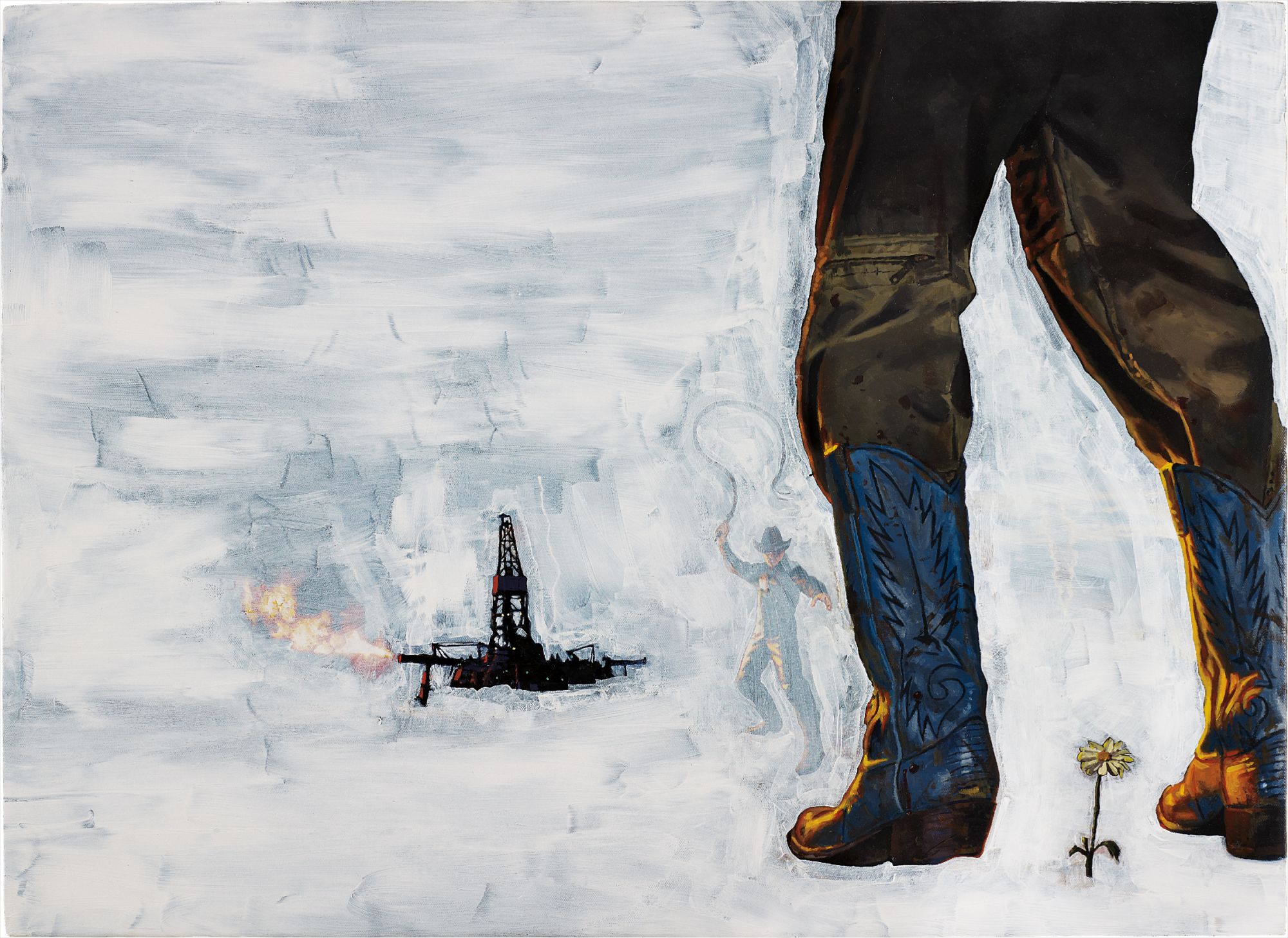
Playing with perception, the viewer’s perspective begins directly behind a pair of anonymous legs, clothed in military fatigues and worn leather cowboy boots. As the figure in the foreground stands in alignment with the oil rig, his blurred counterpart, another anonymous cowboy in full regalia, brandishes his whip while all but vanishing under a veil of expressive white brushstrokes. This broad treatment of the composition creates a sense of desolation, enveloping all but one natural element. While alluding to his Cowboys series, Eden Rock (oil rig and cowboy), 2006, simultaneously underscores a contemporary version of the hyper-masculine figure through the combination of spaghetti western and Die Hard-esque mise-en-scene. Unlike Prince’s Nurses, Cowboys, and Girlfriends, whose full figures and faces fill their respective compositions, the works of Eden Rock are void of the figure’s identity, allowing the viewer to project themselves into the dramatic tableaux.
理察.普林斯
American | 1947For more than three decades, Prince's universally celebrated practice has pursued the subversive strategy of appropriating commonplace imagery and themes – such as photographs of quintessential Western cowboys and "biker chicks," the front covers of nurse romance novellas, and jokes and cartoons – to deconstruct singular notions of authorship, authenticity and identity.
Starting his career as a member of the Pictures Generation in the 1970s alongside such contemporaries as Cindy Sherman, Robert Longo and Sherrie Levine, Prince is widely acknowledged as having expanded the accepted parameters of art-making with his so-called "re-photography" technique – a revolutionary appropriation strategy of photographing pre-existing images from magazine ads and presenting them as his own. Prince's practice of appropriating familiar subject matter exposes the inner mechanics of desire and power pervading the media and our cultural consciousness at large, particularly as they relate to identity and gender constructs.