19Ο︎
Richard Prince
Mystery Nurse
完整圖錄內容
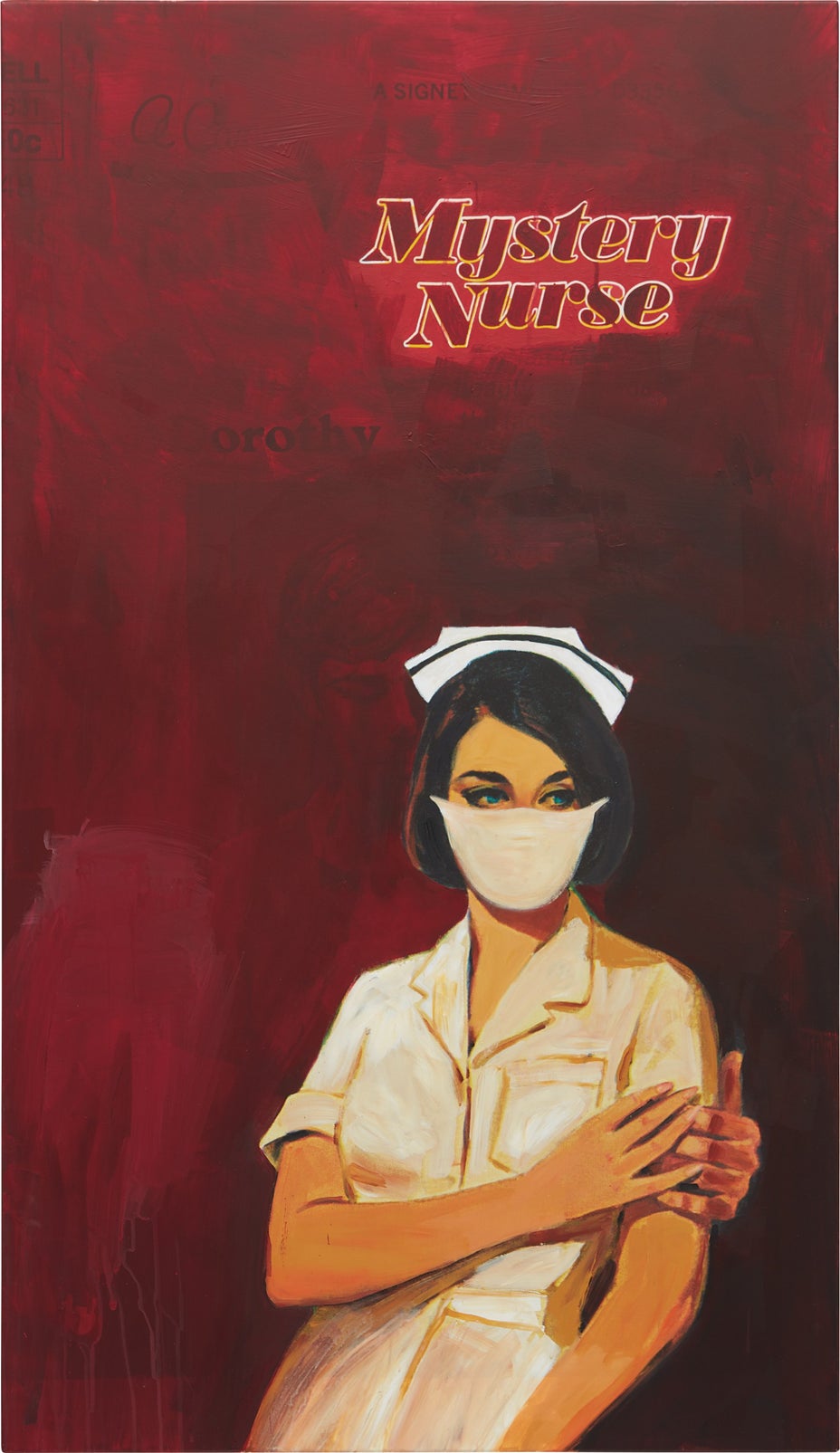
Paintings such as Mystery Nurse are the result of Prince’s "re-photography“ technique, which is widely acknowledged as having expanded the accepted parameters of artmaking when he first innovated this revolutionary appropriation strategy of photographing pre-existing images from magazine ads and presenting them as his own in the late 1970s. Since his early career as a member of the Pictures Generation, coming to artistic maturity alongside artists such as Cindy Sherman and Sherrie Levine, Prince has continued to interrogate the ways in which gender, sexuality and identity are framed by the media and our cultural consciousness at large. An avid bibliophile, Prince found the source material for the Nurse paintings in his personal collection of vintage nurse-romance novels. Published in the 1950s and 1960s, these affordable, small and portable softback publications featured melodramatic and hackneyed narratives of professional woman cast as sexualized and fetishized objects of desire – taking on the role of Good Samaritan, but also victim, villain and seductress. Just as Prince took images of cowboys or “biker chicks” in his earlier work as a point of departure, the viewer here is similarly presented with what Rosetta Brooks has described as visually commonplace imagery: “we’ve seen them before, and even if we haven’t, it doesn’t take us very long to digest them.” This is crucial for Prince’s project, as, “a constant in Prince's early experiments in rephotography is showing others the quality of the images he finds so tantalizing. Prince chooses to represent these images because he himself is seduced by them” (Roberta Brooks, “A Prince of Light or Darkness?”, in Richard Prince, London and New York, 2003, p. 28).
Mystery Nurse is testament to the complex process of appropriation and manipulation that Prince pioneered with his Nurse paintings in 2002. Rather than photographing a pre-existing image as before, here he digitally scans, enlarges and transfers the romance novella front covers onto canvas with an inkjet printer. In the present work, Prince combines the covers of two pulp fiction novellas to construct an image that is as seductive as it is sinister. Taking the front cover of Diana Douglas’ 1968 novella and its dramatic plot line “A titian-haired beauty must hide the fact that she is a nurse - or lose the man she loves and have a death to answer for!” as a thematic point of departure, Prince replaces the frightened titian-haired beauty of the aforementioned novel with the dark-haired heroine from Dorothy Worley’s 1970 novella The High Road. The front cover of the latter romance novel depicts the nurse in the arms of a doctor, lost deep in thought, while her other doctor suitor looks on from afar. Actively embracing the painterly gesture in earnest for the first time in his career with this series, Prince notably adds another layer of complexity by painting over select areas of the print. While the chiaroscuro and color palette found in Mystery Nurse evokes such Old Masters as Rembrandt, paintings such as the present one deliberately play with the language of Abstract Expressionism. In doing so, Prince inadvertently plays into the machismo stereotype of the American painter as embodied by the “masculine” domain of Abstract Expressionism and even invoked by the artist himself. The chromatic sublime of Mark Rothko forms an unlikely union with the subject matter of Willem de Kooning’s jarring Women from the late 1940s and early 1950s, the latter of which Prince has specifically acknowledged as a crucial influence on his practice. Just like de Kooning drew upon an amalgam of female archetypes, including contemporary pin-up girls, to reflect on the ambivalence between admiration for, and fear of, the power of the feminine, Prince here explores the complex socio-sexual stereotypes embodied by the figure of the female nurse in an image that oscillates between beauty and horror.
Mystery Nurse demonstrates the virtuosity with which Prince achieves the subversive union between low-brow sensationalism and the high-brow language of painting to convey a deeply personal artistic vision. By isolating the figure of the nurse and re-casting her within an ominous setting of hide-and-seek, Prince has created a complex psychological portrait that continues his career-long pursuit of exploring concepts of masking and unmasking, revelation and concealment, identity and anonymity. While playing on various gender stereotypes and how they are embedded in our social psyche – as embodied by the nurse figure, the artist or even the viewer – Prince ultimately deconstructs singular notions of authorship, authenticity and identity. Saturated with suggestion and anxiety in a manner that recalls Edward Hopper’s paintings of solitary women or David Lynch’s surrealist dream sequences, this charged painting articulates what curator Nancy Spector has described as “a state of mind, in which fiction shapes reality, travesty reveals essential truths, and beauty resides in the tawdry and illicit” (Nancy Spector, Richard Prince, London and New York, 2003, p. 15). While Prince’s art can be understood as an attempt to come to terms with questions of gender and identity, it is perhaps above all driven by a more existential probing of that very “void that lies at the heart of our spiritual America, a psychic state and dystopic place” (Nancy Spector, Richard Prince, London and New York, 2003, p. 53). Inviting us to view anew the pervasive cultural narratives that surround us, Mystery Nurse asserts itself as a timeless painting whose relevance perseveres in our current socio-cultural landscape and is the example of an artist at his absolute finest.
Richard Prince
American | 1947For more than three decades, Prince's universally celebrated practice has pursued the subversive strategy of appropriating commonplace imagery and themes – such as photographs of quintessential Western cowboys and "biker chicks," the front covers of nurse romance novellas, and jokes and cartoons – to deconstruct singular notions of authorship, authenticity and identity.
Starting his career as a member of the Pictures Generation in the 1970s alongside such contemporaries as Cindy Sherman, Robert Longo and Sherrie Levine, Prince is widely acknowledged as having expanded the accepted parameters of art-making with his so-called "re-photography" technique – a revolutionary appropriation strategy of photographing pre-existing images from magazine ads and presenting them as his own. Prince's practice of appropriating familiar subject matter exposes the inner mechanics of desire and power pervading the media and our cultural consciousness at large, particularly as they relate to identity and gender constructs.