164
中島勝壽
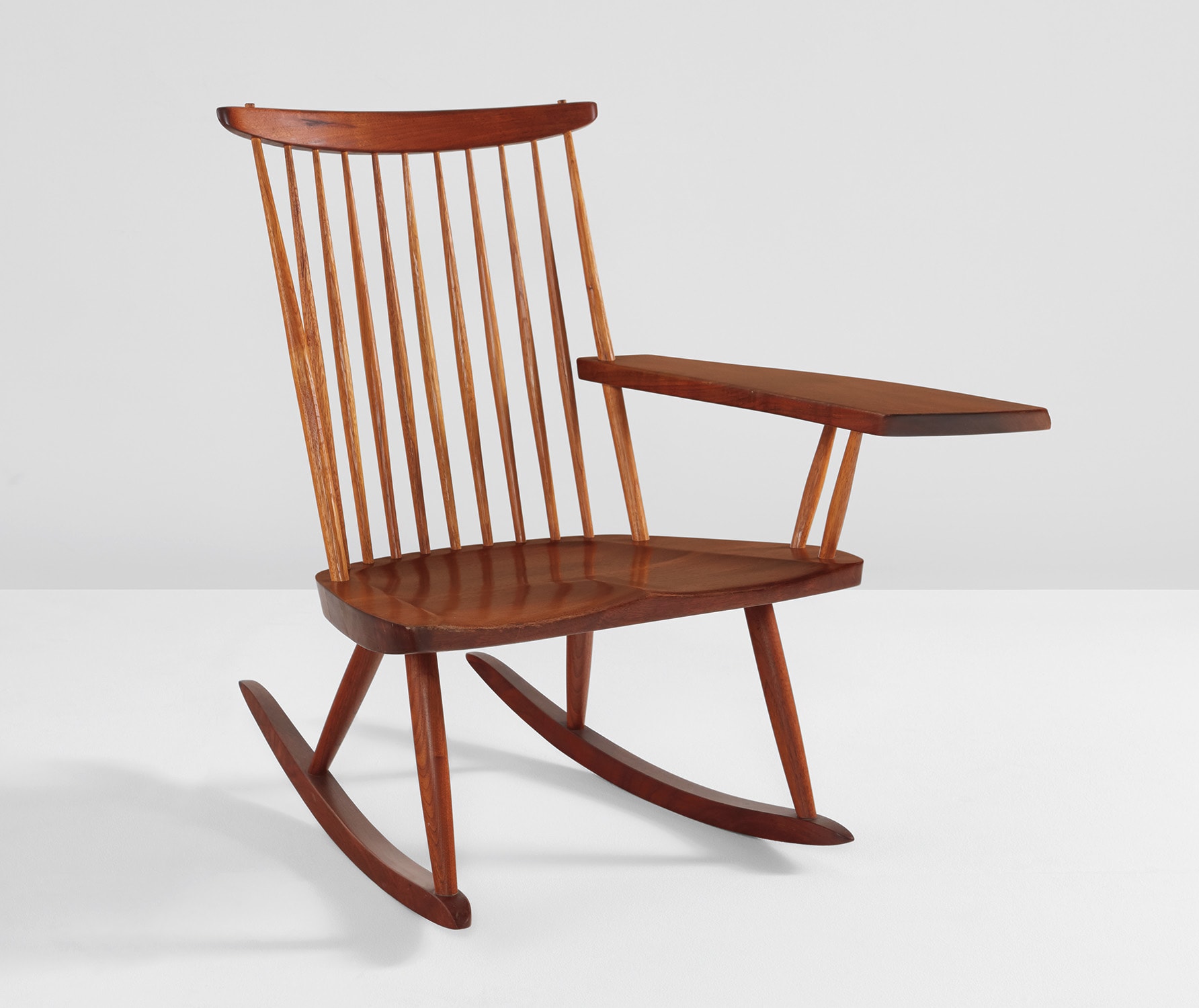
《單臂摇椅》
款識:Schiller/Rocker (底部)
完整圖錄內容
中島勝壽
American | B. 1905 D. 1990Working out of his compound in rural New Hope, Pennsylvania, George Nakashima produced some of the most original and influential furniture designs of the post-war era. Nakashima aimed to give trees a second life, choosing solid wood over veneers and designing his furniture to highlight the inherent beauty of the wood, such as the form and grain. To this end, his tables often feature freeform edges, natural fissures and knot holes. Nakashima was an MIT-trained architect and traveled widely in his youth, gaining exposure to modernist design the world over.
The signature style he developed was the distillation of extraordinary, diverse experiences, which led to the establishment of his furniture-making business in 1946. In particular, his practice of Integral Yoga, which he studied while working under the architect Antonin Raymond on the construction of the Sri Aurobindo Ashram in Pondicherry, India, had a lasting impact on his philosophy as a designer.
After returning to the U.S. in 1940, Nakashima's family was interned in an American concentration camp, a horrible ordeal that nevertheless introduced him to traditional Japanese joinery by way of a Nisei woodworker he met in the camp. He incorporated these techniques and also drew on American vernacular forms, such as the Windsor chair. These diverse influences have resulted in immense crossover appeal in the world of twentieth-century design collecting.