29
Mario Carreño
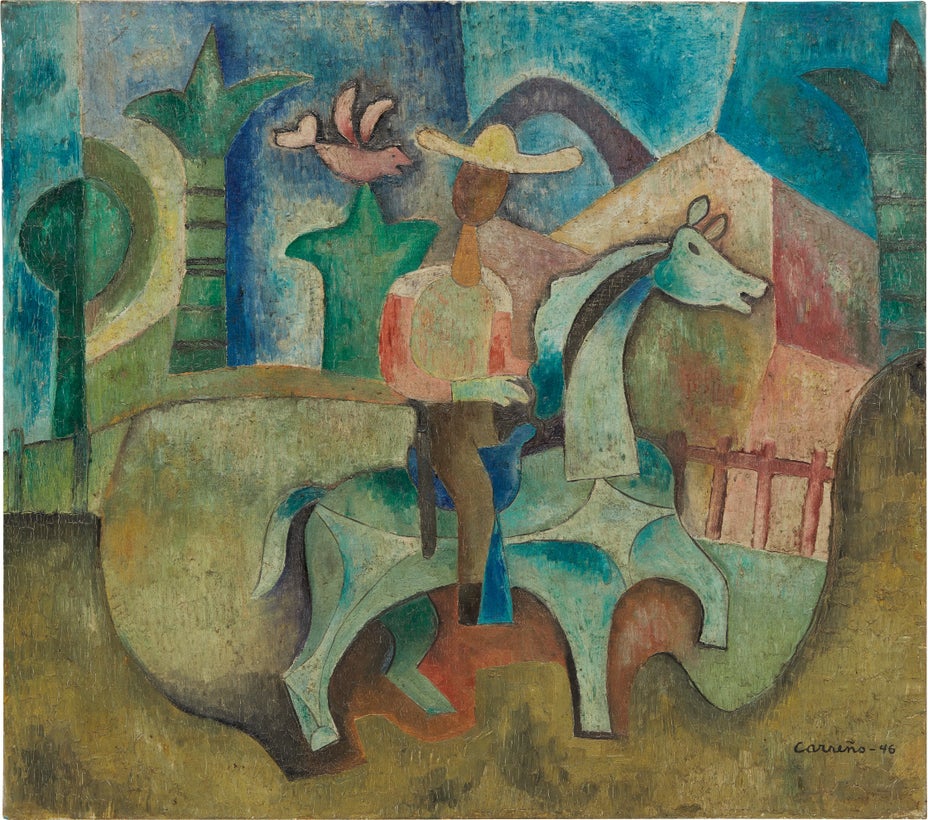
Guajiro a caballo
完整圖錄內容
The initial phase in Carreño’s oeuvre was informed by his studies in Mexico City in the mid‐1930s. He was interested in the work of the mural movement’s Los tres grandes: Diego Rivera, David Alfaro Siqueiros and José Clemente Orozco. Soon Carreño began incorporating duco into his paintings, often depicting socially conscious themes featuring guajiros (cane cutters). At the same time, he met the
Dominican painter Jaime Colson, who would influence his style greatly by showing him the technique of the Renaissance muralists used to model human figures in a sculptural manner. A prime example of this period is the present lot in which Carreño depicts the classic figure of the cane cutter, surrounded by typical tropical foliage, escaping a fire on a horse in a sugar mill town. In this way Carreño epitomizes a nationalist sentiment, embodying a Cuban agrarian nation. During the mid‐1940s, Carreño moved to New York where he was in contact with Piet Mondrian, Jackson Pollock and László Moholy‐Nagy, all of whom would spark his interest in abstraction.
The present lot best exemplifies a transitional moment between Carreño’s Vanguardia works into a period dedicated to abstraction. The subject matter of the guajiro continues to evoke Carreño’s nationalist sentiment; however, both the figure and landscape are more schematic and simplified than his earlier works, as Carreño has introduced geometric shapes in his landscape, resulting in a more abstract composition. This composition also prefigures the grids of vertical lines he would later use in his Concrete works.
Mario Carreño
Cuban | B. 1913 D. 1999Throughout his career, Mario Carreño produced a large body of diverse work ranging in style from Neo-Classical Figuration to Abstraction, and he is widely recognized as a key figure in Modern Cuban art. Carreño spent his formative years abroad, visiting Mexico in 1935 and later traveling throughout Europe in the 1940s. While in Europe, Carreño drew great inspiration from such contemporary avant-garde styles as Expressionism, Cubism and Abstraction.
Like Amelia Peláez, Carlos Enrique and other second-generation Vanguardia artists, Carreño aimed to incorporate European Modernist style into his oeuvre while developing a nationalist visual lexicon. His seminal works from the '40s, including Fuego en el Batey, Corte de Caña and Danza Afrocubana are brilliantly colored Duco works that each represent an essential element of Cuban identity.