36
Jean-Michel Basquiat
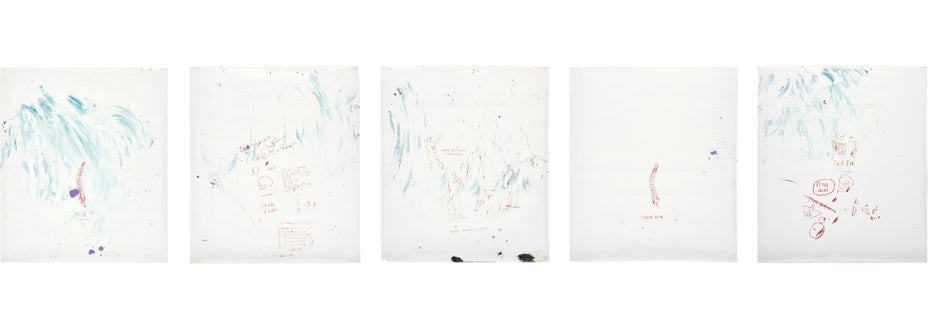
Untitled (From Leonardo)
完整圖錄內容
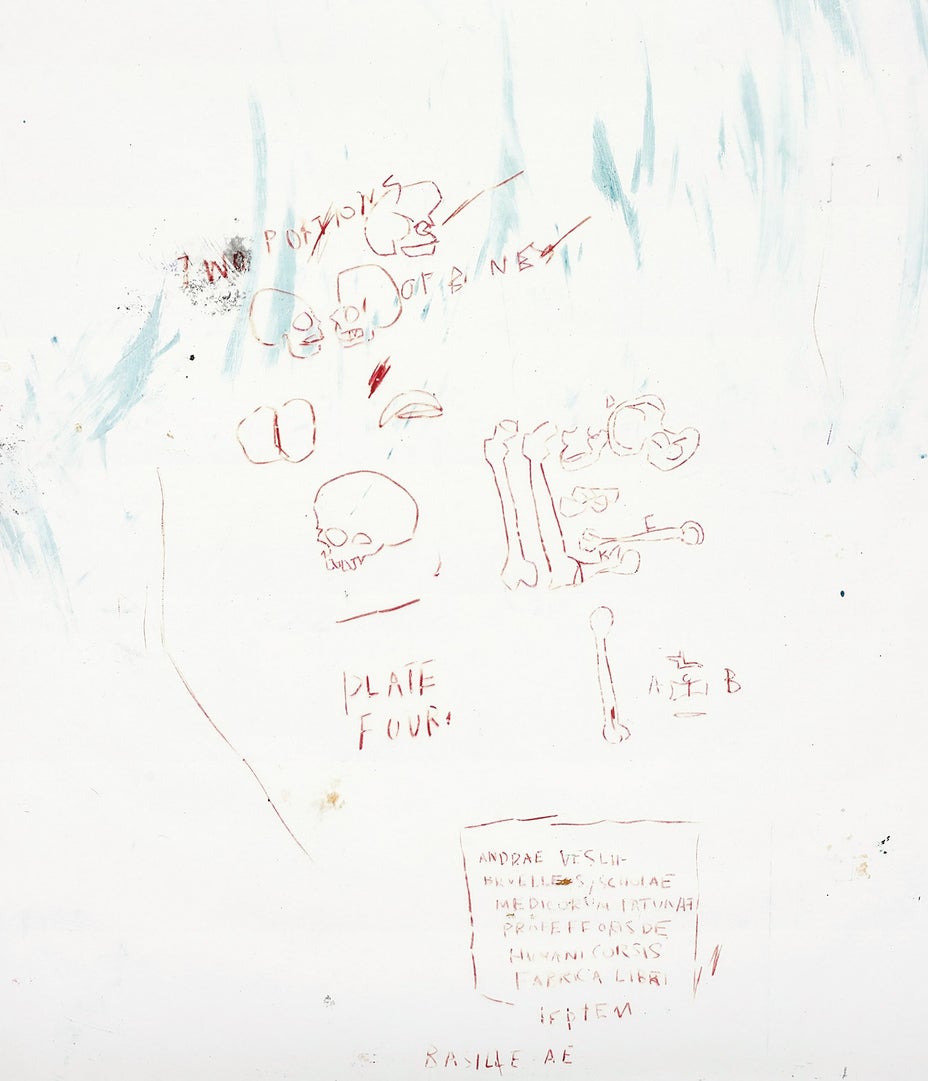
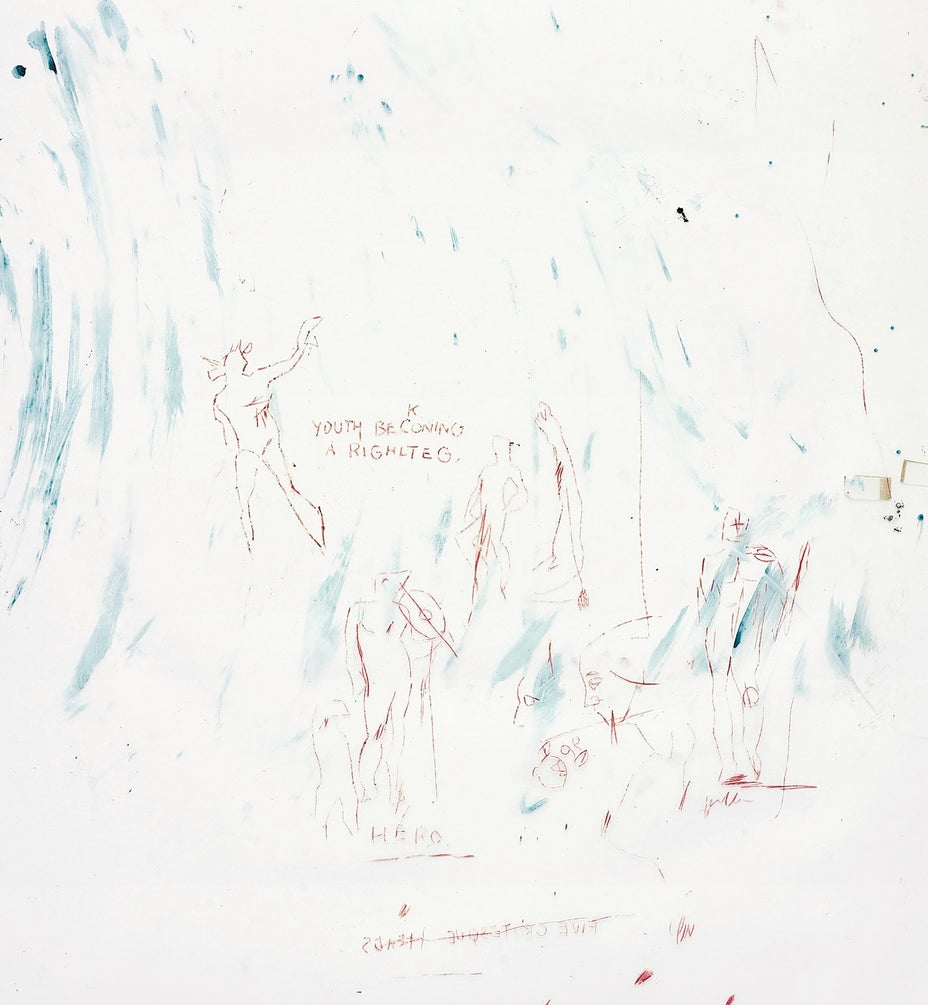
Untitled (From Leonardo) epitomises the artist’s career-long preoccupation with corporeality and bodily fragility, which was instigated by an accident that saw seven-year-old Basquiat struck by a car while playing in the street. His mother gifted him a copy of Gray’s Anatomy while he was convalescing, enabling him to better grasp the enigmatic intricacies of human anatomy and physical pain; according to Hoffman, it was thus no surprise that the agog and precocious painter was 'drawn to Leonardo da Vinci's investigative studies of the human being - from anatomical to physiological, from birth to death. In the work of Leonardo, Basquiat found a viable means of educating himself about human form and function'. Utilising both Leonardo’s sketches and texts as sources for physiological education, Basquiat furthermore 'identified a kindred spirit able to transform scientific truth into artistic vision. Leonardo's seemingly compulsive investigation of human anatomy and physiology would become a lifelong passion for Basquiat' (Fred Hoffman, 'From Leonardo', Jean-Michel Basquiat Drawing, exh. cat., Acquavella Galleries, New York, 2014, p. 124). Untitled (From Leonardo) is thus illustrative not only of corporeality as Basquiat’s signature idée fixe – the work is even complete with a misspelled epitaph for 16-century physician Andreas Vesalius on the first sheet – but also of his idiosyncratic aesthetic vernacular that was already well-employed by 1982.
Evocative of sheets from da Vinci’s notebooks, Untitled (From Leonardo) can be viewed through an iconographic lens in which each figure exists independently, embodying a symbolic – or perhaps hieroglyphic – presence that is similar to those of various disassociated sketches on a single page. Moreover, some of the drawings carry numerous connotations; for example, the skulls that pepper the present work simultaneously act as a nod to the rigorous diagrams of the Renaissance master and as a self-referential motif, pointing to the recurrent use of the momento mori symbol in his oeuvre, such as in Untitled, 1982, located in the Broad Museum, Los Angeles. In the first sheet as well, two skulls face each other, but the nature of what is portrayed – either a confrontational encounter between two men or simply two angles of an anatomical representation – is left unclear.
Despite the fractured nature of the present work, replete with severed spines and outlined bones, Untitled (From Leonardo) carries an ironic sense of totality. By vigorously crafting dismembered organs, Basquiat was, in essence, conceiving of how to physically reassemble himself. As art historian Olivier Berggruen has astutely noted, Basquiat’s anatomical works such as Untitled (From Leonardo) '[create] an aesthetic of the body as damaged, scarred, fragments, incomplete or torn apart, once the organic whole has disappeared. Paradoxically, it is the very act of creating these representations that conjures up a positive corporeal valence between the artist and his sense of self or identity. The creative act of representing a fragmented body probably helped Basquiat regain a temporary sense of wholeness' (Olivier Berggruen, 'The Prints of Jean-Michel Basquiat', Print Quarterly 26, no. 1, pp. 21-32).
Jean-Michel Basquiat
American | B. 1960 D. 1988One of the most famous American artists of all time, Jean-Michel Basquiat first gained notoriety as a subversive graffiti-artist and street poet in the late 1970s. Operating under the pseudonym SAMO, he emblazoned the abandoned walls of the city with his unique blend of enigmatic symbols, icons and aphorisms. A voracious autodidact, by 1980, at 22-years of age, Basquiat began to direct his extraordinary talent towards painting and drawing. His powerful works brilliantly captured the zeitgeist of the 1980s New York underground scene and catapulted Basquiat on a dizzying meteoric ascent to international stardom that would only be put to a halt by his untimely death in 1988.
Basquiat's iconoclastic oeuvre revolves around the human figure. Exploiting the creative potential of free association and past experience, he created deeply personal, often autobiographical, images by drawing liberally from such disparate fields as urban street culture, music, poetry, Christian iconography, African-American and Aztec cultural histories and a broad range of art historical sources.