223
Gerhard Richter
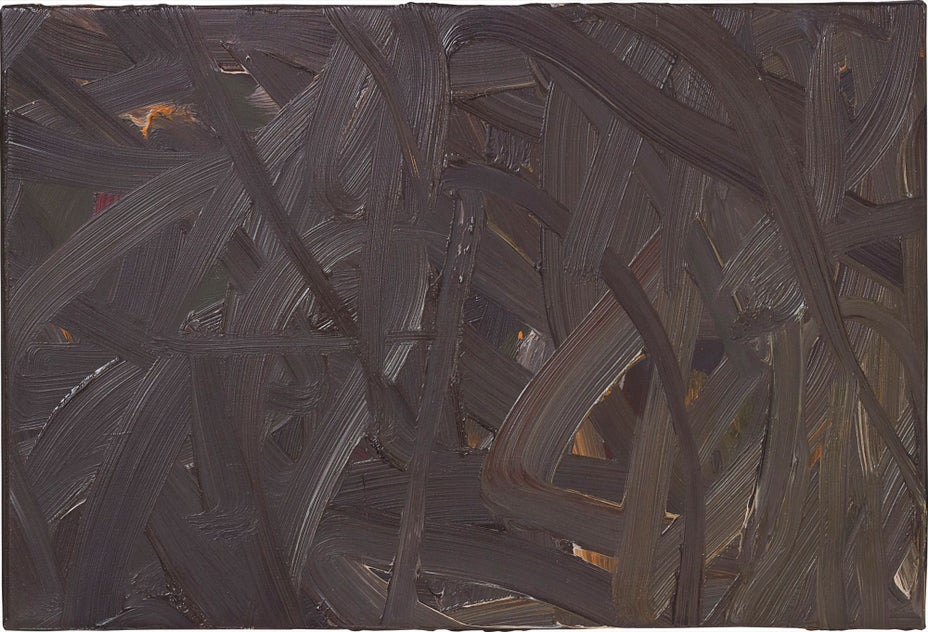
Vermalung (Braun)
完整圖錄內容
The “inpainting” of these works could refer to the manner in which Richter first may have painted a figurative work, but instead of the soft blurring abstraction of his earlier works, here he has literally “painted into” the figuration as to completely obstruct any recognition therein. Informed by his interest in Art Informel, a European abstract movement which abandoned and refuted the harder-edged geometric abstraction of Cubism in favor of a much freer, more intuitive style of painting, Richter has applied his paint in thick bands of impasto, sweeping and whirling across the canvas; however, and in opposition to many of his contemporaries, the works were not meant to be read as expressive. Similarly to other monochromatic abstractionists, such as Robert Ryman, these works were a way for Richter to investigate the nature of the paint and his gesture without a personal or expressive component. These Inpaintings solidified Richter’s belief in the power of abstraction and its ability to reflect an objectivity and immediacy through its textures, patterns, surfaces, colors, and application – qualities which he would most fully investigate in the celebrated Abstraktes Bilds.
Gerhard Richter
German | 1932Powerhouse painter Gerhard Richter has been a key player in defining the formal and ideological agenda for painting in contemporary art. His instantaneously recognizable canvases literally and figuratively blur the lines of representation and abstraction. Uninterested in classification, Richter skates between unorthodoxy and realism, much to the delight of institutions and the market alike.
Richter's color palette of potent hues is all substance and "no style," in the artist's own words. From career start in 1962, Richter developed both his photorealist and abstracted languages side-by-side, producing voraciously and evolving his artistic style in short intervals. Richter's illusory paintings find themselves on the walls of the world's most revered museums—for instance, London’s Tate Modern displays the Cage (1) – (6), 2006 paintings that were named after experimental composer John Cage and that inspired the balletic 'Rambert Event' hosted by Phillips Berkeley Square in 2016.