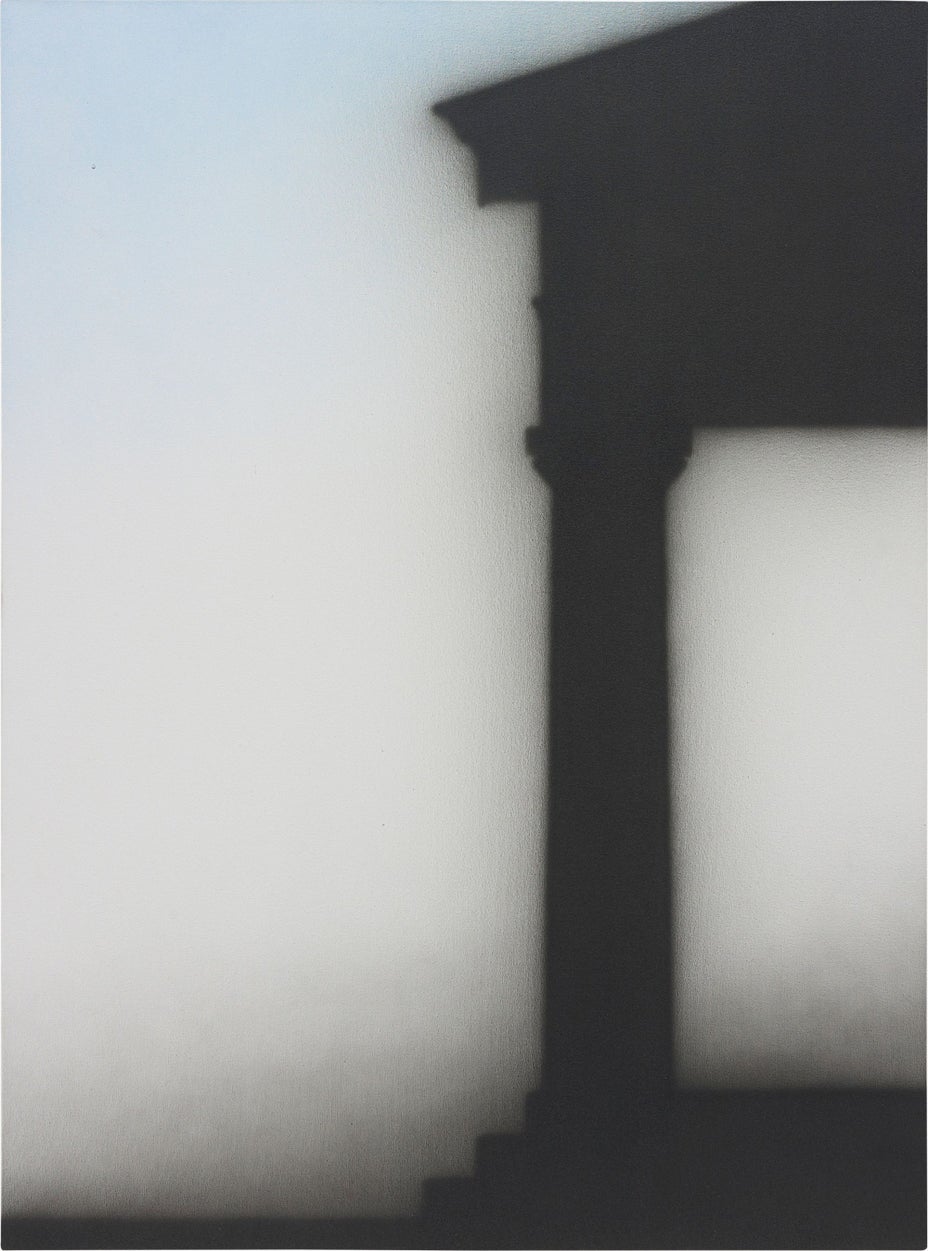
Executed in nuances of black, blue and white, Doric, Ed Ruscha’s dramatic 1996 painting, belongs to a recent body of work influenced by the secondary effects of light as well as the seminal Abstract Expressionist painter Franz Kline. Ruscha recalls having been in school and “thinking how great it was that this man [Kline] only worked with black and white.” (E. Ruscha quoted in R. D. Marshall, Ed Ruscha, New York, p. 210) Taking the monochromatic palette as his inspiration, Ruscha executed a number of works done only in these subdued but powerful tonalities. As opposed to the incredibly expressive brushiness of Kline’s paintings, however, Ruscha applies his own anti-painterly technique in order “to produce a fat, photographic finish.” As he stated, “The dark paintings came mostly from photography, although they are not photographically done or anything. I feel that they are related to the subject of photography. They are dark and strokeless. They’re painted with an airbrush.” (Ibid., p. 211) In this way, the blurred architectural photographs of the vaunted contemporary photographer Hiroshi Sugimoto come immediately to mind. Both elaborating and exalting in the beauty of negative space and the representation of ephemeral atmospherics, Doric, 1996, elucidates the particular, and peculiar, ability of painting to establish an alternative reality in the immediacy of its evanescence not readily established elsewhere. Leaving out his hallmark text, Doric, 1996, exudes visual allure and power through its stoic silence and serves as an important investigation of the artist’s parallel interests in the command of language and the seductive appeal of film throughout Ruscha’s oeuvre.