
Property of an Important European Collector
1
Pablo Picasso
La Minotauromachie
- Estimate
- £800,000 - 1,200,000‡♠
£975,000
Lot Details
Etching and engraving with scraper, on laid Montval paper with watermark, with full margins (deckle on all sides).
1935
I. 49.8 x 69.4 cm (19 5/8 x 27 3/8 in.)
S. 57.3 x 77.4 cm (22 1/2 x 30 1/2 in.)
Baer’s seventh (final) state, one of the 23 impressions from the artist’s estate, printed by Roger Lacourière, Paris, in original condition, framed.
Specialist
Full-Cataloguing
Catalogue Essay
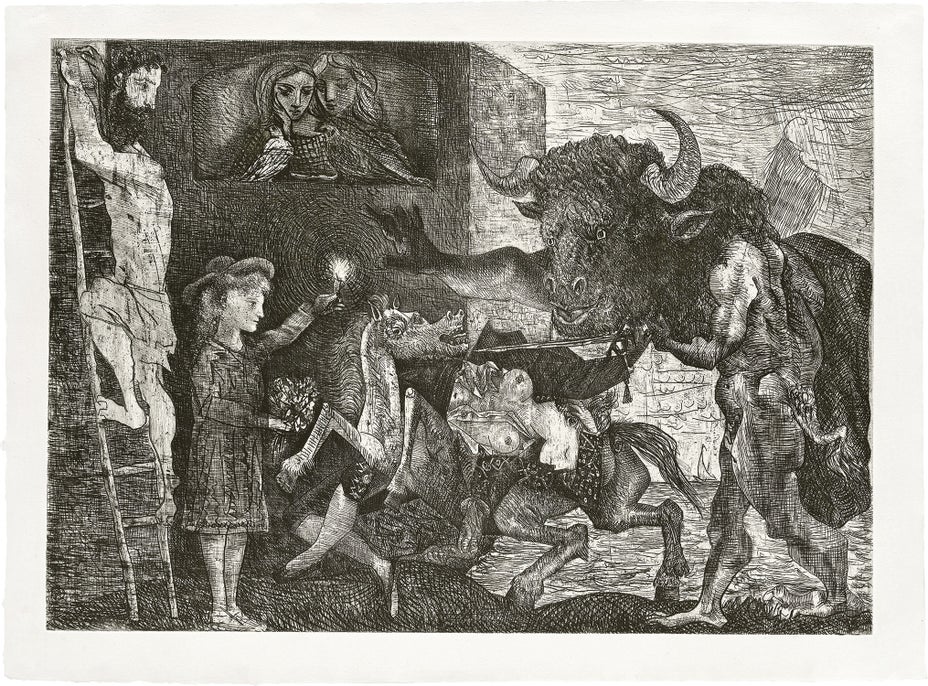
In the Parisian studio of master printer Roger Lacourière, Pablo Picasso began on March 23rd, 1935 to engrave a large copper plate. This plate became one of the most important graphic works of the 20th Century and the pinnacle of Picasso’s printmaking oeuvre: La Minotauromachie. Technically brilliant and visually complex, La Minotauromachie is an intimate and autobiographical allegory rife with personal symbolism. It has been understood as the illustration of a private ethical battle as well as a universal parable of good and evil, violence and innocence, suffering and salvation.
La Minotauromachie is the culmination of a near frenzied period of printmaking as Picasso was completing his most important group of etchings La Suite Vollard (1930-1937), comprising one hundred images. It also coincided with, or was perhaps determined by, a time of strife that the artist later described as “la pire époque de ma vie” (“the worst period of my life”). His wife, the Russian ballerina Olga Khokhlova was on the verge of leaving him after discovering that his much younger mistress, Marie-Thérèse Walter was pregnant. The significant turbulence in Picasso’s personal life was the backdrop to him working directly on plates and indulging in the physical act of complex, visceral mark-making that was driven by an urgent and cathartic need to create.
Through this lens of Picasso’s guilt and frustration with his personal life, the figure of the Minotaur grew. Triggered by a commission to provide a cover illustration for the newly launched Surrealist magazine Minotaure, Picasso’s alter-ego figure of the Minotaur appears throughout the etching series La Suite Vollard, which directly preceded La Minotauromachie. This motif represents the dark centre of man’s violent, irrational and lustful desires. A mythological beast that is at once the monster within, but also the fighting bull of Picasso’s native Spain, whose power, pride and ferocity corresponds with the artist’s own character.
In La Minotauromachie almost half of the printed image is dedicated to the towering figure of the Minotaur whose arm is flung forward, reaching towards a lit candle held aloft in the hand of a young girl who holds a bouquet of flowers in the other. Between their frozen confrontation, a mare horse and torera (female bullfighter) are paired together. The shrieking mare eyes the Minotaur in terror attempting to flee the danger he represents, but she is mortally wounded - her stomach has been gouged with her entrails flowing out. She exudes an abject fear that starkly contrasts with the serene countenance of the female bullfighter, resting placidly on the mare’s back with her breasts exposed. Her features, just as those of all four of the female figures in the print, are those of Marie-Thérèse and her stomach appears swollen with child. Three attendant figures observe the catastrophic scene below: two young women peering down as though from a theatre box, and a bearded Christ-like figure with the face of Picasso who escapes via a ladder, but is unable to resist looking over his shoulder.
According to legend, the Minotaur had the power to see where others could not, because his eyes were accustomed to the darkness of the labyrinth. This opposition between light and dark divides the composition of La Minotauromachie both formally and conceptually into two planes. The unbridled impulses shared by Picasso and the mythical Minotaur: desire, guilt and revenge, are sublimated before the supine figure of Marie-Thérèse who, in her pregnancy, literally embodies the consequences of Picasso’s adultery. Minotaur and torera are halted by the young iteration of Marie-Thérèse who holds a radiating candle and bouquet of flowers as a paradigm of innocence, truth and virtue - the two visions of Picasso’s lover combine to demonstrate her past and future, irrevocably changed through the artist’s intervention.
The mythical Minotaur becomes the physical embodiment of Picasso’s and by extension all of mankind’s fundamentally split personality: torn between conscience, humanity, civility and the underlying animal instinct that begets lust and violence. The imaginary Minotaur lives on the boundary of human experience. Half-man half-monster he has not yet transformed into the dehumanised bull of Guernica, Picasso’s magnum opus painted two years later in response to the Spanish Civil War and the ensuing tyranny of Fascism. In this epic political work Picasso’s iconic Minotaur motif is no longer a symbol of mortal sin, but a full rendering of the malign power of war.
La Minotauromachie is the culmination of a near frenzied period of printmaking as Picasso was completing his most important group of etchings La Suite Vollard (1930-1937), comprising one hundred images. It also coincided with, or was perhaps determined by, a time of strife that the artist later described as “la pire époque de ma vie” (“the worst period of my life”). His wife, the Russian ballerina Olga Khokhlova was on the verge of leaving him after discovering that his much younger mistress, Marie-Thérèse Walter was pregnant. The significant turbulence in Picasso’s personal life was the backdrop to him working directly on plates and indulging in the physical act of complex, visceral mark-making that was driven by an urgent and cathartic need to create.
Through this lens of Picasso’s guilt and frustration with his personal life, the figure of the Minotaur grew. Triggered by a commission to provide a cover illustration for the newly launched Surrealist magazine Minotaure, Picasso’s alter-ego figure of the Minotaur appears throughout the etching series La Suite Vollard, which directly preceded La Minotauromachie. This motif represents the dark centre of man’s violent, irrational and lustful desires. A mythological beast that is at once the monster within, but also the fighting bull of Picasso’s native Spain, whose power, pride and ferocity corresponds with the artist’s own character.
In La Minotauromachie almost half of the printed image is dedicated to the towering figure of the Minotaur whose arm is flung forward, reaching towards a lit candle held aloft in the hand of a young girl who holds a bouquet of flowers in the other. Between their frozen confrontation, a mare horse and torera (female bullfighter) are paired together. The shrieking mare eyes the Minotaur in terror attempting to flee the danger he represents, but she is mortally wounded - her stomach has been gouged with her entrails flowing out. She exudes an abject fear that starkly contrasts with the serene countenance of the female bullfighter, resting placidly on the mare’s back with her breasts exposed. Her features, just as those of all four of the female figures in the print, are those of Marie-Thérèse and her stomach appears swollen with child. Three attendant figures observe the catastrophic scene below: two young women peering down as though from a theatre box, and a bearded Christ-like figure with the face of Picasso who escapes via a ladder, but is unable to resist looking over his shoulder.
According to legend, the Minotaur had the power to see where others could not, because his eyes were accustomed to the darkness of the labyrinth. This opposition between light and dark divides the composition of La Minotauromachie both formally and conceptually into two planes. The unbridled impulses shared by Picasso and the mythical Minotaur: desire, guilt and revenge, are sublimated before the supine figure of Marie-Thérèse who, in her pregnancy, literally embodies the consequences of Picasso’s adultery. Minotaur and torera are halted by the young iteration of Marie-Thérèse who holds a radiating candle and bouquet of flowers as a paradigm of innocence, truth and virtue - the two visions of Picasso’s lover combine to demonstrate her past and future, irrevocably changed through the artist’s intervention.
The mythical Minotaur becomes the physical embodiment of Picasso’s and by extension all of mankind’s fundamentally split personality: torn between conscience, humanity, civility and the underlying animal instinct that begets lust and violence. The imaginary Minotaur lives on the boundary of human experience. Half-man half-monster he has not yet transformed into the dehumanised bull of Guernica, Picasso’s magnum opus painted two years later in response to the Spanish Civil War and the ensuing tyranny of Fascism. In this epic political work Picasso’s iconic Minotaur motif is no longer a symbol of mortal sin, but a full rendering of the malign power of war.
Provenance
Literature
Pablo Picasso
Spanish | B. 1881 D. 1973One of the most dominant and influential artists of the 20th century, Pablo Picasso was a master of endless reinvention. While significantly contributing to the movements of Surrealism, Neoclassicism and Expressionism, he is best known for pioneering the groundbreaking movement of Cubism alongside fellow artist Georges Braque in the 1910s. In his practice, he drew on African and Iberian visual culture as well as the developments in the fast-changing world around him.Throughout his long and prolific career, the Spanish-born artist consistently pushed the boundaries of art to new extremes. Picasso's oeuvre is famously characterized by a radical diversity of styles, ranging from his early forays in Cubism to his Classical Period and his later more gestural expressionist work, and a diverse array of media including printmaking, drawing, ceramics and sculpture as well as theater sets and costumes designs.
Browse Artist