160
Joan Miró
Painting III
Estimate
$150,000–200,000
signed, titled and dated "MIRÓ. 14/X/65 III" on the reverse
oil on canvas
6 1/2 x 9 1/2 in. (16.5 x 24.1 cm.)
Painted in 1965, this work is accompanied by a photo certificate of authenticity issued by Mr. Jacques Dupin in 2003.
Full-Cataloguing
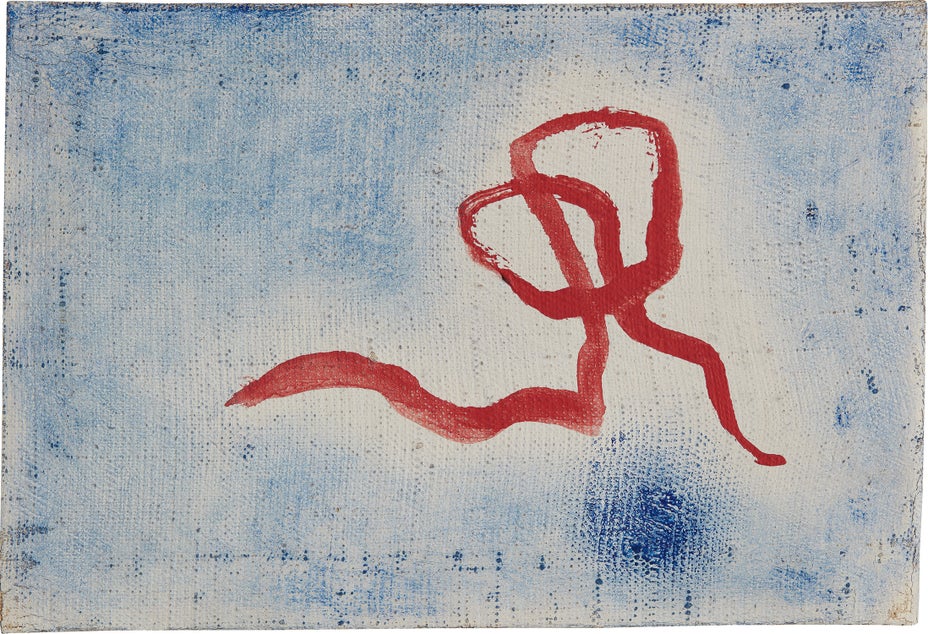
The present work, titled Painting III, 1963, created towards the end of Joan Miró’s prolific career, illustrates the artist’s legacy through the presence of complementary dualities of form. The painting’s free-form components showcase Miró’s approach to art and its intrinsic connection to poetry and literature. William Rubin, the late curator of the MoMA, described Miró’s work as peinture-poésie, translating to “a commitment to subjects of a visionary, poetic, and hence, a metaphoric order” (Dada, Surealism, and Their Heritage, exh. cat., The Museum of Modern Art, New York, 1968).
In Painting III, the viewer is confronted with an ethereal field of blue. A red form flows through the composition as it traverses the canvas from the left to the right, surrounded by an almost white aura that emanates from the central form. Beneath the red motif, a burst of blue pigment provides a ground for the form to reside on; the texture of the canvas is palpable through the wash-like application of the blue pigment, creating a dynamic visual conversation through the poetic juxtaposition of the smooth linear form and the lively background.
Miró’s treatment of the canvas and use of paint reflects his interest in the flat plane of the surface and his counter-inductive treatment of traditional mediums, elements which he has called “the shock” and “the beautiful surprise” (the artist, quoted in Lachner, p. 74). The beautiful surprise in the present work can be interpreted as the shock of the red figure, which disrupts the dreamy blue negative space. Miró’s attraction to the color blue can be further understood from a note written by the artist in the 1960s around the time that the present lot was painted. This note states a simple phrase that the artist quotes from the surrealist Victor Hugo: “L’art c’est l’azur”, which translates to “art is blue.” Miró’s particular inclination towards the color blue and his unique treatment of form is present throughout his career, making Painting III a paradigm of Miro’s poetic approach to painting.
In Painting III, the viewer is confronted with an ethereal field of blue. A red form flows through the composition as it traverses the canvas from the left to the right, surrounded by an almost white aura that emanates from the central form. Beneath the red motif, a burst of blue pigment provides a ground for the form to reside on; the texture of the canvas is palpable through the wash-like application of the blue pigment, creating a dynamic visual conversation through the poetic juxtaposition of the smooth linear form and the lively background.
Miró’s treatment of the canvas and use of paint reflects his interest in the flat plane of the surface and his counter-inductive treatment of traditional mediums, elements which he has called “the shock” and “the beautiful surprise” (the artist, quoted in Lachner, p. 74). The beautiful surprise in the present work can be interpreted as the shock of the red figure, which disrupts the dreamy blue negative space. Miró’s attraction to the color blue can be further understood from a note written by the artist in the 1960s around the time that the present lot was painted. This note states a simple phrase that the artist quotes from the surrealist Victor Hugo: “L’art c’est l’azur”, which translates to “art is blue.” Miró’s particular inclination towards the color blue and his unique treatment of form is present throughout his career, making Painting III a paradigm of Miro’s poetic approach to painting.