178
Fernando Botero
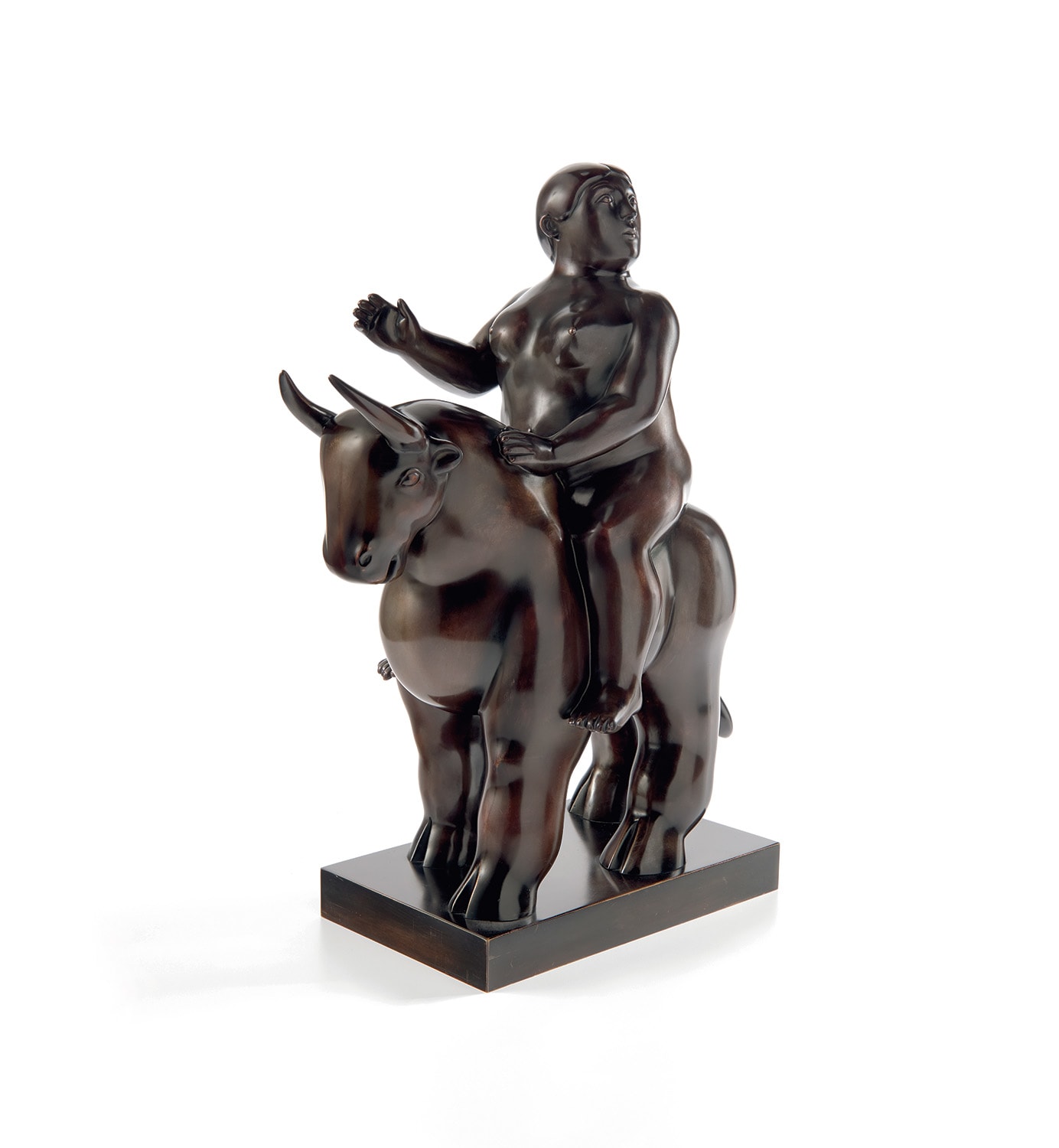
El Rapto de Europa
Full-Cataloguing
The rape of Europa was a favorite subject of Renaissance artists such as Titian, Veronese and Guido Reni, who depicted Europa, enrobed in hazy white gowns, atop the white bull. In Reni’s depiction, Europa gazes upwards passively at a mystical cherub floating in the sky, while Titian’s Europa claws at the air in clear distress while her handmaidens call to her from the shore. In contrast, Botero’s Europa sits astride the bull with confidence and poise, one hand resting on the bull’s powerful neck and head tilted back, perhaps to watch the coasts of her homeland recede beyond the horizon. She is nude, and the curves of her body mirror the shape of the bull’s muscular flanks. The art historian and artist John Sillevis writes, “As in all the techniques that Botero applies, he craves perfection, so the bronzes display a splendid surface in which all the riches of the modeling can be enjoyed by the play of light and shadow. The figures of mythology that we know from his paintings now come to us as larger than life divinities that can easily dominate a square or a rotunda in any city of the world. His reclining nudes, smoking or eating a forbidden fruit, with their undulating shapes, produce a most sensual and seductive effect" (John Sillevis, The Baroque World of Fernando Botero, New Haven, 2006, p. 31).
Inevitably, the influence of Titian and Veronese evoke comparisons between Botero’s art and the famously voluptuous, monumental figures featured in their lustrous masterpieces. Botero’s formal preoccupations build upon these earlier influences, transforming a typically Ciquecento emphasis on physical roundness, sensuality and mass into his own trademark style. In a 1981 interview Botero clarified this link, stating, “To me… the three-dimensional or volumetric plasticity of form is very important. In the first watercolors I painted as a boy, this trend was already very clear-cut. So the artists I preferred were those especially interested in volumes: Giotto, Masaccio, Piero della Francesca, Ingres, etc. By studying those artists I gradually clarified what space and volume meant to me” (Fernando Botero, quoted in Edward J. Sullivan, Botero: Sculpture, New York, 1984, p. 13).
Fernando Botero
Colombian | 1932Colombian artist Fernando Botero is known for his voluptuous and exaggerated paintings, sculptures and drawings. He studied under Roberto Longhi, a renowned authority on Italian Renaissance and Baroque art, obtaining a remarkable art historical knowledge of Western Classicism. This dialogue between an erudite education and religious art for the masses is the key in the development of his aesthetic.
Botero was also influenced by Mexican muralism, with which he became acquainted while living in Mexico City. The monumental scale of the human forms in the murals gave rise to the voluminous figures for which he is best known. Botero's works make mordant comments on society's shortcomings; they also incorporate classical elements and are imbued with political satire and caricature.