Property from an Important Private Collection
114Ο︎◆︎
Ed Ruscha
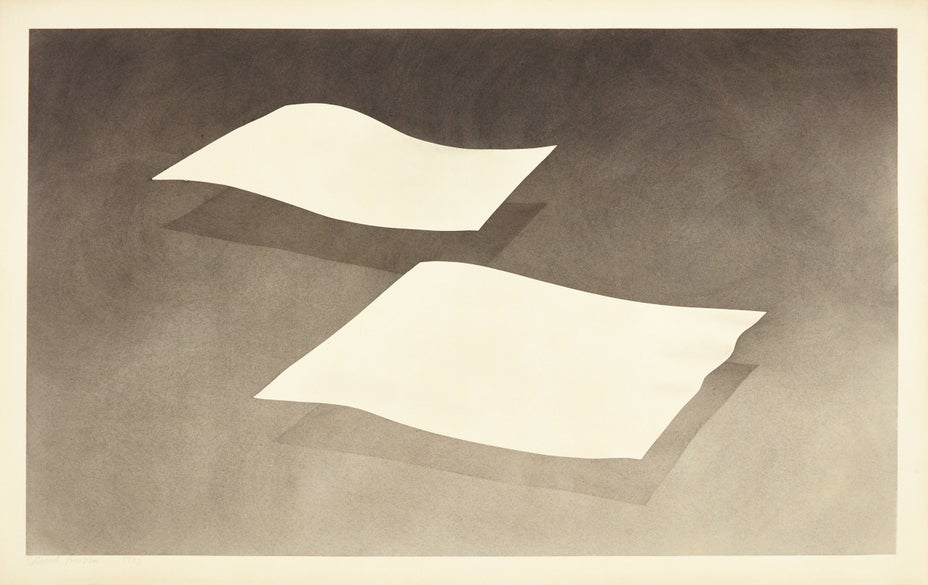
Two Sheets with Whisky Stains
Full-Cataloguing
Of his use of gunpowder, Ruscha said, “I soaked some gunpowder in water once and I saw it separated all the salt out of it. I just did it as an experiment…I could see it would make a good choice of materials; it could actually impregnate on paper. You could use it almost like charcoal…Graphite was much more laborious, but it has a different feel altogether...So gunpowder was simple, it was easy to get going” (Ed Ruscha, quoted in Alexandra Schwartz, ed., Leave Any Information at the Signal, Writings, Interviews, Bits, Pages, Cambridge, 2002, pp. 155-156).
Adding substances ranging from alcohol to the oil from fruits and spices, Ruscha continued these experimentations in unconventional mediums with the sheet drawings. Following his ribbon text works of 1966-1971, these works would “advance the representational riddle of the ribbon drawings: a sheet of paper is pictured illusionistically on a paper ground via the subtractive process of masking out, so the object figured as three-dimensional is actually the flattest and least worked area of the support. Paper and stain, both, are simultaneously real and represented; the stain, in penetrating the support and affirming its flatness, destroys the pretense of illusionism even as it comprises part of an illusionistic rendering” (Lisa Turvey, Edward Ruscha, Catalogue Raisonné of the Works on Paper, Volume One: 1956-1976, New York, 2014, p. 32). As such, works like Two Sheets with Whisky Stains are the first self-referential pieces in Ruscha’s prolific oeuvre, representing a pivotal shift from the literal to the conceptual.
Ed Ruscha
American | 1937Quintessentially American, Ed Ruscha is an L.A.-based artist whose art, like California itself, is both geographically rooted and a metaphor for an American state of mind. Ruscha is a deft creator of photography, film, painting, drawing, prints and artist books, whose works are simultaneously unexpected and familiar, both ironic and sincere.
His most iconic works are at turns poetic and deadpan, epigrammatic text with nods to advertising copy, juxtaposed with imagery that is either cinematic and sublime or seemingly wry documentary. Whether the subject is his iconic Standard Gas Station or the Hollywood Sign, a parking lot or highway, his works are a distillation of American idealism, echoing the expansive Western landscape and optimism unique to postwar America.