Article | Chronographs Phillips Geneva Sessions Spring 2026 Online Auction
Timing Is Everything: The Chronographs in the Phillips Geneva Sessions, Spring 2026, Online Auction
A look at how watchmakers have interpreted the chronograph in radically different ways, revealing a complication with unmatched versatility.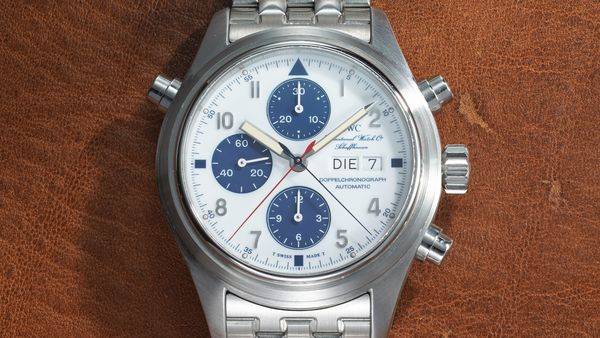
Phillips in Association with Bacs & Russo is thrilled to welcome you to The Geneva Sessions, Spring 2026, Online Auction, running from 12:00 PM CET, Thursday, 5 March, to 2:00 PM CET, Thursday, 12 March. The sale features more than 80 high-end luxury wristwatches, ranging from A. Lange & Söhne and F.P. Journe to Audemars Piguet and Patek Philippe.
– By Logan Baker
The chronograph is one of the few complications in watchmaking that refuses to be boxed into a single identity. Born as a practical instrument for science, medicine, sport, and navigation, it has evolved into a canvas that brands and watchmakers have interpreted in wildly different ways.
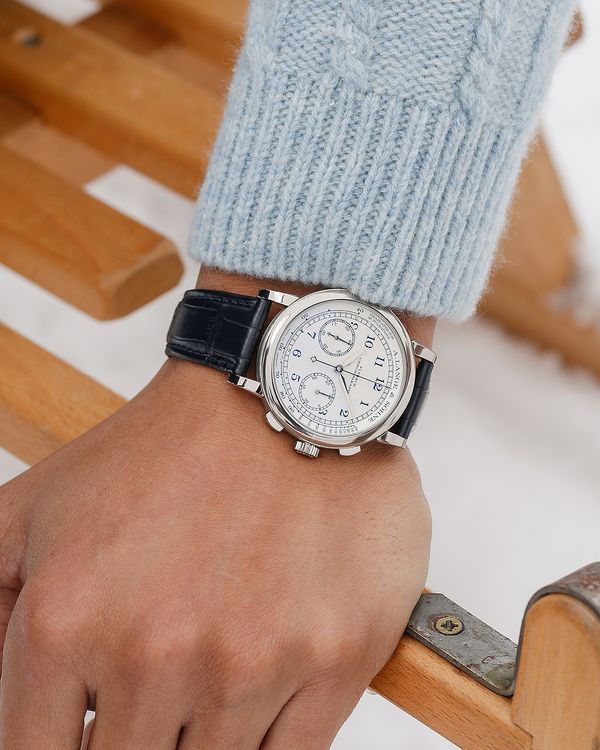
Lot 84: A 2021 A. Lange & Söhne 1815 Chronograph 'Boutique Edition' Ref. 414.026 in 18k white gold that’s included in the upcoming Phillips Geneva Sessions, Spring 2026, Online Auction. Estimate: CHF 20,000 - 40,000
For some collectors, the appeal lies in mechanical ingenuity, in the cleverness of a movement or the elegance of a rattrapante solution. For others, it is about design, proportion, and how a chronograph expresses a moment in time, whether rooted in the 1930s, the excess of the 1980s, or the confidence of modern sports watchmaking.
Look across the landscape and the range becomes clear. There are chronographs that celebrate tradition, built around enamel dials, coin-edged cases, and movements whose architecture traces back a century or more. There are others that lean fully into color, scale, and contemporary materials, designed to be worn hard and noticed. Some prioritize restraint, stripping the display down to two registers and perfect balance. Others embrace complexity, layering functions, textures, and stories tied to sailing, medicine, or aviation. Even within a single brand, the chronograph often serves as a proving ground, a place where heritage and experimentation meet.
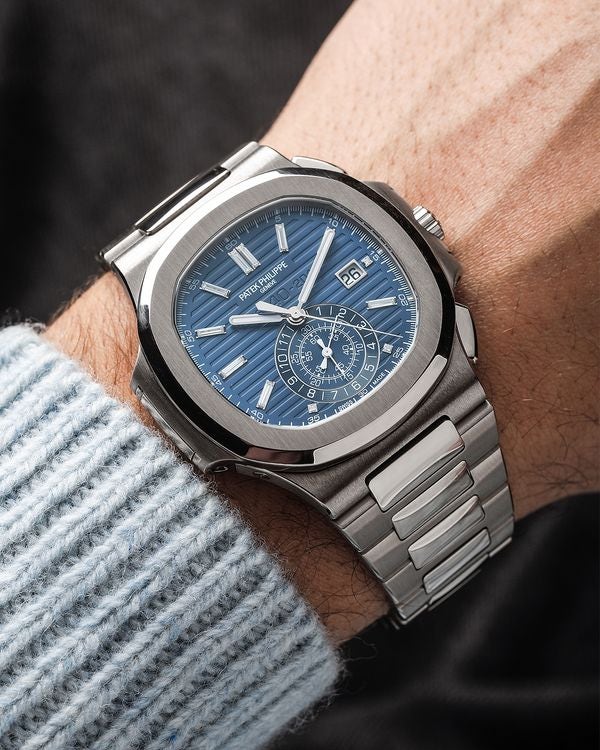
Lot 33: A 2017 Patek Philippe Nautilus '40th Anniversary' Chronograph Ref. 5976/1G-001 in 18k white gold that’s included in the upcoming Phillips Geneva Sessions, Spring 2026, Online Auction. Estimate: CHF 120,000 - 240,000
What unites all of these watches is not a single aesthetic or purpose, but versatility.
The chronograph adapts. It can be elegant or rugged, playful or severe, historically faithful or deliberately forward-looking. For watch collectors, that flexibility is precisely the point.
There is a chronograph for every taste, every philosophy, and every stage of a collecting journey. The watches that follow illustrate just how broad – and how compelling – that spectrum can be.
Lot 84: A 2021 A. Lange & Söhne 1815 Chronograph 'Boutique Edition' Ref. 414.026 in 18k White Gold
Estimate: CHF 20,000 - 40,000
When A. Lange & Söhne introduced the 1815 collection in 1995, it marked an important moment in the brand’s modern rebirth.
This was the first entirely new line to follow the now-mythic 1994 quartet, and it leaned deliberately into Saxon tradition. Large, legible cases, railway-track minute scales, and Arabic numerals drew a straight line back to Lange’s most serious 19th-century pocket watches.
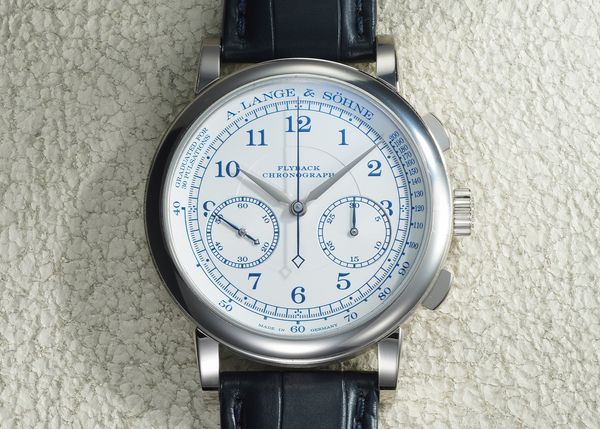
Lot 84: A 2021 A. Lange & Söhne 1815 Chronograph 'Boutique Edition' Ref. 414.026 in 18k white gold that’s included in the upcoming Phillips Geneva Sessions, Spring 2026, Online Auction. Estimate: CHF 20,000 - 40,000
Nearly two decades later, Lange calmly surprised us once more with the 1815 Chronograph Boutique Edition. At a glance, it is the color that stops you. Blue accents, used sparingly but decisively, introduced a tone the 1815 line had never seen before. Even more notable was the return of the pulsometer scale, a feature rooted in early chronograph history and one that feels entirely at home in this context.
Inside beats the manually wound calibre L951.5, a movement that needs little introduction among seasoned collectors. Through the sapphire caseback, you see everything that defines Lange at its best: a column wheel chronograph with flyback function, immaculate Glashütte ribbing, sharp polished chamfers, blued screws, and the unmistakable hand-engraved balance cock. The 39.5mm white-gold case strikes a rare balance for Lange, offering presence without excess and warmth without softness.
Lot 50: A Circa 1990s Ebel 1911 Chronograph Ref. 5134901 in 18k Pink Gold
Estimate: CHF 2,000 - 4,000
The Ebel 1911 Chronograph stands as one of the clearest expressions of 1980s watchmaking. It is bold, luxurious, and entirely comfortable with excess.
At a time when many brands chased understatement, Ebel leaned the other way, embracing strong forms, precious metals, and visual confidence. Decades later, that clarity of intent is exactly what makes these watches compelling.
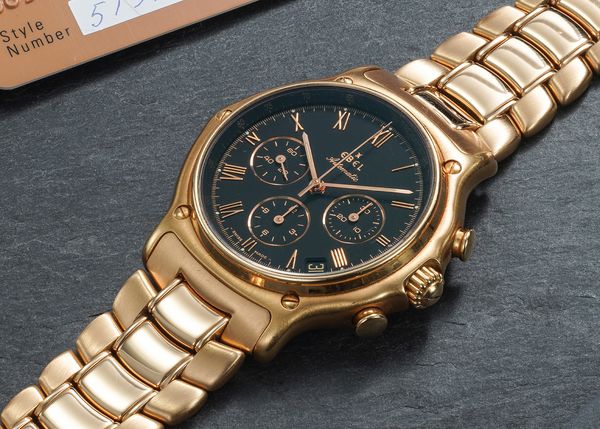
Lot 50: A circa 1990s Ebel 1911 Chronograph Ref. 5134901 in 18k pink gold that’s included in the upcoming Phillips Geneva Sessions, Spring 2026, Online Auction. Estimate: CHF 2,000 - 4,000
Although the company dates back to 1911, Ebel spent much of its early history supplying private-label watches to others. Everything changed in the late 1970s when Pierre-Alain Blum, the founders’ grandson, took control. Under his leadership, Ebel transformed from a behind-the-scenes manufacturer into one of the most recognizable Swiss names of the 1980s and 1990s. The brand understood the moment – integrated bracelets, sculptural cases, and precious metals were all elements they embraced.
The watch now known as the 1911 Chronograph began life in 1982 as the Sport Classic Chronograph. In 1986, it was renamed “1911” to celebrate the brand’s 75th anniversary, and the identity was solidified with the introduction of the signature wave-style link bracelet. That bracelet defines how the watch wears and looks, giving the case a fluid, almost jewelry-like presence that still feels distinct today.
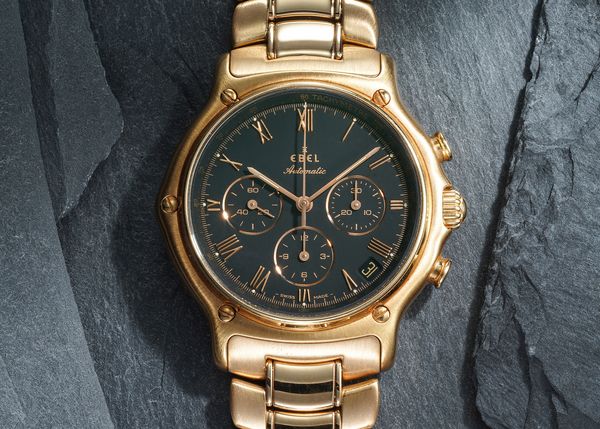
Lot 50: A circa 1990s Ebel 1911 Chronograph Ref. 5134901 in 18k pink gold that’s included in the upcoming Phillips Geneva Sessions, Spring 2026, Online Auction. Estimate: CHF 2,000 - 4,000
Powering the 1911 Chronograph is the El Primero, Zenith’s high-frequency automatic chronograph movement. At a moment when mechanical chronographs were far from guaranteed commercial successes, Ebel committed to one of the finest calibres ever made, helping sustain its relevance years before Rolex adopted it for the Daytona.
Ebel also showed unusual freedom with design, producing these chronographs in a remarkable range of dial configurations. The example here, with its black dial, applied gilt Roman numerals, and 18k pink-gold case and matching bracelet, captures the spirit of the era perfectly. It is confident, luxurious, and unmistakably of its time.
Lot 56: A 2019 Vacheron Constantin Historiques Cornes de Vache 1955 in Stainless Steel
Estimate: CHF 15,000 - 30,000
This stainless-steel chronograph draws a direct line back to one of Vacheron Constantin’s most charismatic mid-century designs.
In the 1950s, the manufacture produced a small number of chronographs distinguished by dramatically flared, sculptural lugs, most famously the Ref. 6087. Collectors later gave these watches the nickname “Cornes de Vache,” or bull’s horns, a perfectly apt description of lugs that feel almost muscular in their confidence. That defining feature carries over intact here, instantly anchoring the watch in Vacheron Constantin’s post-War chronograph lineage.
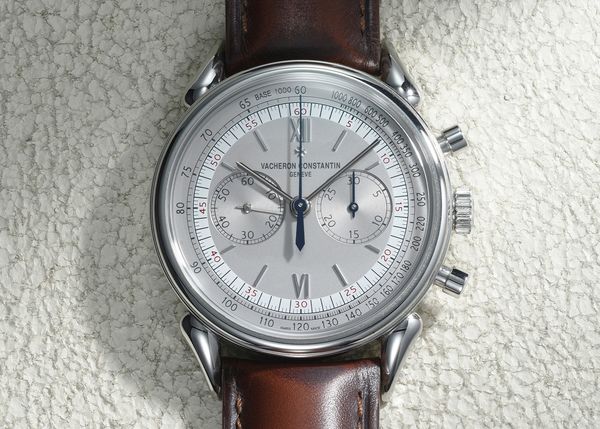
Lot 56: A 2019 Vacheron Constantin Historiques Cornes de Vache 1955 in stainless steel that’s included in the upcoming Phillips Geneva Sessions, Spring 2026, Online Auction. Estimate: CHF 15,000 - 30,000
What separates this modern interpretation from its vintage predecessors is the scale and presence. At 38.5mm, the case feels thoroughly contemporary without drifting into excess, allowing the Cornes de Vache lugs to breathe while keeping the proportions balanced and wearable. The stainless-steel construction reinforces that sense of modernity. Where the original models were unmistakably gentlemen’s chronographs of their era, this execution adds a distinctly sportier edge, one that feels aligned with how collectors actually wear watches today.
Lot 55: A 2019 Patek Philippe Aquanaut Chronograph Ref. 5968A-001 in Stainless Steel
Estimate: CHF 50,000 - 100,000
When Patek Philippe unveiled the Ref. 5968A at Baselworld in 2018, it marked a meaningful shift for the Aquanaut line.
This was the first time the model received a chronograph complication, and the execution left no doubt about the intended audience. With its bold orange accents on both the dial and the tropical rubber strap, the watch leaned decisively toward a younger, more contemporary collector, one interested in sport watches that feel current rather than purely traditional.
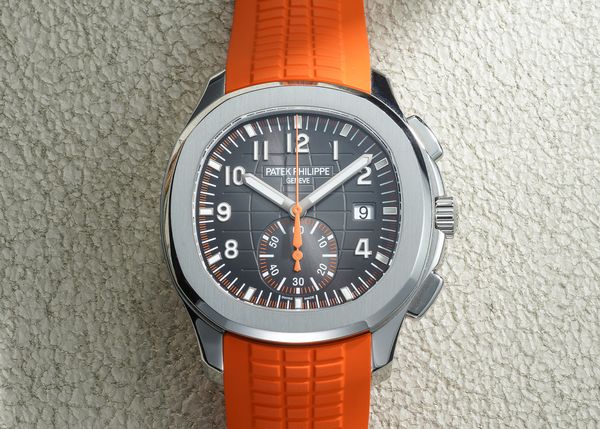
Lot 55: A 2019 Patek Philippe Aquanaut Chronograph Ref. 5968A-001 in stainless steel that’s included in the upcoming Phillips Geneva Sessions, Spring 2026, Online Auction. Estimate: CHF 50,000 - 100,000
At 42mm in stainless steel, the case sits at the upper end of Patek Philippe’s sport-watch spectrum, yet it remains well-judged. Even with the addition of chronograph pushers, the proportions stay compact and cohesive, avoiding the bulk that often plagues modern chronographs. The familiar Aquanaut case geometry does much of the work here, keeping the watch wearable while reinforcing its unmistakably sporty character.
Inside, the in-house calibre CH 28-520 delivers the mechanical substance to match the modern design. This automatic chronograph features a flyback function and incorporates Patek Philippe’s signature technical hallmarks, including the Gyromax balance and Spiromax hairspring, all finished to the standards required by the internal Patek Philippe Seal. It is a thoroughly modern movement, designed for real-world use without sacrificing refinement.
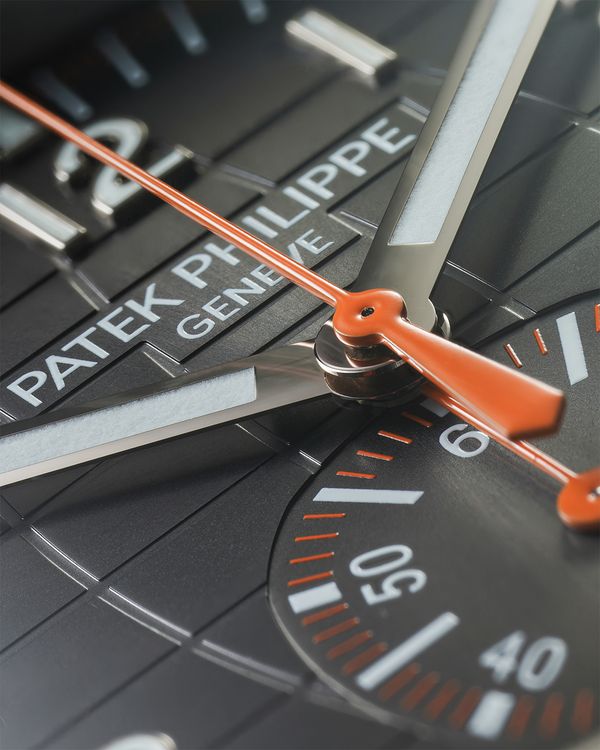
Lot 55: A 2019 Patek Philippe Aquanaut Chronograph Ref. 5968A-001 in stainless steel that’s included in the upcoming Phillips Geneva Sessions, Spring 2026, Online Auction. Estimate: CHF 50,000 - 100,000
The present example is preserved in very good condition and is accompanied by its Certificate of Origin and fitted presentation box.
The Ref. 5968A retains the Aquanaut’s core identity while embracing color, scale, and functionality in a way that feels confident and intentional.
Lot 17: An 1877 Patek Philippe Single-Button Inking Chronograph Pocket Watch in Silver
Estimate: CHF 5,000 - 10,000
This is the kind of watch that stops even seasoned collectors in their tracks.
Known as an Inking Chronograph, it transforms the abstract act of timing into something tangible and almost playful. The large central chronograph hand is engineered to hold a tiny reservoir of ink, while a smaller inking hand sits above it. The pusher at 11 o’clock starts the chronograph in the usual way. The second pusher, at 1 o’clock, triggers the inking hand to jump forward and leave a precise ink mark on the enamel dial at the chosen moment. To reset the stage, the user opens the hinged cuvette, wipes the dial clean, and the watch is ready to be used again.
It is equal parts scientific instrument and horological curiosity.
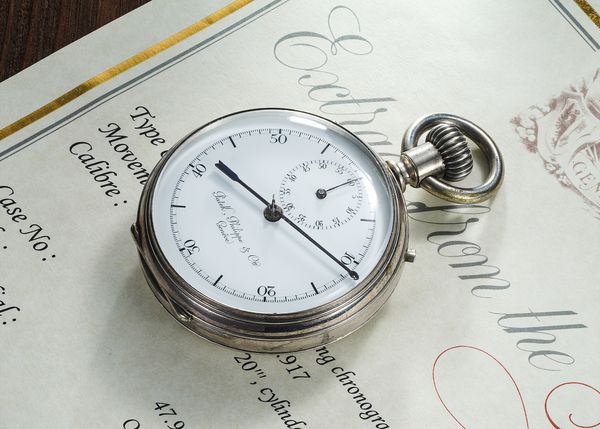
Lot 17: An 1877 Patek Philippe Single-Button Inking Chronograph Pocket Watch in silver that’s included in the upcoming Phillips Geneva Sessions, Spring 2026, Online Auction. Estimate: CHF 5,000 - 10,000
Fewer than a dozen examples have surfaced at auction over the years, and surviving watches appear to fall into at least two distinct production groups. Later pieces carry case numbers in the 58’xxx range, while earlier examples, including the present watch, bear 47’xxx case numbers. What makes this especially intriguing is that the overwhelming majority of known examples belong to the later batch. Very few, if any, comparable watches from the earlier 47’xxx series are documented, and this piece may well stand alone. That said, incomplete archival records, missing case numbers in older sales, and the absence of a formal reference designation make absolute certainty elusive.
The present example last appeared publicly more than 20 years ago, in 2004, and has remained out of sight ever since. For the intellectually curious collector, this is a watch that rewards study, invites conversation, and embodies a moment when watchmakers were willing to pursue wildly unconventional solutions to very specific problems.
Lot 65: A 2013 Breguet Classique Chronograph Ref. 5247 in 18k Pink Gold
Estimate: CHF 10,000 - 20,000
The history of Breguet is inseparable from the history of modern watchmaking itself.
Many of the codes collectors now take for granted trace back to the work of Abraham-Louis Breguet, whose ideas reshaped how watches were designed, built, and read. The Classique collection is the clearest contemporary expression of that legacy. Its appeal lies in restraint. Proportions feel measured rather than styled, and familiar details serve a purpose rather than acting as decoration.
The Ref. 5247 embodies those principles with particular clarity. Cased in white gold, its round profile feels instantly recognizable as Breguet, thanks to the coin-edged caseband and grand feu enamel dial. Achieving that dial is anything but simple. The surface has a subtle grain and depth that only traditional firing techniques can produce, and close inspection reveals Breguet’s secret signature, quietly inscribed using a pantograph stylus.
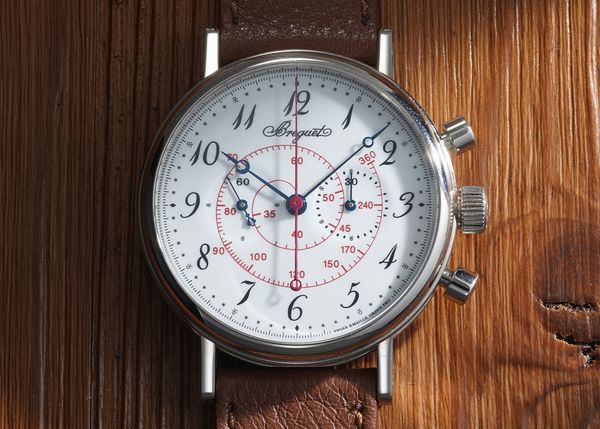
Lot 65: A 2013 Breguet Classique Chronograph Ref. 5247 in 18k pink gold that’s included in the upcoming Phillips Geneva Sessions, Spring 2026, Online Auction. Estimate: CHF 10,000 - 20,000
Inside beats the manually wound chronograph calibre 533-3, a movement that bridges historic architecture and modern refinement. Its lineage traces back to the legendary Lemania 2310, a base calibre also used in the Patek Philippe Ref. 5070, the Vacheron Constantin Les Historiques Chronograph, and the Roger Dubuis Hommage Chronograph. In Breguet’s hands, the movement gains renewed energy, with its frequency increased to 3Hz, bringing improved stability while preserving the classical chronograph architecture collectors admire.
Preserved in excellent condition, this Ref. 5247 speaks to Breguet’s ongoing ability to balance reverence and evolution.
Lot 42: A Circa 1995 Franck Muller Chronograph Ref. 2870NA in 18k Yellow Gold
Estimate: CHF 2,000 - 4,000
The Franck Muller Ref. 2870 is one of the earliest chronograph models produced by the brand.
Configured as a two-register chronograph, it represents the purest expression of the design, especially when set against the more architectural three-register variant offered by the brand at the same time. By limiting the display to the essentials, the watch achieves a clarity and balance that feels deliberate rather than restrained.
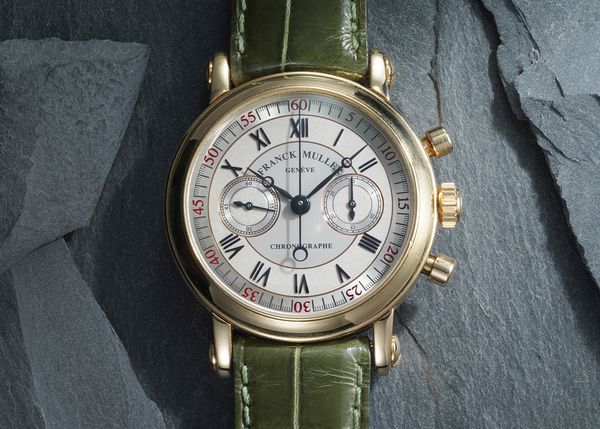
Lot 42: A Circa 1995 Franck Muller Chronograph Ref. 2870NA in 18k yellow gold that’s included in the upcoming Phillips Geneva Sessions, Spring 2026, Online Auction. Estimate: CHF 2,000 - 4,000
The 36mm case plays a large role in that impression. It sits squarely between eras, small by modern standards yet entirely purposeful, and pairs naturally with the two-tone sector-style dial. That dial, with its distinct zones and strong graphic structure, bridges vintage sensibility and modern legibility. Adding to the character is the officer-style case construction, most evident in the oversized screw-down bracelet bars. It is a detail that suggests robustness and functionality while giving the watch a subtly utilitarian edge.
The movement is finished to an exceptionally high standard, with pronounced brushing and careful anglage across nearly every component. Nothing feels perfunctory. As a result, the Ref. 2870 offers more than early Franck Muller significance. It delivers a thoughtful, well-resolved chronograph that speaks directly to the high-end horological connoisseur.
Lot 34: A 1998 Minerva Phoebus Ref. C722 in 18k Yellow Gold
Estimate: CHF 3,000 - 6,000
The story of Minerva begins in 1858, when brothers Charles and Hyppolite Robert founded H. & C. Robert.
By 1887, the company adopted the name Minerva, drawn from the Roman goddess of craftsmanship, the arts, and strategic thought. That choice proved fitting. When Minerva introduced its first chronograph movement in 1908, it set the course for a reputation built on technical seriousness and careful execution.
Over the decades that followed, the brand became known less for scale and more for substance, producing chronographs that prized construction and finish over novelty.
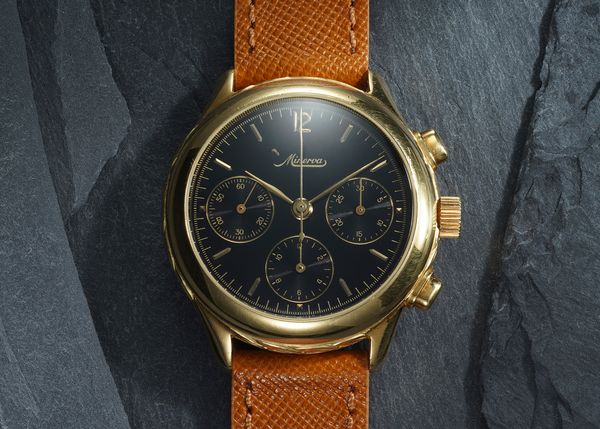
Lot 34: A 1998 Minerva Phoebus Ref. C722 in 18k yellow gold that’s included in the upcoming Phillips Geneva Sessions, Spring 2026, Online Auction. Estimate: CHF 3,000 - 6,000
Like many historic Swiss watchmakers, Minerva faced periods of instability, but a decisive turning point came in the 1960s when the Frey family took control. Their stewardship carried the company through the Quartz Revolution by doubling down on what Minerva did best.
Few brands at the time could match its ability to manufacture key components in-house, including balance wheels and hairsprings. By the 1980s and 1990s, Minerva had narrowed its focus almost entirely to chronographs, refining its identity around mechanical excellence at a moment when many peers had abandoned it.
The Phoebus chronograph, introduced in the early 1990s, clearly reflects that philosophy. Named after the Greek god of light, prophecy, and healing, it was produced in a limited run of just 80 pieces, with the present example numbered 74. Inside is the venerable Valjoux 72, a vintage new-old-stock calibre long admired for its reliability and classical chronograph architecture. The example here is especially appealing, featuring the rarer black gilt dial rather than the more common white gloss dial. That dial is framed by an 18k yellow gold case with hand-engraved flanks.
Lot 27: A Circa 2000 Vacheron Constantin Medicus Chronograph Ref. 47151 in 18k Pink Gold
Estimate: CHF 15,000 - 30,000
When Vacheron Constantin launched the Medicus in 2000, the inspiration was firmly rooted in the 1930s.
Cushion-shaped cases, expressive dials, and purpose-built scales defined many of the era’s most charismatic chronographs, and the Medicus channels that spirit directly. Its name derives from the pulsation scale, originally designed for doctors to calculate a patient’s heart rate – a reminder that chronographs were once practical tools before becoming objects of connoisseurship.
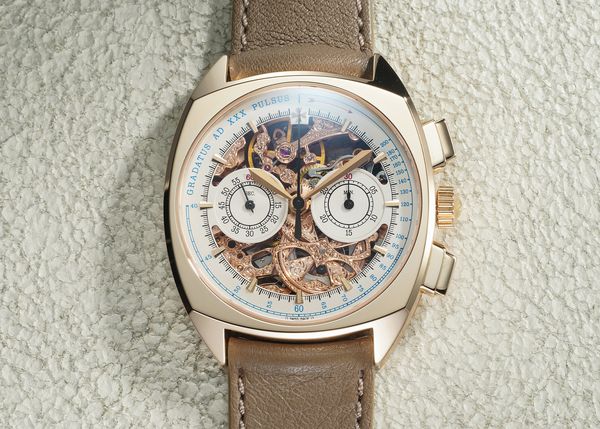
Lot 27: A circa 2000 Vacheron Constantin Medicus Chronograph Ref. 47151 in 18k pink gold that’s included in the upcoming Phillips Geneva Sessions, Spring 2026, Online Auction. Estimate: CHF 15,000 - 30,000
What sets this version apart is its treatment of the movement. Fully skeletonized and hand-engraved, it puts Vacheron Constantin’s decorative craft front and center. The ridges have been opened, shaped, and embellished by hand, transforming the chronograph from an instrument into a canvas.
The Medicus was produced as a limited edition in both 18k pink gold and platinum, offered with either a traditional dial or in this openworked configuration. The present example represents the latter and elevates it further by its status within the series. Cased in pink gold and fitted with a pink gold-plated movement, it bears the coveted number 1 of just 30 pieces produced.
Lot 43: A Circa 2008 Cartier Tank Chronographe Monopoussoir Ref. 2846 in 18k Pink Gold
Estimate: CHF 25,000 - 50,000
The Tank Chronographe Monopoussoir is one of the most compelling modern re-editions Cartier has produced.
Inspired directly by the original 1935 Tank monopusher chronograph, it respects the spirit of the vintage watch while acknowledging contemporary expectations. The case is larger, yes, but the essential geometry remains intact. Dial layout, proportions, and the overall balance remain remarkably faithful to the original, avoiding the common pitfall of over-modernization. Only 100 examples were made in 18k pink gold, and the present watch, numbered 89, sits firmly within that restricted run.
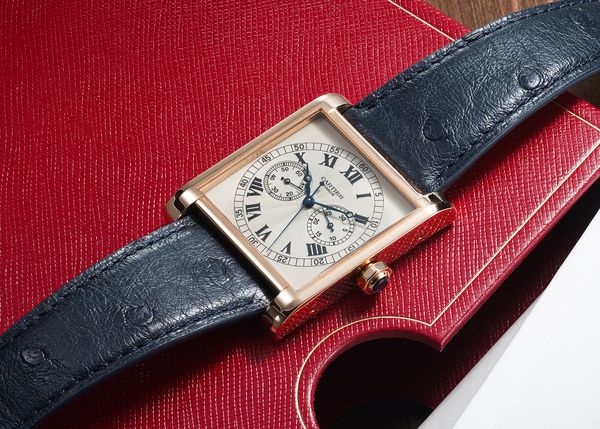
Lot 43: A circa 2008 Cartier Tank Chronographe Monopoussoir Ref. 2846 in 18k pink gold that’s included in the upcoming Phillips Geneva Sessions, Spring 2026, Online Auction. Estimate: CHF 25,000 - 50,000
The movement inside is the manual-wind calibre 045MC, co-developed by three of the most influential independent watchmakers of the modern era: F. P. Journe, Denis Flageollet, and Vianney Halter. The choice of a monopusher configuration reinforces the historical link while allowing for a clean, disciplined case profile.
Visually, the oversized Tank Chronographe Monopoussoir feels bold without drifting into novelty. The elongated case, sharp angles, and restrained dial design give it a timeless quality, while modern finishing ensures it does not feel like a pastiche.
Cartier has long been associated with style, taste, and an extraordinary roster of historical clients, but watches like this remind you that the brand’s horological credibility runs just as deep.
Lot 79: A Circa 1996 IWC Schaffhausen Doppelchronograph Japan Edition Ref. IW3713-30 in Stainless Steel
Estimate: CHF 2,000 - 4,000
From the very first generation of IWC split-seconds chronographs, the emphasis was clear – this was about engineering pragmatism rather than spectacle.
Richard Habring devised a rattrapante system that was simple, clever, and cost-effective, built on the same design logic that made the Valjoux 7750 a historic benchmark for reliability. The result was a split-seconds chronograph that could be produced, serviced, and worn without compromise. That same architecture proved robust enough to underpin far more complex projects at IWC, including watches that combined rattrapante timing with a minute repeater and – of course – Kurt Klaus’s legendary perpetual calendar mechanism.
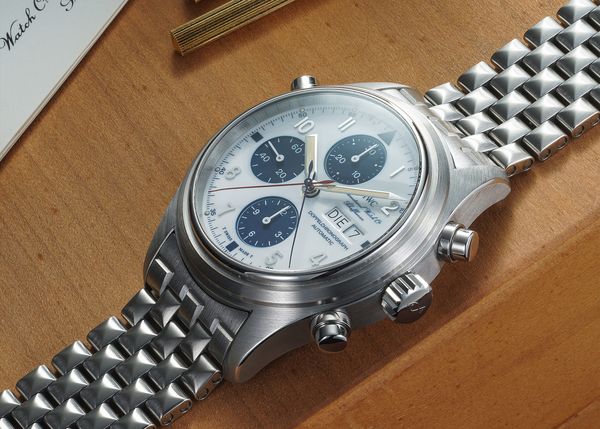
Lot 79: A circa 1996 IWCSchaffhausen Doppelchronograph Japan Edition Ref. IW3713-30 in stainless steel that’s included in the upcoming Phillips Geneva Sessions, Spring 2026, Online Auction. Estimate: CHF 2,000 - 4,000
Visually, this example strikes a very different tone. The glossy white panda dial recalls the enamel dials of historic IWC pocket watches and is signed with the vintage International Watch Company script. Produced exclusively for the Japanese market, it was made in extremely small numbers – approximately 130 examples in stainless steel and just five in platinum. The present steel example, numbered 62, rests firmly within that rare group.
Red and blue chronograph seconds hands make split timing intuitive at a glance, while the IWC bracelet stands out as one of the best of its era, with solid links, a push-button clasp, and a modern quick-link release system that still feels considered today.
Lot 39: A 2024 Tudor Black Bay Chrono 'Miami Pink' Dial Ref. 79360N in Stainless Steel
Estimate: CHF 3,000 - 6,000
The Black Bay Chrono "Miami Pink" Edition is one of those watches that reminds you that Tudor does not always take itself too seriously.
A limited-production special edition, it takes the familiar Black Bay Chrono platform and injects it with a dose of color and attitude. Sun-soaked excess and the pink of Inter Miami CF all converge in a watch that feels deliberately playful without abandoning its tool-watch roots.
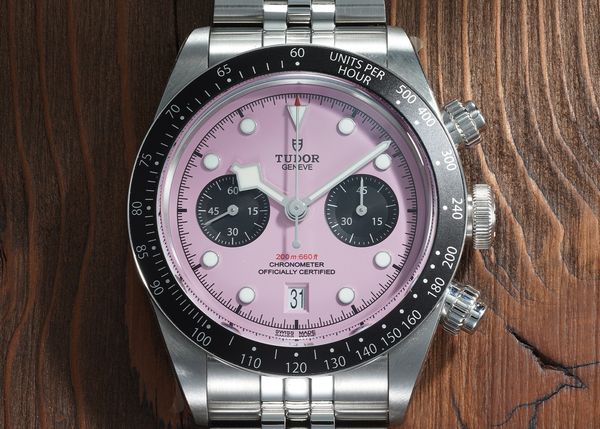
Lot 39: A 2024 Tudor Black Bay Chrono 'Miami Pink' Dial Ref. 79360N in stainless steel that’s included in the upcoming Phillips Geneva Sessions, Spring 2026, Online Auction. Estimate: CHF 3,000 - 6,000
Cased in stainless steel, the watch pairs a vivid pink dial with contrasting black sub-dials, a combination that would have seemed unthinkable for Tudor not all that long ago. Yet it works. The underlying design remains solid and legible, anchored by the same robust case and layout that define the standard Black Bay Chrono. Inside is the manufacture calibre MT5813, a COSC-certified automatic chronograph known for its reliability and everyday usability, reinforcing that this is still a serious sports watch beneath the bright dial color.
What makes this specific Black Bay Chronograph so appealing is its context. It was produced in very limited numbers and never entered the regular catalogue.
Lot 33: A 2017 Patek Philippe Nautilus '40th Anniversary' Chronograph Ref. 5976/1G-001 in 18k White Gold
Estimate: CHF 120,000 - 240,000
The Ref. 5976/1G occupies a very specific place in the history of the Patek Philippe Nautilus.
Created to mark the model’s 40th anniversary in 2016, it is one of just two commemorative references fitted with a unique dial embossed with “1976–40–2016,” a subtle but unmistakable nod to Gérald Genta’s original design and its enduring appeal.
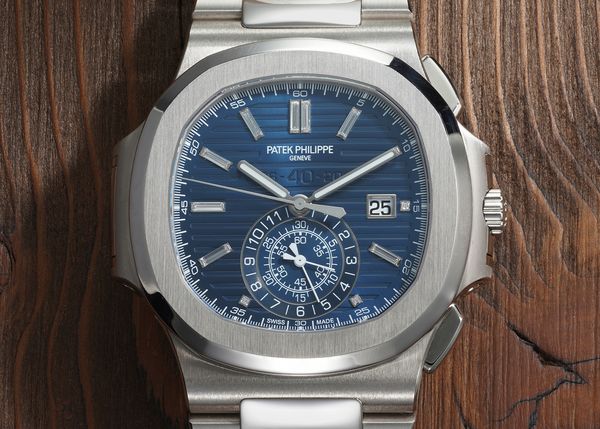
Lot 33: A 2017 Patek Philippe Nautilus '40th Anniversary' Chronograph Ref. 5976/1G-001 in 18k white gold that’s included in the upcoming Phillips Geneva Sessions, Spring 2026, Online Auction. Estimate: CHF 120,000 - 240,000
That decision is most obvious in the case.
At 44mm in diameter, the Ref. 5976/1G is the largest Nautilus ever produced. The scale alone sets it apart from the rest of the family, giving the familiar porthole design a weight and authority rarely seen. Alongside its sibling anniversary time-only Ref. 5711/1P, it was also the first Nautilus to carry a commemorative date directly on the dial, integrated into the classic ribbed sunburst blue surface without overwhelming it.
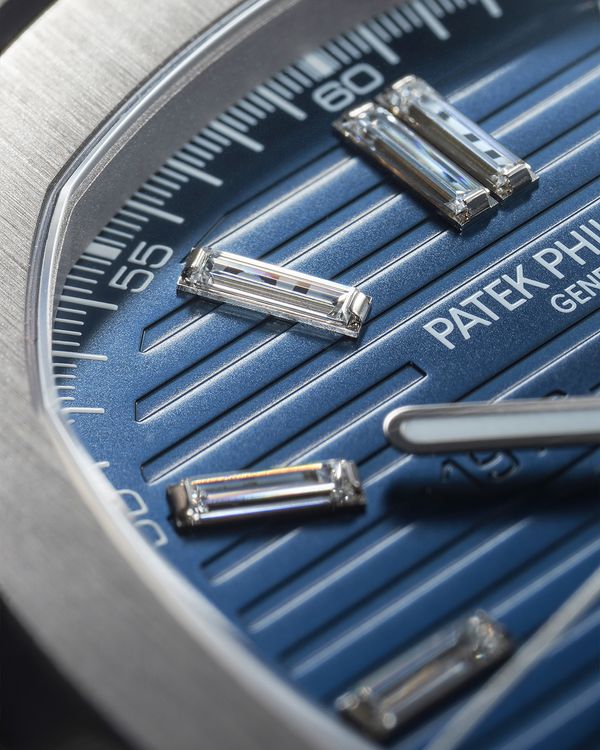
Lot 33: A 2017 Patek Philippe Nautilus '40th Anniversary' Chronograph Ref. 5976/1G-001 in 18k white gold that’s included in the upcoming Phillips Geneva Sessions, Spring 2026, Online Auction. Estimate: CHF 120,000 - 240,000
The watch is offered with the complete set of accessories originally supplied to the first owner, including the now-iconic cork presentation box created specifically for the anniversary release.
As a result, the Ref. 5976/1G reads less as a variation on a theme and more as a deliberate marker in the Nautilus's ongoing story.
Lot 52: A 2001 Audemars Piguet Royal Oak City of Sails 'Be Happy - Crew Member' Edition Ref. 25860IS in Titanium and Stainless Steel
Estimate: CHF 20,000 - 40,000
When Audemars Piguet introduced the Royal Oak Chronograph in 1997, it marked a pivotal evolution of Gérald Genta’s original leisure-chic design.
Released to celebrate the Royal Oak’s 25th anniversary, the Ref. 25860 officially brought the chronograph complication into the collection for the first time, powered by the automatic calibre 2385. It was a natural progression, adding functionality without disturbing the sharp geometry and integrated-bracelet architecture that has defined the Royal Oak from the very start. Remaining in production until 2012, it firmly established the Royal Oak Chronograph as a permanent and essential pillar of the collection.
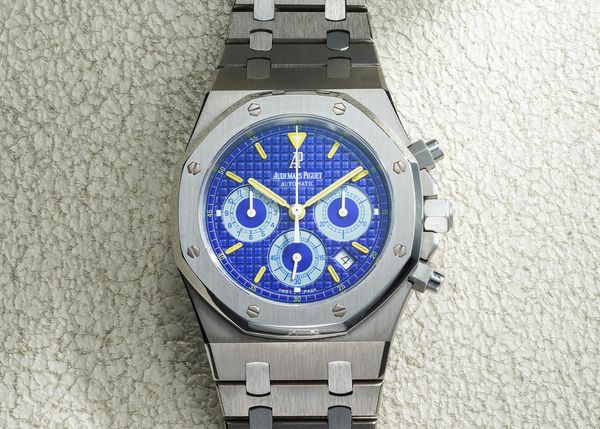
Lot 52: A 2001 Audemars Piguet Royal Oak City of Sails 'Be Happy - Crew Member' Edition Ref. 25860IS.0.1110IS.01 in titanium and stainless steel that’s included in the upcoming Phillips Geneva Sessions, Spring 2026, Online Auction. Estimate: CHF 20,000 - 40,000
Just two years later, Audemars Piguet applied that platform to a far more specific story.
In 1999, the brand unveiled the Royal Oak “City of Sails – Be Happy” Edition to commemorate Switzerland’s first-ever America’s Cup challenge, held in Auckland, New Zealand. While 300 examples were made available to the public, a far rarer subset was produced exclusively for those directly involved. The present watch is one of only 25 pieces issued to the crew members of the competing "Be Happy" sailing yacht, a distinction confirmed by its accompanying Certificate of Authenticity.
Executed in lightweight titanium and steel, the watch feels purpose-built for its maritime inspiration. The blue tapisserie dial evokes sea and sky, while the bright yellow hands inject energy and recall sunlit regattas and racing sails. Turning the watch over reveals a caseback engraved “City of Sails."
You can view the complete Phillips Geneva Sessions, Spring 2026, Online Auction catalogue here.
About Phillips In Association With Bacs & Russo
The team of specialists at PHILLIPS Watches is dedicated to an uncompromised approach to quality, transparency, and client service. Phillips in Association with Bacs & Russo holds the world record for the most successful watch auction, with its Geneva Watch Auction: XIV having realized $74.5 million in 2021. Over the course of 2021 and 2022, the company sold 100% of the watches offered, a first in the industry, resulting in the highest annual total in history across all the auction houses at $227 million.
About Logan Baker
Logan has spent the past ten years covering the watch industry from every angle. He joined Phillips in Association with Bacs & Russo in early 2023 as Senior Editorial Manager, after previous roles at Hodinkee and WatchTime. Originally from Texas, he spent a decade in New York and now calls Geneva home.
Recommended Reading
A Question of Gravity: The Tourbillons in the Phillips Geneva Sessions, Spring 2026, Online Auction
The History of the Vacheron Constantin Chronomètre Royal
The Patek Philippe 'Ref. 50-' Series, and the Rebirth of Complicated Watchmaking