Article | The Patek Philippe Ref 50 Series And The Rebirth Of Modern Complications
The Patek Philippe 'Ref. 50-' Series, and the Rebirth of Complicated Watchmaking
From annual calendars to grand complications, the watches that defined a pivotal chapter in Patek Philippe's modern history.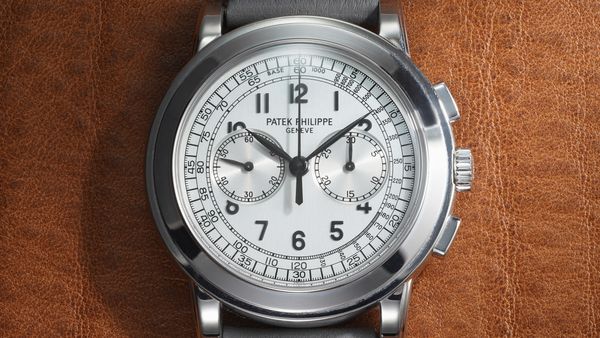
Phillips in Association with Bacs & Russo is thrilled to welcome you to The Geneva Sessions, Spring 2026, Online Auction, running from 12:00 PM CET, Thursday, 5 March, to 2:00 PM CET, Thursday, 12 March. The sale features more than 80 high-end luxury wristwatches, ranging from A. Lange & Söhne and F.P. Journe to Audemars Piguet and Patek Philippe.
– By Logan Baker
Collectors often speak of Patek Philippe by era rather than by reference.
Calatrava-derived purity in the mid-century years. Experimentation in the 1960s and 1970s (hello, Ellipse and Nautilus). The rediscovery of mechanical authority in the late 1980s and 1990s. Within that last period, a loose but meaningful group of watches has come to stand in for Patek Philippe’s triumphant return to complicated series-produced watchmaking after the Quartz Revolution: the so-called “50-” series.
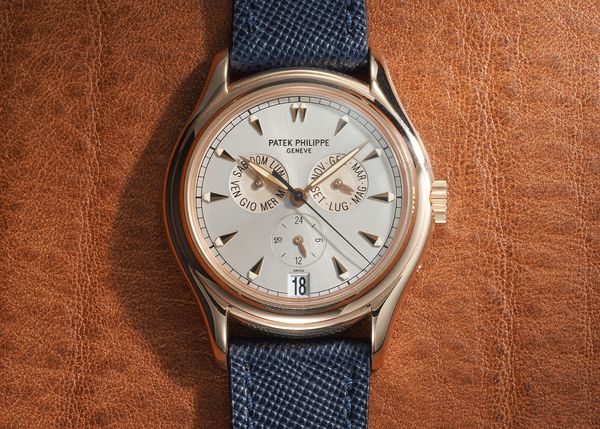
Lot 58: A circa 1999 Patek Philippe Annual Calendar Ref. 5035R-028 in 18k pink gold, part of a limited edition of 100 pieces made for the 100th anniversary of "A.C Milan." Included in the upcoming Phillips Geneva Sessions, Spring 2026, Online Auction. Estimate: CHF 20,000 - 40,000
To be clear, certain complications – such as the perpetual calendar chronograph – remained in production at Patek Philippe throughout the previous decades. And it's also worth mentioning that Patek Philippe's recommitment to a broader perspective on complicated mechanical watchmaking took place in 1989, during the firm's 150th anniversary celebration, with the creation and release of the self-winding minute repeater Ref. 3979, the self-winding, perpetual calendar minute repeater Ref. 3974, and the legendary Calibre 89 Pocket Watch. But it was the next generation – the diverse "50-series" – that turbocharged the brand's efforts in complicated watchmaking and brought countless new clients into the company's stable.
These watches were never formally grouped together. Patek Philippe never announced a “50-series” as a cohesive family, nor did it market these watches as a unified collection. But taken together, the references beginning with “50” – from the early 1990s into the late 2000s – tell a remarkably coherent story about the brand’s priorities at a critical moment in its modern history. These were the watches through which Patek Philippe reaffirmed its technical leadership, recalibrated its design language for a new generation of collectors, and quietly set the template for much of what would follow in the 21st century.
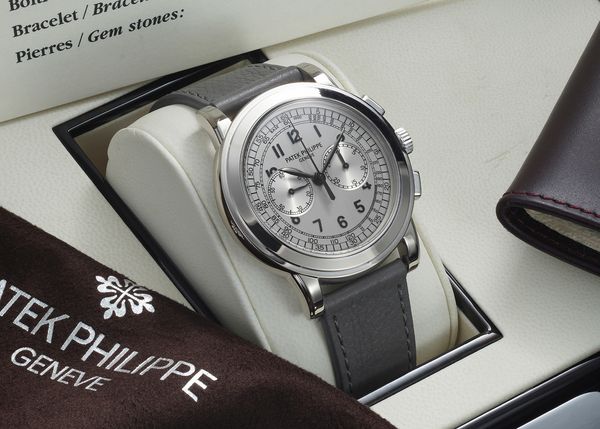
Lot 6: A 2009 Patek Philippe Chronograph Ref. 5070 in 18k white gold that's included in the upcoming Phillips Geneva Sessions, Spring 2026, Online Auction. Estimate: CHF 30,000 - 60,000
To understand the significance of the 50-series, it helps to situate it in time.
The earliest of these watches emerged in the early 1990s, during the tenure of Philippe Stern, who assumed the role of president of the company from his father, Henri Stern, in 1993 (Philippe Stern had previously served as Patek Philippe's managing director since 1977). Mechanical watchmaking was recovering but not yet dominant. Complications were admired, but they were still niche. Patek Philippe’s challenge was not simply to make complicated watches again, but to make them relevant, legible, and wearable in a contemporary context.
One of the clearest expressions of this shift was the Ref. 5050, introduced in 1993. A perpetual calendar with retrograde date, it was compact, classically styled, and technically confident without being ostentatious. And shortly after, in 1996, came the Ref. 5035, the first annual calendar wristwatch ever produced. The annual calendar was not a historical complication revived from the archives; it was a modern invention, conceived specifically for a contemporary wearer who wanted mechanical interest without the fragility, complexity, or price of a perpetual calendar. The 5035 represented a new philosophy: complications as practical tools, not just demonstrations of virtuosity.
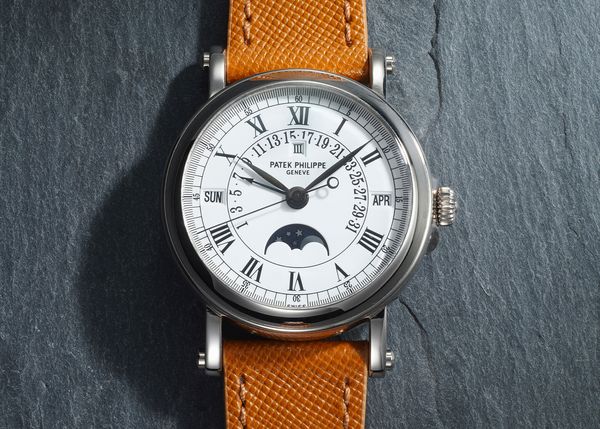
Lot 38: A circa 1999 Patek Philippe Perpetual Calendar Ref. 5059G-000 in 18k white gold that’s included in the upcoming Phillips Geneva Sessions, Spring 2026, Online Auction. Estimate: CHF 25,000 - 50,000
Patek Philippe complemented the release of its annual calendar-equipped Ref. 5035 with a new perpetual calendar wristwatch the same year: the Ref. 5038. This new perpetual calendar riffed on the success of Patek Philippe's signature Ref. 3940 perpetual calendar (released in 1985), with a sportier aesthetic: a black dial with Roman numerals, sword-shaped hands, and a distinctive beaded bezel. Only 500 examples of the Ref. 5038 were produced, exclusively in 18k white gold.
At the other end of the spectrum sat the Ref. 5004, introduced in 1994.
Here was the first wristwatch in history to combine a split-seconds chronograph with a perpetual calendar – an incredibly ambitious and unapologetically complex achievement that was immediately positioned as one of the most significant wristwatches Patek Philippe had ever created. Yet even here, the design language was modernized. The dial was cleaner and more architectural than one might expect based on the brand's archives. The watch felt contemporary – it still feels contemporary – and not at all nostalgic. That balance, between historical legitimacy and modern execution, became a defining trait of the entire 50-series.
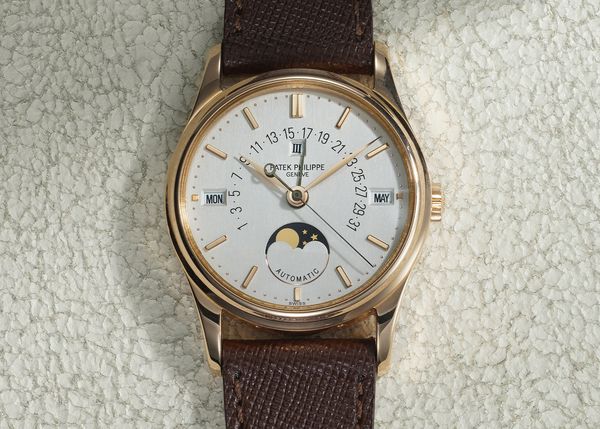
Lot 28: A 1995 Patek Philippe Perpetual Calendar Ref. 5050 in 18k pink gold that’s included in the upcoming Phillips Geneva Sessions, Spring 2026, Online Auction. Estimate: CHF 30,000 - 60,000
Nowhere was Patek Philippe’s willingness to experiment more evident than in the unusual Ref. 5020, the oft-forgotten perpetual calendar chronograph wristwatch in Patek Philippe's history. With its so-called “TV Screen” rounded rectangular case, it stood apart from the round-cased orthodoxy that defined much of Patek Philippe’s historical catalogue. The 5020 has always been divisive, but it speaks to the confidence of the period. Patek Philippe was not simply repeating its past; it was testing how far its design language could stretch without breaking.
That same spirit can be seen in watches like the Ref. 5015 and Ref. 5054, both featuring a moon-phase and power reserve, as well as the minute-repeating Ref. 5029 and perpetual calendar Ref. 5059, all of which utilized officer-style cases and hinged casebacks, blending historical cues with contemporary scale.
If these 1990s references laid the foundation, the early 2000s demonstrated just how ambitious the 50-series could be. The Ref. 5002 Sky Moon Tourbillon was a statement unlike anything else on the market at the time. Double-faced, astronomically complex, and visually imposing, it announced that Patek Philippe intended to continue to define the highest level of watchmaking. It was not a museum piece or a revival of a pocket watch concept; it was a wristwatch conceived from the ground up for the modern era. In many ways, the 5002 reset expectations for what contemporary haute horlogerie could look like.
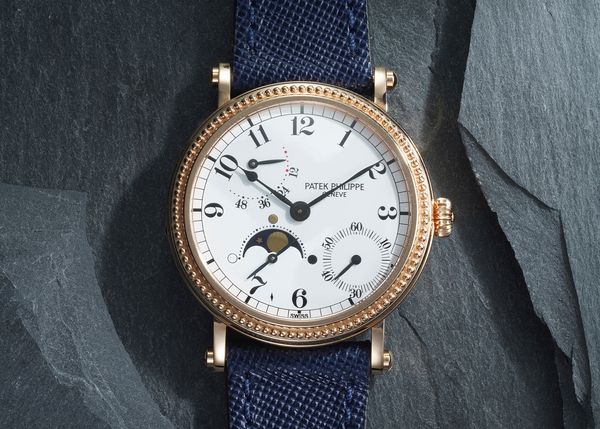
Lot 72: A circa 1995 Patek Philippe Moon Phase Power Reserve Ref. 5015R in 18k pink gold that’s included in the upcoming Phillips Geneva Sessions, Spring 2026, Online Auction. Estimate: CHF 12,000 - 18,000
Chronographs also played a central role in defining the series. The Ref. 5070, introduced in 1998, deserves special attention. At 42mm, it was dramatically larger than any series-produced Patek Philippe chronograph that preceded it. At the time, this was controversial. The 5070 marked Patek Philippe’s recognition that modern tastes had shifted and that size mattered. It also reintroduced the idea of the standalone chronograph as a flagship product for Patek Philippe, paving the way for later references that would further refine the concept. Other references, such as the rare and highly complicated Ref. 5073 and Ref. 5074, continued this trajectory, combining classical finishing with contemporary proportions, all while layering in minute repeating and perpetual calendar complications.
Across the 50-series as a whole, several technical throughlines emerge.
This was a period of increasing reliance on robust, finely finished, but industrially viable movements. Patek Philippe was preparing for the eventual transition to its own internal quality seal and for greater in-house control, even if that shift would not be fully articulated until the late 2000s. Complications became more standardized in their architecture, easier to service, and more consistent in performance. Design, too, evolved in a measurable way. Case diameters grew. Dials became more open, with clearer typography and improved legibility. Hands and indices were bolder. These were watches meant to be worn regularly.
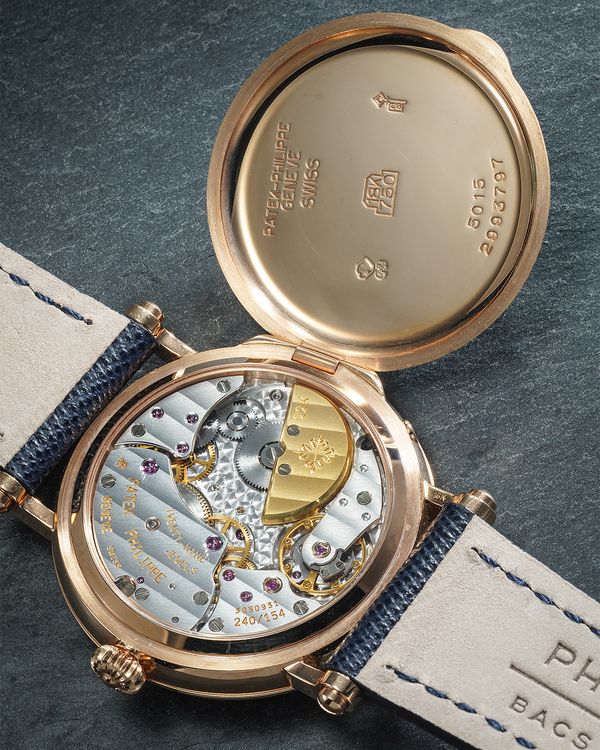
Lot 72: A circa 1995 Patek Philippe Moon Phase Power Reserve Ref. 5015R in 18k pink gold that’s included in the upcoming Phillips Geneva Sessions, Spring 2026, Online Auction. Estimate: CHF 12,000 - 18,000
By the late 2000s, the character of Patek Philippe’s catalogue began to change again. Reference numbers moved beyond the 50xx framework, and a new generation of complications emerged, often larger still and more explicitly modern in styling. In hindsight, the 50-series occupies a distinct and finite chapter. Roughly speaking, it spans from the early 1990s through the first decade of the 2000s, a period when Patek Philippe was still rediscovering its voice as the standard-bearer for complicated mechanical watchmaking.
Today, collectors look back on these watches with increasing appreciation. The market has taken notice, particularly for models like the Ref. 5004 and Ref. 5070, but the deeper appeal of the 50-series lies elsewhere.
These watches capture a moment when Patek Philippe was both cautious and daring, respectful of tradition yet unafraid to reinterpret it. They are neither purely vintage nor fully modern, and that in-between quality is precisely what makes them so compelling.
You can view the complete Phillips Geneva Sessions, Spring 2026, Online Auction catalogue here.
About Phillips In Association With Bacs & Russo
The team of specialists at PHILLIPS Watches is dedicated to an uncompromised approach to quality, transparency, and client service. Phillips in Association with Bacs & Russo holds the world record for the most successful watch auction, with its Geneva Watch Auction: XIV having realized $74.5 million in 2021. Over the course of 2021 and 2022, the company sold 100% of the watches offered, a first in the industry, resulting in the highest annual total in history across all the auction houses at $227 million.
About Logan Baker
Logan has spent the past ten years covering the watch industry from every angle. He joined Phillips in Association with Bacs & Russo in early 2023 as Senior Editorial Manager, after previous roles at Hodinkee and WatchTime. Originally from Texas, he spent a decade in New York and now calls Geneva home.
Recommended Reading
An In-Depth Collectors’ Guide To The Patek Philippe Chronograph Ref. 5070
The History of the Vacheron Constantin Chronomètre Royal
Patek Philippe’s TV-Shaped Ref. 5020 Is A Genuine ‘90s Deep-Cut