Article | Specialist Picks Design London
Specialist Picks: Design London
From Jean Royère to Gio Ponti, Napoleone Martinuzzi, and more — these are the works our specialists would love to live with.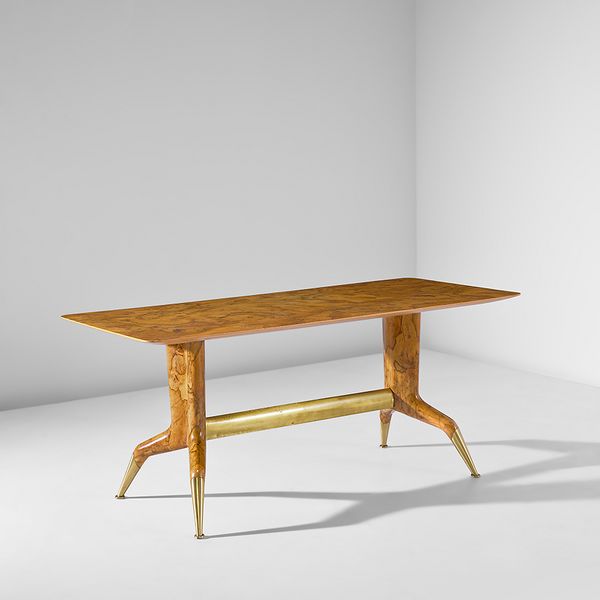
Gio Ponti, Unique desk, from Casa Ceccato, Milan, circa 1950. Design London.
Gio Ponti
Sofia Sayn-Wittgenstein, Head of Design, London.
I don’t think I’ve ever encountered a work by Gio Ponti that I wouldn’t want to live with, but I’m especially drawn to his pieces where he pushes the boundaries of sculptural expression — like with this Unique desk from Casa Ceccato in Milan. There’s a sense of theatrical drama in the way the legs splay outward with their elongated brass sabots, giving the piece a sensual, almost animalistic presence. The burr-walnut veneer, arranged like interlocking puzzle pieces in an irregular pattern, adds a painterly quality that distorts a direct reading of the form and wraps fluidly around the undulating legs. Ponti masterfully balances playfulness with precision. The result is a piece that exudes Mannerist elegance while feeling both modern and timeless — a striking testament to his mid-century genius.
Lucie Rie
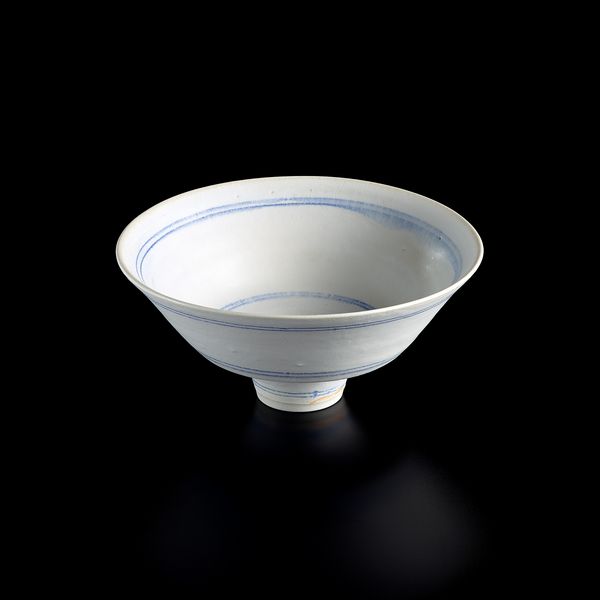
Lucie Rie, Footed bowl, circa 1978. Design London.
Antonia King, Head of Sale, Design, London.
This exquisite Footed bowl, timeless in its beauty and modernist elegance, evokes a harmoniously serene feeling of simplicity and stillness while also being imbued with so much life. Here, we see a more complex variation of other open-form bowls, with its cantilevered kick-like angle at the foot and pinpoint delicacy of the inlaid design which continues both on the inside and outside, creating an illusion of thinness. It is as though Lucie Rie, with immense dexterity, was drawing concentric circles in space. Rie’s measured use of decoration and colour, as seen here in the exceptionally rare pastel blue hues for this example of bowl, is one which I love for its ability to conjure a sense of calm. Another example, which features on the cover of the first edition of Tony Birks’ celebrated book Lucie Rie, is in the collection of the National Crafts Museum, Tokyo. For me, the perfection in this work lies in the fact that it is not ‘machine-perfect’, but in the undulating softness that comes from being made by the human hand, revealing Rie’s minimalist approach and commitment to looking for the ‘essential’ in art.
Carlo Scarpa
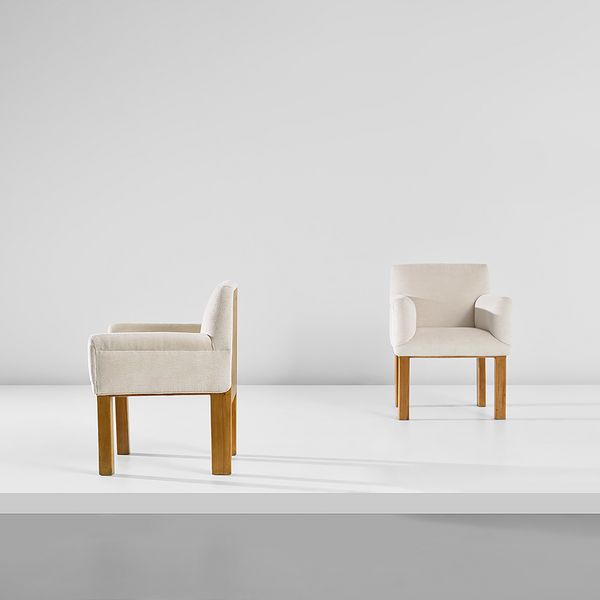
Carlo Scarpa, Two rare armchairs, 1935–1937. Design London.
Domenico Raimondo, Head of Design, Europe.
These armchairs, designed by Carlo Scarpa in 1935 for the Aula Magna during his first iteration of Ca’ Foscari, embody a studied, linear simplicity that reflects Scarpa’s reverence for drawing as a precise tool for both communication and execution. One which he used as a ‘Categorical Imperative’ quoting Leon Battista Alberti’s ‘nulla dies sine linea – not a single day without a line’ as a guiding principle for his students. Scarpa once told his students he produced 250 drawings just to design a hinge that would open in both directions.
In a video interview, Scarpa recalled his arrival in Venice as a teenager from Treviso, and how the city instantly captivated him. He spoke of an innate ‘bizantinismo’ a Byzantine quality intrinsic to Venice that manifests in an unrelenting attention to detail.
On close inspection, what appears to be simplicity in these chairs is, in fact, the result of a highly considered composition of tectonic elements. The wooden structure reveals a sophisticated interplay of components that counterbalance and elevate one another with quiet precision. The refinement evokes an exhausted geometric beauty expressed in the construction’s details.
Once an architect always an architect, and as one, I’m particularly drawn to these chairs because they exemplify Scarpa’s unique ability to transform something as utilitarian as a chair into a sophisticated architectural gesture. It is a modernist work deeply anchored in the archetype of the traditional chair — one that I once recognized in a painting by Cima da Conegliano at the Hermitage, his Annunciation from 1495.
Jean Royère
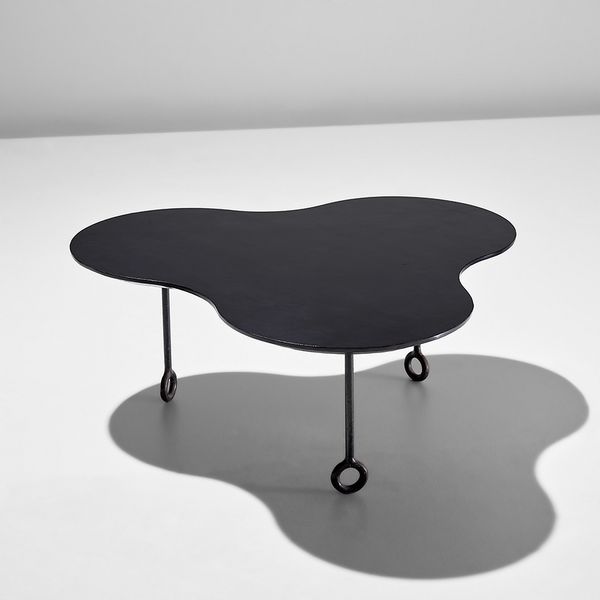
Jean Royère, Coffee table, circa 1955. Design London.
Elie Massaoutis, Head of Design, France.
The Coffee table by Jean Royère is my top pick for its elegant design and rich history. Documented in the archives of the Musée des Arts Décoratifs, this model table was also part of the Hotel Philadelphia furnishings in Beirut, showcasing Royère's innovative approach in the late 1940s. Its charming clover-shaped tabletop exemplifies his love for sinuous curves and playful motifs, reflecting a decorative style that resonates with me. This table represents a pivotal era in design when Royère was redefining interior spaces and its connection to Lebanese diplomat Mr. Ali Bazzi adds depth, as it was acquired during a significant personal celebration. The Coffee table embodies artistry and craftsmanship, making it a standout piece within 20th-century design and a testament to Royère's enduring legacy.
Shiro Kuramata
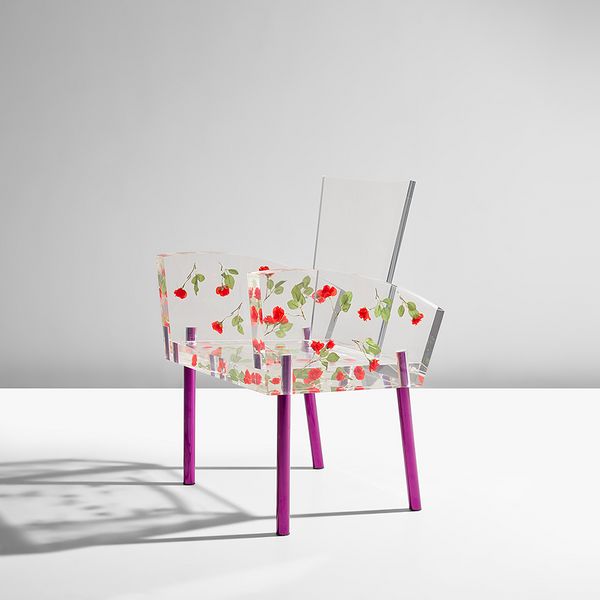
Shiro Kuramata, ‘Miss Blanche’ chair, designed 1988, executed before 1991. Design London.
Madalena Horta e Costa, Specialist, Design.
Shiro Kuramata’s ‘Miss Blanche’ chair stands as a poetic embodiment of ephemeral beauty, illusion, and fragility — qualities that resonate deeply with the character it’s named after, Blanche DuBois from Tennessee Williams’ A Streetcar Named Desire. The chair’s transparent acrylic seat structure, in which artificial roses appear to float suspended, evokes a dreamlike quality, blurring the line between materiality and imagination. This ethereal effect mirrors Blanche DuBois’s desperate retreat into illusion to escape the harshness of her reality. Just as Blanche cloaks herself in pretensions of gentility and romance, Kuramata’s chair disguises its weight and rigidity beneath an appearance of weightlessness and delicacy. What draws me to ‘Miss Blanche’ is not only its aesthetic allure but its conceptual depth. It encapsulates a narrative tension between appearance and truth — a central theme in both the play and the design. The roses, artificial and frozen in time, suggest a yearning for beauty untouched by decay, echoing Blanche’s futile attempts to preserve youth and grace. Kuramata’s work transcends functional furniture; it becomes a meditation on transience and artifice. For me, ‘Miss Blanche’ is more than a chair — it is a quiet, poignant homage to the fragility of dreams and the seductive power of illusion.
Josef Frank
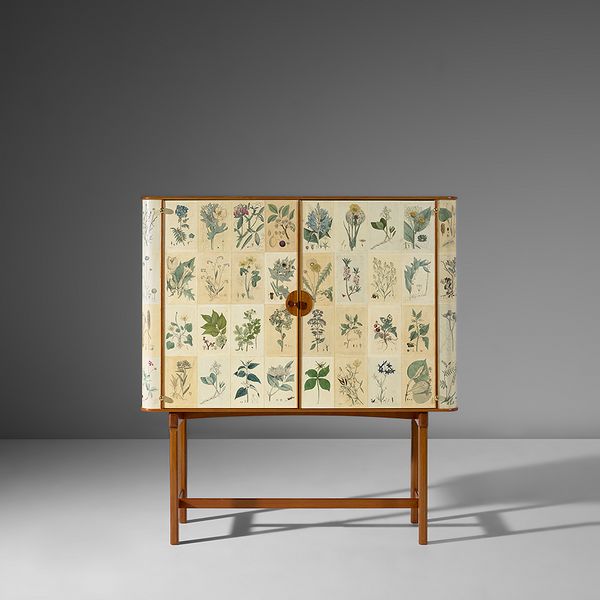
Josef Frank, ‘Flora‘ cabinet, model no. B 955, designed 1938, produced 1965. Design London.
Margherita Manca, Senior Cataloguer, Design, London.
Of all the works in our spring auction, the ‘Flora’ cabinet, model B 955, by Josef Frank for the Swedish interiors firm Svenskt Tenn, is one of the pieces I enjoyed researching the most. The cabinet is simple in form with an instantly captivating surface. Its main body is covered in 19th-century botanical prints from Svensk Botanik, a landmark in natural history publishing by J. W. Palmstruch, which I had the pleasure to leaf through. I love how these illustrations, once bound in volumes for scientific study, have been reimagined here as a striking decorative detail, inextricably entwined with the designer’s ethos. Frank had a predilection for the decorative — not as ornamentation for its own sake, but as a vital source of joy, identity, and meaning in the everyday. The ‘Flora’ cabinet is a perfect example of this belief: its surface is not merely embellished but expressive. The decoration doesn’t serve to mask function — it becomes the function, inviting us to live with beauty, curiosity, and wonder. For Frank, as for me, that is perhaps the point of design itself.
Napoleone Martinuzzi
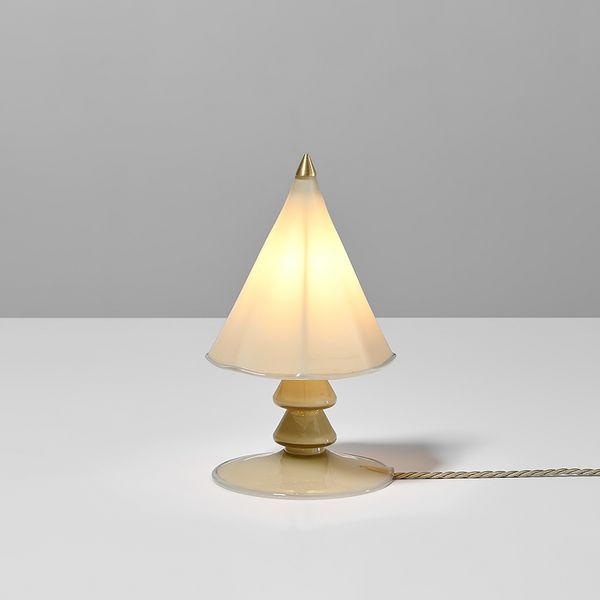
Napoleone Martinuzzi, Rare table lamp, model no. 9010, circa 1930. Design London.
Carlotta Pintucci, Cataloguer & Assistant to Head of Design, Europe.
Have you ever had the pleasure of visiting the Vittoriale degli Italiani, Gabriele D’Annunzio’s private residence? If so, you’ve undoubtedly experienced the vibrant eclecticism of his collection — especially the stunning glassworks by his beloved artist, Napoleone Martinuzzi. This very connection is a compelling reason to bring one of his exquisite pieces into your own collection. Take, for instance, this table lamp — an absolute masterpiece of elegance and refinement, perfect for any bedside. Its intricate craftsmanship and timeless beauty are sure to enchant any designer or admirer of fine art. As D’Annunzio wrote in a letter to Martinuzzi: “Carissimo Napè, your creations have finally delighted me, though not quite satisfied me. I devoured them all in the same evening. Therefore, I’m in need of a new harvest...” And like D’Annunzio, I believe no one could ever truly be satiated by such overwhelming beauty.
Kaj Gottlob
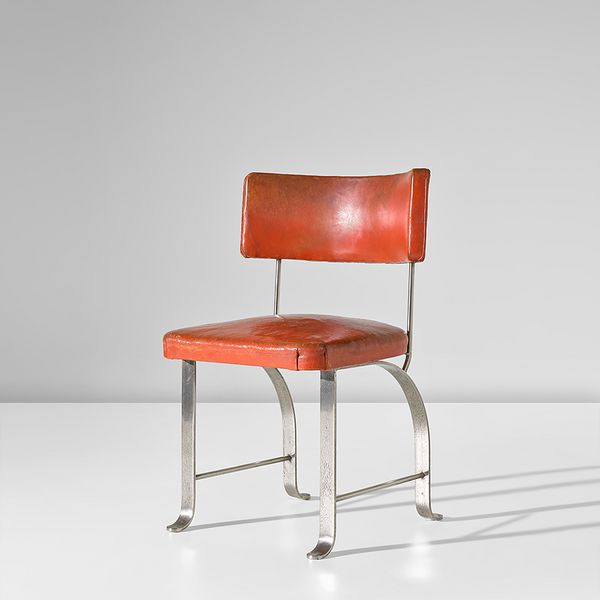
Kaj Gottlob, Rare side chair, designed for the Lolland Falsters Industri & Landbrugsbank, Nykøbing Falster, circa 1935. Design London.
Tabitha Blackburn, Intern, Design, London.
A discreet yet salient fragment of Danish design history, Kaj Gottlob’s Rare side chair, specially made around 1935 for the vault room of the Lolland Falsters Industrial & Agricultural Bank in Nykøbing Falster, southern Denmark, is my pick for the upcoming London Design sale. Whilst based on the archetypal Greek ‘Klismos’ form prominent in Danish classical revival furniture, the chair features a base of nickel-plated steel, an unexpected medium choice linked to Gottlob’s holistic, context-conscious vision for the interior of the industrial building. Swedish designers beat their Danish counterparts to the craze for steel furniture at the onset of the 1930s, though with his models for the bank, Gottlob was an early pioneer. For me, a particularly compelling detail is the chair’s label, which confirms its production by one of the first known dedicated manufacturers of steel furniture in Scandinavia: Malmö-based company DS Staal-Stel. With only a handful of furnishings remaining today from the long-forgotten interior, Gottlob’s chair is a rare survival, representing a remarkable early instance of the adoption of a material now synonymous with Danish Modern design.
Judy Kensley McKie
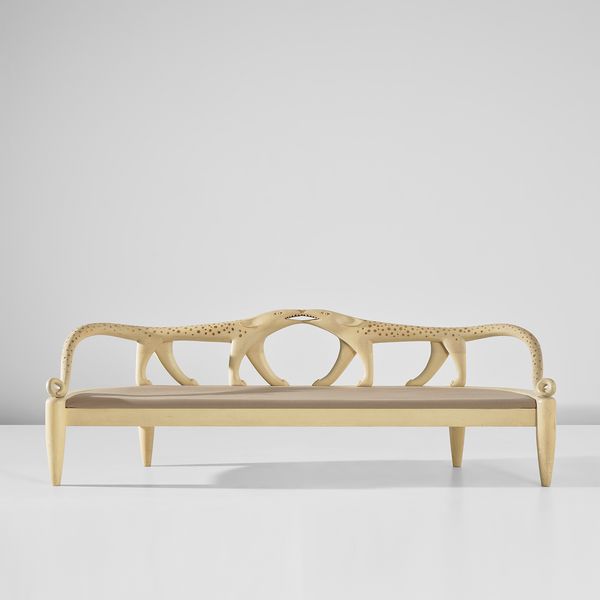
Judy Kensley McKie, ‘Leopard Couch’, 1983. Design London.
Rosie Simon, Intern, Design, London.
I imagine Judy Kensley McKie’s ‘Leopard Couch’ at the centre of a busy home — perhaps a first resting point after coming in the door, or as a gathering point along a kitchen wall while someone cooks. Specifically, I find myself thinking about my grandparents’ kitchen in the suburban house my father grew up in. One wall of the room was made up of a bank of windows, the sills of which I remember being decorated with expressive carved folk-art animals and a veritable farm of weathervanes. McKie’s couch — in its deft integration of form and function and its combination of studio furniture technique and American folk-art spirit — slots well into this scene and into the broader narrative of American craft and design, which was my first, though unconscious, introduction to the field of design and the practice of building a collection. Without ever sitting on it, McKie’s couch feels comfortable, nostalgic to me in the best possible way, speaking to her skill at manipulating wood in a way that imbues it with feeling and memory to create heirloom pieces in the truest sense of the word.
Recommended Reading
Collecting Guide: Postmodern and Contemporary Design 101 >
Spotlight on Women Designers >
Five Things to Know: Ettore Sottsass’ Early Enameled Copper Plates >
