Article | Creative Diary Gio Pontis Letters
Creative Diary: Gio Ponti's Letters
Writing and drawing go hand-in-hand in these five unique letter drawings by Gio Ponti.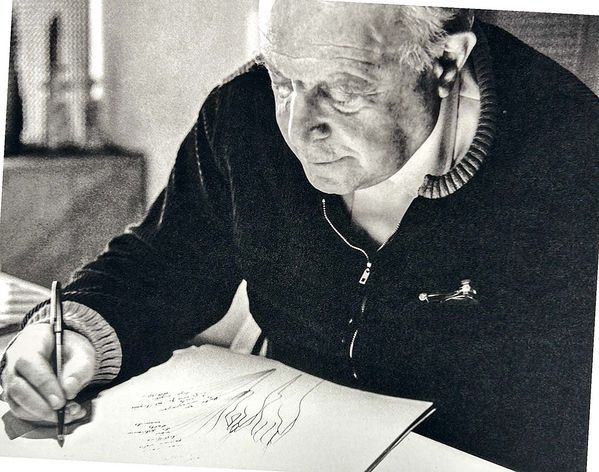
Gio Ponti illustrating a letter, circa 1970. © Gio Ponti Archives / archivio storico Eredi Gio Ponti.
In contemporary society, we have become accustomed to brief, immediate, and often virtual conversations, where the keyboard has replaced the pen. Written communication, once defined by the physical act of writing by hand on a blank sheet of paper, now feels almost distant, even archaic. If we were to write everything by hand, after holding the pen for some time, we would quickly realise how tiring it can be for the hand. Yet, it is precisely these letters written by Gio Ponti that reveal a mode of communication that, in today’s world, seems to belong to another era, and for this reason, they captivate us so deeply.
Each morning, Ponti would wake up at dawn, and the first thing he felt compelled to do was write letters, notes, or communications — not only for friends and family, but also for his collaborators. This ritual, reminiscent of the Morning Pages from The Artist’s Way, became a creative diary, where thoughts flowed unfiltered onto the page. From the first moments of the day, his mind was already directed toward others, and those thoughts quickly took shape as delicate marks on paper. His writing — smooth, fluid, and sometimes almost feminine — captured the speed, spontaneity, and inventiveness of his thoughts, always eager to leave a mark, to convey an idea, a concept, or a new vision.
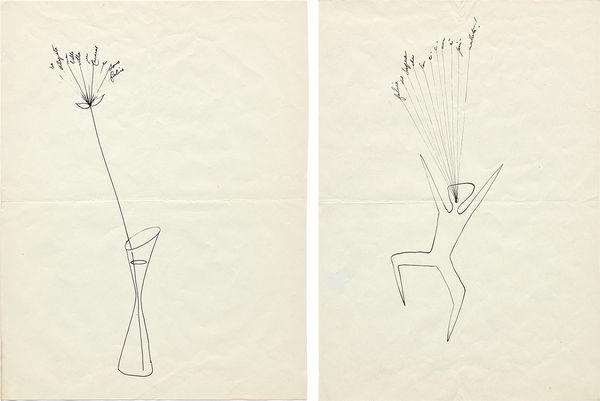
Left: Gio Ponti, 'Villa a Caracas' letter, circa 1955. Right: Gio Ponti, 'Felice di sapere' letter, circa 1955. Design London.
These letters, therefore, are not merely written communications; they are a journey through a landscape of words and lines that intertwine. The marks on the paper evolve beyond simple letters: at times, they transform into geometric segments or planes, while at other times, they become human figures or objects that, though inanimate, acquire an active role. These marks are not just a reflection of thought but an extension of Ponti’s character, confronting themes that repeatedly appeared in his artistic work, such as the iconography of hands, angels, and horses. Just as his architecture was designed to respond to the needs of its inhabitants and the surrounding context, his drawings and marks come to life only when they serve as communication, intended for a specific recipient. Every stroke on the page becomes part of a journey, a path leading toward the “visit” of a friend.
In 1987, the Jannone Gallery in Milan hosted an exhibition titled Gio Ponti: Cento Lettere, which later gave rise to the eponymous book. This volume collects one hundred of his letters, now treasured as intimate, personal gems—a testament that invites us into the very heart of Ponti’s work. The book opens with a letter addressed to Lisa, his daughter, in which Ponti writes: “I wanted to write to you, Lisa, but instead I drew. What does this mean?” (Sermisani, 1987, 10). This simple yet profound reflection encourages us to explore the role of drawing and imagery as forms of communication that transcend words.
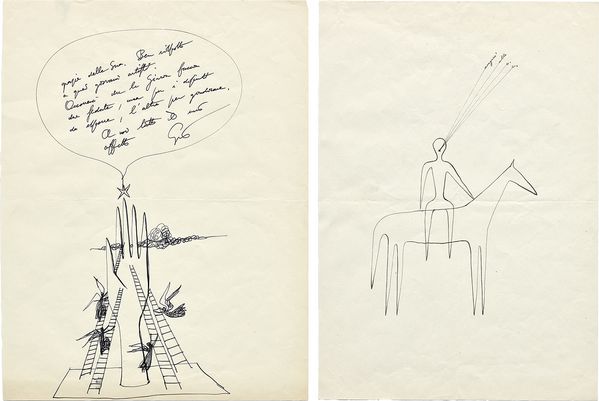
Left: Gio Ponti, 'Ginori' letter, circa 1955. Right: Gio Ponti, 'Cavaliere' letter, circa 1955. Design London.
In Lezioni Americane: Sei Proposte per il Prossimo Millennio (American Lessons: Six Proposals for the Next Millennium), Italo Calvino delves into the concept of imagination and fantasy, defining imagination as “a place where it rains inside.” According to Calvino, images are capable of expressing what language cannot, and the reader’s ability to recreate these images in their mind is essential. Yet, today, we are overwhelmed by so many images that we can no longer discern whether what we see is the result of our direct experience or something imposed upon us by the media.
Calvino, reflecting on the concept of visibility, argues that it is a value worth preserving. He expresses concern that our capacity for imagination may fade under the pressure of external stimuli. This is why, despite technological advancements, it remains crucial to preserve the habit of reading, for it is through reading that we continue to nurture our imagination.
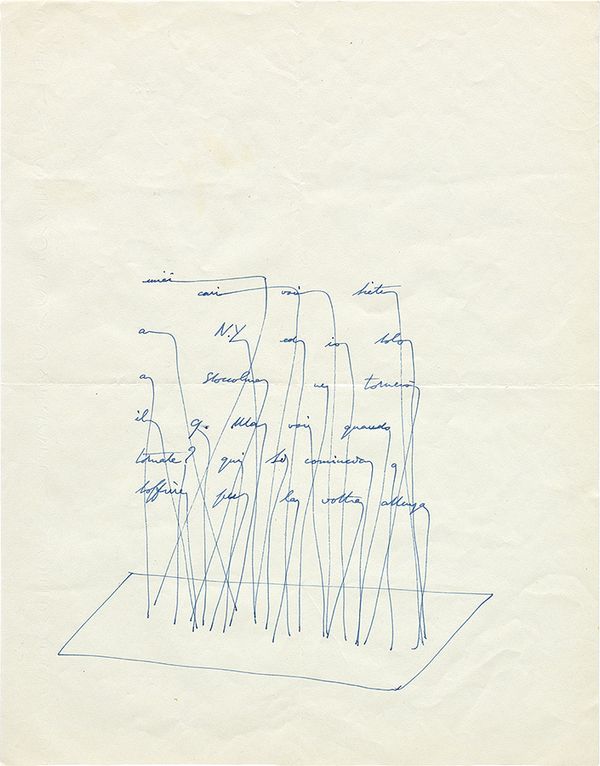
Gio Ponti, 'Miei cari' letter, circa 1955. Design London.
In this context, the letters of Gio Ponti provide a valuable source of inspiration. They invite us to rediscover our ability to imagine in unconventional ways, to look beyond immediate reality, and to explore new worlds through images and symbols. Ponti offers us an important lesson: communication is not just about words, but about signs, gestures, and images that, like his architecture, come to life only when intended for a specific person and a meaningful interaction. In a world that is increasingly digital and distant, these letters remind us of the importance of maintaining our capacity for direct, authentic, and imaginative communication.
Ultimately, images and words unite to communicate a thought. Imagination serves as the force that coordinates the sense of discourse.
Recommended Reading
Specialist Picks: Design London >
Collecting Guide: Postmodern and Contemporary Design 101 >
Spotlight on Women Designers >
Five Things to Know: Ettore Sottsass’ Early Enameled Copper Plates >
