28
華金.托里斯-卡西亞
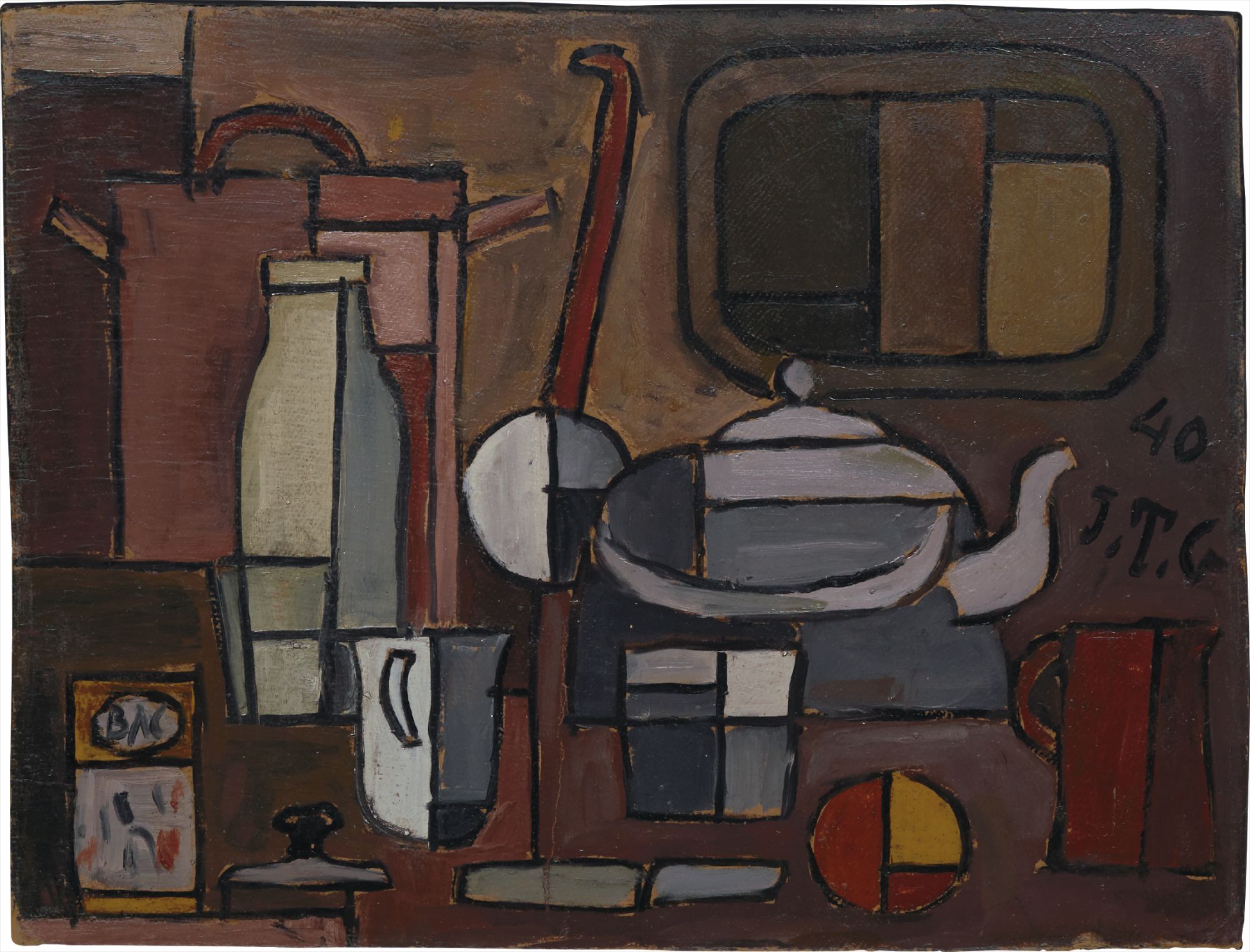
Objectos con estructura interior
This is work No. 1940.35 from the Online Catalogue Raisonné under the direction of Cecilia de Torres, Assisted by Susanna V. Temkin
完整圖錄內容
Torres-García’s return to Uruguay after 43 years of absence marked a pivotal moment in his career, coinciding with the time during which the present lot was created. He was delighted to witness the grand twentieth century metropolis that the capital of Uruguay had become, but he recognized that the artistic life in the city was outmoded. To this end, he started publishing innumerable articles in various papers, gave lectures and exhibited extensively throughout Montevideo. This was for the sole purpose of instructing his countrymen and gaining new converts to the cause of modern art. Importantly, in his native country he finally found a newly fresh artistic environment where he developed Constructive Universalism to its full potential. He began to introduce a series of symbolic and geometric forms, arranged with a remarkable sense of structural rhythm. These orthogonal symbols which include squares, triangles and other archetypes associated with Pre-Columbian art, alluded to the world of reason, matter and emotion. Torres-García also realized that his concept of Constructivism adapted perfectly to the cosmovision of various indigenous civilizations given their preference for abstraction and two-dimensional figures over naturalistic representation in their plastic arts.
The still life rendered in this work can also be placed within the larger panorama of the twentieth century aesthetic movements, where the painting is imbued with the aesthetic of Cubism, seen in the composition and palette. Furthermore, the Constructivism and palette of earthy and red undertones also allude to the artist’s series of wooden toys. This, in turn, evokes the Torres- García’s obsessive interest in wood as an artistic medium, which was, at the same time, something intimate and personal, as it related to his youth in Uruguay. The material of wood reminded him of his father’s sawmill next to their family owned shop in Montevideo during his youth.
In short, Objetos con estructura interior, 1940 is representative of a very important period within the artist’s oeuvre. This still life perfectly exemplifies Torres-García’s pictorial temperament. Indeed, in describing these quotidian elements from the reality around him, he does so by synthesis, rather than analysis, denoting more importance to the essence than to the detail. He remains in the world of figuration yet integrates abstraction’s structural grid within the composition. Torres-García accomplishes this by incorporating Cubist affiliations and Pre- Columbian abstract aesthetics within his work, thereby giving shape to and coloring his unique and masterful Constructive Universalism.
華金.托里斯-卡西亞
Uruguayan | B. 1874 D. 1949Joaquín Torres-García was born in Montevideo and moved to Barcelona with his family, studying at the Escuela Oficial de Bellas Artes. The Catalan Noucentismo movement provided the foundation for his artistic development. His work was also influenced by Neo-Plasticism, Cubism and Vibrationism, which fused Cubism and Futurism with urban imagery.
Torres-García returned to Uruguay after a 43-year absence. While at home, he continued to develop his iconic style of Constructive Universalism, a chief contribution to modernism that affected many younger generations of Uruguayan artists. This style aspired to establish a universal structural unity through synthetic abstraction. In order to accomplish this, Torres-García synthesized rather than analyzed the quotidian elements and urban scenes from reality. While remaining in the world of figuration, he integrated abstraction's structural grids within the composition, also incorporating pre-Columbian aesthetics.