

201
Patek Philippe
Ref. 1135
"Les 4 Saisons de Vivaldi"
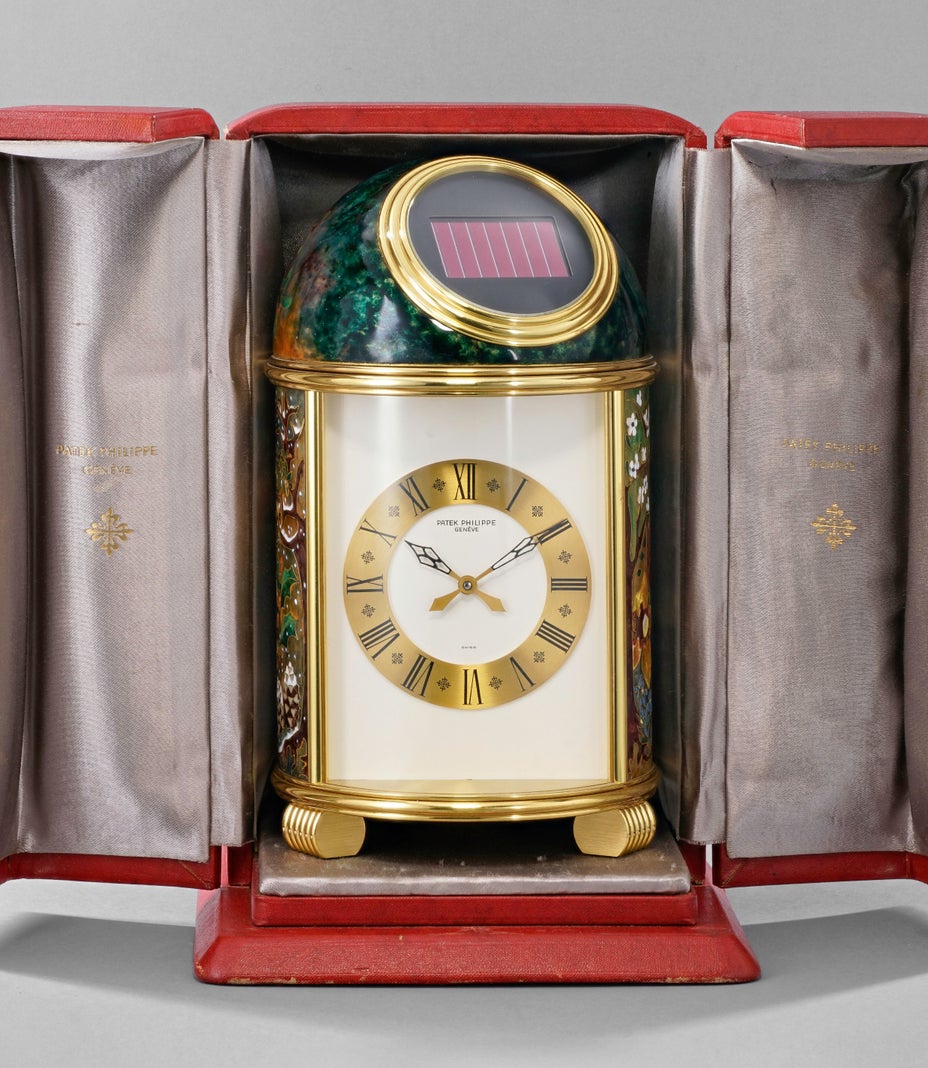
An extremely fine and unique gilt brass solar powered dome table clock with cloisonné enamel scene depicting Vivaldi's Four Seasons
完整圖錄內容
The Dome Clock not only displays beautiful art, but merges timekeeping with technological innovation. It is the perfect canvas for an artisan to showcase his or her ability to create beautiful paintings. To apply enamel on the curved panels requires extremely delicate handling and high technical ability, as enamel is particularly prone to cracking. The relatively vast space furthermore enables the artisan to exhibit a wide range of color and design.
The present example is inspired by Vivaldi's Four Seasons, as confirmed by the Extract from the Archives. The background is painted with luscious varying hues, ranging from swathes of deep forest green, to rich burgundy. Each panel showcases the wilting or waning of flora, depending on the season. The flowers are scattered throughout, providing vivid pops of color. The artisan’s use of gold cloisons is particularly impressive here, given the number of delicate flowers and leaves rendered throughout the clock.
Signed "EPL", the enamel work was most probably created by Elisabeth Perusset Lagger, one of Patek Philippe's best enamelists. Elisabeth Perusset Lagger is particularly well known for rendering images of nature.
The clock itself is preserved in astounding condition. There is no restoration to the panels, and the enamel remains intact, exhibiting its rich hues with no losses. Dome Clocks are increasingly collectible and valuable today, due to their rarity and technical superiority. To find one like the present example, still retaining its original fitted presentation box, is nothing short of extraordinary.
Patek Philippe
Swiss | 1839Since its founding in 1839, this famous Geneva-based firm has been surprising its clientele with superbly crafted timepieces fitted with watchmaking's most prestigious complications. Traditional and conservative designs are found across Patek Philippe's watches made throughout their history — the utmost in understated elegance.
Well-known for the Graves Supercomplication — a highly complicated pocket watch that was the world’s most complicated watch for 50 years — this family-owned brand has earned a reputation of excellence around the world. Patek's complicated vintage watches hold the highest number of world records for results achieved at auction compared with any other brand. For collectors, key models include the reference 1518, the world's first serially produced perpetual calendar chronograph, and its successor, the reference 2499. Other famous models include perpetual calendars such as the ref. 1526, ref. 3448 and 3450, chronographs such as the reference 130, 530 and 1463, as well as reference 1436 and 1563 split seconds chronographs. Patek is also well-known for their classically styled, time-only "Calatrava" dress watches, and the "Nautilus," an iconic luxury sports watch first introduced in 1976 as the reference 3700 that is still in production today.