1010
Frères Rochat
The Duke of Sussex Singing Bird Cage Clock
Frères Rochat,極度精美,鍍金銅製二問報時音樂鳥鳴活動人偶鳥籠座鐘,約1825年製。
估價
HK$480,000–960,000
€53,100–106,000
$61,500–123,000
成交價
HK$3,810,000
製造商
Frères Rochat
年份
Circa 1825
機芯編號
586
型號名稱
The Duke of Sussex Singing Bird Cage Clock
材料
Ormolu
機芯
Clock movement: cylinder escapement, two going barrels; Singing Bird movement: fusée-and-chain, circular bellows
尺寸
110mm width x 280mm high
簽名
Singing bird movement signed
完整圖錄內容
Former property of His Royal Highness Augustus Frederick, Duke of Sussex
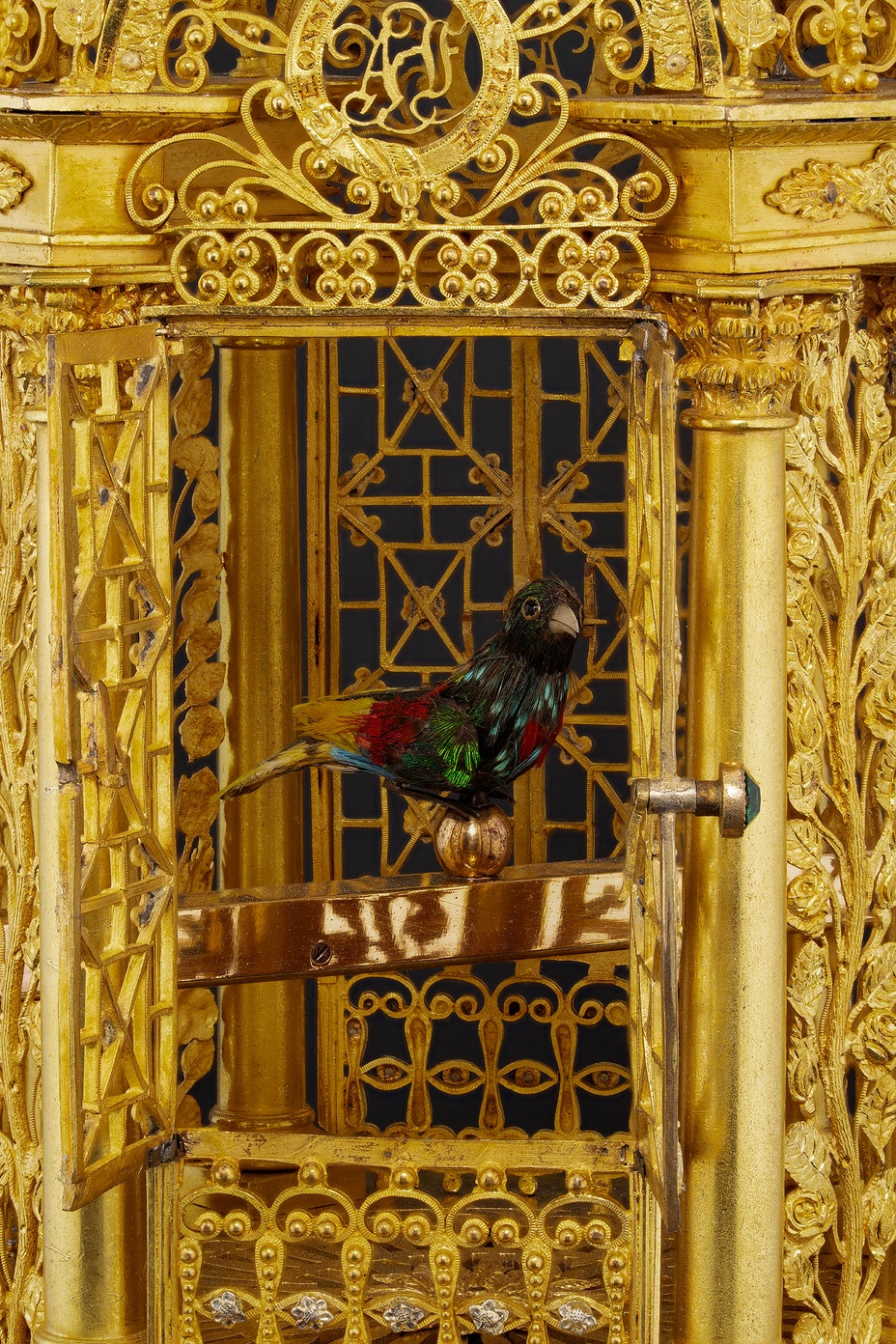
Often crafted for members of royalty, this magnificent birdcage belonged to His Royal Highness Augustus Frederick, Duke of Sussex (1773-1843), the sixth son and ninth child of King George III and Queen Charlotte. The birdcage was sold at auction on July 4, 1843, for 41 guineas, a significant sum considering an average laborer's monthly earnings were about 2 guineas. This sale represented roughly two years' salary for a typical worker. The Duke's clock and watch collection was remarkable, with the items in the 1843 auction showcasing his deep understanding of horology. His collection included majestic clocks from renowned makers like Joseph Knibb and Thomas Tompion, as well as watches and chronometers by John Arnold, Thomas Mudge and Breguet, among others. The present birdcage was the fourth most expensive item out of 137 lots in the sale. Its royal provenance is supported by the filigree panels featuring the Royal Garter engraved with "Honi Soit Qui Mal Y Pense", surmounted by a crown and centered with the monogram "AF" (Augustus Frederick).
The singing birdcage has long been regarded as a mythical piece of art since the early 19th century. A remarkable example of mechanical artistry, it combines intricate craftsmanship with the enchanting allure of nature. These cages housed exquisitely engineered automata that mimicked the songs of various birds. Crafted during the Industrial Revolution, they showcased advanced clockwork mechanisms, allowing the birds to flap their wings, turn their heads, and produce melodious tunes that captivated audiences. Often adorned with delicate floral motifs and vibrant colors, these cages served not only as functional timepieces but also as opulent decorative objects, reflecting the Victorian fascination with nature and technology. Collectors cherished them as symbols of elegance and innovation, making the singing birdcage a timeless treasure of the period.
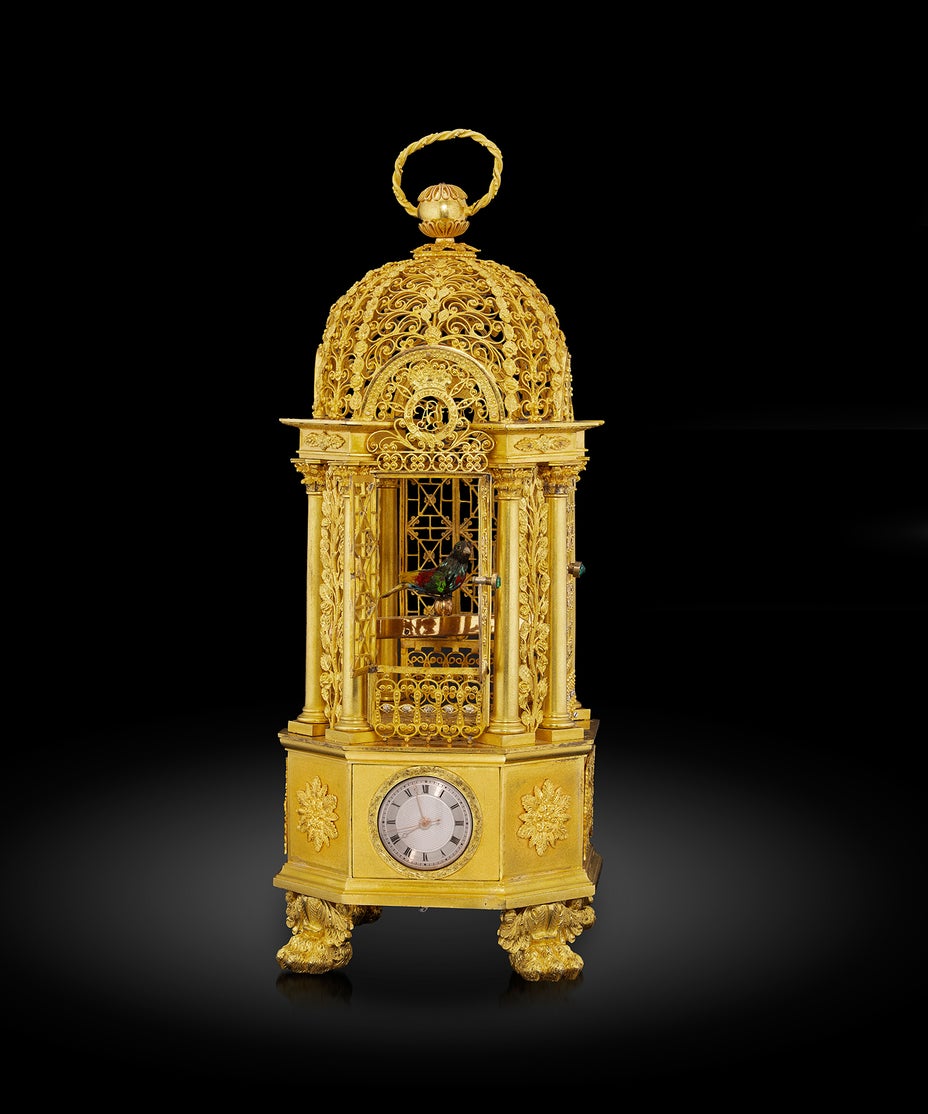
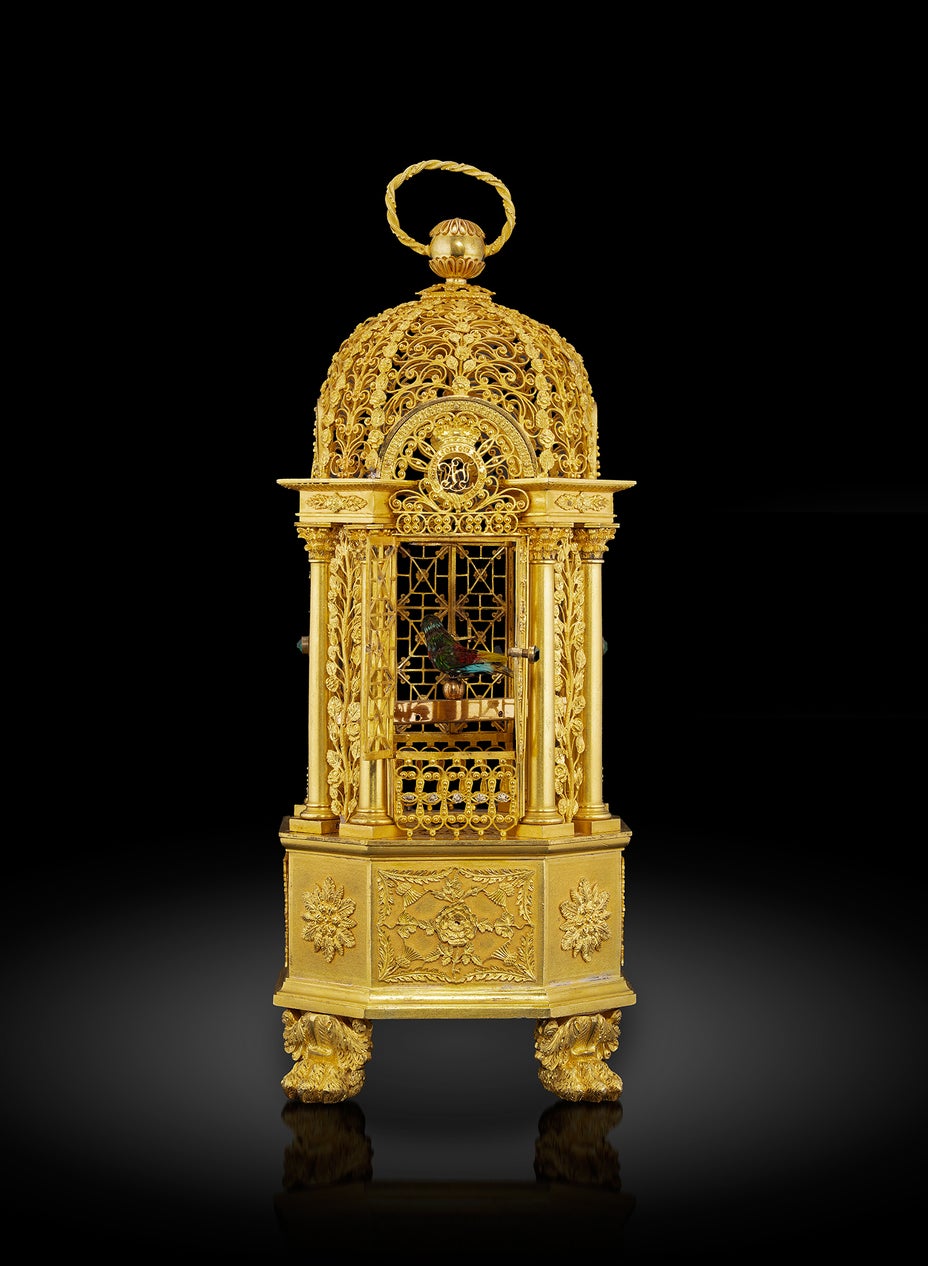
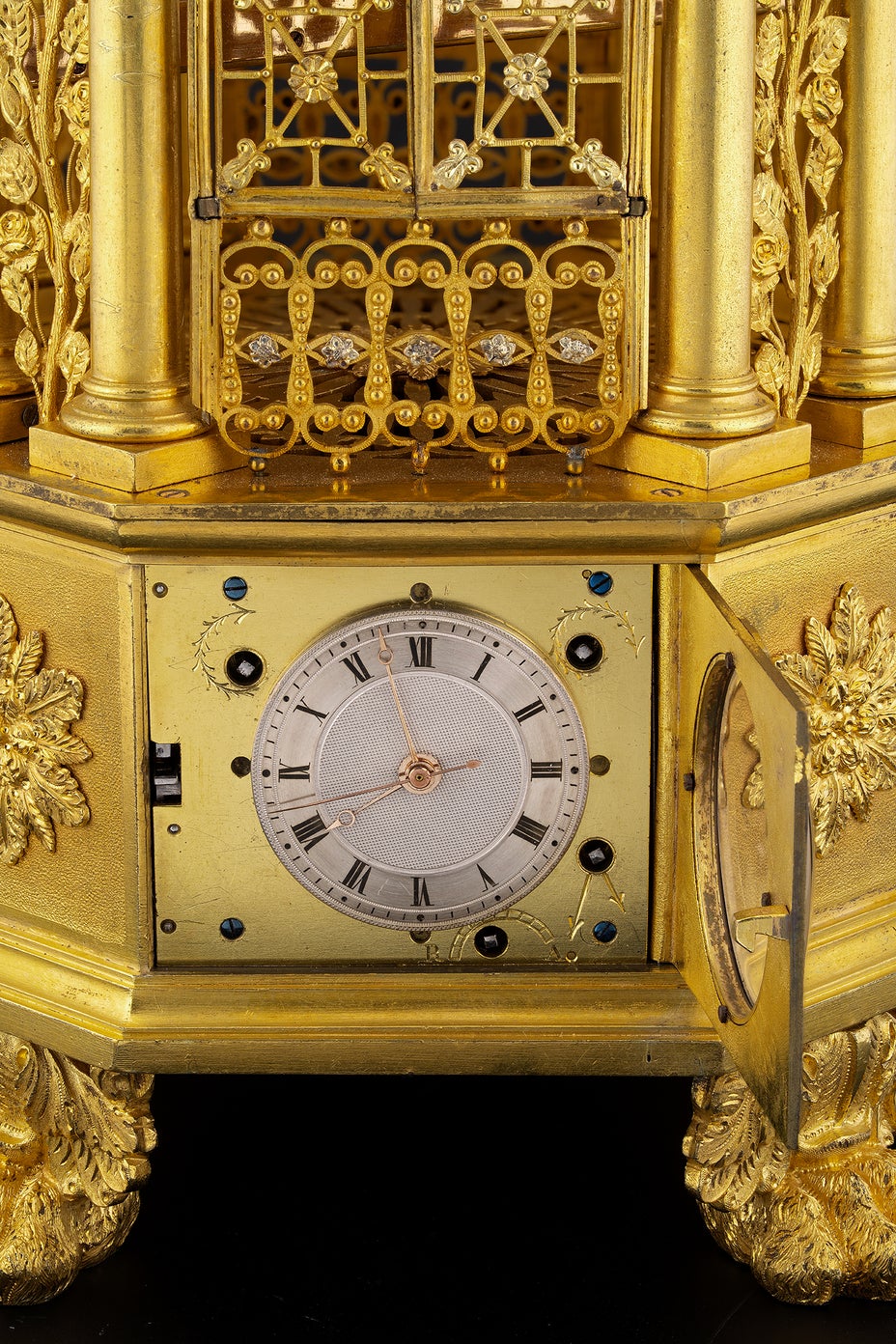
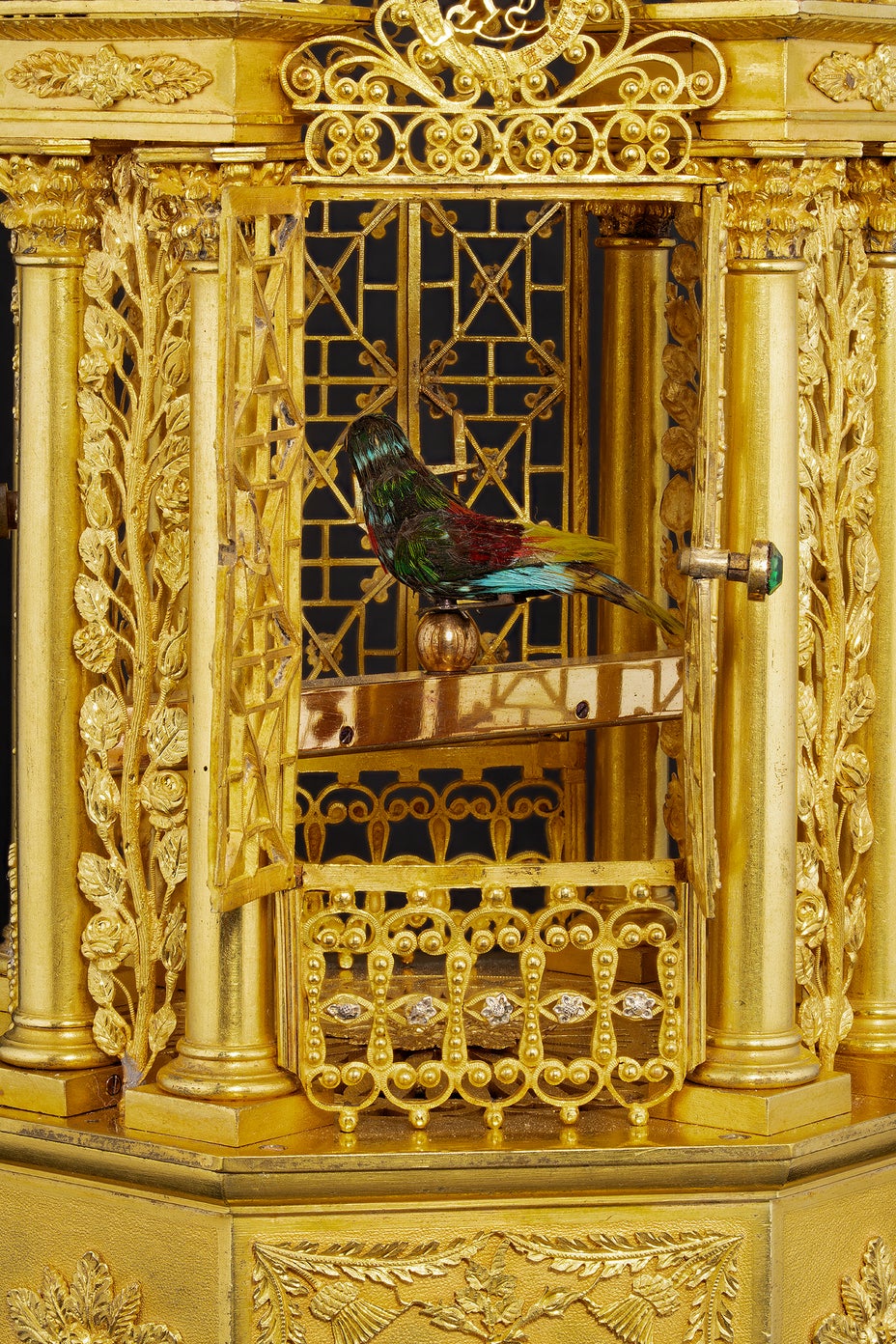
This particular example is crafted with extraordinary detail and luxury. The filigree case resembles a birdcage, featuring a rope-twist loop handle atop a domed structure supported by four pairs of Corinthian columns with arches set between filigree panels. The front and rear doors, along with the octagonal base, showcase matted panels overlaid with foliate mounts in varying gilding. The front is adorned with a clock dial featuring a hinged matted cover with a push release button underneath, revealing a silver chapter disc with Roman numerals, an engine-turned center, and gold hour and minute hands with a sweeping second hand. Winding squares are positioned above for the going and strike trains, with hand-set and regulation squares in the right-hand corner.
The clock movement is equipped with a cylinder escapement and two going barrels. The quarter strike is activated on a single gong by two hammers, while the singing bird mechanism employs a fusée-and-chain transmission with circular bellows. On the left side of the birdcage, a steel lever allows the bird automaton to sound or silence on the hour, while another lever on the right side activates the bird manually.
By opening the front and rear doors, the beautifully decorated bird can sing four different tunes and articulate in five distinct ways when the mechanism is engaged: its tail, beak, wings, head rotation, and side-to-side movement. This bird is one of the most vibrant and lively examples found in a singing birdcage, showcasing animated movements and chirping.
Few artisans possessed the skill required to craft these birdcages and their intricate movements. The maker’s punch on this clock “FR” represents the workshops of Frères Rochat. The brothers François Elisée (1771-1836), Frédérick (1774-1848), and Samuel Henri (1777-1854) were the sons of David Rochat, a master watchmaker from Le Brassus in the Vallée de Joux. They provided ebauches for singing bird movements to the esteemed Swiss automaton clockmakers such as Jacquet Droz & Leschot. Another punch mark on the movement has been found on similar singing bird cage movements, although its origins remain a mystery.
However, the letter “M” may be attributed to the stamp of the Swiss watchmaker Milleret. Based on the auction catalogue from 1843 dedicated to the Duke's collection, it is noted that the Duke purchased several expensive watches by Milleret, including a repeating watch that sold for 34 guineas. The present lot was intriguingly cataloged as “A small watch by Milleret, in an ormolu filigree case, in the form of an octagonal temple, containing a bird, which sings and moves its wings on a musical stand.”
The condition of the birdcage is exceptionally well-preserved, with sharp engravings. The singing bird mechanism operates beautifully and audibly, and the colors on the bird remain vibrant and lively. Its last appearance at an international auction was in 2000, and it has not been touched since. This artisanal gem is extremely rare, and the combination of its provenance and condition makes it a once-in-a-blue-moon opportunity to acquire a purely mechanical beauty.
Often crafted for members of royalty, this magnificent birdcage belonged to His Royal Highness Augustus Frederick, Duke of Sussex (1773-1843), the sixth son and ninth child of King George III and Queen Charlotte. The birdcage was sold at auction on July 4, 1843, for 41 guineas, a significant sum considering an average laborer's monthly earnings were about 2 guineas. This sale represented roughly two years' salary for a typical worker. The Duke's clock and watch collection was remarkable, with the items in the 1843 auction showcasing his deep understanding of horology. His collection included majestic clocks from renowned makers like Joseph Knibb and Thomas Tompion, as well as watches and chronometers by John Arnold, Thomas Mudge and Breguet, among others. The present birdcage was the fourth most expensive item out of 137 lots in the sale. Its royal provenance is supported by the filigree panels featuring the Royal Garter engraved with "Honi Soit Qui Mal Y Pense", surmounted by a crown and centered with the monogram "AF" (Augustus Frederick).
The singing birdcage has long been regarded as a mythical piece of art since the early 19th century. A remarkable example of mechanical artistry, it combines intricate craftsmanship with the enchanting allure of nature. These cages housed exquisitely engineered automata that mimicked the songs of various birds. Crafted during the Industrial Revolution, they showcased advanced clockwork mechanisms, allowing the birds to flap their wings, turn their heads, and produce melodious tunes that captivated audiences. Often adorned with delicate floral motifs and vibrant colors, these cages served not only as functional timepieces but also as opulent decorative objects, reflecting the Victorian fascination with nature and technology. Collectors cherished them as symbols of elegance and innovation, making the singing birdcage a timeless treasure of the period.
This particular example is crafted with extraordinary detail and luxury. The filigree case resembles a birdcage, featuring a rope-twist loop handle atop a domed structure supported by four pairs of Corinthian columns with arches set between filigree panels. The front and rear doors, along with the octagonal base, showcase matted panels overlaid with foliate mounts in varying gilding. The front is adorned with a clock dial featuring a hinged matted cover with a push release button underneath, revealing a silver chapter disc with Roman numerals, an engine-turned center, and gold hour and minute hands with a sweeping second hand. Winding squares are positioned above for the going and strike trains, with hand-set and regulation squares in the right-hand corner.
The clock movement is equipped with a cylinder escapement and two going barrels. The quarter strike is activated on a single gong by two hammers, while the singing bird mechanism employs a fusée-and-chain transmission with circular bellows. On the left side of the birdcage, a steel lever allows the bird automaton to sound or silence on the hour, while another lever on the right side activates the bird manually.
By opening the front and rear doors, the beautifully decorated bird can sing four different tunes and articulate in five distinct ways when the mechanism is engaged: its tail, beak, wings, head rotation, and side-to-side movement. This bird is one of the most vibrant and lively examples found in a singing birdcage, showcasing animated movements and chirping.
Few artisans possessed the skill required to craft these birdcages and their intricate movements. The maker’s punch on this clock “FR” represents the workshops of Frères Rochat. The brothers François Elisée (1771-1836), Frédérick (1774-1848), and Samuel Henri (1777-1854) were the sons of David Rochat, a master watchmaker from Le Brassus in the Vallée de Joux. They provided ebauches for singing bird movements to the esteemed Swiss automaton clockmakers such as Jacquet Droz & Leschot. Another punch mark on the movement has been found on similar singing bird cage movements, although its origins remain a mystery.
However, the letter “M” may be attributed to the stamp of the Swiss watchmaker Milleret. Based on the auction catalogue from 1843 dedicated to the Duke's collection, it is noted that the Duke purchased several expensive watches by Milleret, including a repeating watch that sold for 34 guineas. The present lot was intriguingly cataloged as “A small watch by Milleret, in an ormolu filigree case, in the form of an octagonal temple, containing a bird, which sings and moves its wings on a musical stand.”
The condition of the birdcage is exceptionally well-preserved, with sharp engravings. The singing bird mechanism operates beautifully and audibly, and the colors on the bird remain vibrant and lively. Its last appearance at an international auction was in 2000, and it has not been touched since. This artisanal gem is extremely rare, and the combination of its provenance and condition makes it a once-in-a-blue-moon opportunity to acquire a purely mechanical beauty.