944
Dent
Grand complication
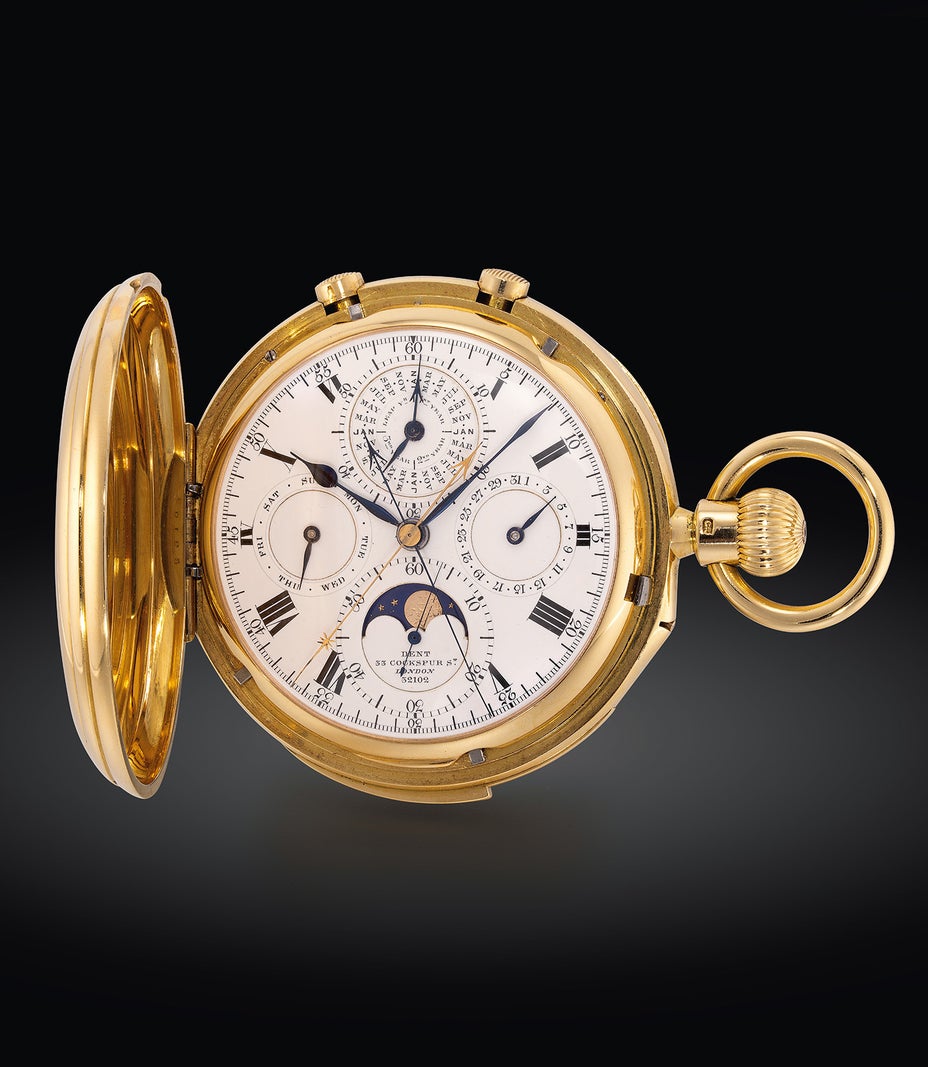
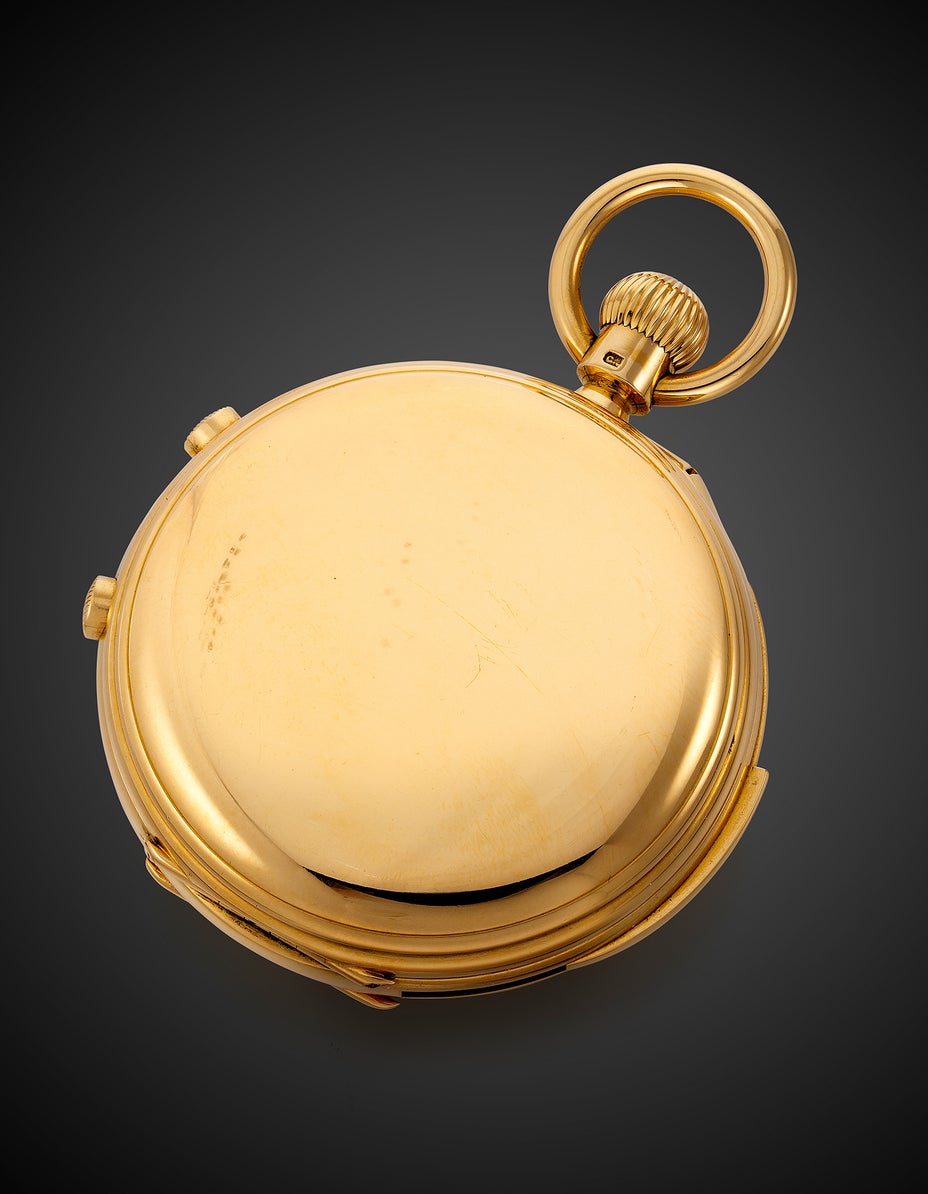
Dent,十分精細,黃金三問追針計時萬年曆獵殼懷錶,備琺瑯錶盤、月相、閏年顯示,約1900年製。
估價
HK$320,000–640,000
€35,400–70,800
$41,000–82,100
成交價
HK$952,500
製造商
Dent
年份
Circa 1900
機芯編號
32’102
錶殼號碼
32’102
型號名稱
Grand complication
材料
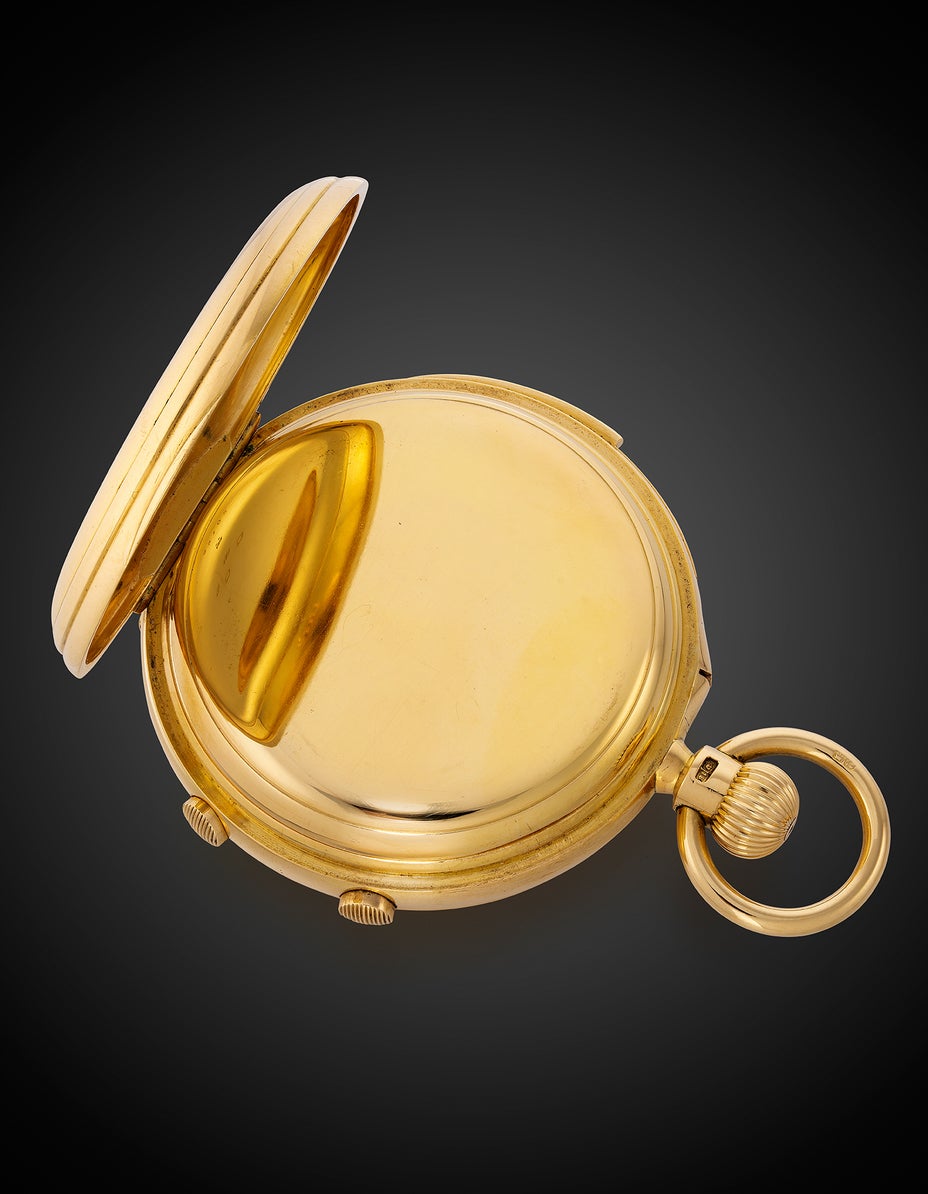
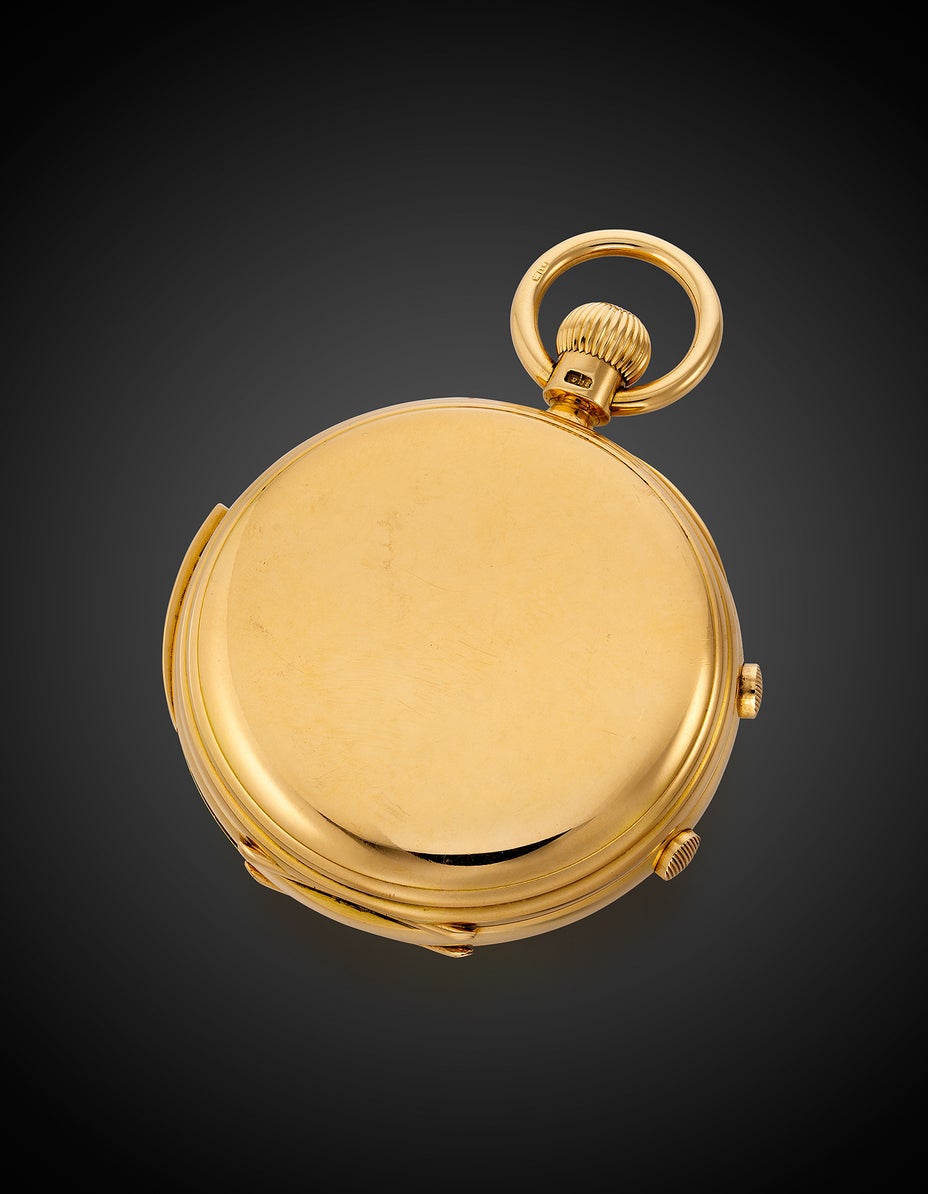
18K yellow gold
機芯
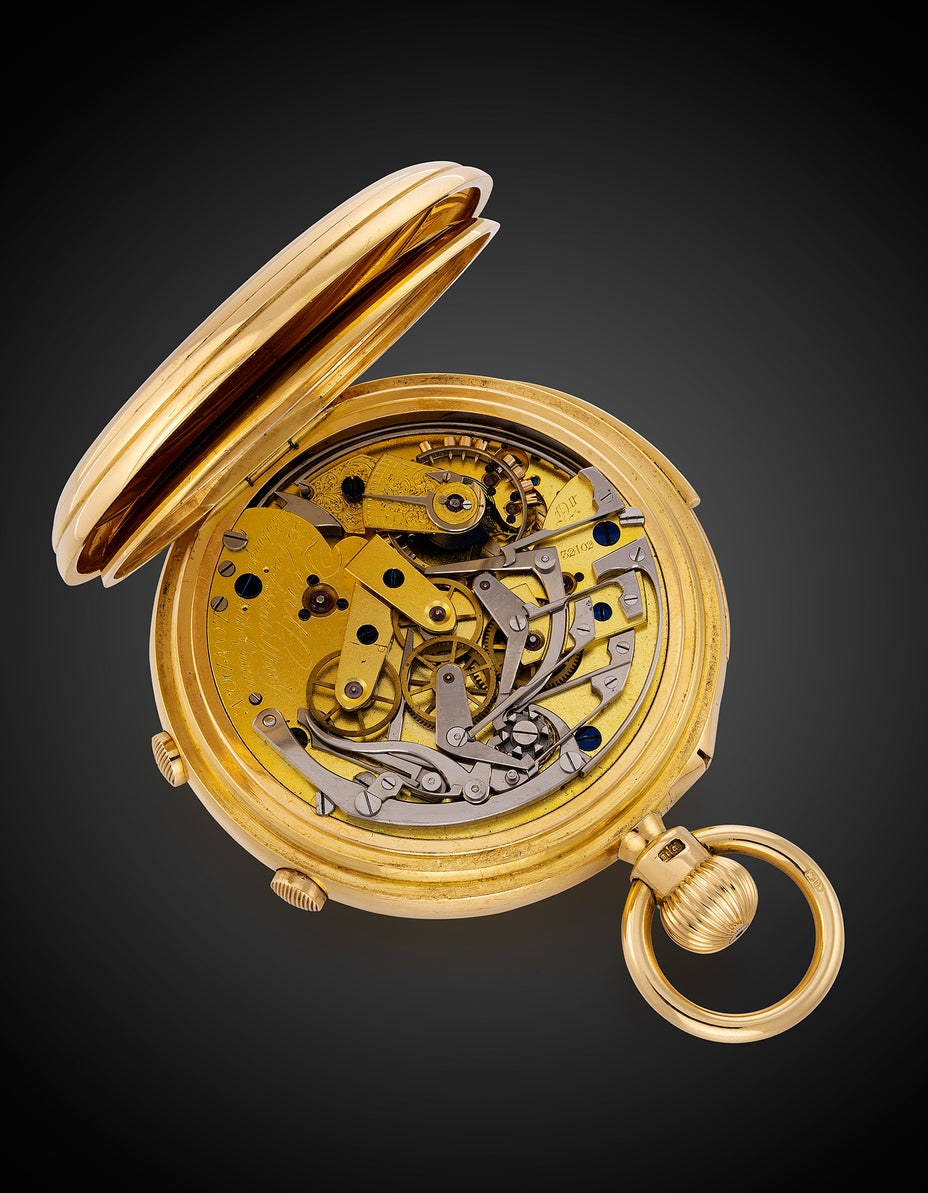
Manual, 19” gilt brass three quarter plate English lever movement, 26 jewels
尺寸
55mm diameter
簽名
Case with London hallmarks for 1900, dial signed “Dent, 32 Cockspur St, London”, movement signed “Dent, 32 Cockspur Street, Watchmaker to the Queen, London”. Case, cuvette, dial and movement numbered.
完整圖錄內容
At the turn of the 20th century, no nation rivalled Great Britain in its watchmaking artistry. From the late 19th century into the Edwardian age, British workshops produced works of unrivalled complexity and beauty, today treasured by collectors for both their rarity and their innovation. The present example, a Dent “Grande Complication”, unites a minute repeater, split-seconds chronograph, and perpetual calendar with moon phases in a 18K yellow gold hunter-cased pocket watch.
Founded in 1814 by Edward J. Dent, the company became synonymous with precision and innovation during the great age of Victorian expansion. Dent chronometers navigated Royal Navy vessels and guided explorers across uncharted worlds. In 1852, the firm constructed the Standard Clock at the Royal Observatory, Greenwich, the reference for “Greenwich Mean Time” (GMT), regulating the Empire until replaced in 1946. Dent also built perhaps the most famous clock of all: the Great Clock of the Palace of Westminster, universally known as “Big Ben”.
Dent’s reputation brought Royal Warrants from Queen Victoria, Prince Albert, and successive monarchs, extending to the Russian Tsars and the Japanese Emperor Meiji. By the dawn of the 20th century, Dent occupied a central place in British horological prestige, with premises at 33 Cockspur Street, as inscribed on the dial of the present watch. The movement is further engraved with the address along with “Watchmaker to the Queen, London”.
Hallmarked in London for 1900, its case is fitted with a slide at 6 o’clock activating the repeater, striking the hours, quarters, and minutes on two gongs. The split‑seconds chronograph, controlled by dual pushers at 11 and 1 o’clock, records elapsed time via a 60‑minute counter at 12 o’clock, ingeniously integrated with leap-year and month indications. The white enamel dial, crafted and signed by the eminent dial‑maker Frederick Willis, exemplifies the highest standards of the age. Roman numerals encircle subsidiary dials displaying the day, month, and date, alongside running seconds, moon phases, and the lunar cycle. Willis’ work was sought by Britain’s finest makers and reserved for their most important creations.
Unseen publicly since it last appeared at auction in 1989, this well-preserved Dent Grande Complication is an exceptionally collectible timepiece that embodies the inventive spirit of British horology.
Founded in 1814 by Edward J. Dent, the company became synonymous with precision and innovation during the great age of Victorian expansion. Dent chronometers navigated Royal Navy vessels and guided explorers across uncharted worlds. In 1852, the firm constructed the Standard Clock at the Royal Observatory, Greenwich, the reference for “Greenwich Mean Time” (GMT), regulating the Empire until replaced in 1946. Dent also built perhaps the most famous clock of all: the Great Clock of the Palace of Westminster, universally known as “Big Ben”.
Dent’s reputation brought Royal Warrants from Queen Victoria, Prince Albert, and successive monarchs, extending to the Russian Tsars and the Japanese Emperor Meiji. By the dawn of the 20th century, Dent occupied a central place in British horological prestige, with premises at 33 Cockspur Street, as inscribed on the dial of the present watch. The movement is further engraved with the address along with “Watchmaker to the Queen, London”.
Hallmarked in London for 1900, its case is fitted with a slide at 6 o’clock activating the repeater, striking the hours, quarters, and minutes on two gongs. The split‑seconds chronograph, controlled by dual pushers at 11 and 1 o’clock, records elapsed time via a 60‑minute counter at 12 o’clock, ingeniously integrated with leap-year and month indications. The white enamel dial, crafted and signed by the eminent dial‑maker Frederick Willis, exemplifies the highest standards of the age. Roman numerals encircle subsidiary dials displaying the day, month, and date, alongside running seconds, moon phases, and the lunar cycle. Willis’ work was sought by Britain’s finest makers and reserved for their most important creations.
Unseen publicly since it last appeared at auction in 1989, this well-preserved Dent Grande Complication is an exceptionally collectible timepiece that embodies the inventive spirit of British horology.