1091
Attributed to Piguet Meylan
Musique Aiguilles
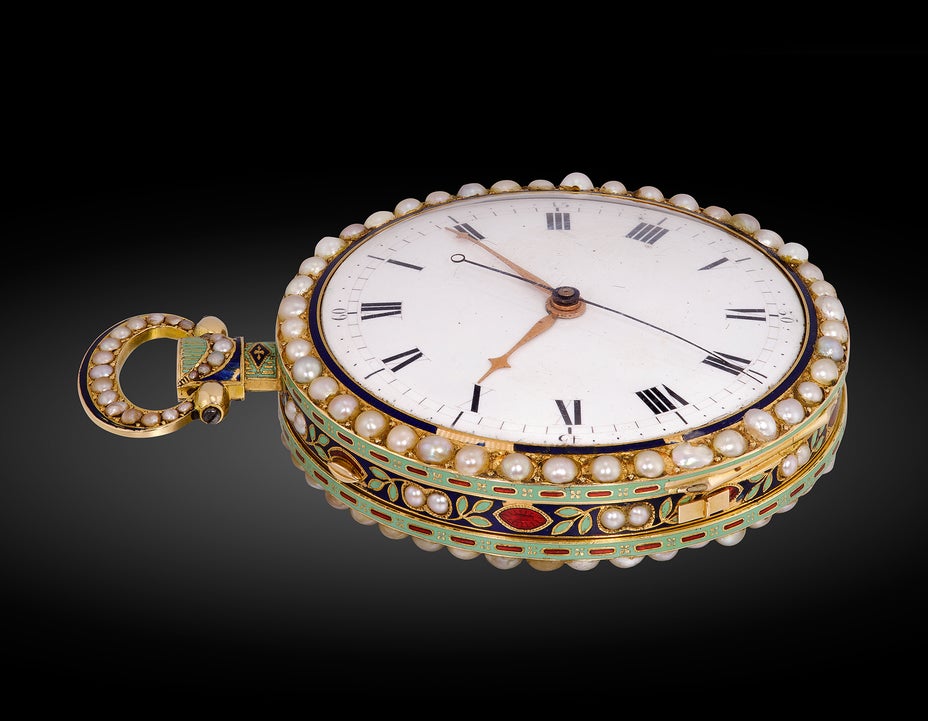
應為Piguet Meylan,罕見、精美,黃金鑲珍珠大八件大三針二問懷錶,備白色琺瑯錶盤、鍍金雕花機芯,可歸為Jean Francois Victor Dupont之彩繪琺瑯作品,特為中國市場製造,約1800年製。
估價
HK$200,000–400,000
€22,300–44,600
$25,600–51,300
成交價
HK$889,000
製造商
Attributed to Piguet Meylan
年份
Circa 1800
錶殼號碼
1493
型號名稱
Musique Aiguilles
材料
Yellow gold, pearls and enamel
機芯
Manual, cylinder movement
尺寸
58mm diameter
完整圖錄內容
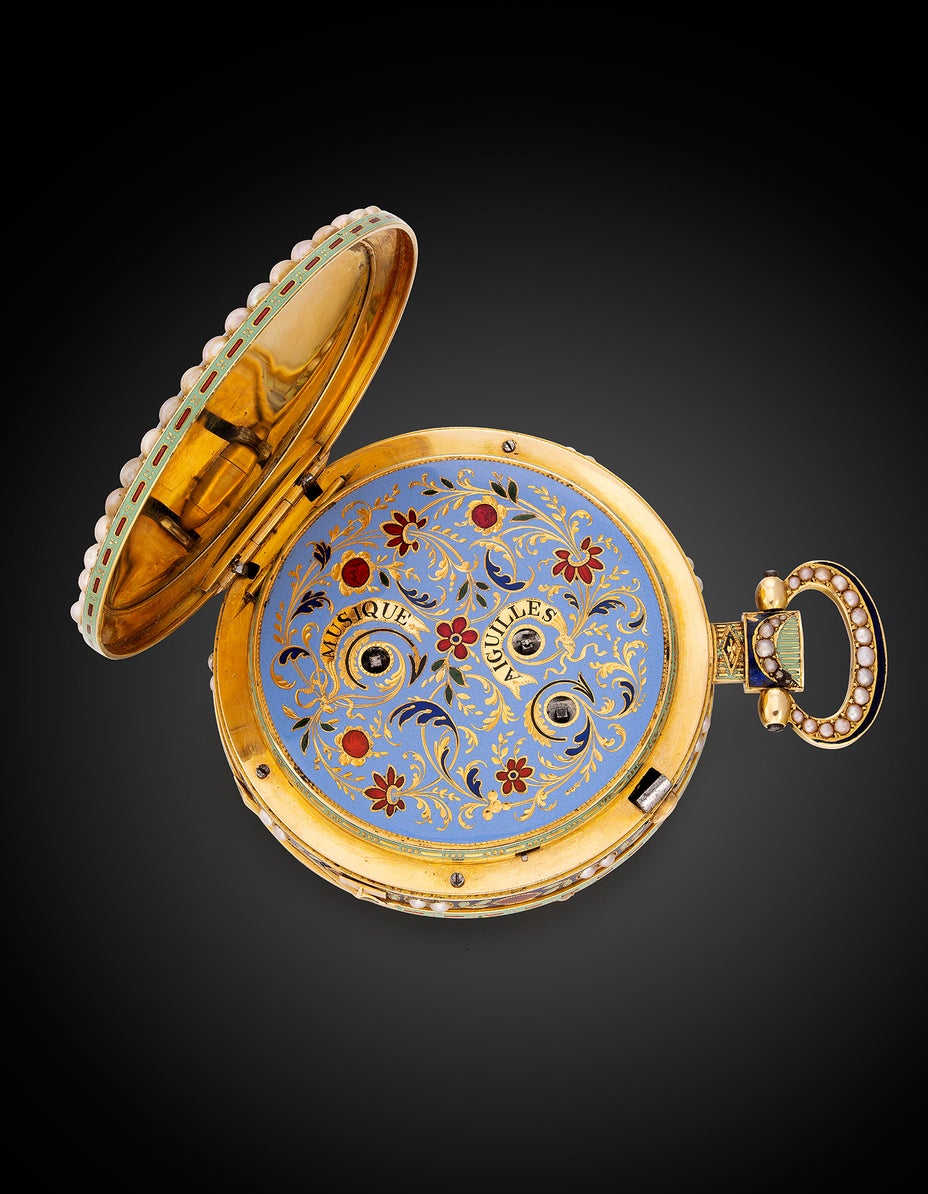
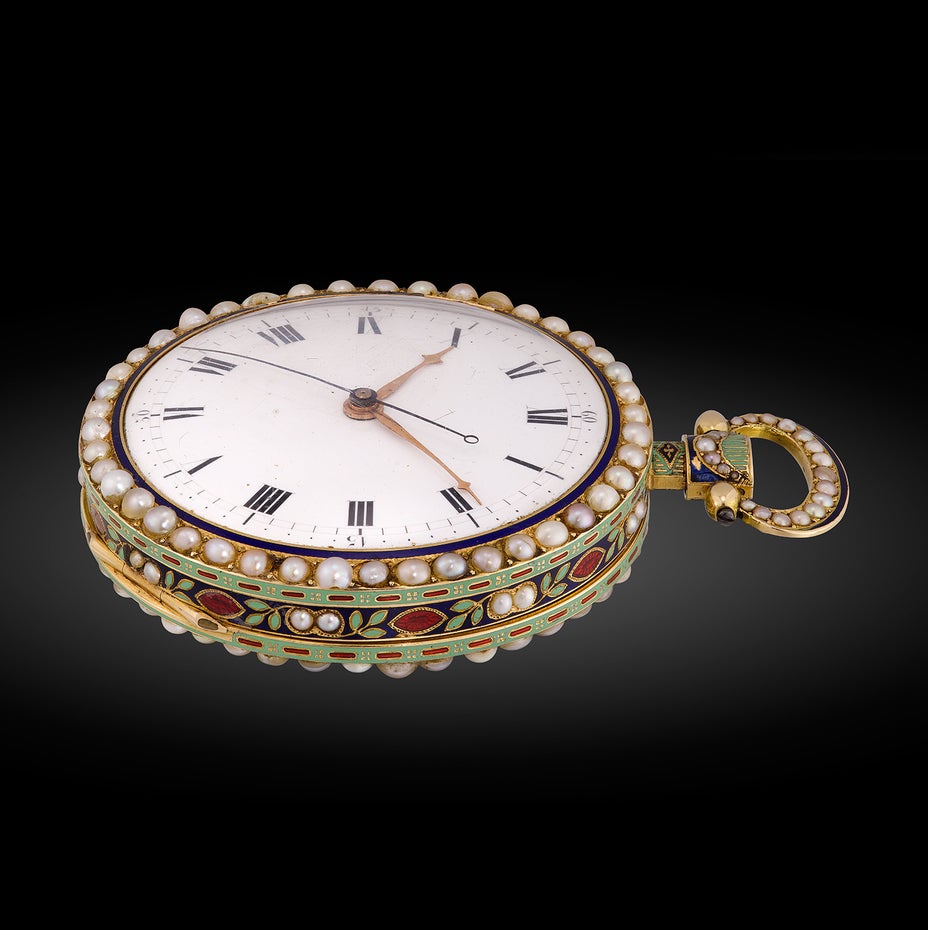
In striking contrast to its opulently adorned case, this distinguished timepiece reveals a dial of remarkable restraint. The white enamel surface is punctuated by Roman numerals formed with short, broad strokes, accompanied by a centre seconds. This understated aesthetic is emblematic of pocket watches produced in the Empire style. The case, inspired by the whimsical design fashionable in the early nineteenth century, is highly distinctive and replete with charming embellishments. The gold cuvette is exquisitely decorated with polychrome enamel flowers set against a field of opaque powder blue enamel, bearing the inscription “Musique Aiguilles”, denoting its function as a musical watch. The movement can be attributed to the workshop of the renowned watchmakers and goldsmiths Isaac-Daniel Piguet (1775-1841) and Philippe-Samuel Meylan (1772-1845), amongst Switzerland's foremost makers of musical and automaton watches mainly for the Chinese market. Within the cuvette, the case maker’s mark “I.E.” is stamped inside a diamond-shaped cartouche, with the case number engraved beneath. The band is, again, adorned with opaque blue enamel, interspersed with translucent red enamel ovals and green enamel foliage, each motif alternating with lustrous pearls. The rims are enriched with opaque green and red enamel geometric patterns, while the bezels, pendant, and bow are all set with pearls to complete the composition with a flourish of luxury.
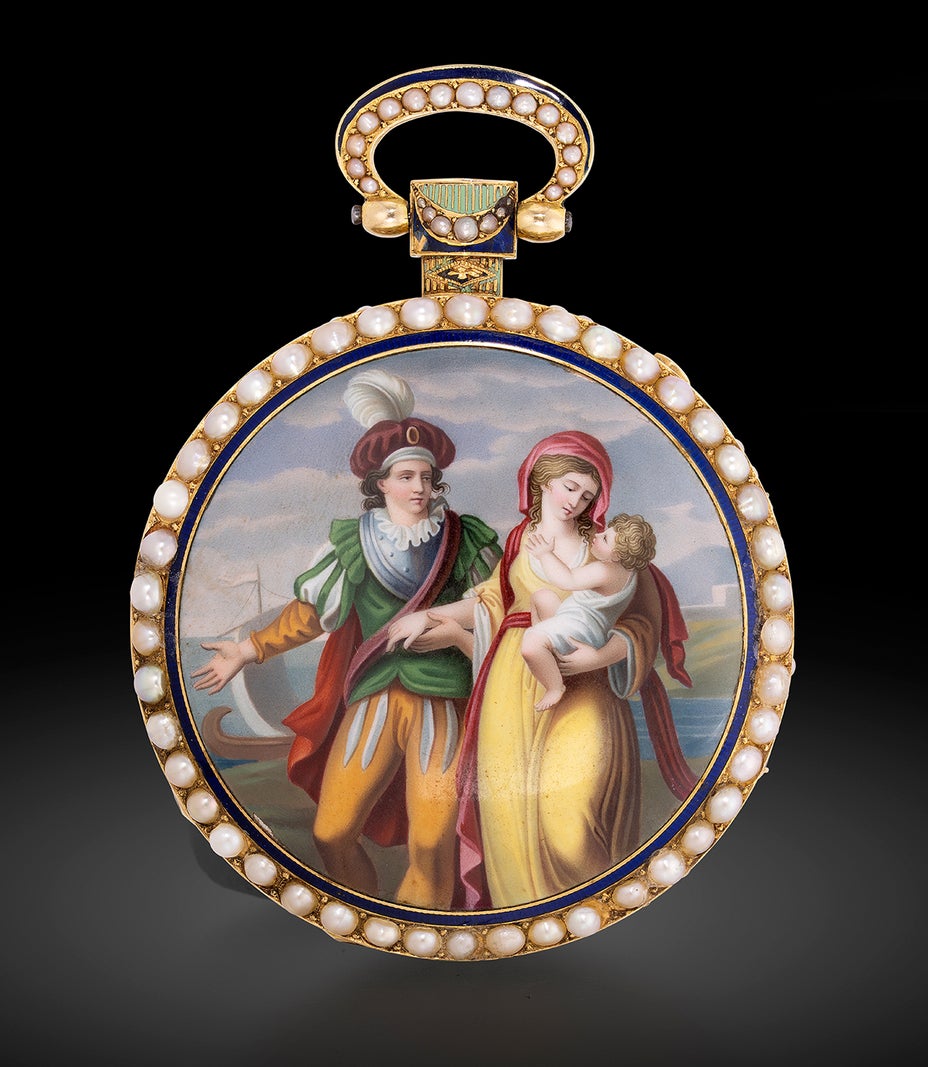
Empire-style watches were often the result of collaboration with eminent enamel painters, among them François Dupont, Richter, Dufaux, L’Evesque, Roux, and Lissignol. While floral motifs, particularly peonies influenced by oriental art and Chinese porcelain, were prevalent, the present example features an evocative polychrome enamel scene. On the back panel, a woman cradling a child is consoled by her husband, who appears poised to embark upon a ship at the pier. The gentleman is attired in vivid, elaborate garments with a feathered hat, suggestive of a nobleman or explorer, while the lady wears robes of yellow and red. The composition, with its finely rendered figures and rich palette, reflects the influence of Italian schools of painting, particularly those active in Tuscany during the nineteenth century or earlier, drawing inspiration from Renaissance masters.
This scene exemplifies the pinnacle of Swiss enamel artistry from the early nineteenth century. The colours are delicately chosen, and the surface polish is executed with exceptional finesse. It is customary for such panels to remain unsigned, as most Geneva artists of the period refrained from marking their work. Only three painters—Jean-François Soiron, Jean Louis Richter, and Jean François Victor Dupont—are known to have signed their creations with regularity. The present enamel is most plausibly attributed to Dupont. His style is readily identifiable to the discerning eye: figures are prominently grouped in the foreground, occupying the majority of the pictorial space, with only minimal background elements rendered in perspective. The narrative unfolds entirely in the foreground, with the figures commanding full attention. These hallmarks are clearly evident in this example.
Dupont’s mastery is revealed in the proportions and gestures of his figures, which convey a sense of continuity and vitality. His distinctive approach renders his compositions truly inimitable. Notably, he was among the few artists to employ the lost “pointillé” technique for rendering faces and hands, using a single-bristle brush. This rare and meticulous method further elevates the prestige of the piece.
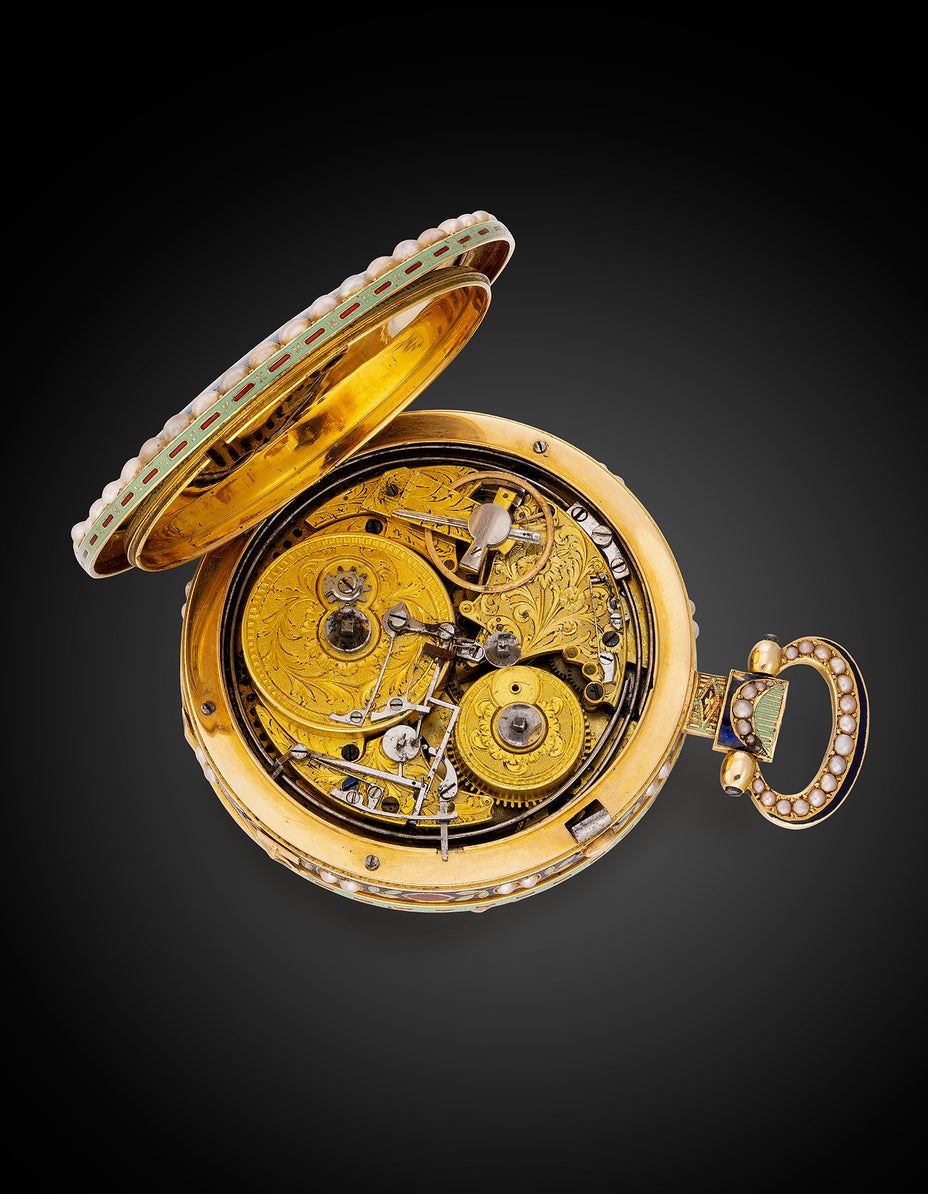
Beneath the richly decorated golden cuvette lies a movement preserved in exceptional condition for over two centuries. It comprises a gilt cylinder mechanism, featuring a three-arm balance, a pinned disc musical complication, and barrels and plates engraved with elegant foliate scrolls. The harmonious union of mechanical sophistication and artistic excellence renders this timepiece a superlative example of horological and decorative craftsmanship.
Empire-style watches were often the result of collaboration with eminent enamel painters, among them François Dupont, Richter, Dufaux, L’Evesque, Roux, and Lissignol. While floral motifs, particularly peonies influenced by oriental art and Chinese porcelain, were prevalent, the present example features an evocative polychrome enamel scene. On the back panel, a woman cradling a child is consoled by her husband, who appears poised to embark upon a ship at the pier. The gentleman is attired in vivid, elaborate garments with a feathered hat, suggestive of a nobleman or explorer, while the lady wears robes of yellow and red. The composition, with its finely rendered figures and rich palette, reflects the influence of Italian schools of painting, particularly those active in Tuscany during the nineteenth century or earlier, drawing inspiration from Renaissance masters.
This scene exemplifies the pinnacle of Swiss enamel artistry from the early nineteenth century. The colours are delicately chosen, and the surface polish is executed with exceptional finesse. It is customary for such panels to remain unsigned, as most Geneva artists of the period refrained from marking their work. Only three painters—Jean-François Soiron, Jean Louis Richter, and Jean François Victor Dupont—are known to have signed their creations with regularity. The present enamel is most plausibly attributed to Dupont. His style is readily identifiable to the discerning eye: figures are prominently grouped in the foreground, occupying the majority of the pictorial space, with only minimal background elements rendered in perspective. The narrative unfolds entirely in the foreground, with the figures commanding full attention. These hallmarks are clearly evident in this example.
Dupont’s mastery is revealed in the proportions and gestures of his figures, which convey a sense of continuity and vitality. His distinctive approach renders his compositions truly inimitable. Notably, he was among the few artists to employ the lost “pointillé” technique for rendering faces and hands, using a single-bristle brush. This rare and meticulous method further elevates the prestige of the piece.
Beneath the richly decorated golden cuvette lies a movement preserved in exceptional condition for over two centuries. It comprises a gilt cylinder mechanism, featuring a three-arm balance, a pinned disc musical complication, and barrels and plates engraved with elegant foliate scrolls. The harmonious union of mechanical sophistication and artistic excellence renders this timepiece a superlative example of horological and decorative craftsmanship.