43
David Hockney
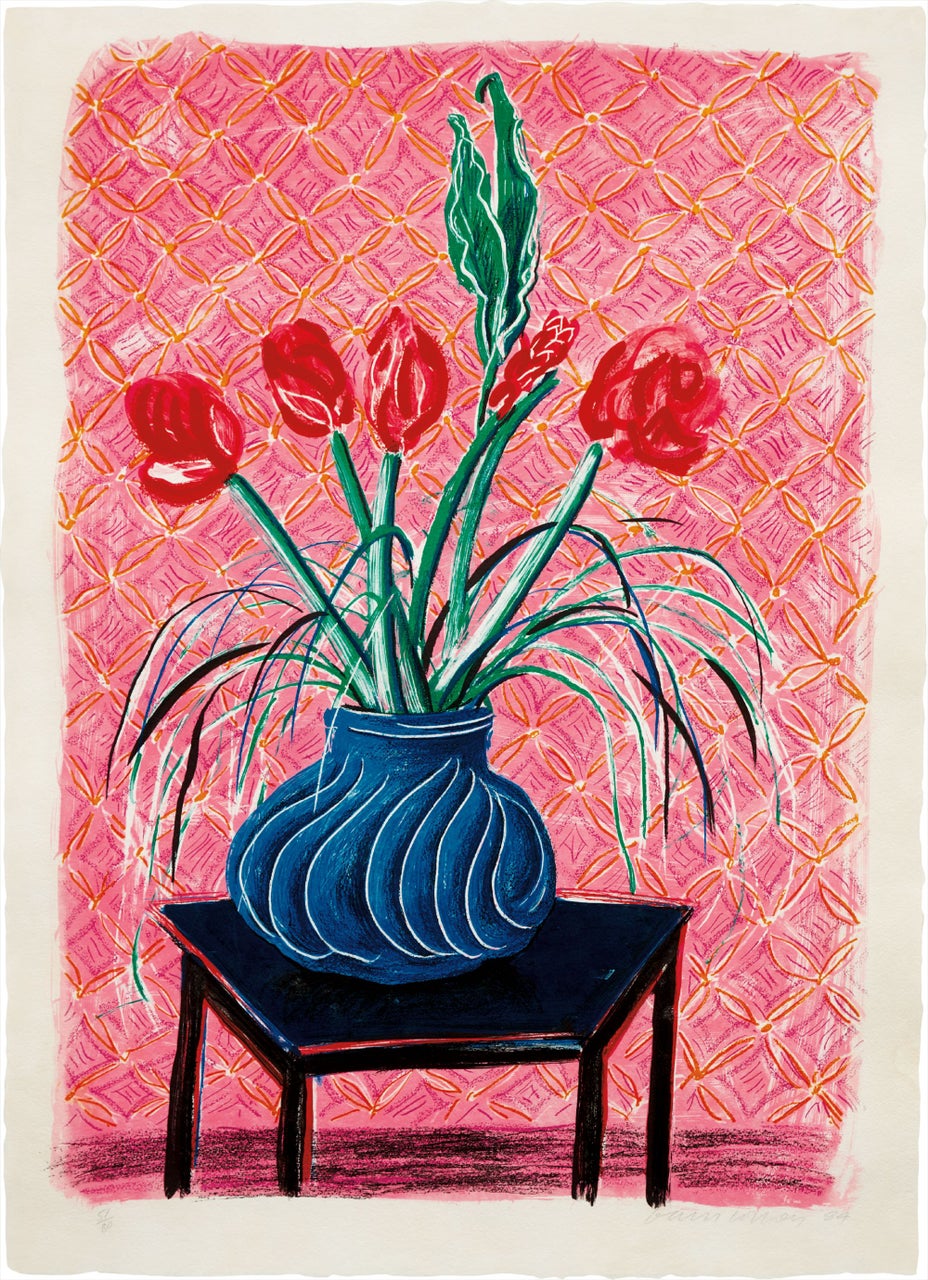
Amaryllis in Vase, from Moving Focus
S. 50 x 36 in. (127 x 91.4 cm)
完整圖錄內容
For Hockney, single-point perspective is a limited, constrictive way of communicating our experience of the world around us, which he likens to “looking at the world from the point of view of a paralyzed Cyclops - for a split second.” Drawing inspiration from the Cubism of Picasso’s 1980 retrospective at the Museum of Modern Art, New York, Hockney embraced a pictorial structure that could accommodate multiple viewpoints and perspectives as well as time and movement.
For Amaryllis in Vase, Hockney uses reverse perspective, placing the shorter end of the table closer to the viewer in the foreground of the composition, with the longer side at the back of the picture space. By reversing the traditional vanishing point, Hockney exploits the fluctuations of deep and shallow space, pushing everything into the foreground and directly involving the viewer. The hazy chequerboard background (reminiscent of Persian miniature paintings) bulges and recedes in optical illusion as our eye flits across the surface. The wallpaper appears to melt into the flowers rather than sitting passively behind them and as the table tilts forwards, the eye calculates the possibility of the vase smashing onto the floor.
Hockney recognises that we see both geometrically and psychologically and uses that knowledge to create images of sensuous line and colour, through which the eye dances and where edges of viewpoints fold into and across each other. Hockney compared the human experience of looking as a matter of layering, of understanding the present by comparing it with the past - layer upon layer. When we look at his Amaryllis in Vase we are seeing not only what is in front of us, but all of the vases of flowers that we have ever seen.
David Hockney
British | B. 1937 D. 2026David Hockney is one of the most celebrated artists of the 20th and 21st centuries. With a career spanning over seven decades, Hockney’s practise embraced many mediums including painting, edition-making, and collage, with his more recent digital iPad drawings defining the later part of his career. From semi-abstract representations of domestic life and vibrant still-lifes, to detailed portraits of his closest friends, Hockney’s artworks are nothing short of electric, reflecting the eccentric personality of one of Britain’s greatest artists.
Hockney’s works have been exhibited at the Museum of Modern Art in New York, the Royal Academy of Arts in London and the Van Gogh Museum in Amsterdam, among many other institutions. On the secondary market, his work has sold for more than $90 million.