文章 | Why Watchmakers Keep Returning To Hardstone Dials Phillips Geneva Fall 2026 Online Auction
Why Watchmakers Keep Returning to Hardstone Dials
Fine natural stone offers colors and patterns that no dial maker can replicate. Turning it into a watch dial, however, presents a very different challenge.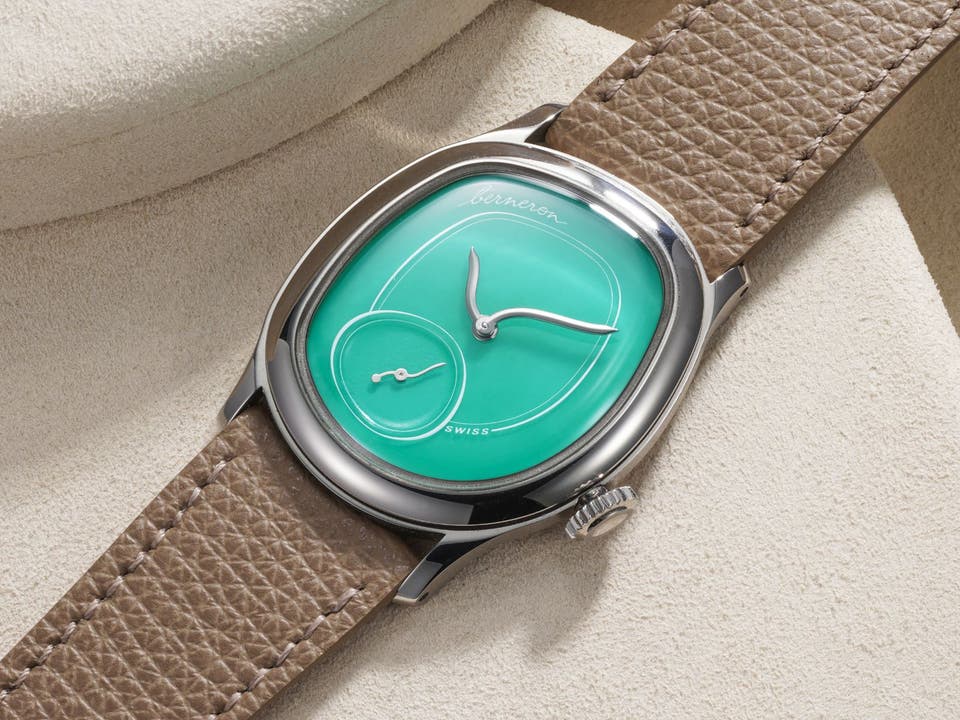
Phillips in Association with Bacs & Russo is pleased to present The Geneva Sessions, Fall 2026, an online auction running from 4–11 September. Featuring more than 90 exceptional luxury timepieces from leading makers including A. Lange & Söhne, Audemars Piguet, F.P. Journe, and Patek Philippe, the sale includes the three watches featured in this story.
Lapis lazuli, malachite, tiger’s eye, jade, onyx, and other ornamental stones have been prized for their color and natural patterns for thousands of years. Their use for watch dials, however, is actually quite recent, especially compared with decorative techniques such as enameling, engraving, and guilloché.
And there is something else that sets hardstone apart. With enamel or guilloché, the decoration is created by the craftsperson. With stone, nature has already done much of that work, providing the color, veins, inclusions, and other characteristics that make each slice unique.
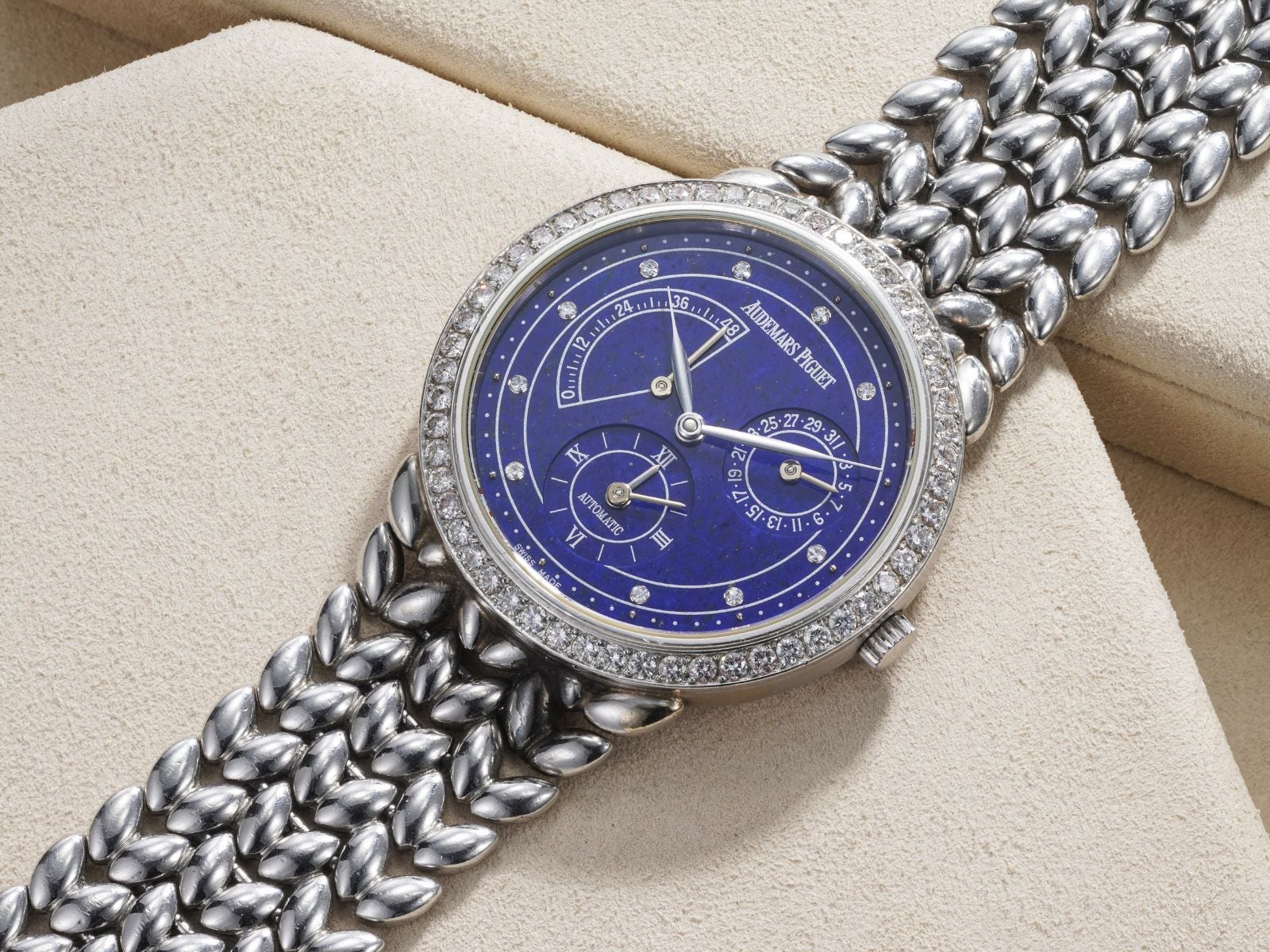
Lot 41: A 1997 Audemars Piguet Jules Audemars Dual-Time Ref. 25754 in platinum with lapis lazuli dial and diamond-set bezel and indexes, included in the Phillips Geneva Sessions, Fall 2026, Online Auction. Estimate: CHF 12,000–24,000
Three watches in Phillips’ The Geneva Sessions, Fall 2026 illustrate the variety on offer: a 1997 Audemars Piguet Jules Audemars Dual-Time Ref. 25754 featuring lapis lazuli dial, a 2000 Rolex Datejust Ref. 16234 with dial made of sodalite, and a 2025 Berneron Mirage 34 with chrysoprase dial.
A Modern Story
The modern hardstone dial really came to prominence during the 1960s and ‘70s, with Piaget playing an important role. Under the creative direction of vice-president Valentin Piaget, the maison embraced color through dials, cabochons, and beads made from jade, lapis lazuli, tiger’s eye, malachite, and turquoise.
Specialist dial maker Stern Frères was another key player. According to watch historian Dr Helmut Crott, Stern entered ornamental-stone dial production around 1970 and developed methods for working the material at the extreme thinness required for watch dials. These included bonding stone to a metal base for support and using ultrasonic machining to make delicate openings. Rolex soon became an important client. In his definitive book The Dial, Crott documents, for example, a lapis lazuli Datejust dial made by Stern in 1977 whose stone layer measured just 0.4mm thick.
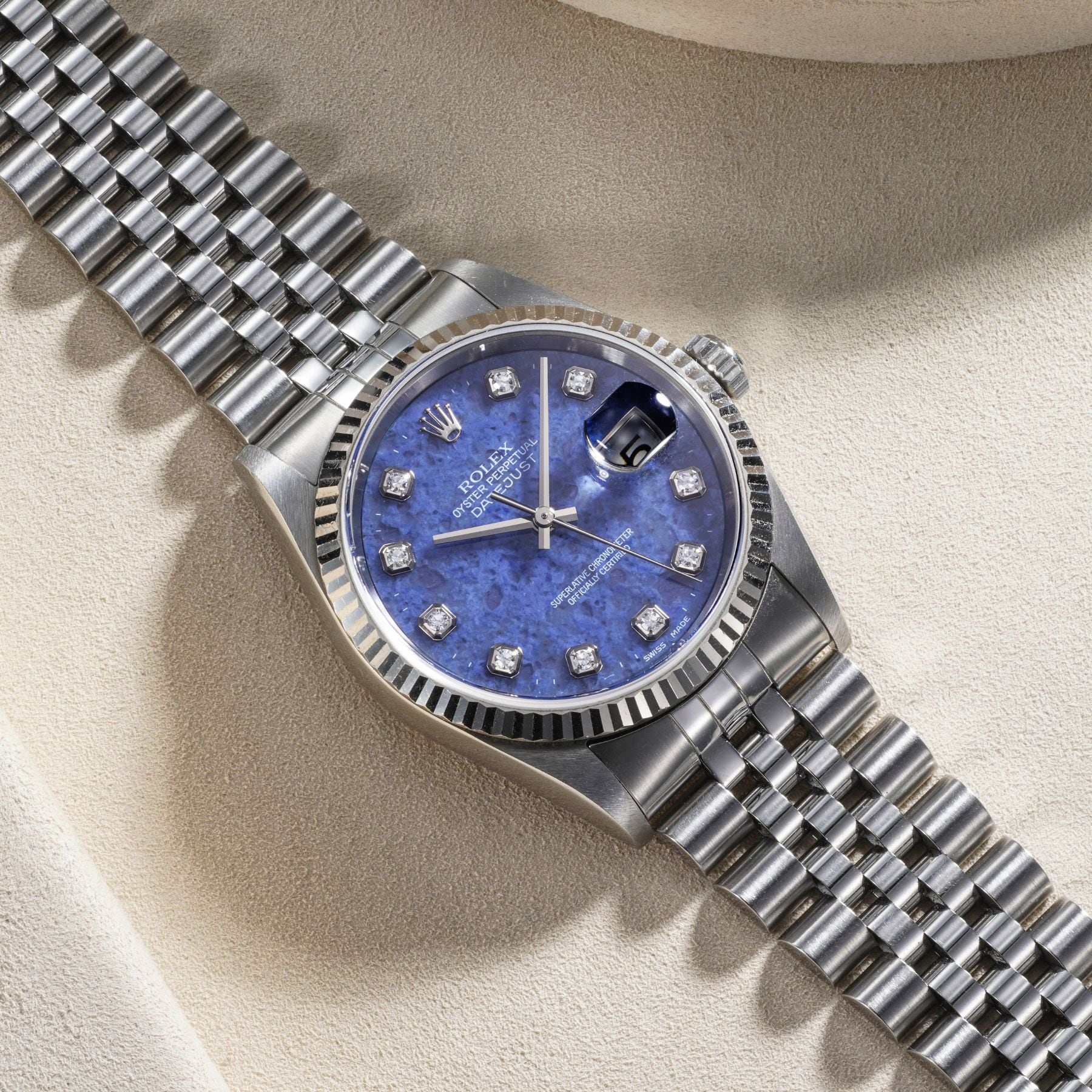
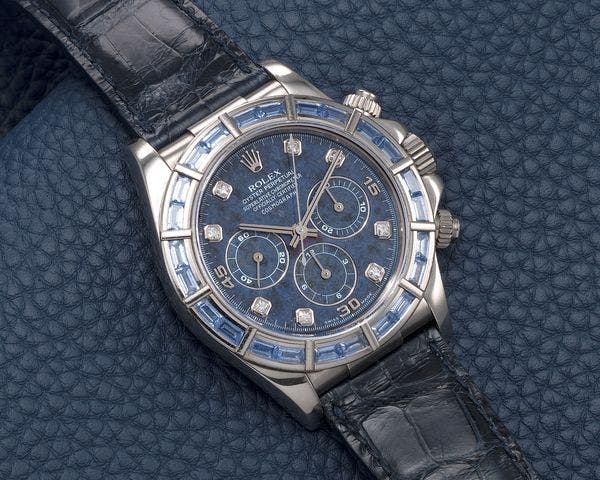
Lot 22: A 2000 Rolex Datejust Ref. 16234 in stainless steel with blue sodalite dial and diamond-set indexes, included in the Phillips Geneva Sessions, Fall 2026, Online Auction. Estimate: CHF 7,000–14,000
Hardstone may have enjoyed its great initial boom sixty years ago, but it never entirely went away. Our Audemars Piguet and Rolex, both dating from the turn of the millennium, provide ample proof of that.
From Rock to Dial
So how do you turn a lump of stone into a wafer-thin watch dial with the required precision and finish?
For some answers, we visited the atelier of Olivier Vaucher in Geneva, a company specializing in decorative watchmaking arts whose expertise in engraving, miniature painting, gem-setting, and stone work has been called upon by the likes of Richard Mille, Roger Dubuis, Hermès, Romain Gauthier, and Taos.
Technical Director Philippe Prud’hon explains that the process begins with coring (carottage in French), extracting a cylindrical core from the raw material. This is sliced into discs before lapping (lapidage) progressively reduces the stone to the required thickness, using increasingly fine abrasives until the desired surface and polish are achieved.
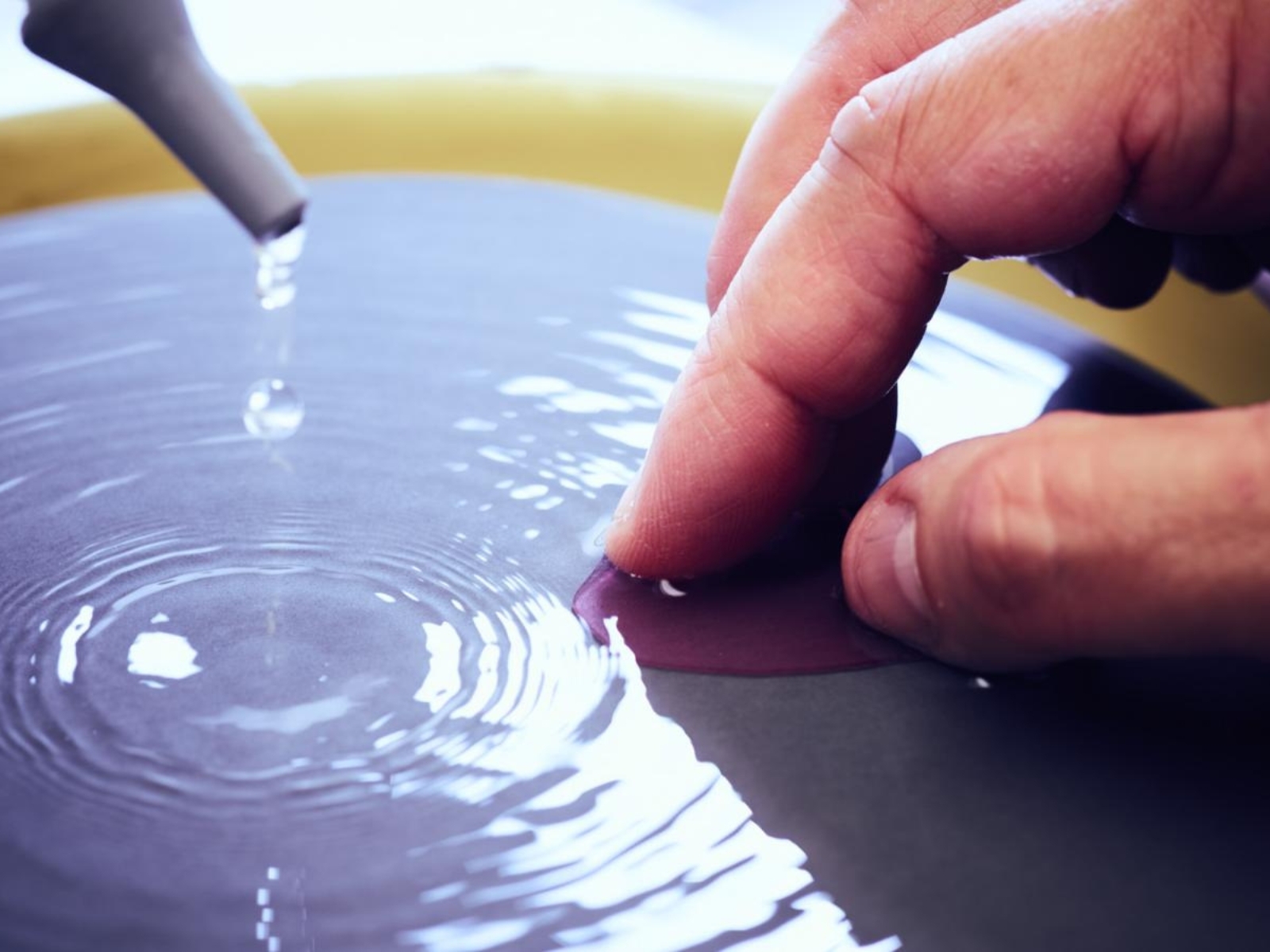
A slice of stone is progressively reduced to the required thickness on a lapping wheel at the Olivier Vaucher atelier. Olivier Vaucher
For a typical stone dial, Prud’hon puts that thickness – or perhaps more aptly, thinness – at just 0.3mm to 0.5mm. For smaller, recessed indications, that can fall to just 0.20mm to 0.25mm. The finished stone is then glued to a dial base, generally made from brass or gold, which provides the necessary support before the other dial elements are added.
Machining has evolved too. While techniques such as ultrasonic cutting have historically been used to pierce hardstone, Olivier Vaucher can now avail of three-axis CNC machinery equipped for stone work, as well as an ultrasonic spindle for particularly hard materials like sapphire.
The fundamental difficulty, however, remains: “The stone can break at any time,” Prud’hon tells us.
A fissure may reveal itself during coring. A slice can break when separated. An edge can chip during machining. Even fitting appliques brings risk. Prud’hon says that if he needs one straightforward stone dial, he might start work on two or three pieces to improve the chances of obtaining one satisfactory example. Even a relatively simple stone dial, consisting of just a metal dial base and the stone itself, can involve tens of hours of work from raw material through to final assembly.
“The stone can break at any time.”
—Philippe Prud’hon
The architecture of the dial naturally has an impact too. Our Audemars Piguet Ref. 25754 asks plenty of its lapis lazuli, with recesses required for its second time zone, date, and fan-shaped power-reserve indication. Prud’hon immediately noted the additional work involved when shown the watch.
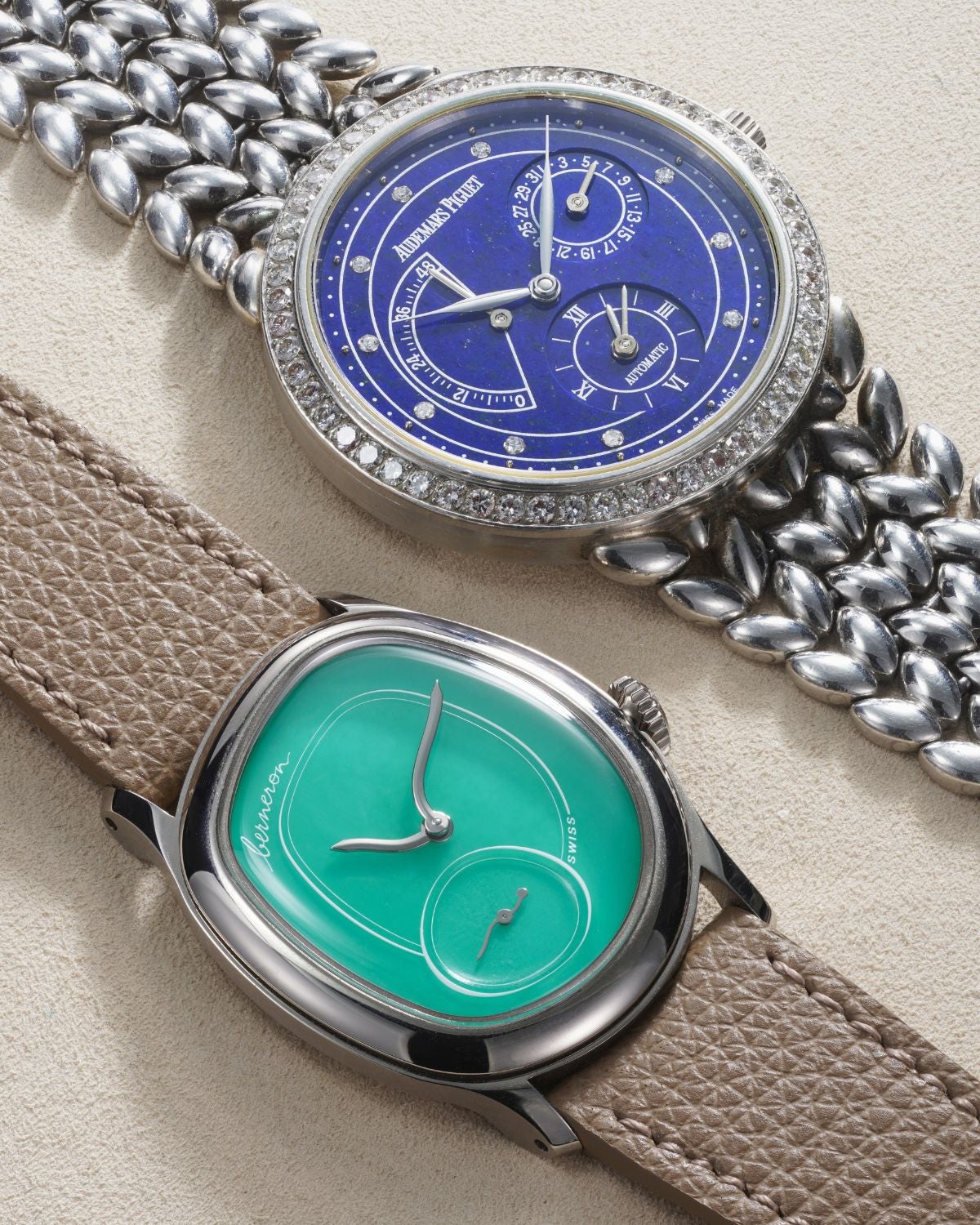
A 1997 Audemars Piguet Jules Audemars Dual-Time Ref. 25754 in platinum with lapis lazuli dial and diamond-set bezel and indexes,and a 2025 Berneron Mirage 34 in 18k white gold with chrysoprase dial, included in the Phillips Geneva Sessions, Fall 2026, Online Auction.
The Berneron Mirage here presents a different challenge. Its asymmetric outline can be handled using modern CNC equipment, but its chrysoprase has also been worked in three dimensions, with a significant amorphous depression in the stone defining the small-seconds area, for instance.
Nature Calls the Shots
Not all stones behave in the same way either.
Lapis lazuli is a rock composed mainly of lazurite along with minerals that can include calcite and pyrite. Prud’hon considers it relatively workable when good material is selected, although veins and fissures can create weak points. Even pyrite becomes a question of taste: some clients want an uninterrupted blue surface, while others actively seek the metallic inclusions for their visual effect.
Sodalite can be more troublesome. Prud’hon describes examples he has worked with as relatively friable and prone to breaking, although he stresses that the quality of the raw material plays an important role.
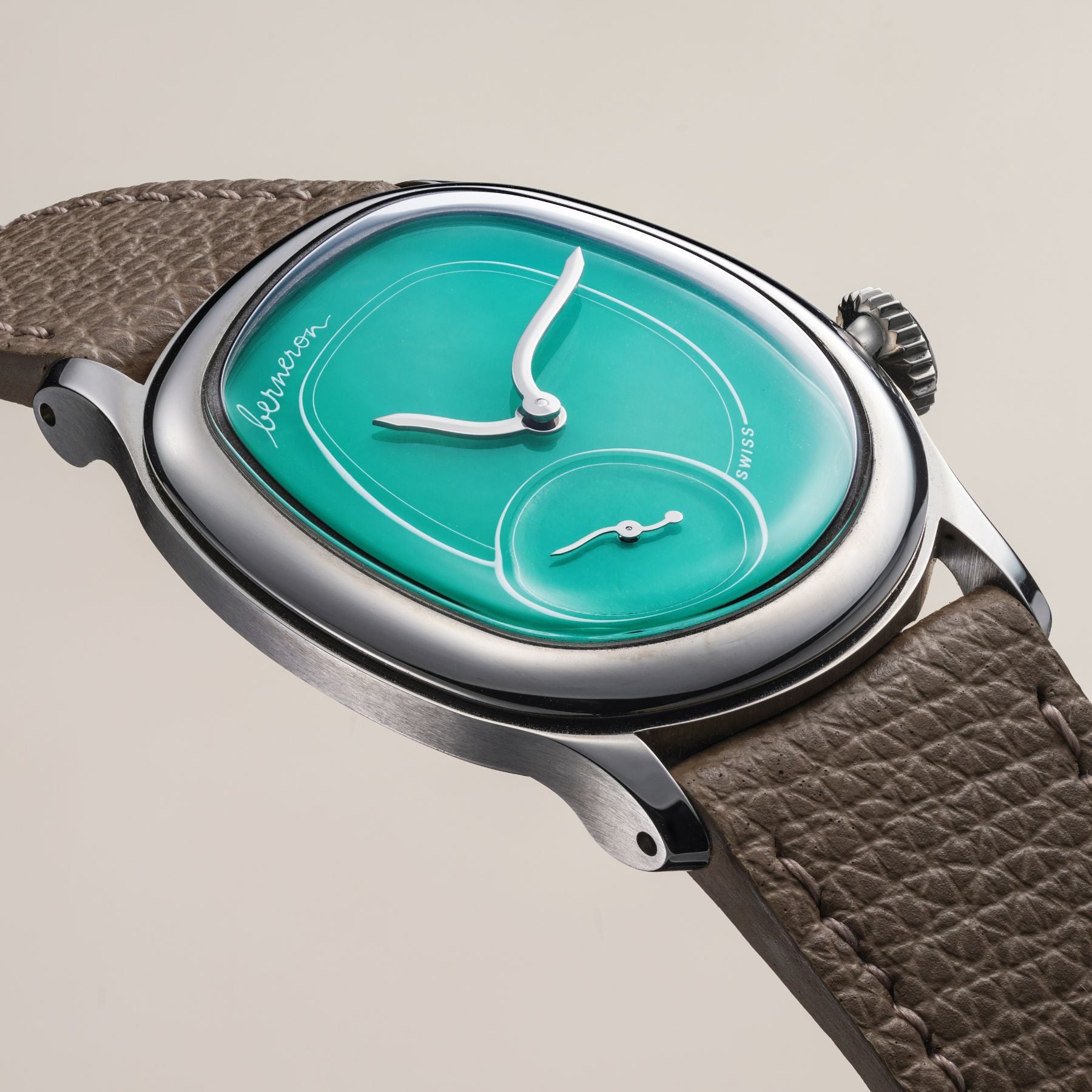
Lot 1: A 2025 Berneron Mirage 34 in 18k white gold with chrysoprase dial, one of 48 examples, included in the Phillips Geneva Sessions, Fall 2026, Online Auction. Estimate: CHF 50,000–100,000
Our 2000 Rolex Datejust Ref. 16234 makes the stone's individuality particularly easy to appreciate. Its dial is alive with irregular blue, white, and grayish areas, complemented by diamond-set hour markers. The sodalite has been cut to accommodate these, as well as the Datejust's date window, magnified through the famous Cyclops lens above.
Chrysoprase, meanwhile, is a translucent green variety of chalcedony, with a hardness of around 6.5 to 7 on the Mohs scale. But hardness – essentially resistance to scratching – only tells part of the story. Fissures, inclusions, porosity, density, and the structure of a particular piece can all influence how it responds to machining.
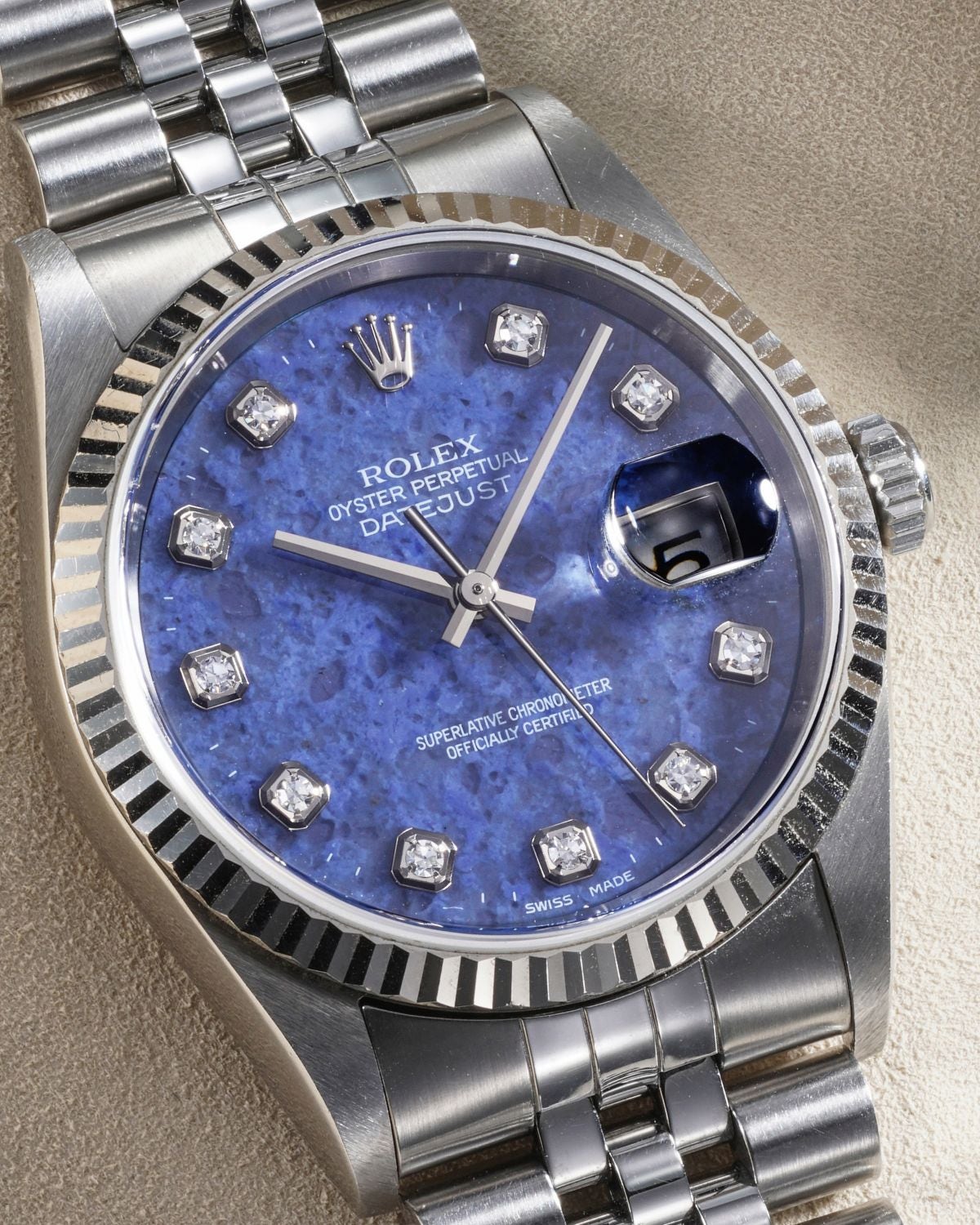
Lot 22: A 2000 Rolex Datejust Ref. 16234 in stainless steel with blue sodalite dial and diamond-set indexes, included in the Phillips Geneva Sessions, Fall 2026, Online Auction. Estimate: CHF 7,000–14,000
That natural variability can present another headache for dial makers. Prud’hon gives the example of ordering material for 20 turquoise dials and potentially receiving 20 different shades. For series production, the workshop therefore keeps color references to help match the stone slices as closely as possible.
Of course, that unpredictability is also part of the attraction: no two natural-stone dials will ever be exactly the same.
Back in Vogue
Today, hardstone dials appear to be enjoying another moment. Recent examples can be found across the industry, from Audemars Piguet and Frédérique Constant to Piaget, which has returned to the look with recent iterations of its Andy Warhol watch.
The revived Dennison, meanwhile, has used tiger’s eye, lapis lazuli, malachite, and aventurine to offer natural-stone dials at a much more accessible price point. At the other end of the spectrum, specialists such as Olivier Vaucher are capable of turning stone into elaborate miniature marquetry.
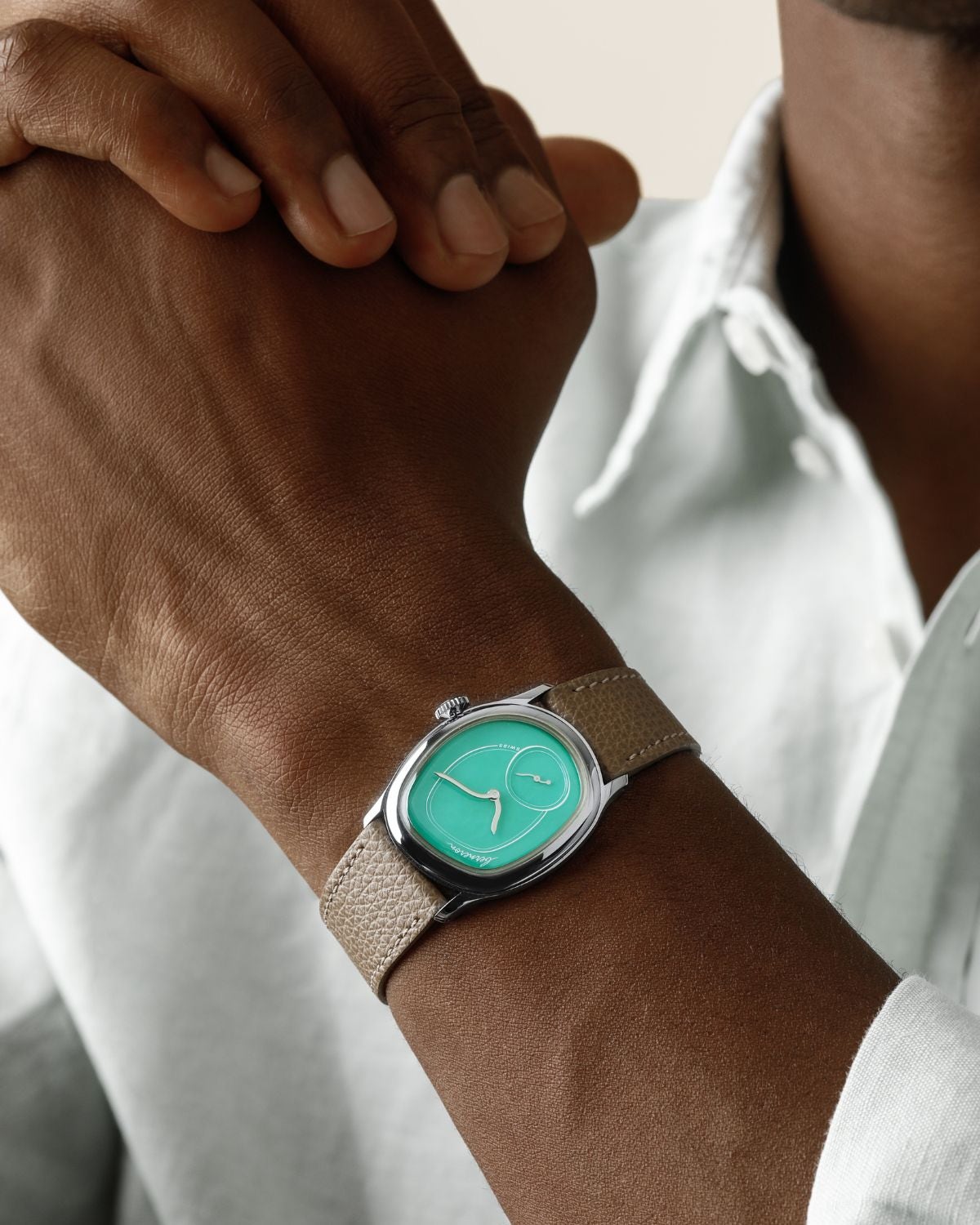
Lot 1: A 2025 Berneron Mirage 34 in 18k white gold with chrysoprase dial, one of 48 examples, included in the Phillips Geneva Sessions, Fall 2026, Online Auction. Estimate: CHF 50,000–100,000
Prud’hon has witnessed the ebb and flow of demand first-hand. He remembers significant interest in stone and mosaic work around 15 years ago, before activity subsequently slowed. This year, however, the workshop has already received a number of requests involving stone dials, some revisiting projects first explored a decade ago.
Whether that represents another long-term cycle remains to be seen. What is clear is that watchmakers are looking at stone again.
Well Worth the Effort
The appeal isn't difficult to understand. Hardstone offers intense color and pattern without requiring them to be painted, engraved, or engine-turned into existence. But transforming that natural material into a beautiful dial only fractions of a millimeter thick requires time, skill, patience, and awareness of the challenges and risks at each stage of the process.
The rewards, however, are considerable: richness of color, depth, natural variation, and a character that changes according to the stone selected. Perhaps that combination – what nature provides and what the dial maker must then do with it – explains why watchmakers keep returning to stone dials.
You can learn more, place a bid, and view the entire Geneva Sessions, Fall 2026, catalog here.