文章 | Patek Philippe Modern World Time Travel Time Watches Phillips New York Fall 2026 Online Auction
Around the World with Patek Philippe: Travel Watches for the Modern Age
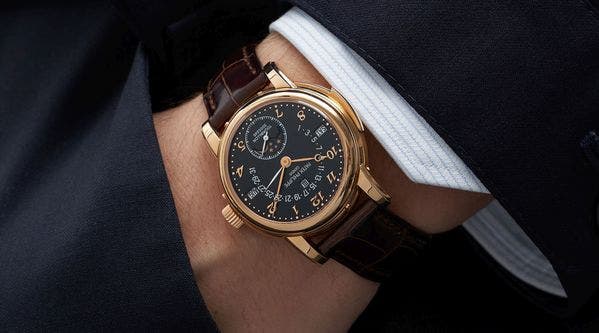
Five watches that show how Patek Philippe has developed its approach to travel timekeeping over the past decade and a half.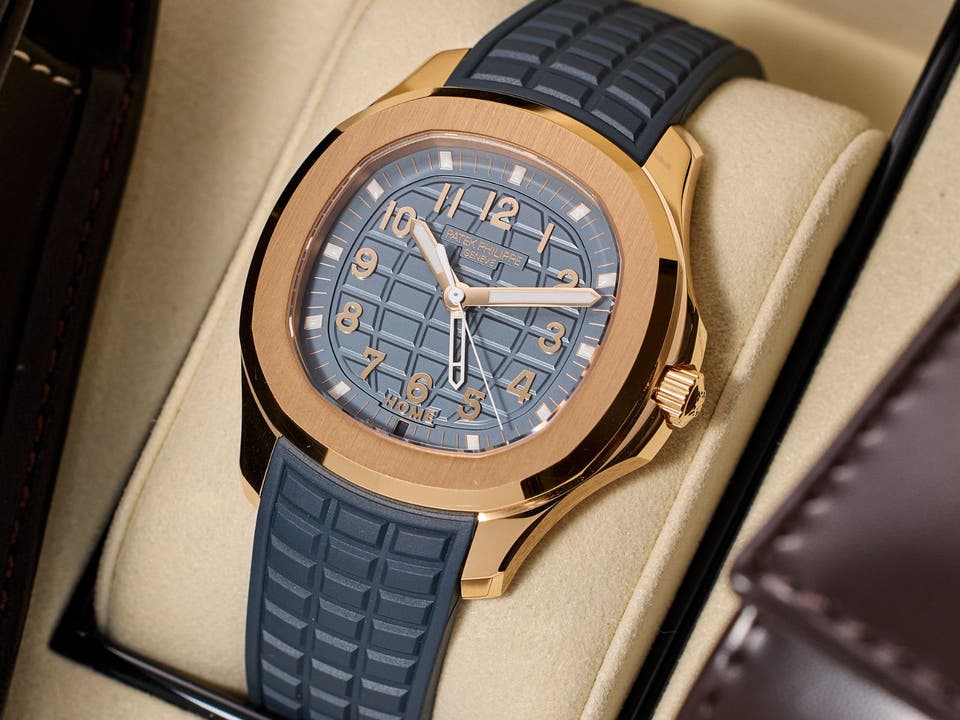
Phillips in Association with Bacs & Russo is delighted to present The New York Sessions, Fall 2026, an online auction running from 1–9 October. Featuring more than 80 exceptional timepieces from leading makers including Patek Philippe, Rolex, A. Lange & Söhne, Audemars Piguet, and F.P. Journe, the sale includes all the watches featured in this story.
There is more than one way for a watch to make life easier when you cross a time zone. It can keep home time visible alongside local time. Or, with a world time complication, it can put 24 principal time zones on the dial at once.
Patek Philippe has spent much of the modern era exploring both ideas. Its connection with World Time reaches back to the 1930s, when the Geneva brand began working with Louis Cottier, who had developed his ingenious system earlier in the decade. His mechanism paired local time on the central hands with a counterclockwise 24-hour ring and a surrounding ring of reference cities, allowing the wearer to read the time across 24 zones at once.
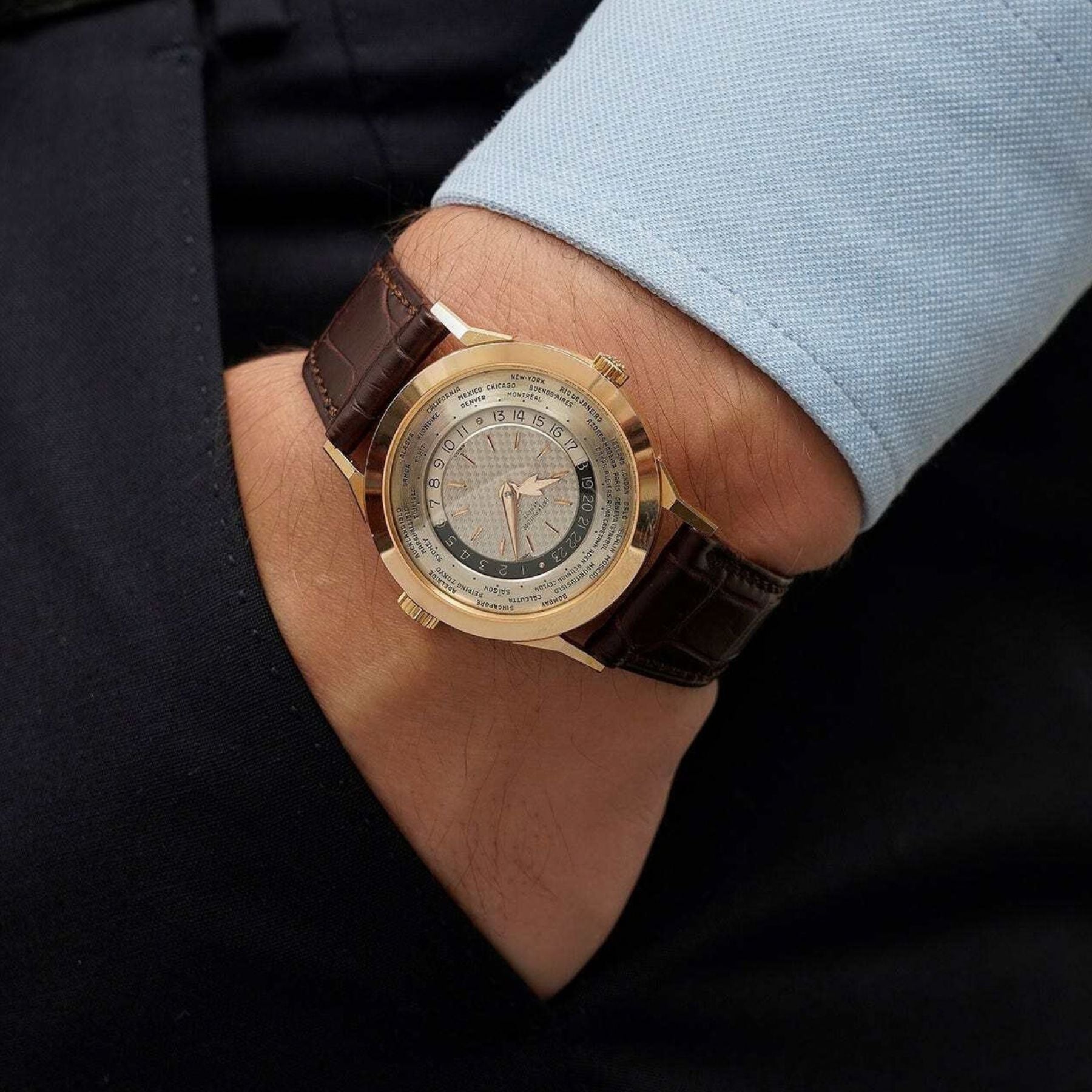
A 1954 Patek Philippe Ref. 2523/1 in 18k pink gold that sold for CHF4,991,000 at the The Geneva Watch Auction: XII
But the more relevant starting point for us here is the turn of the millennium, when the Ref. 5110 brought World Time back into the Patek Philippe catalog in 2000 after a long absence. The larger Ref. 5130 followed in 2006. Since then, Patek Philippe has continued to refine the World Time concept, pair it with other complications, and develop its separate Travel Time system in parallel.
Made between circa 2009 and 2025, the five watches offered in The New York Sessions, Fall 2026 provide a useful snapshot of what a modern Patek Philippe travel watch can be.
World at a Glance
The circa 2010 Ref. 5130G-001 is a logical place to begin. Introduced in 2006, the Ref. 5130 succeeded the smaller Ref. 5110, increasing the case diameter to 39.5mm while retaining the same automatic Caliber 240 HU, or Heure Universelle. The larger format gave its information-heavy dial a little more room to breathe.
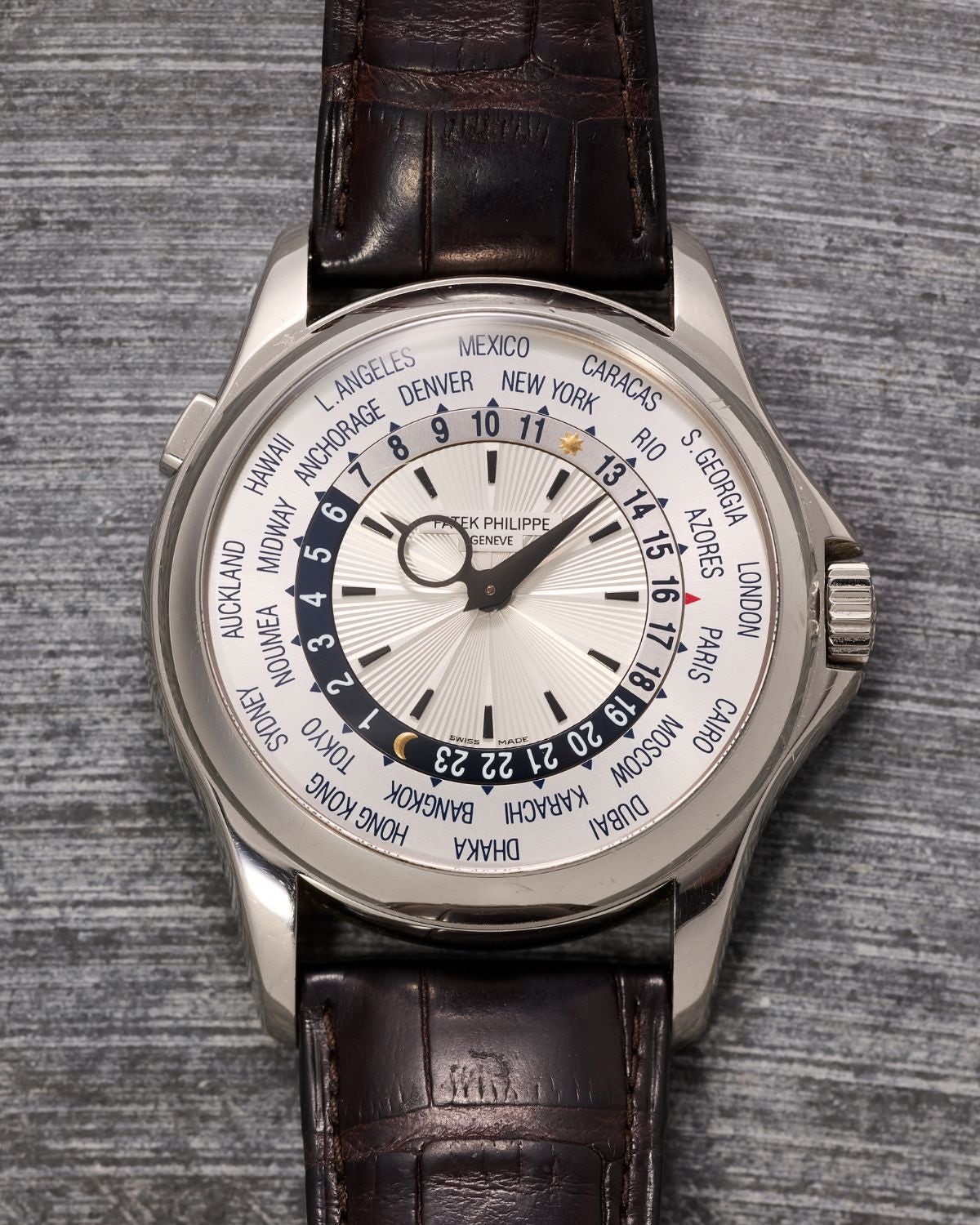
Lot 49: A circa 2010 Patek Philippe World Time Ref. 5130G-001 in 18k white gold, included in the Phillips New York Sessions, Fall 2026. Estimate: USD $18,000–36,000
The reference would remain in production for around a decade, appearing in yellow, rose, and white gold, as well as platinum. This white-gold example has a silvered guilloché center surrounded by a 24-hour ring and an outer ring carrying the names of 24 reference cities.
The clever part is how simple the whole system is to use. Position your local city at 12 o’clock and the central hands give you local time, while the rotating 24-hour ring lets you read the hour in the other main time zones. Arrive somewhere new, press the pusher at 10 o’clock, and the World Time indications advance together in one-hour increments. No mental arithmetic required.
Platinum Perspective
Made circa 2009, the Ref. 5130P gives us essentially the same watch from a different angle. The case remains 39.5mm and the Caliber 240 HU still provides hours, minutes, World Time, and day/night indication, but platinum and a blue-gray guilloché center change the personality.
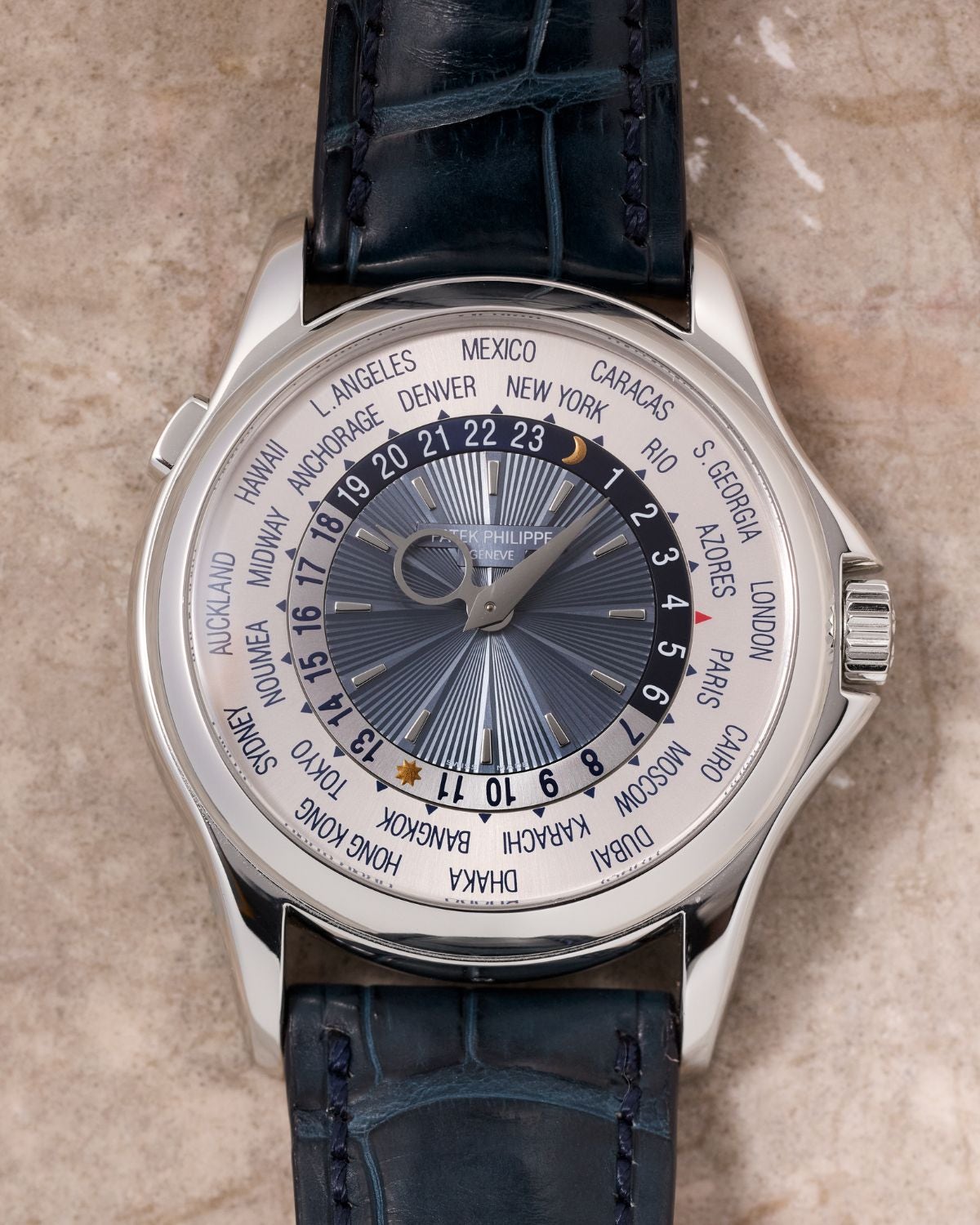
Lot 64: A circa 2009 Patek Philippe World Time Ref. 5130P in platinum, included in the Phillips New York Sessions, Fall 2026. Estimate: USD $20,000–40,000
The wider 5130 family gave Patek Philippe plenty of room to play with the basic formula, including city-specific editions and, in the Ref. 5131, cloisonné enamel world maps.
This example takes a more conventional route, with the appeal coming from the contrast between the cool weight of platinum, the soft blue of the dial, and one of Patek Philippe’s most recognizable modern complications.
A Fresh Generation
Then, in 2016, came the Ref. 5230. Patek Philippe reduced the case size, introduced new hands, reshaped the lugs, and gave the watch a different overall profile. The platinum Ref. 5230P-001 arrived in 2022, with the example in the New York Sessions dating to circa 2023.
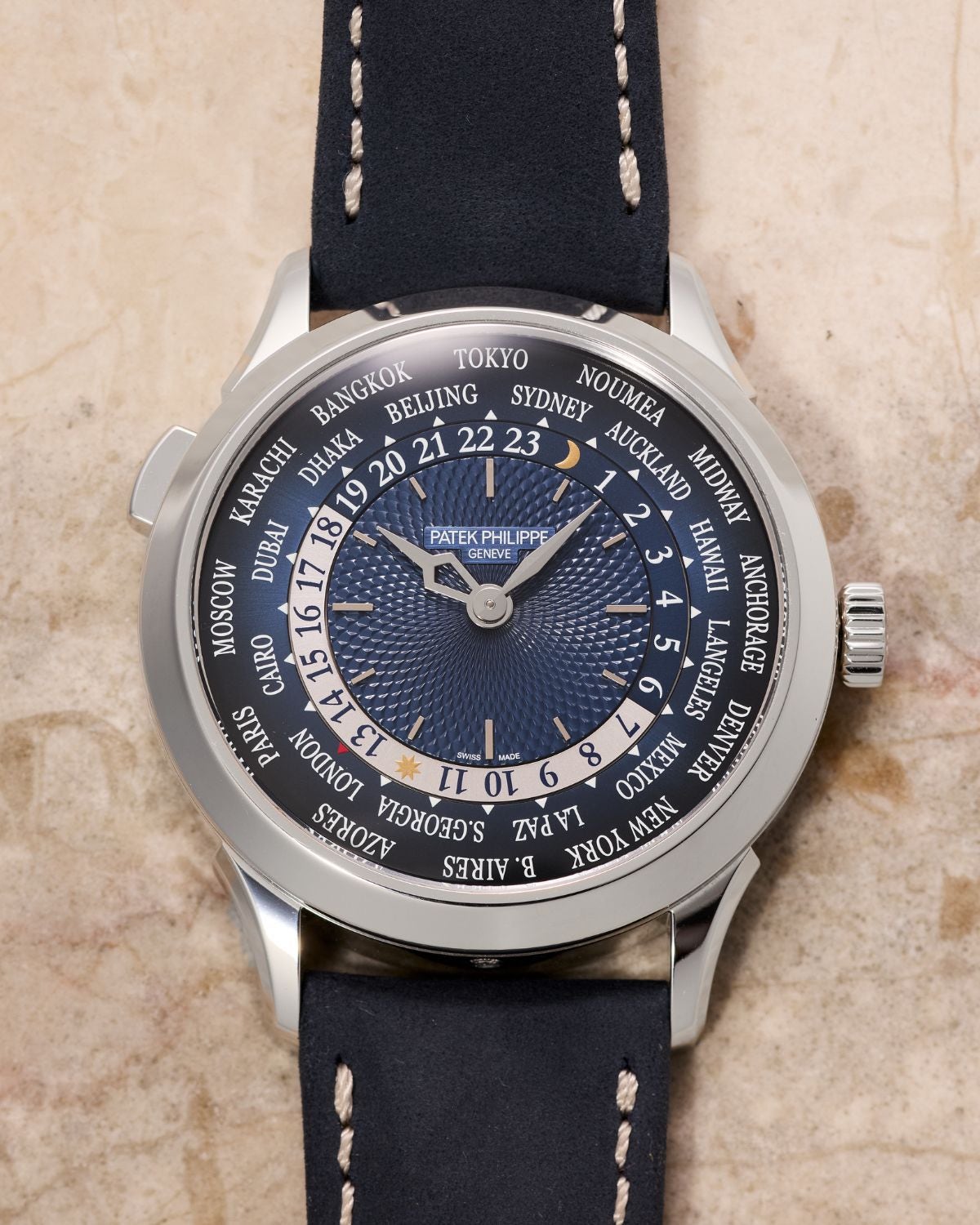
Lot 86: A circa 2023 Patek Philippe World Time Ref. 5230P-001 in platinum, included in the Phillips New York Sessions, Fall 2026. Estimate: USD $30,000–60,000
At 38.5mm, it is slightly smaller than the 5130, with winglet-style lugs, a slim bezel, and a blue dial centered by a hand-guilloché pattern. Local time is shown by a skeletonized hour hand inspired by the Southern Cross constellation and a lozenge-shaped minute hand.
What Patek Philippe did not change is just as notable. The Caliber 240 HU remains, as does the pusher at 10 o’clock. Pressing it advances the World Time displays in one-hour increments while temporarily uncoupling the mechanism so the minute hand continues its progression and the balance amplitude is unaffected.
So while the 5230 looks different, there is a definite consistency to the idea underneath.
Now Add a Chronograph
Of course, Patek Philippe was not going to stop at World Time alone. In 2016, the Ref. 5930 became its first serially produced World Time chronograph. Six years later, the Ref. 5935A brought the combination into stainless steel for the first time. The example offered here dates to circa 2024.
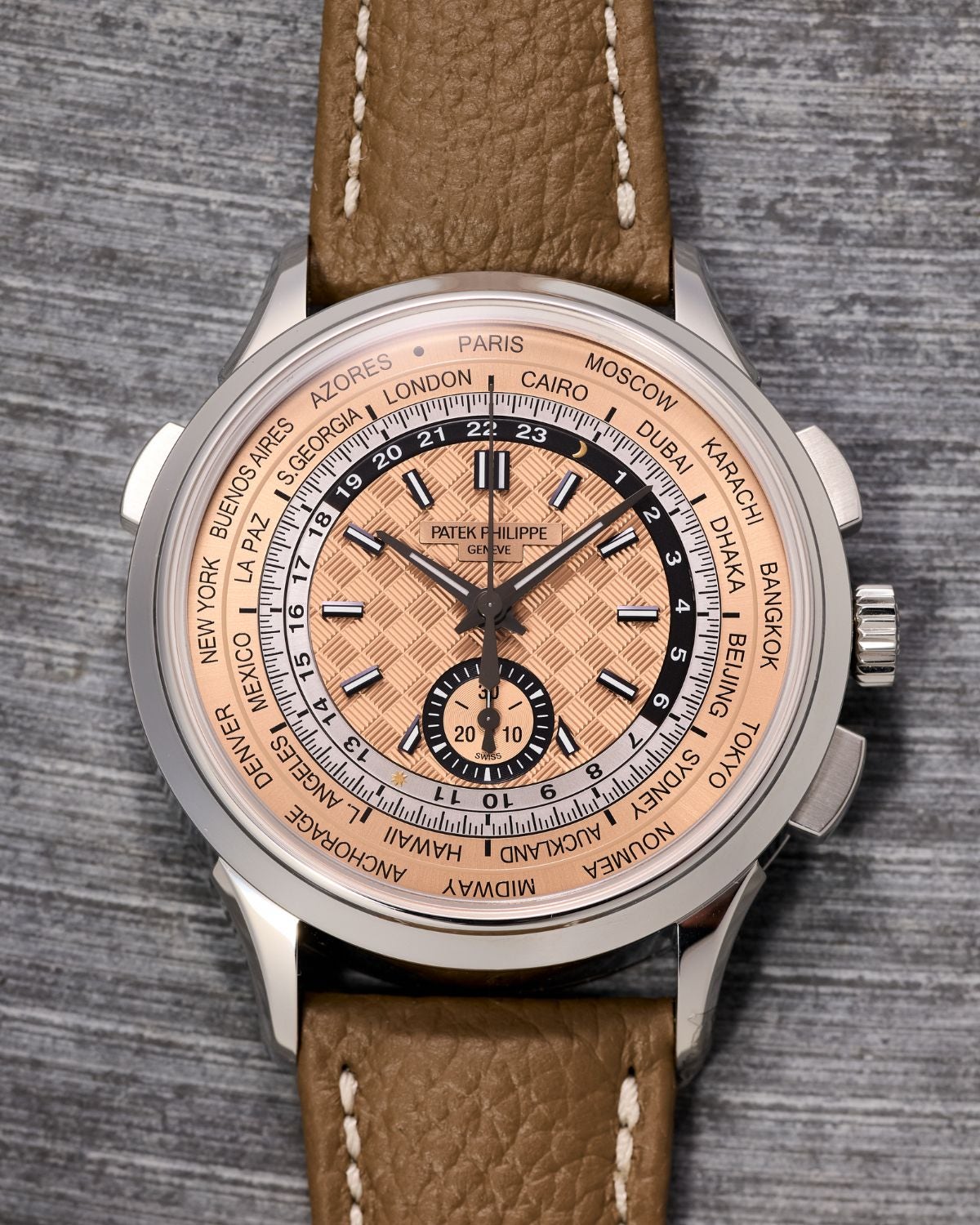
Lot 9: A circa 2024 Patek Philippe World Time Flyback Chronograph Ref. 5935A-001 in stainless steel, included in the Phillips New York Sessions, Fall 2026. Estimate: USD $30,000–60,000
At 41mm, it is the largest of the World Time watches in this group, and visually it heads in a sportier direction too.
The rose-gilt opaline dial has a geometric “carbon” motif at its center, while charcoal-gray white-gold hour markers and dauphine hands carry white lume. Around them are the 24-hour scale, city ring, and chronograph seconds track, with a 30-minute counter at 6 o’clock.
There is a lot going on, but operating it is fairly intuitive. The pusher at 10 o’clock advances the local city and corresponding World Time indications in one-hour increments, while the two pushers on the right take care of the flyback chronograph.
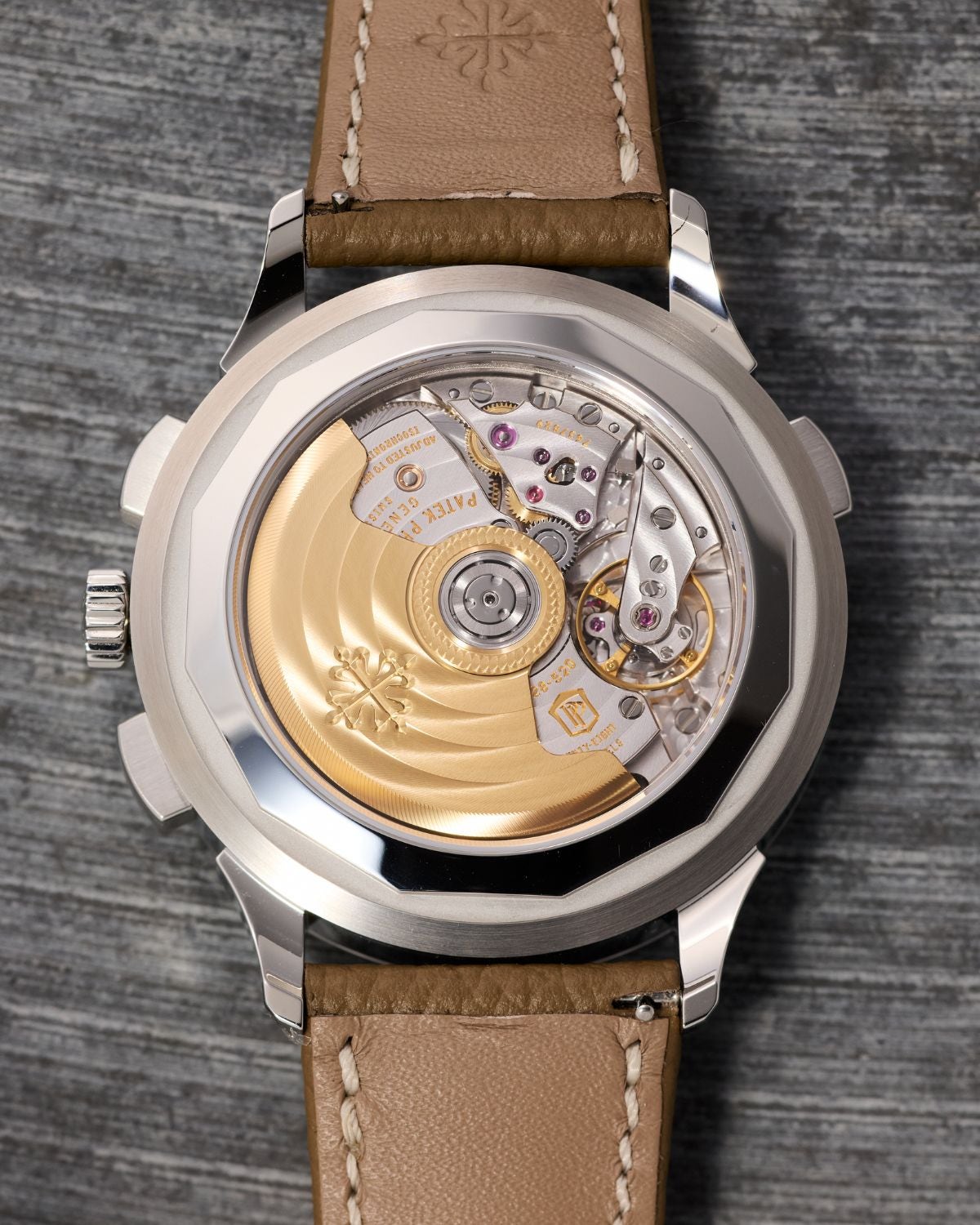
Lot 9: A circa 2024 Patek Philippe World Time Flyback Chronograph Ref. 5935A-001 in stainless steel, included in the Phillips New York Sessions, Fall 2026. Estimate: USD $30,000–60,000
Inside, the automatic Caliber CH 28-520 HU brings the two complications under one roof.
Home and Away
The youngest watch here changes tack completely. Introduced in 2024, the Aquanaut Travel Time Ref. 5269R-001 does away with the 24-city display and concentrates on the two times most travelers are likely to care about: where they are, and what time it is back home.
The solid hour hand indicates local time, while a skeletonized hand tracks home time. A small aperture at 6 o’clock tells you whether it is day or night there.
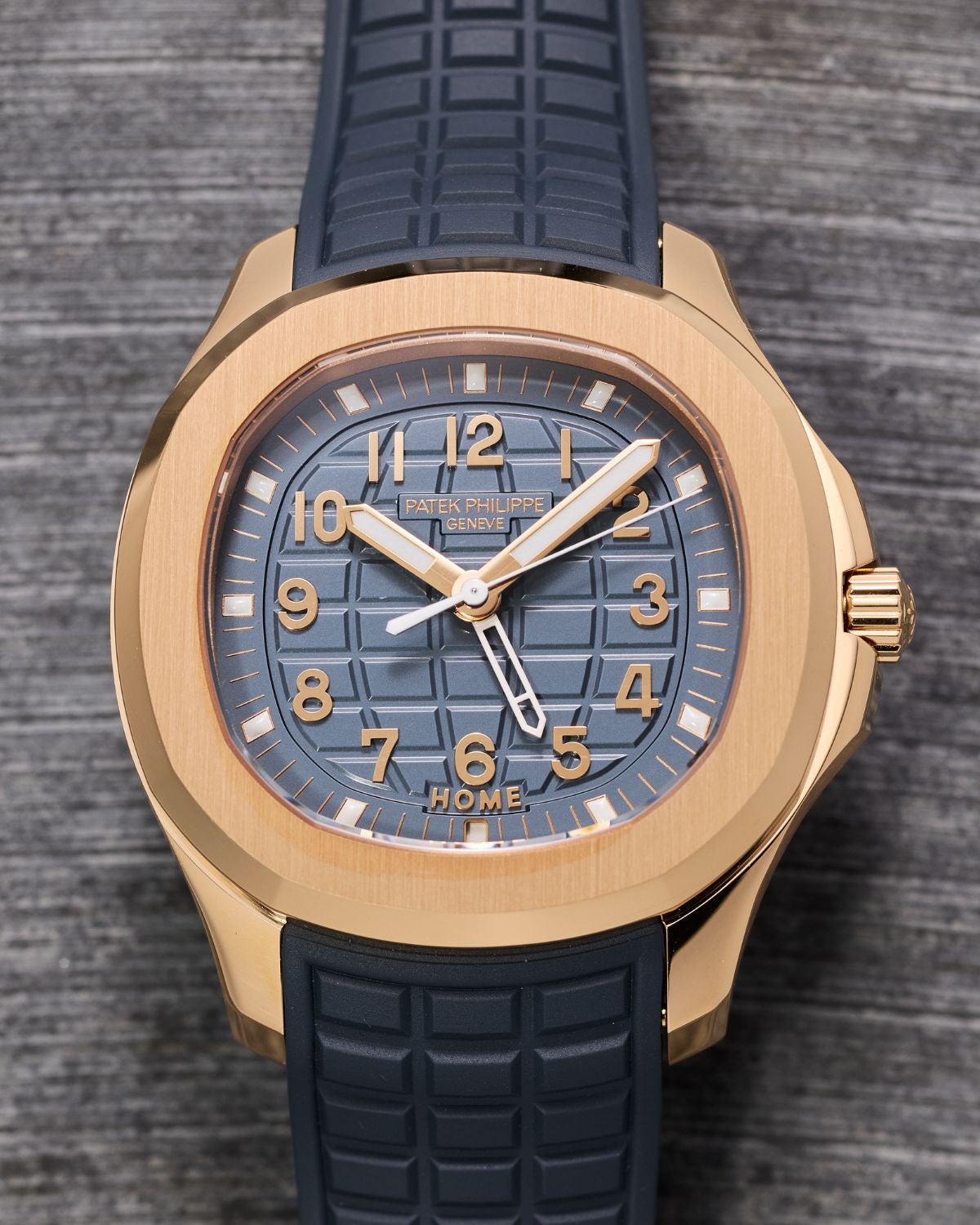
Lot 29: A 2025 Patek Philippe Aquanaut Ref. 5269R-001 in 18k pink gold, included in the Phillips New York Sessions, Fall 2026. Estimate: USD $30,000–60,000
There is another notable difference. Inside the 38.8mm rose-gold case is not a mechanical caliber but the quartz Caliber E 23-250 S FUS 24H. And unlike the mechanical Aquanaut Travel Time Ref. 5164, which uses pushers on the left side of the case to adjust local time, the 5269R handles the job through the crown. That removes two protruding controls from the case and makes adjustment particularly straightforward when arriving in a new time zone.
It is perhaps the most direct expression of the travel-watch idea in this group. At one end of the spectrum, the World Timers let you survey 24 zones at once. At the other, this Aquanaut asks a much simpler question: what time is it here, and what time is it at home?
You can learn more, place a bid, and view the entire New York Sessions, Fall 2026, catalog here.
Recommended Stories
Twenty-Four Cities, One Dial: The World-Timer is a Complication for the Curious
2026年3月
A Clash Of Complications: Which Patek Philippe Perpetual Calendar Split-Seconds Chronograph Is Right For You?
2023年9月