文章 | Jaeger Lecoultre Gyrotourbillon Three Generations Phillips Hong Kong Watch Auction Xxiii November 2026
Three Generations of the Gyrotourbillon
We revisit the beginnings of Jaeger-LeCoultre’s celebrated dual-axis tourbillon and trace how the mechanism evolved during its first decade.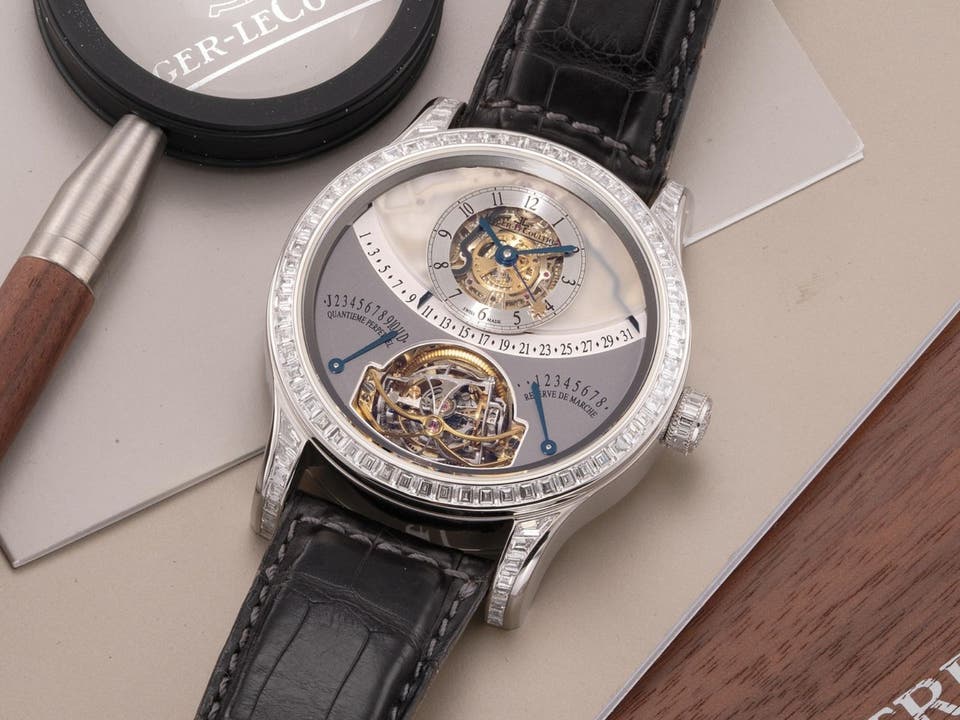
Phillips in Association with Bacs & Russo presents The Hong Kong Watch Auction: XXIII, a live auction taking place on 21–22 November 2026 at our West Kowloon headquarters. Among the more than 320 timepieces offered are three platinum Jaeger-LeCoultre watches tracing the first three generations of the Gyrotourbillon: the diamond-set Gyrotourbillon 1, Reverso Gyrotourbillon 2, and Master Grande Tradition Gyrotourbillon 3 Jubilee.
There is a lot to take in when watching a Jaeger-LeCoultre Gyrotourbillon at work. Follow the balance wheel and, before you have worked out its orientation, the surrounding cage has carried it somewhere else. A second cage rotates around another axis, adding to the difficulty of keeping track. You can spend a fair while gazing at the mechanism without seeing quite the same view twice. It is mesmeric.
When it appeared in 2004, the Gyrotourbillon extended La Grande Maison’s long record of mechanical invention. After all, this was the manufacture behind the miniature Caliber 101, the tourbillon Caliber 170, the Atmos clock, and the Memovox alarm wristwatch, while its iconic Reverso had housed tourbillons, minute repeaters, and perpetual calendars.
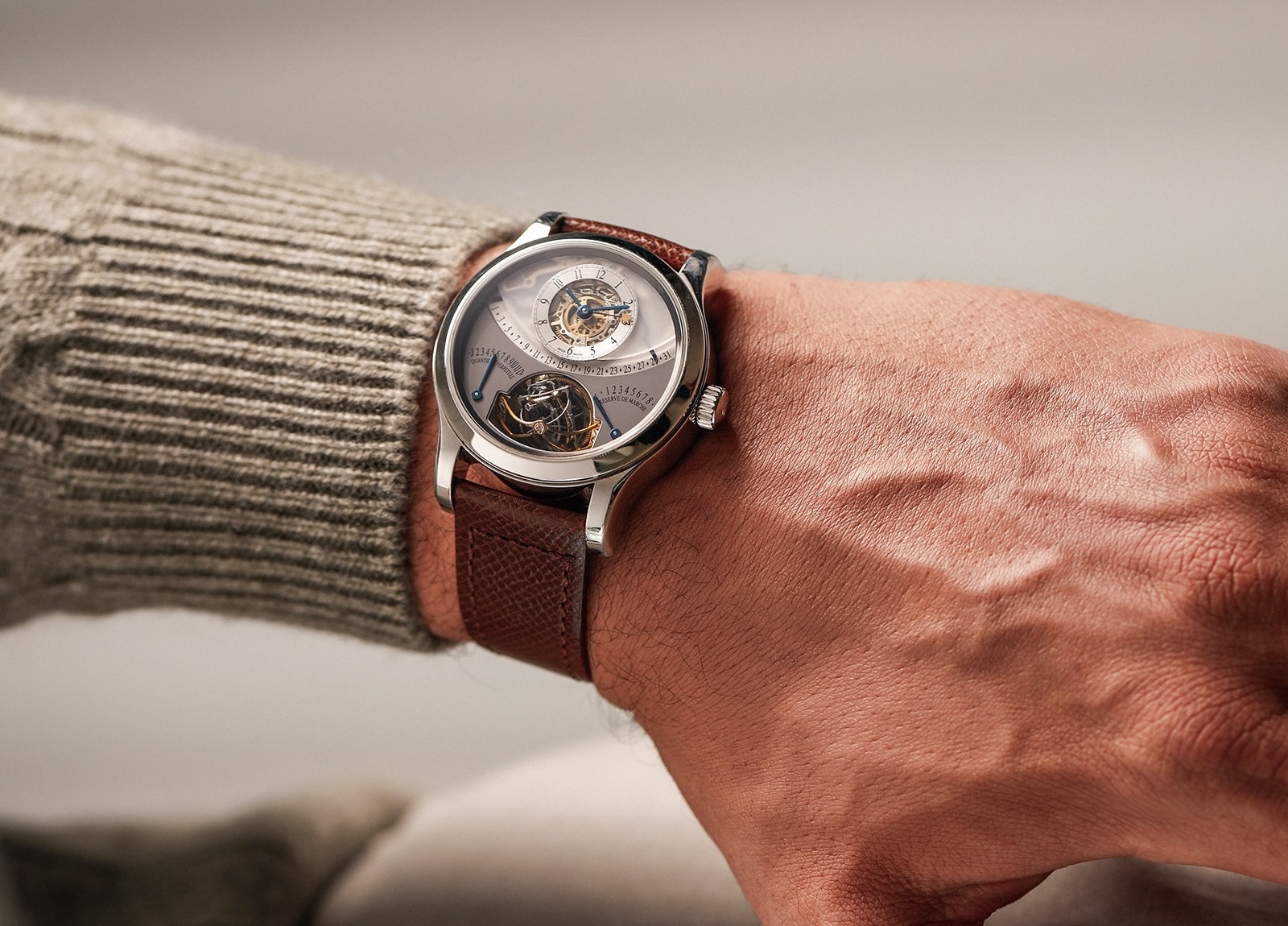
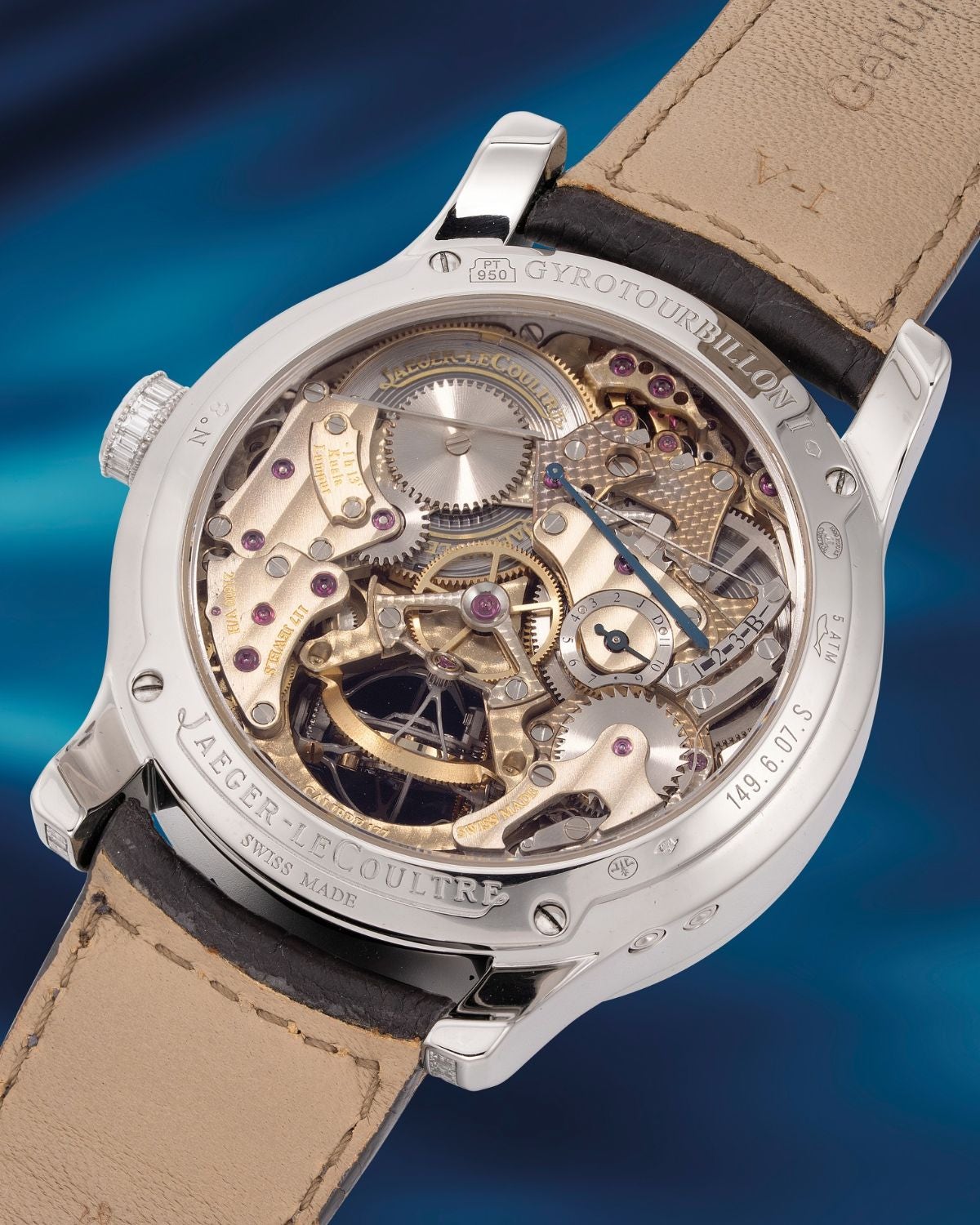
A Jaeger-LeCoultre Ref. 149.6.07.S Gyrotourbillon 1 in platinum.
With the Gyrotourbillon, the brand’s movement constructors and watchmakers turned their attention to a different challenge: rethinking how a tourbillon could perform on the wrist.
Over the following nine years, the dual-axis mechanism would acquire new balance springs, enter a Reverso case, and lose its upper supporting bridge. Each iteration brought a different set of challenges.
A Second Axis
To understand the thinking behind the Gyrotourbillon, it helps to go back to the 18th century to consider why the conventional, single-axis tourbillon was originally conceived.
A pocket watch spends much of its working day upright in a waistcoat pocket. Rotating its balance and escapement in a cage helps average out errors in rate caused by gravity in those vertical positions. The great Abraham-Louis Breguet devised his tourbillon to address this problem, obtaining a patent on June 26, 1801.
A wristwatch has a more varied existence. Its orientation changes as its owner moves, and a traditional tourbillon cannot address every position in the same way. Jaeger-LeCoultre’s 21st-century answer, developed by watchmaker Éric Coudray and the manufacture’s team, was to make the regulating assembly rotate around two perpendicular axes.
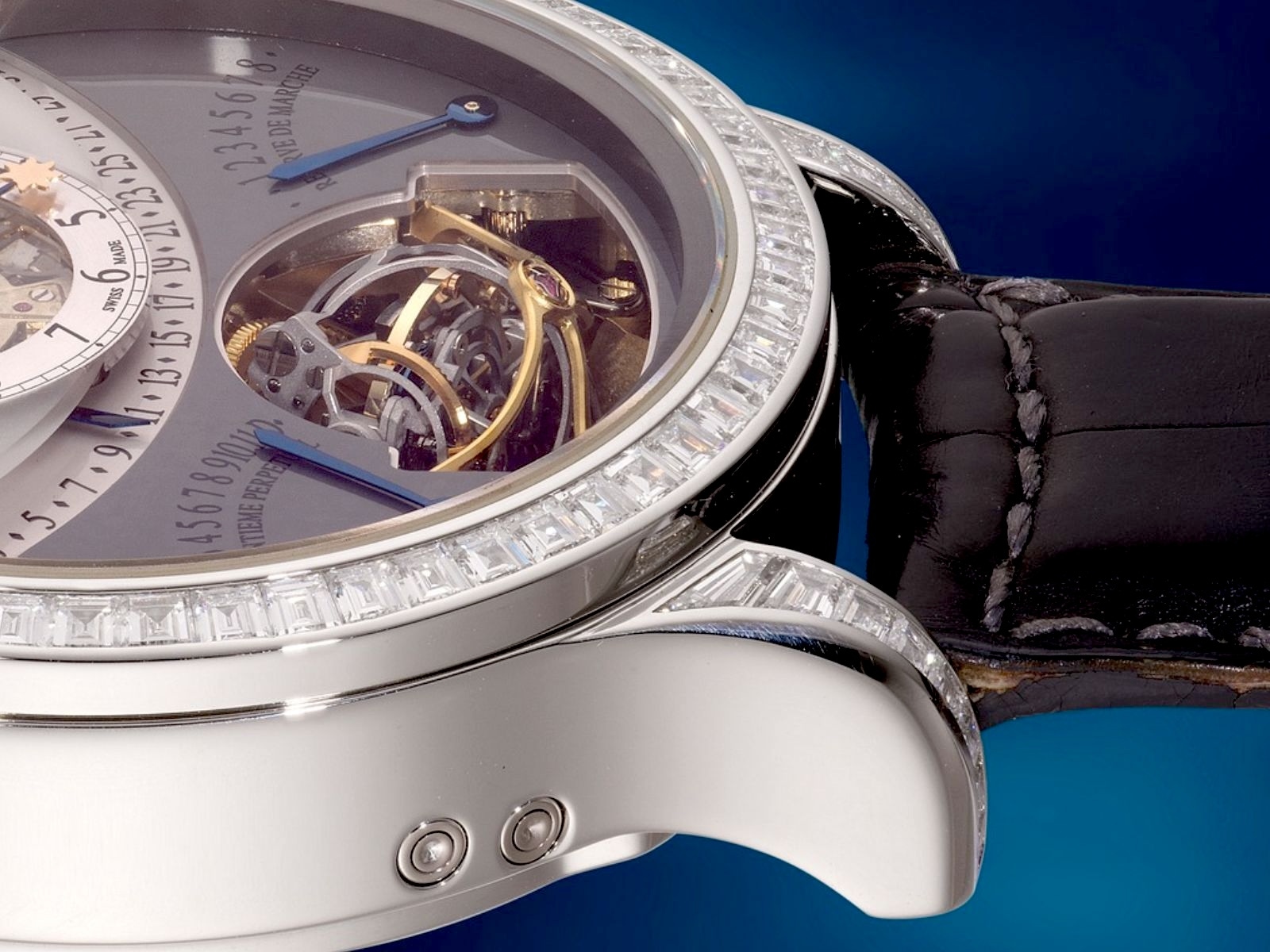
Close-up of a circa 2004 Jaeger-LeCoultre Gyrotourbillon 1 Ref. 149.6.07.S in platinum with baguette diamonds, a perpetual calendar, and equation of time. Lot 1105 in The Hong Kong Watch Auction XXIII. Estimate: HKD $400,000–800,000
A native of Tours, France, Coudray trained in watchmaking and antique restoration in Besançon and La Chaux-de-Fonds before joining Jaeger-LeCoultre in 1989. His work there ranged from developing and refining Reverso minute repeaters and chronographs to creating the Atmos Régulateur and Atmos Mystérieuse clocks.
Bringing the dual-axis tourbillon to life required considerable thought about space, weight, and energy consumption. Driving two rotating cages places greater demands on the mainspring, while a three-dimensional mechanism has to fit inside a watch that someone can wear.
The growing appetite for larger cases at the turn of the millennium helped. So did advances in computer-aided design and simulation, which allowed the team to study how the components would move and interact before making them.
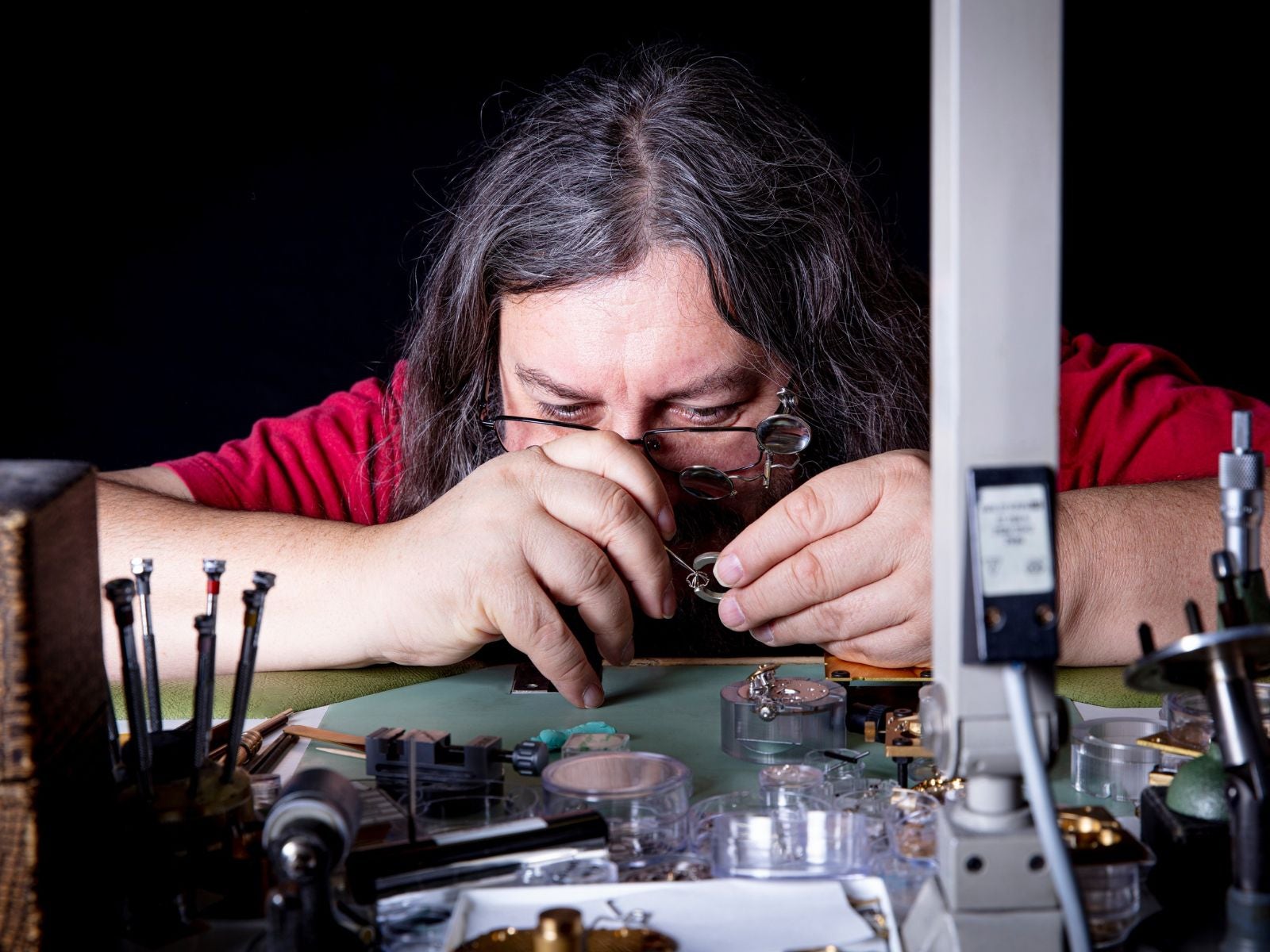
Éric Coudray at his bench. Purtec Movements / Jérôme Saillard
Making the cages posed further challenges. Their intricate shapes had to leave room for the components inside and remain light enough to rotate with minimal energy, while retaining the rigidity to support the mechanism. Machining such slender structures to precise tolerances left little margin for error.
The outcome was a tourbillon with one cage rotating inside another, continually changing the orientation of the balance and escapement. Its name gave a fair indication of what to expect: Gyrotourbillon.
An Ambitious Debut
The first model gave this headline mechanism plenty of company. Its hand-wound Caliber 177 incorporated a perpetual calendar, running equation of time, and eight-day power reserve, with 679 components and 117 jewels accommodated in a 43mm platinum case.
At 6 o’clock, the lightweight aluminum outer tourbillon cage completes a revolution every minute, while the inner cage turns once every 24 seconds. That means two and a half inner rotations per minute, providing much of the animation that draws the eye toward the lower half of the dial.
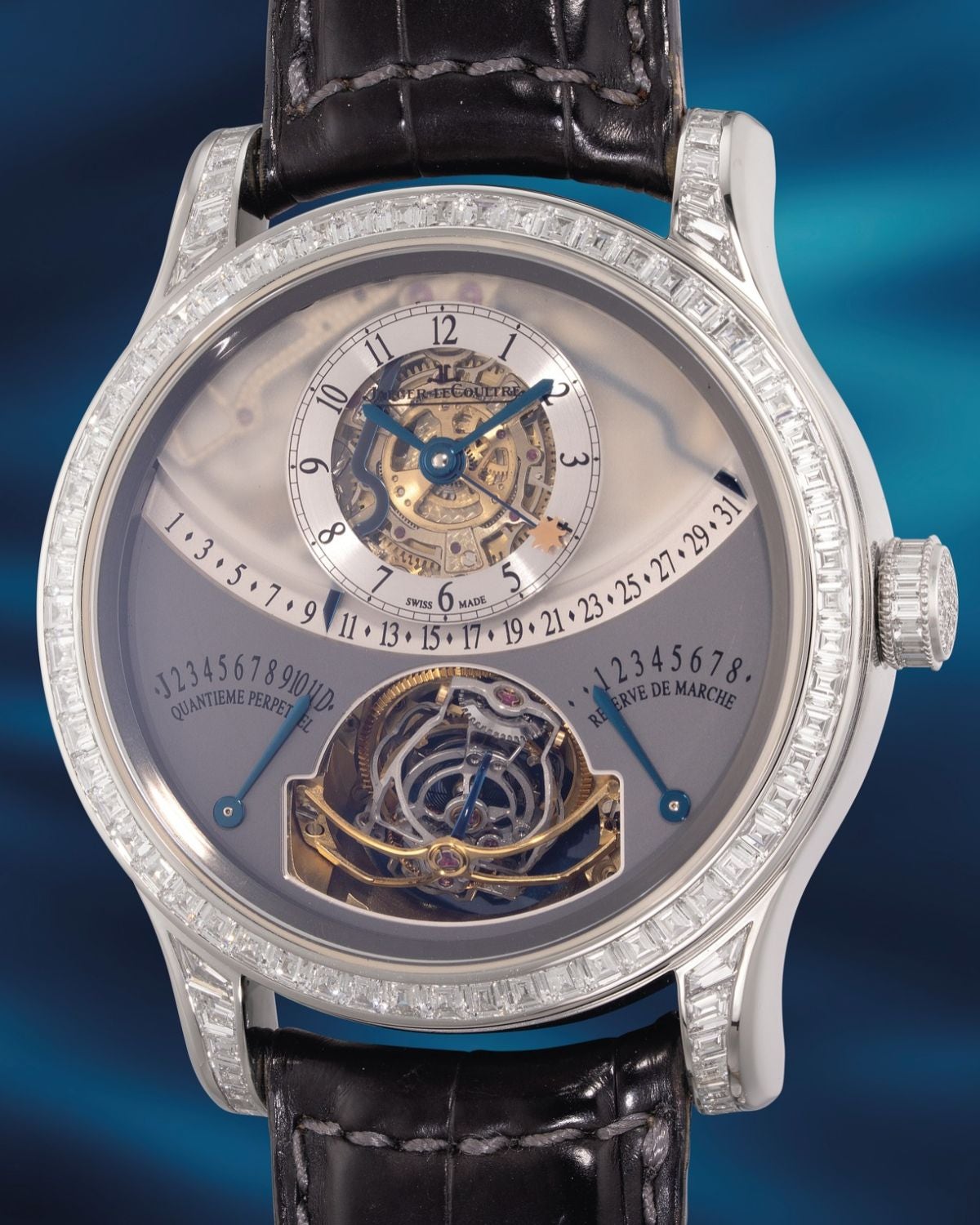
Lot 1105: A circa 2004Jaeger-LeCoultre Gyrotourbillon 1 Ref. 149.6.07.S in platinum with baguette diamonds, a perpetual calendar, and equation of time, included in The Hong Kong Watch Auction XXIII. Estimate: HKD $400,000–800,000
Above it, two retrograde hands under a frosted sapphire section of the dial take turns indicating the date, handing over on the 16th of each month along the broad scale beneath the hour-minute display. The month and power reserve occupy smaller scales on either side of the tourbillon, while the leap-year indication is consulted on the back.
The equation of time is less immediately obvious. An additional minute hand tipped with a sun indicates apparent solar time alongside the conventional minute hand. Over the year, apparent solar time runs ahead of or behind mean solar time – the uniform measure on which our everyday timekeeping is based. Here, that discrepancy is something you can keep track of on the dial.
Lot 1105: A circa 2004Jaeger-LeCoultre Gyrotourbillon 1 Ref. 149.6.07.S in platinum with baguette diamonds, a perpetual calendar, and equation of time, included in The Hong Kong Watch Auction XXIII. Estimate: HKD $400,000–800,000
The example offered as Lot 1105 in The Hong Kong Watch Auction: XXIII – numbered 8 – brings a different sort of spectacle. Its platinum case and white gold clasp are set with 114 baguette-cut diamonds totaling approximately 6.7 carats. The stones extend across the bezel, lugs, crown, and clasp, adding sparkling highlights to an already absorbing dial.
Phillips identifies this factory-set watch as outside a limited edition, distinguishing it from the original unadorned platinum series of 75 pieces.
The Reverso Turn
In 2008, the brand moved the Gyrotourbillon into a case whose identity needed no introduction. Fitting the mechanism inside a Reverso, though, required a new movement and substantial dimensions: the platinum example offered as Lot 1104 measures 55mm long by 36mm wide.
The case has a sliding lock to prevent it from opening inadvertently. Release it, slide the case along its carriage, and turn it over to examine the movement from the other side.
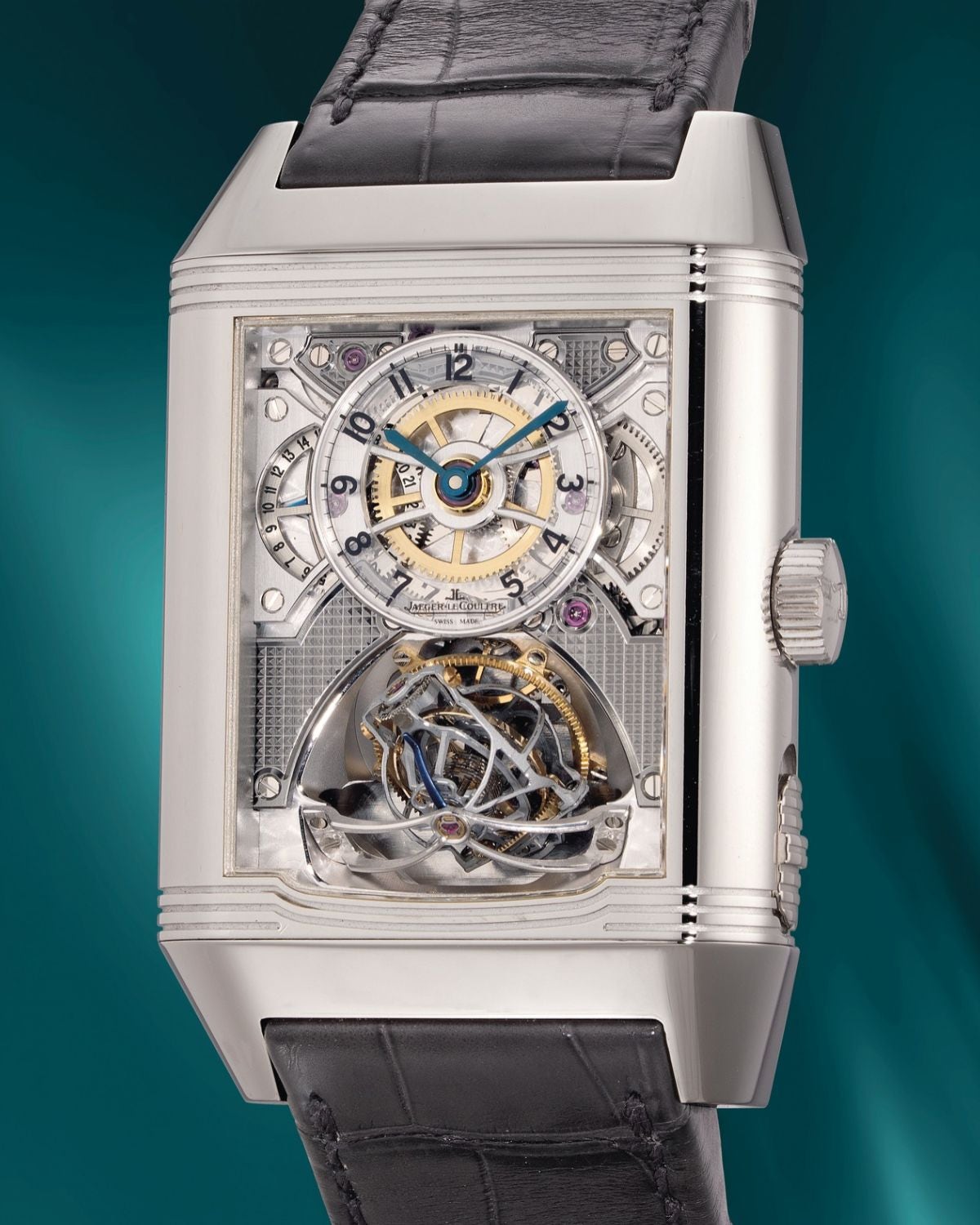
Lot 1104: A circa 2008 Jaeger-LeCoultre Reverso Gyrotourbillon 2 Ref. Q2336420 / 247.6.07in platinum, included in The Hong Kong Watch Auction XXIII. Estimate: HKD $400,000–800,000
The rear gives a second view of the tourbillon, along with the power reserve indicator. On the front, a 24-hour indication tells you whether the indicated hour is morning or afternoon (rather than providing another time zone).
Inside, Caliber 174 brought changes that went well beyond shape. The balance frequency rose from 3Hz to 4Hz, and the inner cage accelerated to one revolution every 18.75 seconds. The outer cage retained its one-minute circuit. A single mainspring barrel replaced the original’s twin-barrel arrangement, providing 50 hours of autonomy, with a stopwork mechanism halting the movement before declining spring tension – torque – could compromise its rate.
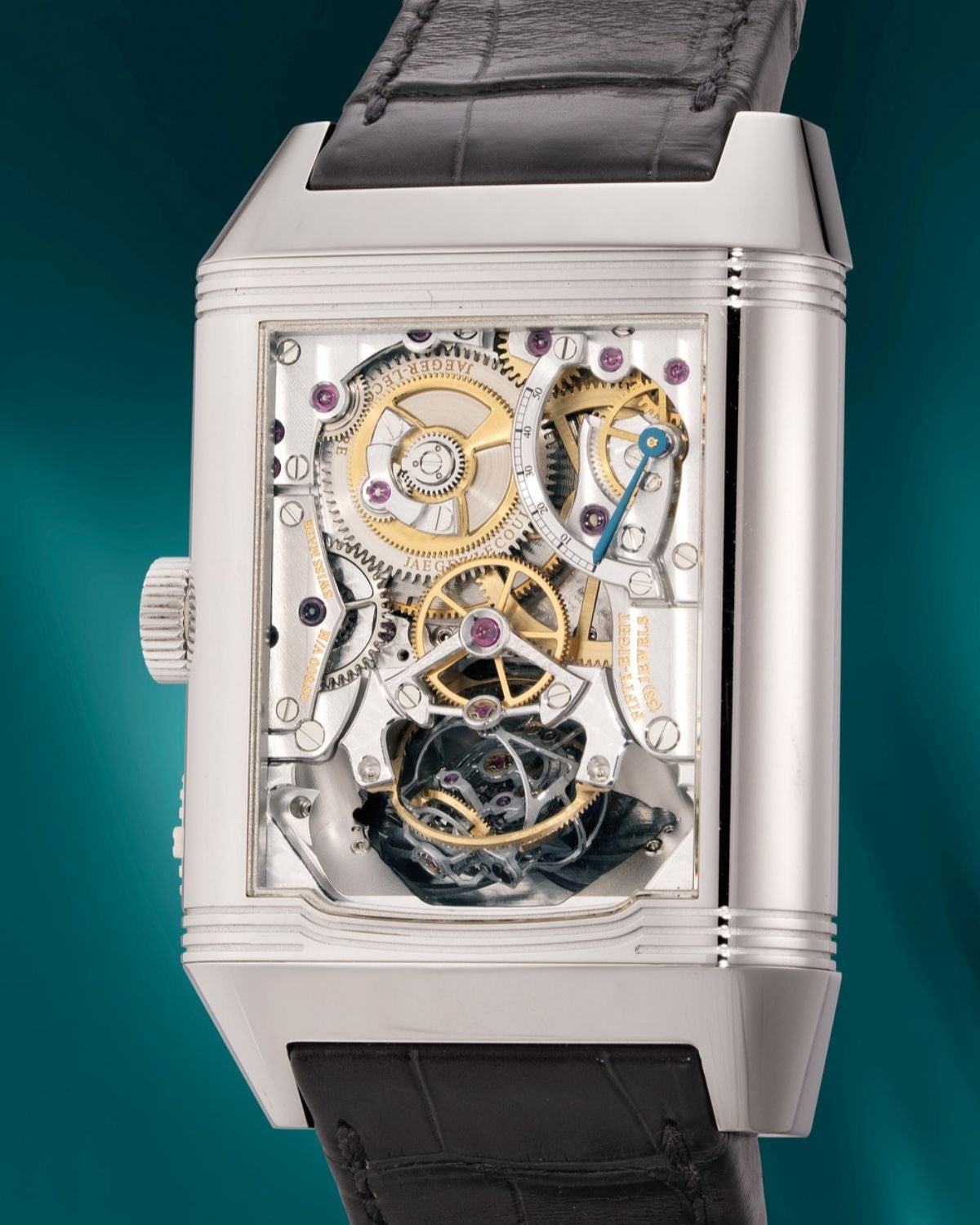
Lot 1104: A circa 2008 Jaeger-LeCoultre Reverso Gyrotourbillon 2 Ref. Q2336420 / 247.6.07in platinum, included in The Hong Kong Watch Auction XXIII. Estimate: HKD $400,000–800,000
The balance spring also assumed a different form. Instead of the first generation’s Breguet overcoil, the Reverso Gyrotourbillon 2 uses a cylindrical spring, its coils stacked one above another.
Familiar from marine chronometers, this construction, with carefully formed curves at both ends, encourages the spring to expand and contract concentrically. The aim is to limit displacement of its center of gravity as it breathes, helping the balance maintain a regular rate.
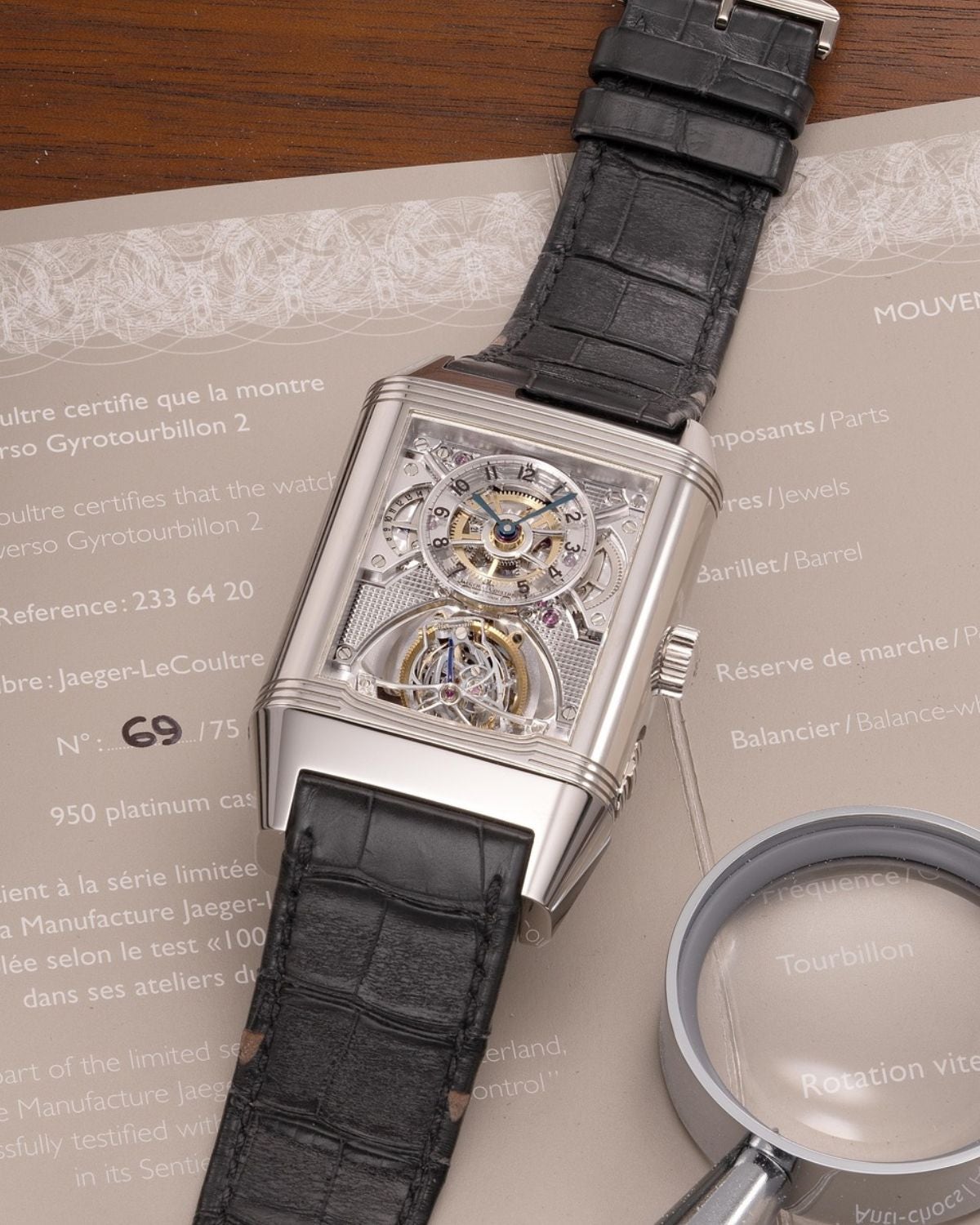
Lot 1104: A circa 2008 Jaeger-LeCoultre Reverso Gyrotourbillon 2 Ref. Q2336420 / 247.6.07in platinum, included in The Hong Kong Watch Auction XXIII. Estimate: HKD $400,000–800,000
Visible within the rotating assembly, the spring gives the observer another moving element to behold. The surrounding details reward attention too, including the openworked bridge carrying the hands, polished bevels, and clous de Paris movement surfaces.
Our example is numbered 69 of the 75-piece platinum edition and comes with its certificate, manual, and presentation box.
Taking Flight
For the Master Grande Tradition Gyrotourbillon 3 Jubilee of 2013, the Vallée de Joux manufacture returned to a round case and opened up the view of the mechanism further. The tourbillon was now supported from beneath, dispensing with the bridge that had crossed above it, meaning its rotation could be appreciated with fewer obstructions.
Within the aluminum cages sat a spherical balance spring and a blued gold balance wheel. After the cylindrical spring of the Reverso, the new spring’s rounded profile continued the pursuit of concentric breathing.
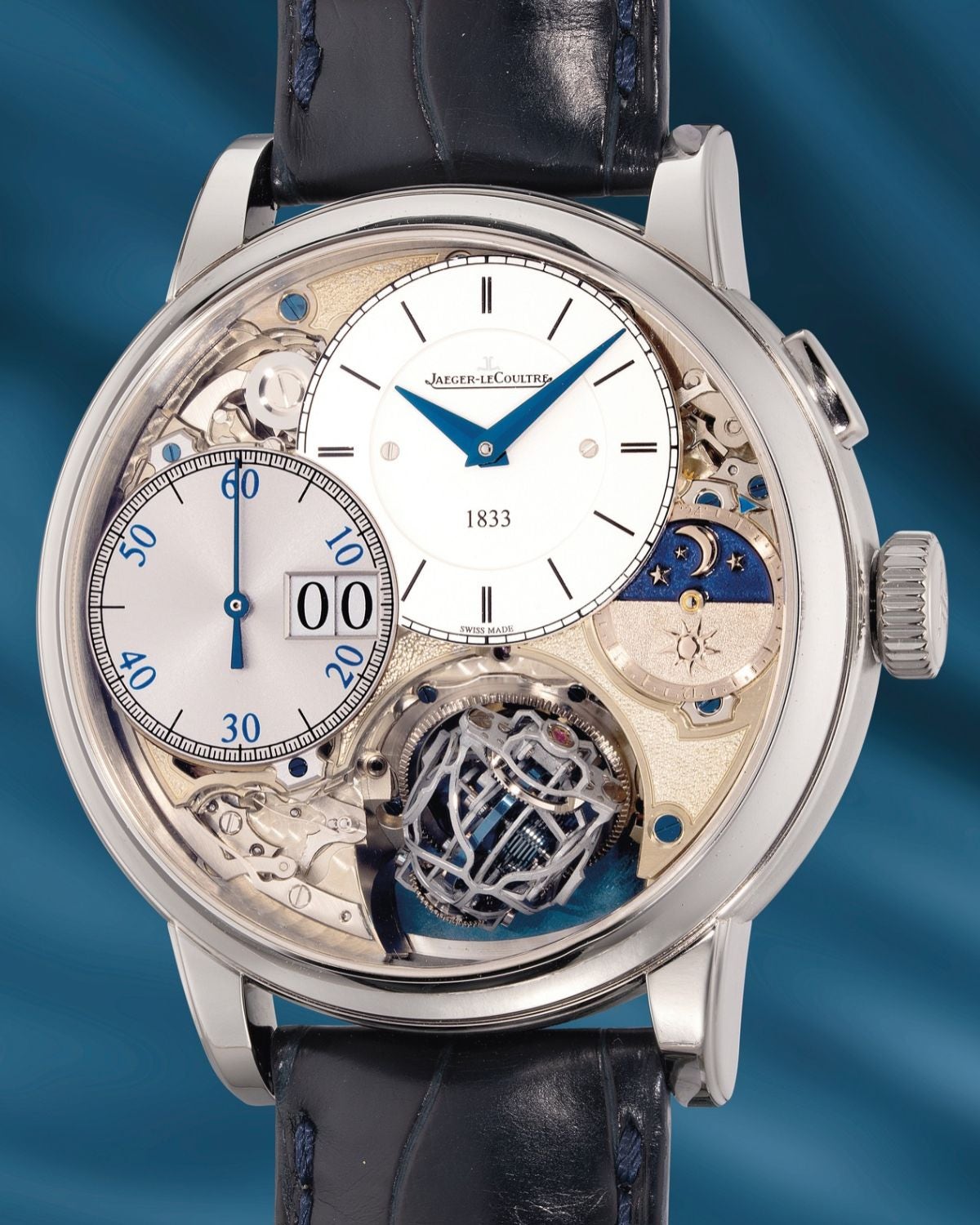
Lot 1103: A circa 2013 Jaeger-LeCoultre Master Grande Tradition Gyrotourbillon 3 Jubilee Ref. 5036420 in platinum with a monopusher chronograph, included in The Hong Kong Watch Auction XXIII. Estimate: HKD $400,000–800,000
A specialist was required to shape its terminal curves by hand, checking their profile against a template using an optical comparator. Small adjustments could take hours to get right.
Then there is the display at 9 o’clock. Its two windows might suggest a large date, but both belong to the monopusher chronograph, operated using the button at 2 o’clock. With the chronograph running, a hand sweeps around the seconds scale, while the digital numerals jump at the end of each minute to record elapsed minutes.
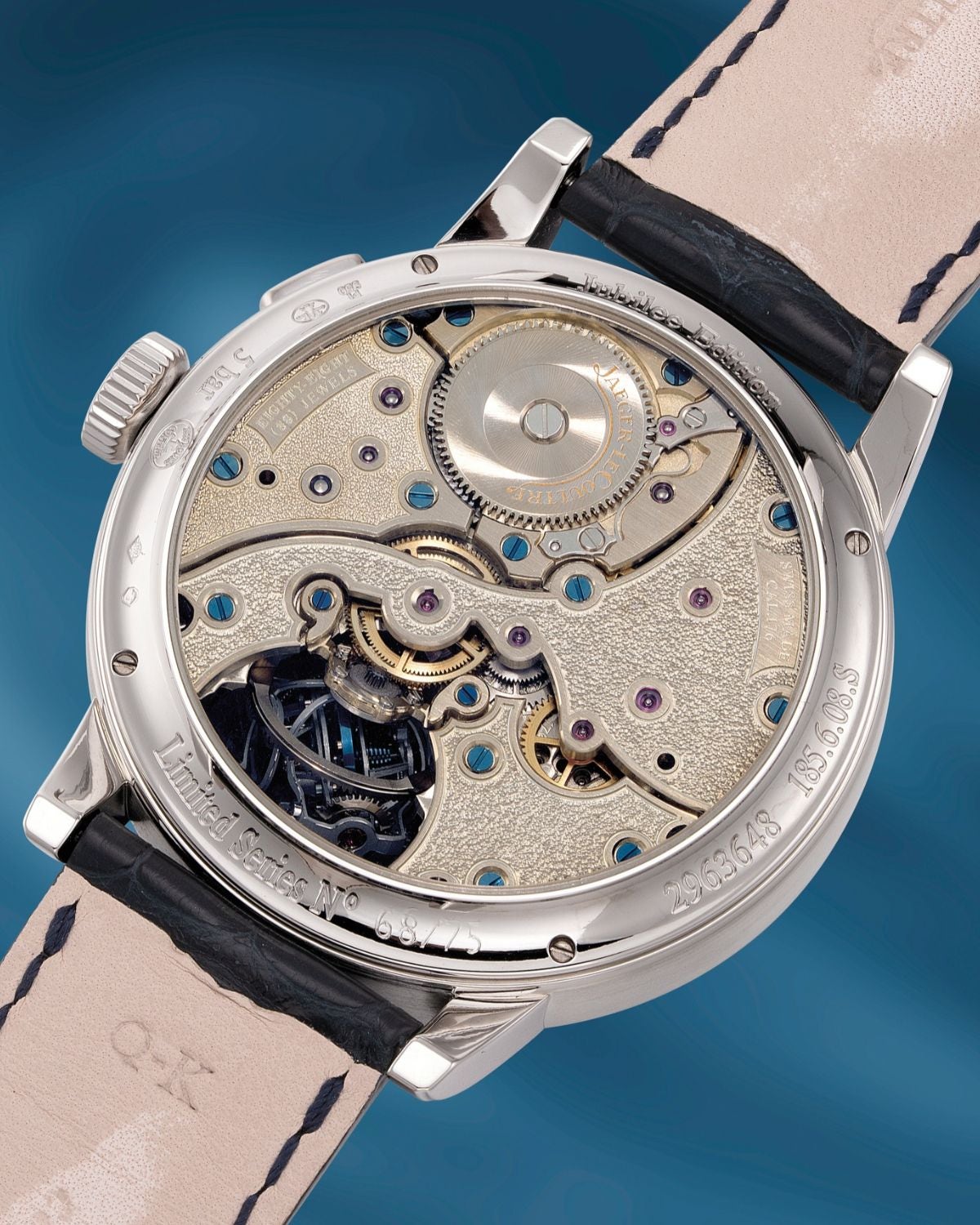
Lot 1103: A circa 2013 Jaeger-LeCoultre Master Grande Tradition Gyrotourbillon 3 Jubilee Ref. 5036420 in platinum with a monopusher chronograph, included in The Hong Kong Watch Auction XXIII. Estimate: HKD $400,000–800,000
Making those minute discs jump cleanly, stay correctly positioned, and return to zero calls for careful management of energy and inertia. It is a substantial complication in its own right, with a clear display that takes little effort to read.
The pictorial day-night display adds a touch of poetry and color, its hand-punched surface partly coated in translucent blue lacquer. Turning the watch over reveals the hand-wound Caliber 176, whose German silver bridges gain texture and depth from hammered surfaces and polished bevels.
Lot 1103 is numbered 68 of the 75 platinum examples created for Jaeger-LeCoultre’s 180th anniversary.
Further Revolutions
Development of the Gyrotourbillon has, of course, continued since. The 2016 Reverso Tribute Gyrotourbillon reduced the mechanism’s dimensions, while the 2019 Westminster Perpétuel featured a smaller Gyrotourbillon with a remontoir d’égalité, perpetual calendar, and Westminster minute repeater. In 2026, the Gyrotourbillon À Stratosphère added a third axis of rotation, bringing the family to its sixth generation.
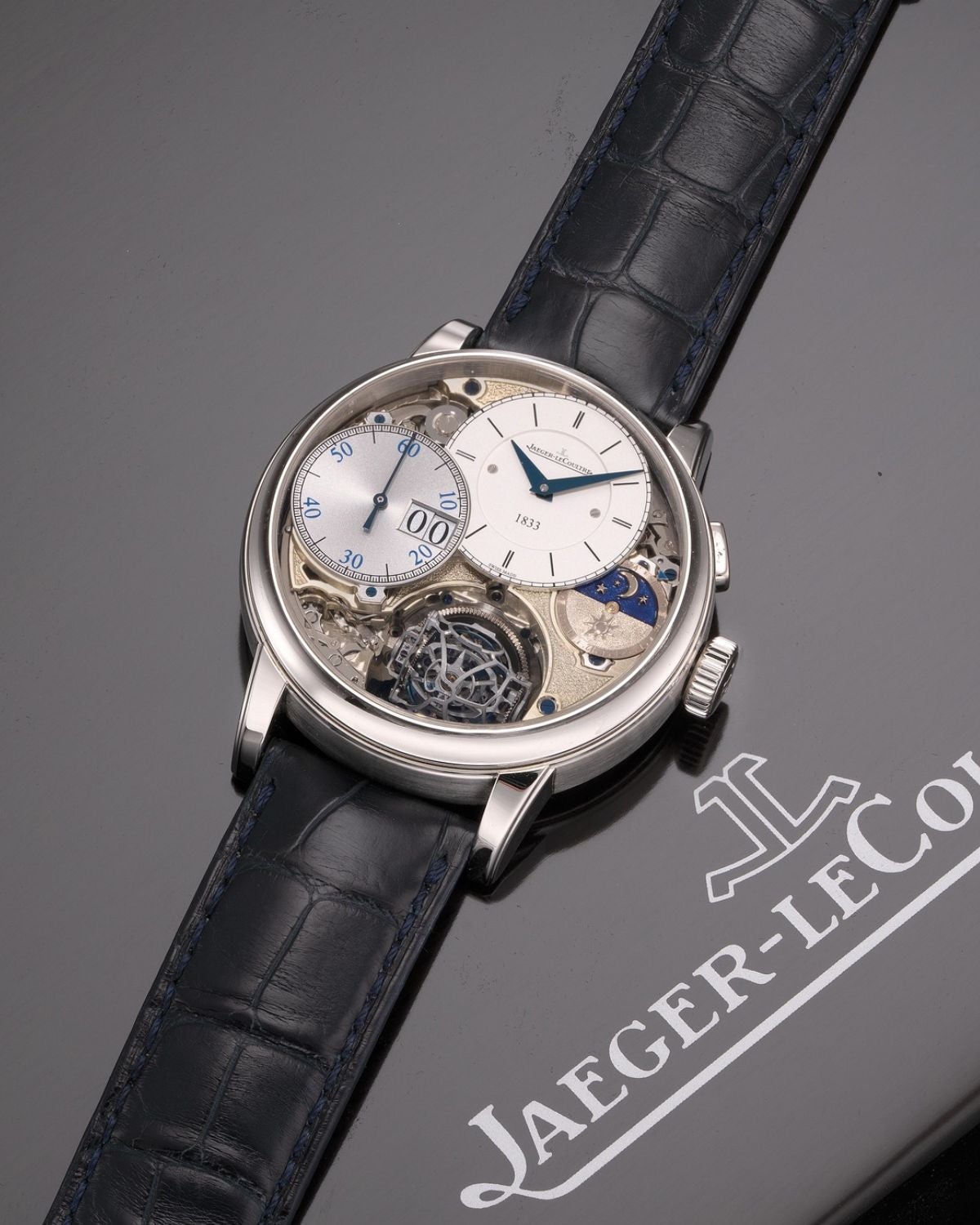
Lot 1103: A circa 2013 Jaeger-LeCoultre Master Grande Tradition Gyrotourbillon 3 Jubilee Ref. 5036420 in platinum with a monopusher chronograph, included in The Hong Kong Watch Auction XXIII. Estimate: HKD $400,000–800,000
The first three still give us much to admire. Examining the first model’s calendar scales, turning over the No. 2 Reverso, or starting the Jubilee’s chronograph gives us different ways to revel in the watchmaking behind them. When our gaze returns to the rotating cages, knowing what they are doing helps, but keeping track of them is another matter.
You can learn more, place a bid, and view the entire Hong Kong Watch Auction: XXIII catalog here.