132
Banksy
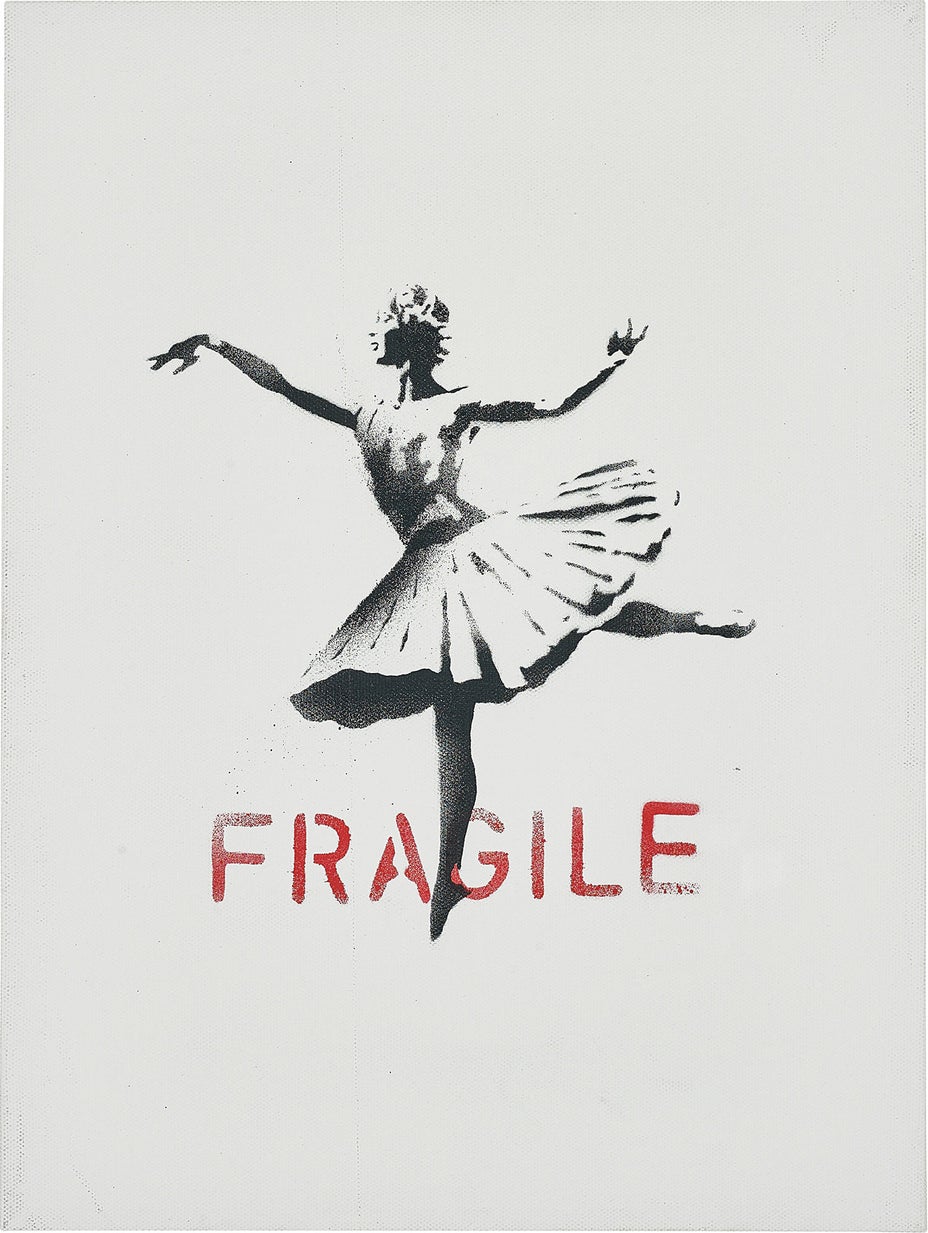
Ballerina CP/03
Full-Cataloguing
The artistic quality in the present lot cannot be overlooked. Banksy confronts and disrupts another icon in Ballerina CP/03, where he takes the silhouette of Princess Odette in one of the most prominent ballets composed by Pyotr Illyich Tchaikovsky, Swan Lake, and transforms the figure into a caricature, all the while retaining the sinister underlying emotions of the character's inevitable demise. The grace and poise of the ballerina en pointe in an arabesque is at once contrasted with the potentially disquieting text “FRAGILE” overlaid on the canvas rendered in red. Banksy’s use of the instantly-recognisable features of Princess Odette as a visual theme demonstrates his laser-sharp sense of satire. Using the story of Odette, a princess turned into a swan by an evil sorcerer’s curse and who is only able to break the spell by finding eternal love, Banksy points to the softness and delicacy of the character and implies that there is often more than what simply meets the eye. As part of the artist’s aesthetic vocabulary, he uses a stencil to create the figure of the ballerina while evidently keeping his style and control through his use of the spray can, applying his graffiti sensibilities on canvas.
Ballerina CP/03 is at once a work of art that not only exhibits Banksy’s clean aesthetic but also recalls a distinctly transformative public art form unprecedented by any other artist of our time, further consolidating his position as an iconic artist of the contemporary age.
Banksy
British | 1975Anonymous street artist Banksy first turned to graffiti as a miserable fourteen year old disillusioned with school. Inspired by the thriving graffiti community in his home city, Bristol, Banksy's works began appearing on trains and walls in 1993, and by 2001 his blocky, spray-painted works had cropped up all over the United Kingdom. Typically crafting his images with spray paint and cardboard stencils, Banksy is able to achieve a meticulous level of detail. His aesthetic is clean and instantly readable due to his knack for reducing complex political and social statements to simple visual elements.
His graffiti, paintings and screenprints use whimsy and humour to satirically critique war, capitalism, hypocrisy and greed — with not even the Royal family safe from his anti-establishment wit.