Article | The Weight Of Platinum A Spotlight On The Metal At The Phillips Watches Hong Kong Sessions Spring 2026 Online Auction
The Weight of Platinum: A Spotlight on the Metal at the Phillips Watches Hong Kong Sessions, Spring 2026, Online Auction
Platinum’s density, resistance to corrosion, and punishing machining demands make it the most exacting choice in watch cases. That is precisely why the best brands reserve it for their finest work.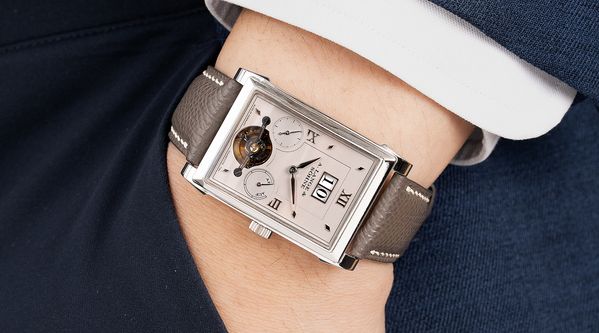
Phillips in Association with Bacs & Russo is thrilled to welcome you to The Hong Kong Sessions, Spring 2026, Online Auction, running from 12:00 PM HKT, Wednesday, 18 March, to 2:00 PM HKT, Wednesday, 25 March. The sale features more than 100 high-end luxury wristwatches, ranging from A. Lange & Söhne and Breguet to Audemars Piguet and Patek Philippe.
– By Logan Baker
Platinum occupies a curious place in watchmaking.
It is not louder than gold. It does not carry the immediate warmth of yellow or the cool glamour of white gold. And yet, within the hierarchy of case metals, it sits at the top.
On paper, platinum is not dramatically rarer than gold in the Earth’s crust. Gold occurs at roughly four parts per billion. Platinum at about five. What matters more is how much of each metal humanity has actually extracted. If you gathered all the gold ever mined, you would form a cube roughly 25 meters on each side. All the platinum ever mined would fit into a cube about seven meters across.
Platinum is mined in tiny quantities by comparison, and much of it historically went to industry, particularly catalytic converters, where platinum-group metals catalyze the conversion of harmful exhaust gases. Jewelry and watchmaking have always competed with far more utilitarian uses.
Rarity alone does not make a metal desirable. Both gold and platinum resist corrosion and oxidation, meaning they survive the elements with remarkable resilience. Outside of extreme laboratory conditions, neither rusts nor tarnishes. That chemical stability allows both to exist in native form in nature and makes them ideal for objects meant to endure decades of wear.
But platinum has another advantage – it's exceptionally dense.
When you pick up a platinum watch, the difference is immediate. A platinum case feels planted on the wrist, like a mechanical instrument rather than an ornament. You know it before you look at it.
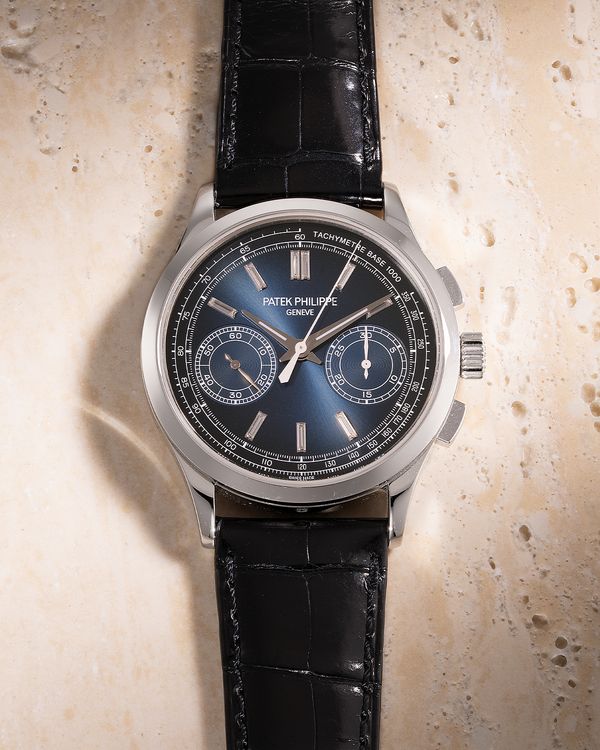
Lot 8004: A circa 2020 Patek Philippe Chronograph Ref. 5170P-001 in platinum with blue dial that’s included in the Phillips Hong Kong Sessions, Spring 2026, Online Auction. Estimate: HKD $350,000 - 500,000
Historically, platinum is a relatively new metal. Gold has been worked with for thousands of years.
Platinum, by contrast, remained largely misunderstood in Europe until the 18th century. It appeared in pre-Columbian South American objects and occasionally in ancient Egyptian artifacts, but was often used as an additive rather than as a distinct material. In 1557, Julius Caesar Scaliger described a mysterious white metal that no known technique could melt. It was not until Antonio de Ulloa’s studies in 1748 that platinum entered European scientific consciousness in a meaningful way.
Even then, it resisted easy use. Naturally occurring platinum is often alloyed with other platinum-group metals, such as iridium and osmium, which makes it brittle. Only in the late-18th century did metallurgists develop methods to purify it, revealing its true character. Once refined, platinum proved both malleable and extraordinarily resistant to wear. It began appearing in decorative arts, in everything from weaponry to Fabergé creations. Later, houses like Cartier embraced it enthusiastically because it allowed jewelers to create lighter, stronger settings than gold ever could.
And then there is the cosmic angle. The heavier elements are not formed in ordinary stellar fusion. For years, scientists believed supernovas might account for metals as heavy as platinum. Today, the prevailing theory points to neutron-star collisions. Two ultra-dense remnants of exploded stars, composed largely of neutrons, spiral inward and collide with unimaginable violence. In that instant, under pressures and energies beyond comprehension, heavy elements, including platinum, are forged and scattered into space. When you fasten a platinum watch to your wrist, you are wearing matter born from one of the most violent events in the universe.
From a practical standpoint, platinum is close to ideal for a watch case. It is typically used in 95% purity, often alloyed with ruthenium. The material must be homogenized through hammering and annealing to eliminate porosity. Even microscopic contamination can cause surface defects. Platinum sheet is rolled to thickness, stamped into blanks, and then machined in stages.
Here, the romance gives way to difficulty. Platinum is famously challenging to machine. It is ductile and what machinists call “gummy.” Instead of producing clean chips, it tends to be displaced by a cutting tool. Tool wear is rapid and severe. Surfaces degrade quickly if speeds and pressures are not carefully controlled. It takes significantly longer to produce a platinum case than a gold one. Slower tool speeds, lower pressures, and more frequent tool changes are required to maintain acceptable surface quality. The metal’s very virtues – strength and ductility – become obstacles on the production floor.

Lot 8066: A circa 1926 Cartier Tortue in platinum and 18K yellow gold that’s included in the Phillips Hong Kong Sessions, Spring 2026, Online Auction. Estimate: HKD $60,000 - 120,000
Yet those same qualities make platinum remarkably long-wearing. When scratched, platinum does not lose material as gold does. Instead, the metal displaces. Over time, it develops a soft patina rather than thinning out. Many collectors come to prefer that subtle surface texture. It speaks of age without fragility.
There are tradeoffs. Platinum’s density can dampen sound, which makes it less ideal for minute repeaters, where acoustical resonance matters. But in most other contexts, its combination of weight, chemical stability, and structural integrity makes it exceptionally well-suited to horology.
Platinum has even appeared in unexpected places. In 1993, Swatch produced nearly 13,000 platinum examples of the Trésor Magique, accounting for the majority of Switzerland’s platinum watch output that year. It was an anomaly, but it underscored an important point. Platinum does not belong to a single aesthetic. It can house a simple three-hand watch, a high complication, or even a plastic-fantastic icon rendered in precious metal.
In contemporary watchmaking, platinum remains the ultimate quiet flex. The only clue is often a small diamond between the lugs or a discreet hallmark. Its appeal lies in discretion, density, and difficulty.
Each of the watches that follow uses platinum differently, but in every instance, the choice elevates the watch from merely precious to something more considered.
Lot 8050: A Circa 2021 A. Lange & Söhne Lange 1 'Stealth' Ref. 191.025 in Platinum
Estimate: HKD $150,000 - 300,000
When A. Lange & Söhne unveiled the second-generation Lange 1 in 2015, it did something few brands manage gracefully. It updated an icon without disturbing the proportions and visual tension that made the original so arresting in the first place.
To understand why that matters, you have to go back to 1994. The original Lange 1 was a declaration of the reborn brand's intent. In the years following German reunification, it helped reestablish the Saxon manufacture as a serious force in high-end watchmaking.
The asymmetric dial, inspired by the principles of the golden ratio, and the outsized date, framed in polished metal, were unlike anything coming out of Switzerland at the time. It felt cerebral, deliberate, and unmistakably German.
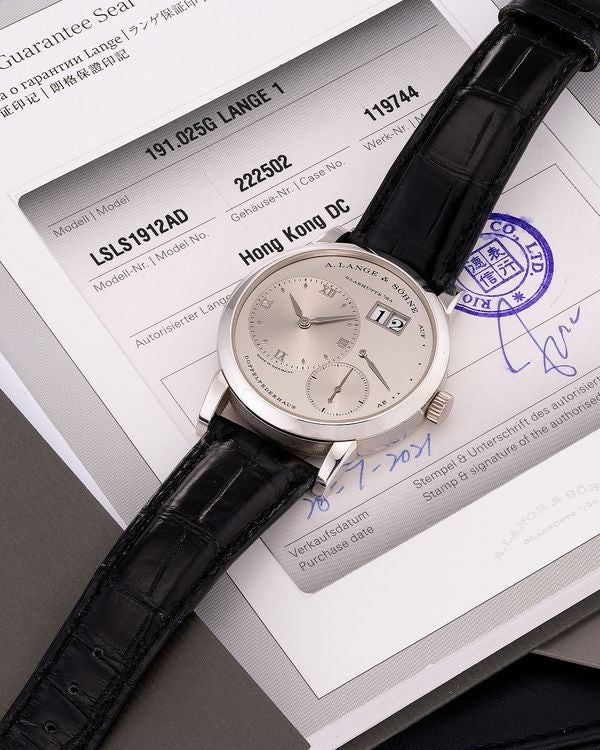
Lot 8050: A circa 2021 A. Lange & Söhne Lange 1 'Stealth' Ref. 191.025 in platinum that's included in the Phillips Hong Kong Sessions, Spring 2026, Online Auction. Estimate: HKD $150,000 - 300,000
The 2015 iteration kept all of that. The familiar off-center hours and minutes, the separate small seconds, the power reserve indicator, the signature big date at one o’clock. What changed were the details. The dial typography tightened. The proportions breathed more evenly. The overall composition gained clarity without losing character.
Collectors often refer to the platinum, silver-dial configuration as the Lange 1 “Stealth,” and it is easy to see why. Platinum does not shout on the wrist like gold. It absorbs light rather than reflecting it, giving the watch a dense, almost matte authority. Paired with a silver dial, the effect is nearly monochromatic. Understated from across the room, devastatingly sharp up close.
Beneath the dial sits the manufacture calibre L121.1, introduced with this second generation. It brought tangible mechanical upgrades, including a newly developed balance with a free-sprung hairspring and a more precisely engineered jumping-date mechanism. Yet it remains unmistakably Lange. The three-quarter plate is in untreated German silver. The balance cock is hand-engraved. The blued screws are secured by gold chatons. It offers modernized performance in a thoroughly traditional language.
In excellent overall condition and accompanied by its accessories, this platinum Lange 1 speaks to a particular kind of collector – someone who values restraint over flash.
Lot 8004: A Circa 2020 Patek Philippe Chronograph Ref. 5170P-001 in Platinum with Blue Dial
Estimate: HKD $350,000 - 500,000
Few names carry as much weight in the history of the chronograph as Patek Philippe.
From the mid-century references that now define the auction market to the muscular, late-20th-century revival pieces, the brand has long treated the chronograph as a canvas for both mechanical rigor and aesthetic restraint.
In 2010, Patek turned a decisive page with the introduction of the Patek Philippe Ref. 5170. For the first time in a traditionally styled, two-register chronograph, the manufacture installed its fully in-house calibre CH 29-535 PS. The preceding Patek Philippe Ref. 5070 had relied on the Lemania-based CH 27-70, a movement beloved in its own right, but the 5170 signaled independence in the most classical sense.
The case told a similar story. Where the 5070 measured a bold 42mm, the 5170 returned to something closer to mid-century proportions at 39.5mm. The lugs softened. The bezel slimmed. The overall profile felt more Calatrava than sports chronograph. On the wrist, it wears with balance and composure, the way a traditional Patek chronograph should.
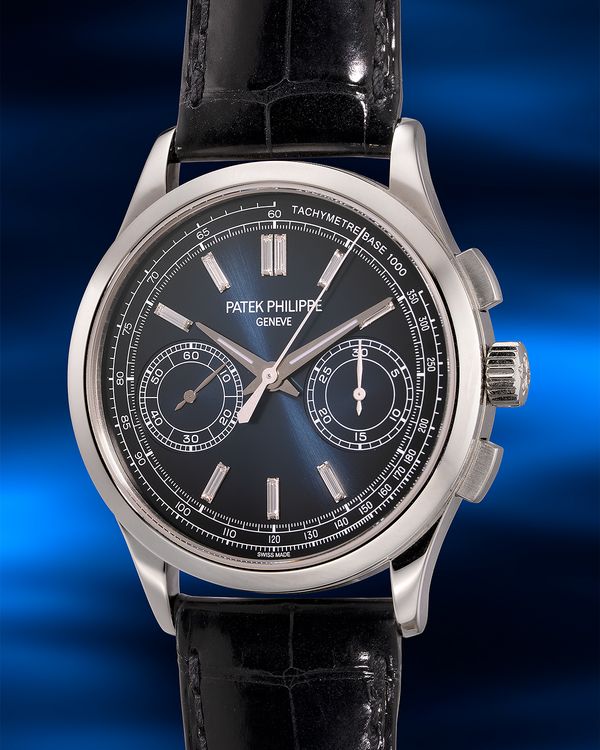
Lot 8004: A circa 2020 Patek Philippe Chronograph Ref. 5170P-001 in platinum with blue dial that’s included in the Phillips Hong Kong Sessions, Spring 2026, Online Auction. Estimate: HKD $350,000 - 500,000
Throughout its production, the 5170 was offered in 18k yellow, white, and pink gold. Then came platinum. The Patek Philippe Ref. 5170P is the most assertive and the most elusive of the series. Its blue fumé dial shifts from electric cobalt at the center to near-black at the periphery, a dramatic backdrop for baguette diamond hour markers. In platinum, Patek often hides a single diamond between the lugs at six o’clock, a discreet signature for those who know to look.
Produced for less than three years, the 5170P became the final expression of the reference before Patek replaced it in 2019 with the Patek Philippe Ref. 5172G.
This example remains exceptionally well preserved, accompanied by its Certificate of Origin and presentation box. For a collector drawn to modern Patek but unwilling to compromise on lineage, mechanics, or presence, the 5170P occupies a compelling middle ground. It is contemporary, yes. But it carries the full weight of the brand's chronograph tradition.
Lot 8011: A Circa 2005 Breguet Classique Tourbillon Ref. 5307 in Platinum
Estimate: HKD $200,000 - 400,000
If one complication defines an entire maison, it is the tourbillon at Breguet. Long before it became a visual shorthand for high watchmaking, it was a practical solution to a specific problem. And it began with a single patent.
Every Breguet tourbillon bears the inscription “7 Messidor An 9” on the movement, a nod to the French Republican calendar. Translated to the Gregorian system, that date is 26 June 26 1801, when Abraham-Louis Breguet secured his patent for the invention. The timing is remarkable. France was emerging from the chaos of the Revolution, the Reign of Terror had only recently ended, and political power was shifting toward Napoleon’s Consulate. In the midst of upheaval, Breguet was quietly refining a rotating escapement designed to average out positional errors in pocket watches.
The idea was simple in theory and fiendishly complex in execution. By mounting the escapement and balance within a rotating cage, the watch could counteract gravity's effects. Two centuries later, the tourbillon remains a technical challenge and, in the right hands, a poetic one.
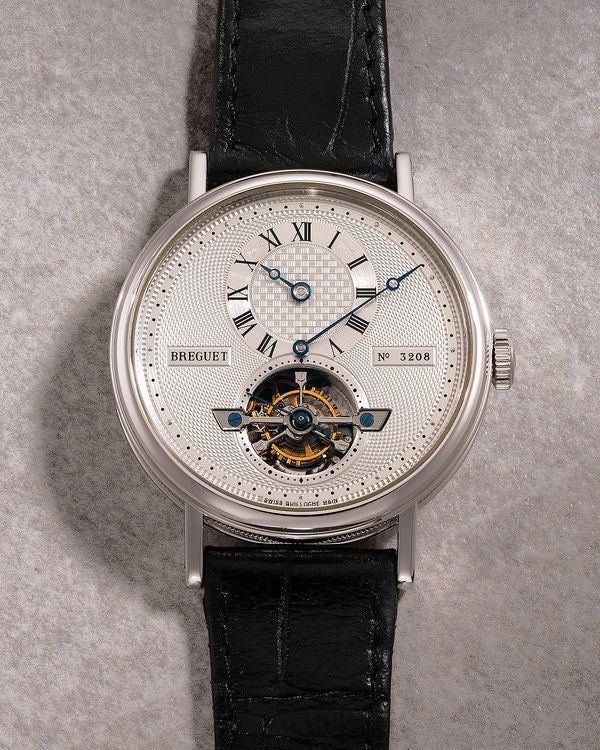
Lot 8011: A circa 2005 Breguet Classique Tourbillon Ref. 5307 in platinum that’s included in the Phillips Hong Kong Sessions, Spring 2026, Online Auction. Estimate: HKD $200,000 - 400,000
On the dial side, this platinum example makes the complication the focal point. The tourbillon cage sits proudly within a field of finely executed guilloché patterns, a decorative feature that has long been part of Breguet’s visual language. The regulator-style display, with separated indications for hours and minutes, recalls the precision clocks once used by watchmakers to set their work.
Turn the watch over, and the mood shifts from architectural to artisanal. The movement is engraved and finished entirely by hand, each flourish cut with confidence rather than machine uniformity. In platinum, the case adds density and quiet authority. It frames the mechanics without distracting from them.
As a whole, the watch feels less like a contemporary luxury object and more like a living continuation of Breguet’s original idea. It unites invention, decoration, and historical continuity in a way few tourbillons manage.
Lot 8087: A Circa 2000 IWC Schaffhausen Da Vinci Perpetual Calendar Split-Seconds Chronograph in Platinum
Estimate: HKD $60,000 - 120,000
The story of the IWC Da Vinci begins in 1969, at a moment when the industry was staring down the Quartz Revolution. The original IWC Da Vinci Ref. 3501 housed the Swiss-made, quartz-powered Beta 21 movement and arrived in a bold, cushion-shaped case with an integrated bracelet and date display. Over time, the Da Vinci name would evolve into something else entirely, but that first chapter set the tone: technical ambition wrapped in distinctive design.
By 1985, at Baselworld, IWC had pivoted decisively back to mechanical watchmaking. The IWC Da Vinci Ref. 3750 introduced Kurt Klaus’s ingenious perpetual calendar module, a system that allowed all calendar indications to be advanced through the crown alone. No fiddly correctors. No stylus required. The case, with its articulated bar lugs and stepped bezel, gave the watch a sculptural presence that was unmistakably of its era.
A decade later, IWC marked the model’s anniversary with the IWC Da Vinci Ref. 3751, adding a split-seconds chronograph to the perpetual calendar. It was a serious escalation. Combining a rattrapante with a perpetual calendar remains one of watchmaking’s more demanding pairings, both mechanically and spatially.
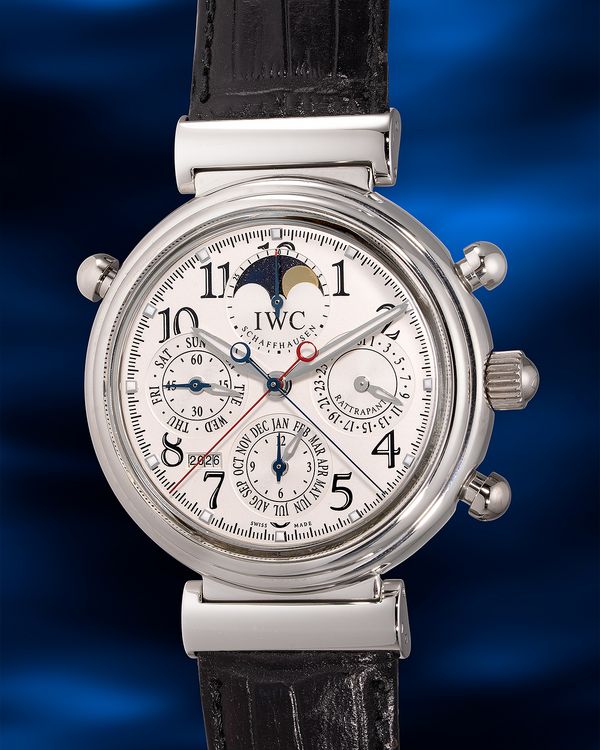
Lot 8087: A circa 2000 IWC Schaffhausen Da Vinci Perpetual Calendar Split-Seconds Chronograph in platinum that’s included in the Phillips Hong Kong Sessions, Spring 2026, Online Auction. Estimate: HKD $60,000 - 120,000
The Ref. 3754 carried that lineage forward with a larger 41.5mm case and a more contemporary stance. Arabic numerals replaced batons, lending the dial greater legibility and a slightly more assertive character. The architecture remained complex, but the watch felt more modern on the wrist.
Cased in platinum and produced in a limited run of 500 pieces between 2000 and 2004, the IWC Da Vinci Ref. 3754 stands at the intersection of late-20th-century ambition and early-2000s confidence. It is dense in the hand, visually intricate, and unapologetically complicated.
This example, number 178 of the edition, remains in excellent overall condition. For a collector drawn to technical bravura and the particular design language of IWC’s revival era, it represents a compelling chapter in the Da Vinci story.
Lot 8039: A Circa 2018 A. Lange & Söhne Lange 1 Moon-Phase Ref. 192.025 in Platinum
Estimate: HKD $120,000 - 220,000
Few modern watches manage to feel both architectural and poetic at once. The A. Lange & Söhne Lange 1 Moon-Phase Ref. 192.025 does exactly that. It takes the disciplined asymmetry that defines the Lange 1 and adds a complication that softens the composition without disturbing its balance.
The Lange 1 itself remains one of the most important watches of the late-20th century. The hours and minutes, small seconds, power reserve, and outsized date align according to strict proportional logic. Nothing overlaps. Nothing feels forced. In this 38.5mm platinum case, the proportions feel particularly at ease. The polished surfaces catch the light gently, without the visual weight that platinum brings.
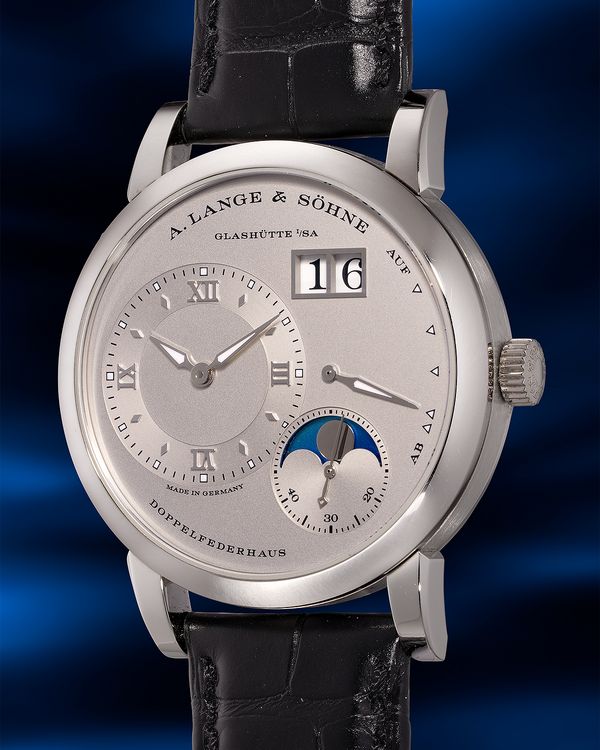
Lot 8039: A circa 2018 A. Lange & Söhne Lange 1 Moon-Phase Ref. 192.025 in platinum that’s included in the Phillips Hong Kong Sessions, Spring 2026, Online Auction. Estimate: HKD $120,000 - 220,000
The solid silver dial carries the familiar layout: time displayed off-center, the large date at two o’clock, and the power reserve at three. At five o’clock, the small seconds subdial features a moon-phase with a day-and-night indication. It is an elegant solution. The vibrant blue of the lunar disc introduces just enough contrast to animate the dial, while remaining fully integrated into the larger geometry. Mechanically and aesthetically, the watch reflects the brand's Saxon priorities. The emphasis lies in clarity, finishing, and structural coherence.
Presented in excellent condition and accompanied by its original box and guarantee, this example speaks to collectors who value restraint over drama. It is not the loudest Lange in the room. It does not need to be. The appeal lies in its balance, its logic, and the quiet romance of that rotating moon tucked neatly within one of modern watchmaking’s most enduring designs.
Lot 8066: A Circa 1926 Cartier Tortue in Platinum and 18K Yellow Gold
Estimate: HKD $60,000 - 120,000
In the early decades of the 20th century, Cartier approached wristwatches not as scaled-down pocket watches, but as design objects in their own right. The firm had already experimented with shaped cases by 1906, introducing the tonneau form before officially putting it into broader production in 1912. That predates even the Tank, and it tells you something important: Cartier was thinking about this silhouette long before most of its contemporaries.
By the mid-1920s, those ideas had matured into the Tortue. The present example, dating to circa 1926, captures that period at its most refined.
The tortue-shaped case curves with a natural ease, neither round nor rectangular, but something more organic. In platinum with an 18k yellow gold caseback, it achieves a subtle two-tone tension that feels deliberate rather than decorative. The lugs are distinctive and sculptural, and in this configuration, the watch is the only known example. Even the 18k yellow gold clasp, stamped “New York,” adds a transatlantic footnote to its story.
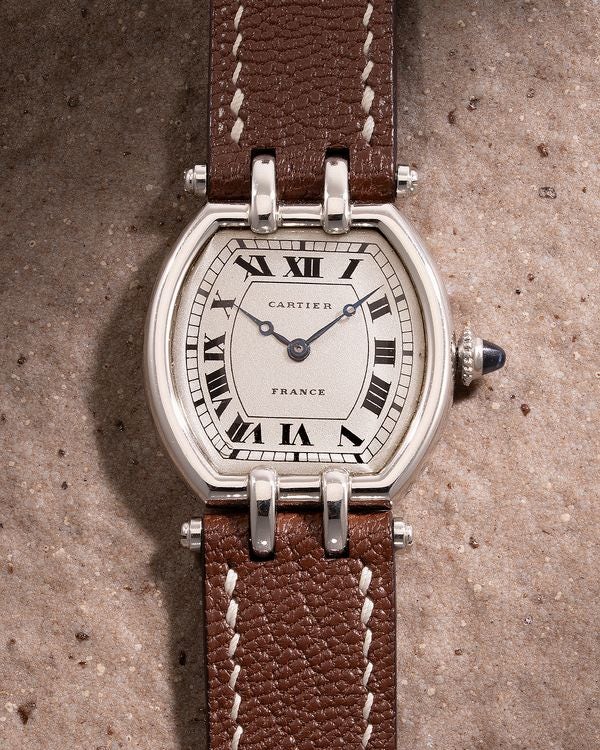
Lot 8066: A circa 1926 Cartier Tortue in platinum and 18K yellow gold that’s included in the Phillips Hong Kong Sessions, Spring 2026, Online Auction. Estimate: HKD $60,000 - 120,000
Inside, the movement is signed by the European Watch & Clock Co., Cartier’s long-standing manufacturing partner at the time. It reflects the collaborative structure that underpinned many early Cartier wristwatches, where design leadership in Paris met technical expertise elsewhere in Europe.
The dial is unmistakably Cartier. Roman numerals radiate around a chemin-de-fer minute track, the signature typography lending the watch its unmistakable authority. The dial is signed "France," anchoring the piece firmly within the brand's golden age of design.
The case remains impressively preserved, with crisp hallmarks still visible, a remarkable level of condition, considering the watch has survived for at least a century. It last appeared at auction (for the first time) in 2021.
In platinum, the watch feels serious but never heavy-handed. It represents Cartier at a moment when elegance and innovation moved in lockstep.
Lot 8027: A Circa 2008 Franck Muller Imperial Tourbillon Ref. 5850T in Platinum
Estimate: HKD $120,000 - 240,000
Few brands embraced the excess and optimism of the 1990s quite like Franck Muller.
Dubbed the “Master of Complications,” the watchmaker built his brand around audacity. Big cases. Bold numerals. Serious mechanics. At a time when much of the industry leaned conservative, Franck Muller pushed in the opposite direction.
The Curvex case became Muller's canvas. Arched, elongated, and unmistakable from across the room, it framed everything from perpetual calendars to minute repeaters. In platinum, the form takes on added gravitas. The weight suits the architecture. The metal reinforces the sense that this is not a casual watch.
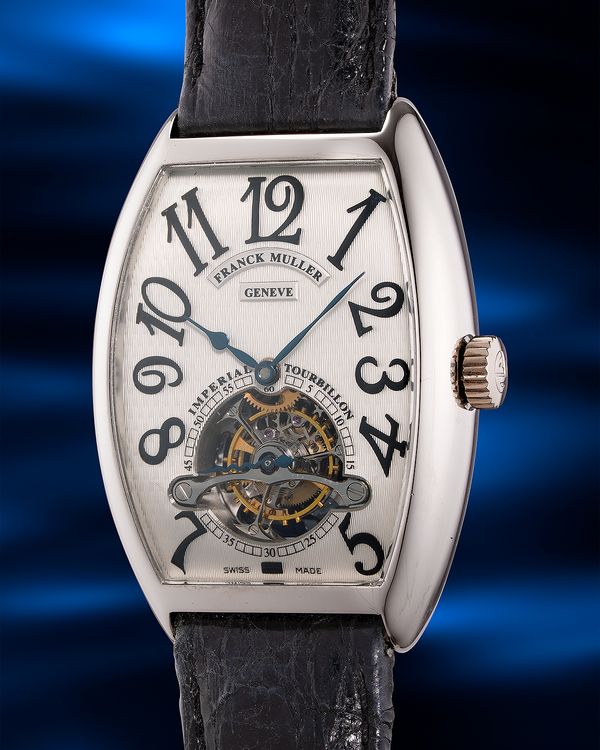
Lot 8027: A circa 2008 Franck Muller Imperial Tourbillon Ref. 5850T in platinum that’s included in the Phillips Hong Kong Sessions, Spring 2026, Online Auction. Estimate: HKD $120,000 - 240,000
The Imperial Tourbillon sits squarely within that philosophy. Measuring 45mm in length, the case carries real presence, but its curved profile hugs the wrist more comfortably than the dimensions suggest. At six o’clock, the tourbillon aperture opens to reveal the escapement in motion. The regulating organ feels central to the design, not an afterthought.
Turn the watch over, and the sapphire caseback reveals a hand-engraved movement that leans fully into the brand’s decorative instincts. Bridges are shaped and finished with flourish. Engraving fills the available space with confident strokes rather than restraint. It is maximalist watchmaking, executed with technical competence.
Accompanied by its original certificate and presentation box, this Imperial Tourbillon represents a specific era in modern collecting. One defined by confidence, experimentation, and a willingness to place high complications in unapologetically expressive cases.
Lot 8010: A Circa 2010 A. Lange & Söhne Cabaret Tourbillon Ref. 703.025 in Platinum
Estimate: HKD $320,000 - 640,000
The shaped wristwatch enjoyed a remarkable flowering during the late 1920s and 1930s, when the clean geometry of the Art Deco movement reshaped watch design across Europe.
Rectangular and tonneau forms appeared with increasing frequency, offering an alternative to the traditional round case. A. Lange & Söhne participated in that early chapter, producing rectangular wristwatches that would later become an important part of its historical identity.
When the brand was revived in the 1990s, that heritage resurfaced. The Arkade collection arrived in 1994, followed by the Cabaret in 1997. The watch reflected the vision of Walter Lange and his close collaborator Günter Blümlein, who believed the rectangular case represented one of the most demanding and elegant forms in watchmaking. Within Lange’s reborn catalogue, the Cabaret stood apart. Where most of the manufactory's watches emphasized round cases and asymmetrical Saxon dial architecture, the Cabaret embraced the disciplined symmetry of the rectangle.
A decade later, Lange transformed the model into something far more technically ambitious. Introduced in 2008, the A. Lange & Söhne Cabaret Tourbillon became the first wristwatch to incorporate a patented stop-seconds mechanism in a tourbillon. When the crown is pulled, the balance within the rotating cage halts completely, allowing the wearer to set the time with true precision.
It was a deceptively simple idea that required a remarkably sophisticated mechanical solution.
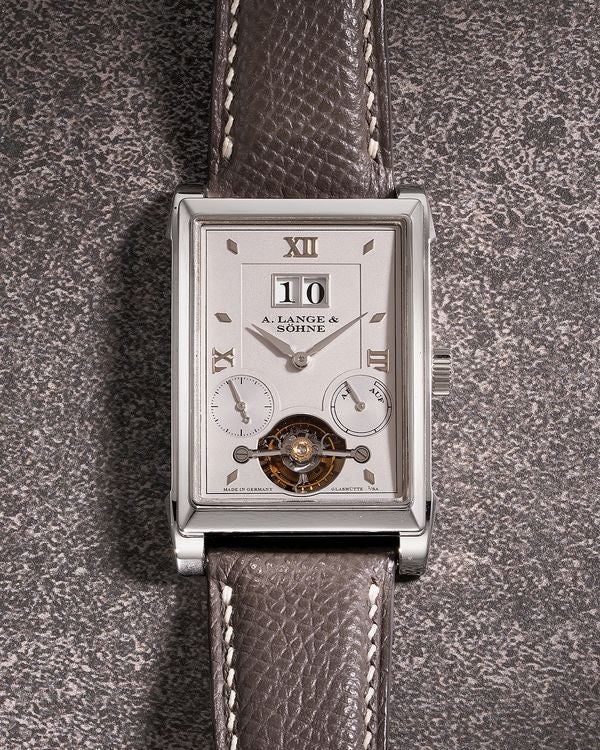
Lot 8010: A circa 2010 A. Lange & Söhne Cabaret Tourbillon Ref. 703.025 in platinum that’s included in the Phillips Hong Kong Sessions, Spring 2026, Online Auction. Estimate: HKD $320,000 - 640,000
The watch remained in production for only five years before disappearing from the catalogue. Total output is estimated at around 250 examples, produced exclusively in platinum or 18k pink gold. That modest run places the Cabaret Tourbillon among the rarer modern Lange complications.
This example is housed in a platinum three-body case, distinguished by a stepped bezel and pronounced lugs that reinforce the design's architectural lines. The grey dial complements platinum's cool weight while preserving the disciplined Art Deco aesthetic. At four o’clock, the AUF/AB power-reserve indicator provides a quiet reminder of the hand-wound movement within, while the small seconds display at eight o’clock, decorated with delicate azurage, balances the composition.
Turning the watch over reveals a movement that is unmistakably Lange. The plates and bridges are crafted from untreated maillechort and decorated with Glashütte ribbing and precisely executed chamfering along every edge. The transmission wheel and tourbillon carriage bridges carry hand-engraved floral motifs, each one cut individually in the traditional Saxon manner.
The result is a watch that combines technical innovation with an unusually restrained aesthetic. In platinum, the Cabaret Tourbillon feels serious, deliberate, and impressively confident.
It stands as a compelling reminder that, within the Glashütte tradition, elegance and engineering have always gone hand in hand.
You can view the complete Phillips Hong Kong Sessions, Spring 2026, Online Auction catalogue here.
About Phillips In Association With Bacs & Russo
The team of specialists at PHILLIPS Watches is dedicated to an uncompromised approach to quality, transparency, and client service. Phillips in Association with Bacs & Russo holds the world record for the most successful watch auction, with its Geneva Watch Auction: XIV having realized $74.5 million in 2021. Over the course of 2021 and 2022, the company sold 100% of the watches offered, a first in the industry, resulting in the highest annual total in history across all the auction houses at $227 million.
About Logan Baker
Logan has spent the past ten years covering the watch industry from every angle. He joined Phillips in Association with Bacs & Russo in early 2023 as Senior Editorial Manager, after previous roles at Hodinkee and WatchTime. Originally from Texas, he spent a decade in New York and now calls Geneva home.
Recommended Reading
Specialists' Picks: The Phillips Watches Hong Kong Sessions, Spring 2026, Online Auction
Twenty-Four Cities, One Dial: The World-Timer is a Complication for the Curious