Article | Round Up Vintage And Neo Vintage Tool Watches In The Phillips Watches Hong Kong Sessions Spring 2026 Online Auction
Built for Work: Vintage Tool Watches in the Phillips Watches Hong Kong Sessions, Spring 2026, Online Auction
The golden age of tool watches produced instruments built to survive pressure, altitude, and combat. Decades later, that integrity still resonates.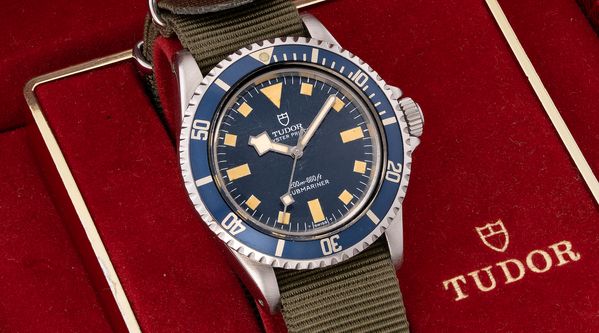
Phillips in Association with Bacs & Russo is thrilled to welcome you to The Hong Kong Sessions, Spring 2026, Online Auction, running from 12:00 PM HKT, Wednesday, 18 March, to 2:00 PM HKT, Wednesday, 25 March. The sale features more than 100 high-end luxury wristwatches, ranging from A. Lange & Söhne and Breguet to Audemars Piguet and Patek Philippe.
– By Logan Baker
Tool watches were never meant to be collectible. They were meant to work. That's part of the appeal.
A dive watch was built to survive pressure, darkness, and cold water. A pilot’s chronograph existed to calculate fuel burn and ground speed in a vibrating cockpit. A military-issued diver or combat instrument was delivered with a stock number, not an Instagram post.
These watches entered the world with a job description.
And yet, decades later, collectors from wildly different backgrounds gravitate toward them. Bankers, mechanics, designers, pilots, journalists, soldiers.
Why?
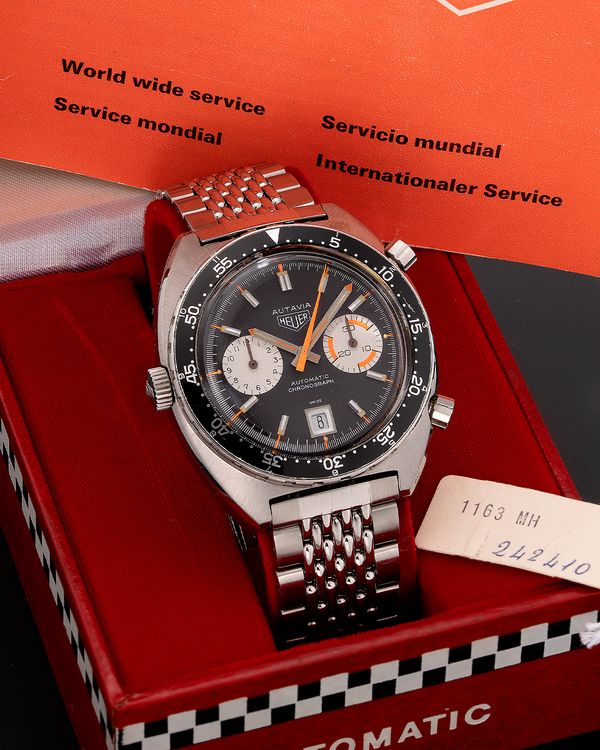
Lot 8063: A circa 1971 Heuer Autavia 'Orange Boy' Ref. 1163 in stainless steel that’s included in the Phillips Hong Kong Sessions, Spring 2026, Online Auction. Estimate: HKD $25,000 - 40,000
Vintage and neo-vintage tool watches feel honest.
Their proportions follow purpose. Their typography prioritizes legibility over branding strategy. Their cases show wear in the places you expect, because they were worn in the environments that demanded it. Even the smallest details, a zig-zag “S” on a Rolex Submariner's dial, a specific casemaker’s hallmark on a Speedmaster, a NATO stock number engraved on the back of an issued diver, tell you that these objects were part of systems larger than themselves.
There is also the matter of constraint. Many of these watches were built before the era of endless variants and annual refresh cycles. Production numbers were finite. Materials were chosen for durability. Movements were reliable, engineered for service and repair.
When you hold a vintage tool watch today, you are holding a solution to a problem that once mattered deeply.
The neo-vintage period adds another layer. The 1980s and 1990s saw brands experimenting with titanium, anti-magnetism, integrated bracelets, hybrid complications, and collaborations with industrial designers.
These watches sit at an intersection. They are modern enough to wear daily, yet old enough to carry the patina of the pre-internet age.
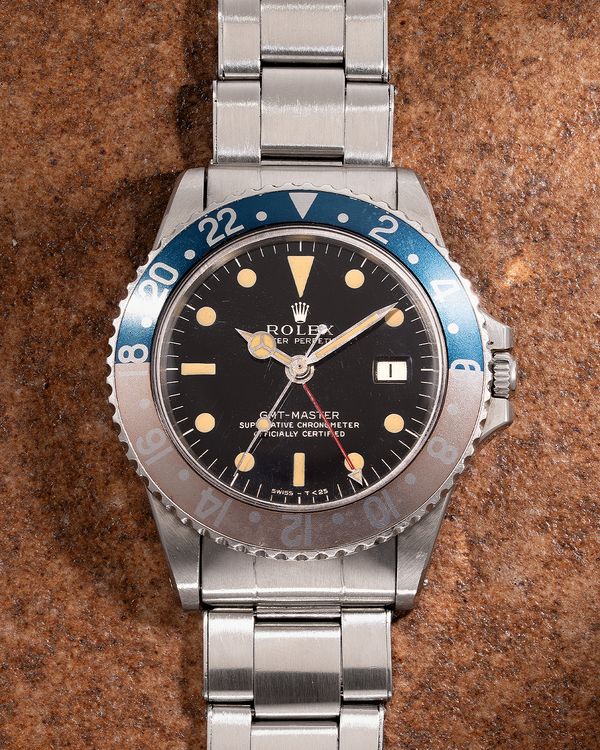
Lot 8019: A circa 1965 Rolex GMT-Master Ref. 1675 in stainless steel with 'Gilt-Gloss, MK III' dial that’s included in the Phillips Hong Kong Sessions, Spring 2026, Online Auction. Estimate: HKD $130,000 - 230,000
For many collectors, the attraction is not about perfection. It is about continuity. A "Red" Submariner with a tropical dial, or a Navitimer with softened edges, are watches that have lived. They have measured elapsed time during dives, flights, races, and missions that will never be fully documented.
In today's world, where most tools are disposable and most technology is invisible, a vintage tool watch feels tangible. You wind it. You set it. You hear it tick. It does one thing well, or sometimes two or three, and it does them mechanically, without pretense.
That combination of purpose, scarcity, and lived history is difficult to replicate.
It is why collectors keep circling back to this era – to participate in a world where purpose was made visible on the wrist.
Lot 8020: A Circa 1974 Rolex Sea-Dweller Ref. 1665 in Stainless Steel with 'Double Red, MK III' Dial
Estimate: HKD $120,000 - 200,000
There are vintage Rolex tool watches you admire, and then there are vintage Rolex tool watches you eventually accept you need to own.
The "Double Red" Sea-Dweller falls squarely into the latter camp. It is one of those watches that anchors a collection, because it represents something fundamental about what Rolex once set out to do.
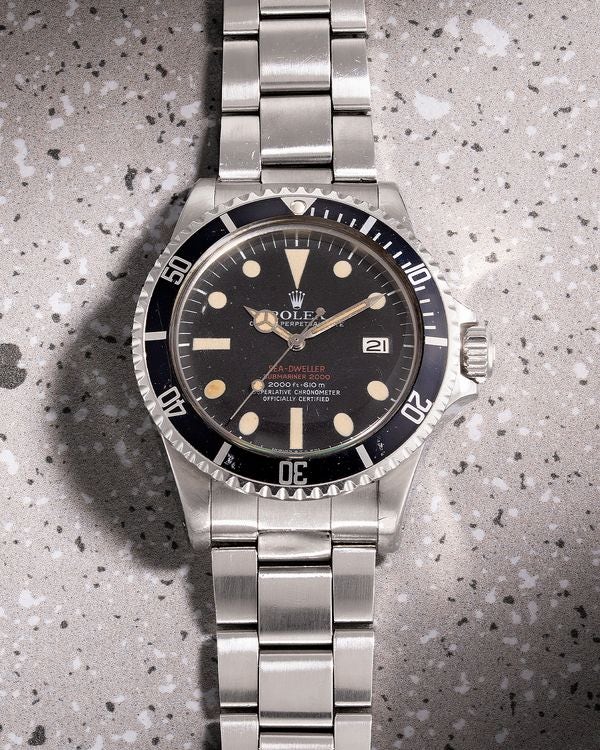
Lot 8020: A circa 1974 Rolex Sea-Dweller Ref. 1665 in stainless steel with 'Double Red, MK III' Dial that’s included in the Phillips Hong Kong Sessions, Spring 2026, Online Auction. Estimate: HKD $120,000 - 200,000
Introduced as a serious professional instrument, the "Double Red" Sea-Dweller was built to survive depths and pressures most of us will never experience. It is larger and more purposeful than its Submariner sibling, with a thicker case, a helium escape valve, and a dial layout that leaves no ambiguity about its intent. The two lines of red text give the watch its nickname and its character, but they also signal a moment in Rolex history when engineering dictated design.
As with many great vintage Rolex references, the details matter.
The dials evolved over time, and collectors have long categorized them into “Mark” variations. This example features the desirable Mark III dial. You notice it immediately if you know where to look.
The “SUBMARINER 2000” line appears in a smaller font than “SEA-DWELLER,” creating a subtle but important visual hierarchy. The red text is printed directly onto the black dial surface, without the white underlay seen on earlier Marks, giving it a slightly crisper, more integrated look. The depth rating shows an open 6, and the Rolex coronet is sharply defined. Even the serial number, repeated inside the caseback, speaks to the production nuances that seasoned collectors appreciate.
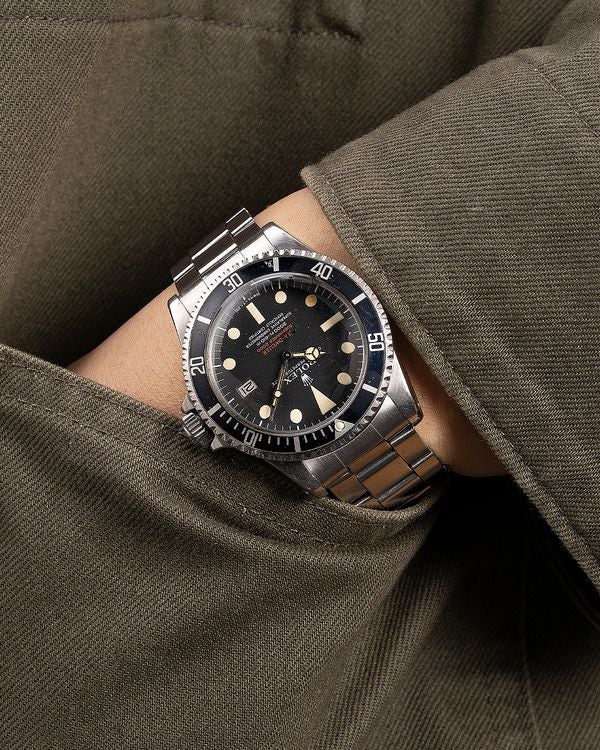
Lot 8020: A circa 1974 Rolex Sea-Dweller Ref. 1665 in stainless steel with 'Double Red, MK III' Dial that’s included in the Phillips Hong Kong Sessions, Spring 2026, Online Auction. Estimate: HKD $120,000 - 200,000
Condition always tells part of the story, but provenance can transform a watch entirely.
Here, the appeal goes well beyond honest wear and strong overall preservation. This watch comes with well-documented Australian Army provenance, including a detailed letter from its previous owners, both Army officers, along with period photographs showing it in use during missions. It has a lived history you can't reproduce.
Lot 8063: A Circa 1971 Heuer Autavia 'Orange Boy' Ref. 1163 in Stainless Steel
Estimate: HKD $25,000 - 40,000
If the "Double Red" Sea-Dweller belongs to the deep, the Heuer Autavia belongs to the pit lane.
In the 1970s, this was the chronograph you spotted on wrists in the race pits between practice sessions and qualifying laps. You saw them on the wrists of Steve McQueen, Jochen Rindt, Jo Siffert, and Mario Andretti, among others. Certain executions even picked up nicknames tied to these men. The Autavia was part of the race-day uniform.
In 1969, Heuer took a major step forward with the introduction of one of the world's first automatic chronograph movements, the calibre 11.
It appeared in three now-iconic models: the Carrera, the Autavia, and the Monaco. The left-side crown became a calling card, signaling that this was something new.
Before long, the calibre 11 gave way to the more robust and more accurate calibre 12, distinguished by its gilt movement plate in place of the earlier nickel finish. It is a small detail, mechanically, but a meaningful one historically. It marks the early evolution of the automatic chronograph era.
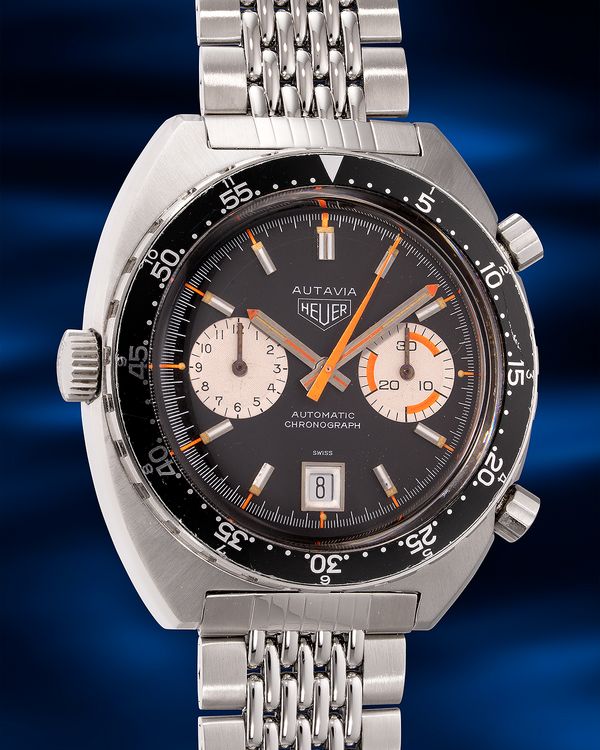
Lot 8063: A circa 1971 Heuer Autavia 'Orange Boy' Ref. 1163 in stainless steel that’s included in the Phillips Hong Kong Sessions, Spring 2026, Online Auction. Estimate: HKD $25,000 - 40,000
The present example houses the gilt calibre 12, but the real impact comes with the dial. The early 1970s embraced color without apology, and watchmakers followed suit.
Heuer’s Autavia Ref. 1163 answered with bright orange accents that cut sharply against a black background. This variant, nicknamed the “Orange Boy,” pairs a matte black dial with crisp white registers and vivid orange luminous highlights.
The C-shaped case anchors the aesthetic. It is broad, confident, and unmistakably of its time. The crown sits on the left, the pushers on the right, and the bezel here is the desirable "MH" configuration, combining stacked minutes and hours for practical timing use. Add to that a period Gay Frères bracelet, and the package feels complete, down to the last detail. The presence of the original Heuer box, guarantee, and hang tag only strengthens the impression.
Vintage Heuers have not attracted the same relentless attention as some of their Swiss contemporaries in recent years. That creates an opening for collectors who appreciate historical substance and design. The “Orange Boy” captures the optimism and edge of the 1970s in one compact, wearable form.
Lot 8067: A 1960 Breitling Navitimer 'AOPA' Ref. 806 in Stainless Steel
Estimate: HKD $38,000 - 78,000
In 1952, the Aircraft Owners and Pilots Association (AOPA) approached Breitling with a clear request: to build a chronograph wristwatch that could serve the real needs of working pilots.
Breitling responded by adapting the logarithmic slide rule first seen on the 1940s Chronomat and integrating it into a rotating bezel. The result was the Navitimer, a contraction of “navigation” and “timer,” and one of the most purpose-driven wristwatches ever made.
At a glance, the dial can look dense, even overwhelming. In practice, it functions as a mechanical computer for the cockpit. In an era before compact electronic calculators, the Navitimer allowed pilots to compute ground speed, fuel consumption, miles per minute, rate and distance of climb or descent, and conversions between nautical and statute miles. Everything happens on a single surface.

Lot 8067: A 1960 Breitling Navitimer 'AOPA' Ref. 806 in stainless steel that’s included in the Phillips Hong Kong Sessions, Spring 2026, Online Auction. Estimate: HKD $38,000 - 78,000
The earliest Navitimers carried the AOPA’s winged logo on the dial and were distributed exclusively to association members.
In 1955, Breitling introduced the Ref. 806 for public sale, marking the first Navitimer reference with the AOPA signature offered to the broader American consumer market. The present example, confirmed by Breitling through its serial number, comes from a batch produced in June 1960. It also bears the Wakmann Watch Co. “WOG” import stamp on the balance cock, indicating importation into the United States by Breitling’s official authorized agent at the time.
Condition matters deeply with a watch like this. As a true pilot’s instrument, most early Navitimers saw hard use. Cases were polished, bezels worn smooth, dials replaced. Here, the watch remains likely unpolished, with sharp edges, pronounced bevels, and clearly visible engravings.
Early Ref. 806 Navitimers with AOPA signature hold a special place in the history of aviation watches. This example, last seen publicly at the Phillips Hong Kong Watch Auction: X, represents a tangible artifact of mid-century flight.
Lot 8075: A Circa 1975 Tudor Submariner Marine Nationale Ref. 9401/0 in Stainless Steel
Estimate: HKD $60,000 - 120,000
When Rolex introduced the Tudor brand in 1926, the idea was straightforward: offer the reliability and technical know-how of Rolex in a more accessible package. In practice, Tudor became something more interesting. It turned into a proving ground.
Over the decades, Rolex used Tudor to explore ideas in design and engineering, some of which later found their way into the Crown-signed lineup. Nowhere is that dynamic clearer than in the Submariner.
By the 1970s, Tudor had carved out an identity of its own, especially with military clients. Among the most important was the French Navy, the Marine Nationale, whose roots trace back to 1624 under Cardinal Richelieu. For combat divers, durability and legibility were not luxuries. They were requirements. Tudor delivered both.
The Submariner Ref. 9401/0, introduced in 1975, replaced the earlier Ref. 7016/0. It retained the defining aesthetic that collectors now associate with vintage Tudor dive watches: square hour markers and the distinctive “Snowflake” hands that maximize luminous surface area. But beneath the dial, it introduced a more robust movement with hacking seconds, a practical upgrade for synchronization during operations. The watch dispensed with a date, keeping the display clean and functional.
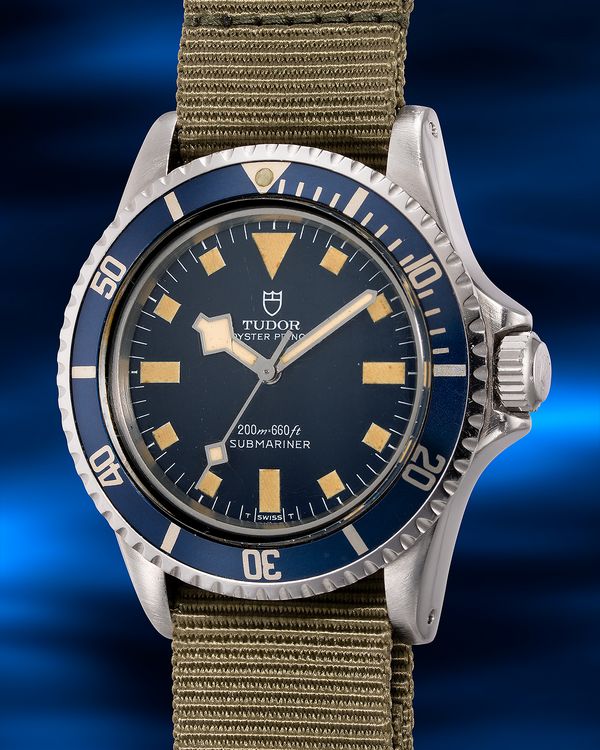
Lot 8075: A circa 1975 Tudor Submariner Marine Nationale Ref. 9401/0 in stainless steel that’s included in the Phillips Hong Kong Sessions, Spring 2026, Online Auction. Estimate: HKD $60,000 - 120,000
Alongside its date-equipped sister references, the Ref. 9401/0 was supplied to the Marine Nationale throughout the 1970s and into the 1980s. These issued examples, engraved on the caseback with the military designation and year, have become some of the most coveted Tudor Submariners. The engraving here reads “M.N. 1975,” a direct link to its year of issue and service. The present example is further supported by a copy of the Marine Nationale ledger and is accompanied by its presentation box.
Tudor’s military supply extended beyond France, reaching naval forces in Canada, the United States, South Africa, and Argentina. Still, the MN-signed pieces remain the most emblematic.
Visually, this Ref. 9401/0 stands out for its rich blue dial, a tone that feels both purposeful and unexpectedly beautiful. Combined with its strong state of preservation, sharp case, and fully legible engravings, it offers the kind of balance collectors seek but rarely find.
Lot 8092: A 1992 IWC Schaffhausen × Porsche Design Compass Watch in Titanium
Estimate: HKD $30,000 - 50,000
In the 1970s and 1980s, few collaborations felt as natural as IWC and Porsche Design.
One side brought Swiss horological credibility. The other brought German industrial clarity. Together, they produced watches that looked less like jewelry and more like instruments pulled from a dashboard or go-bag.
The guiding principle was simple: form follows function. If a detail existed, it existed for a reason. You see that philosophy distilled in the Compass Watch, and even more clearly in the 1990s Ref. 3511.
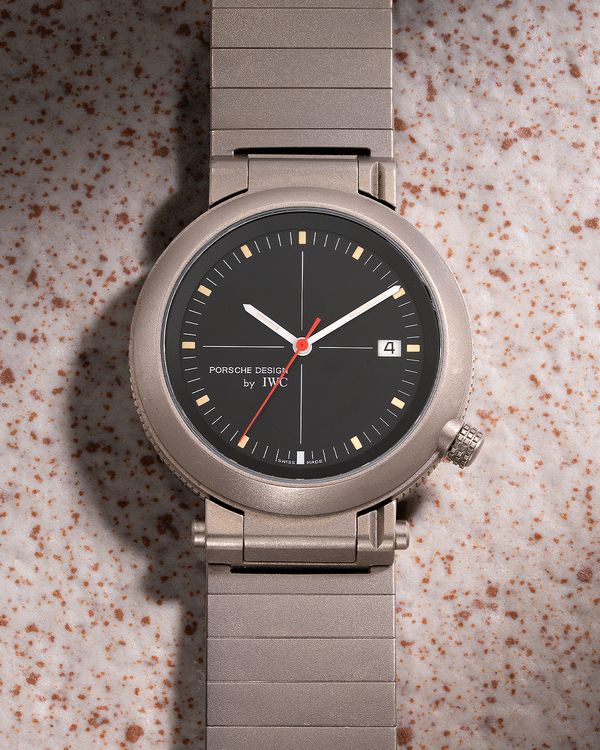
Lot 8092: A 1992 IWC Schaffhausen × Porsche Design Compass Watch in titanium that’s included in the Phillips Hong Kong Sessions, Spring 2026, Online Auction. Estimate: HKD $30,000 - 50,000
Earlier examples, such as the Ref. 3510, used aluminum for the caseband. With the Ref. 3511, IWC shifted to titanium. The change was more than cosmetic.
Titanium gave the watch greater durability while keeping it remarkably light on the wrist, reinforcing its utilitarian intent. At the same time, the dial was refined. The full corporate signature gave way to a pared-back “Porsche Design by IWC” block text near eight o’clock. The date, once rendered in black, now appears in white for stronger contrast against the dial.
At first glance, the watch already hints at its secondary purpose. The proportions and layout evoke a navigational instrument. Press the push-release buttons at six o’clock, and the case opens to reveal a working compass concealed beneath. It is a literal tool watch, designed for field orientation rather than metaphorical adventure.
Of course, integrating a compass into a mechanical wristwatch presents a real engineering challenge.
A magnetized needle and a mechanical movement do not naturally coexist. IWC addressed this by constructing an anti-magnetic double-decker case to shield the movement. To further reduce magnetic interference, the brand replaced conventional rotor bearings with nine ruby balls. It is a typical IWC solution: technical, pragmatic, and sophisticated.

Lot 8092: A 1992 IWC Schaffhausen × Porsche Design Compass Watch in titanium that’s included in the Phillips Hong Kong Sessions, Spring 2026, Online Auction. Estimate: HKD $30,000 - 50,000
The titanium bracelet completes the package. Integrated seamlessly into the case, it emphasizes continuity of line and material. The links adjust easily, and the clasp can be released with one hand, a small detail that speaks to the user-first mindset behind the design.
The Compass Watch reflects a late-20th-century vision of what a tool watch could be: minimalist, engineered, multifunctional, and unapologetically modern. In titanium, with its hidden compass and anti-magnetic architecture, the Ref. 3511 stands as one of the more intriguing neo-vintage experiments in the entire tool-watch genre.
Lot 8069: A Circa 1967 Omega Speedmaster Professional Ref. 105.012-66CB in Stainless Steel
Estimate: HKD $60,000 - 90,000
The Speedmaster earned its reputation in orbit.
Released in 1964, the Ref. 105.012 was the first Speedmaster to carry the word “Professional” on the dial. Five years later, it became the exact reference worn by American astronaut Buzz Aldrin on the lunar surface during the Apollo 11 mission in 1969. That single fact would be enough to secure its place in history. But the Ref. 105.012 stands on its own merits even without the lunar glow.
As the successor to the straight-lug Ref. 105.003, the Ref. 105.012 introduced the now-familiar asymmetrical case with crown guards. Within the reference, there are subtle variations, and those nuances matter.
This example bears the “CB” marking, indicating that the case was manufactured by La Centrale Boîtes. Most Ref. 105.012 cases came from Huguenin Frères. The CB version is notably rarer and identifiable by its distinct architecture: lyre-shaped lugs with a wide oblique surface and curved sides, a flat upper surface bordered by a small ledge, and a slightly different case profile overall. CB produced only the Ref. 105.012-66CB, making it a particularly desirable execution among collectors who pay attention to these details.

Lot 8069: A circa 1967 Omega Speedmaster Professional Ref. 105.012-66CB in stainless steel that’s included in the Phillips Hong Kong Sessions, Spring 2026, Online Auction. Estimate: HKD $60,000 - 90,000
The dial retains the classic stepped configuration, with a visible drop between the flat central zone and the angled minute track. The long tritium hour markers have aged to a soft yellow tone, mirrored by the chronograph seconds hand, which shows a gentle light orange patina.
Inside beats the legendary calibre 321, the column-wheel chronograph movement that powered the Speedmaster through its most consequential years. Estimates suggest that roughly 80,000 to 85,000 Speedmasters were fitted with the calibre 321 in total. For many Speedmaster lovers, the presence of the calibre 321 is non-negotiable. It's the mechanical heart of the original Moonwatch.
The stainless-steel caseback features a single bevel, with the hippocampus medallion still clearly visible. The watch is paired with its original 1506/16 bracelet, dated 3/66. This early bracelet features an Omega logo in relief on the clasp for easier opening, a detail later replaced by a flatter execution.
The Ref. 105.012-66CB occupies a precise and meaningful niche in Speedmaster history.
It is the first “Professional,” the original Moonwatch reference, and in this configuration, a rarer case variant with the correct bracelet and movement.
Lot 8074: A Circa 1982 Rolex Submariner Ref. 5513 in Stainless Steel with 'Maxi, MK IV' Dial
Estimate: HKD $75,000 - 120,000
The Submariner Ref. 5513 is one of those watches that rewards patience.
Produced for decades, it evolved in small, almost imperceptible steps. To the untrained eye, one Ref. 5513 can look much like another. To a seasoned collector, the dial alone can place it within a narrow production window, shifting its desirability and value entirely.
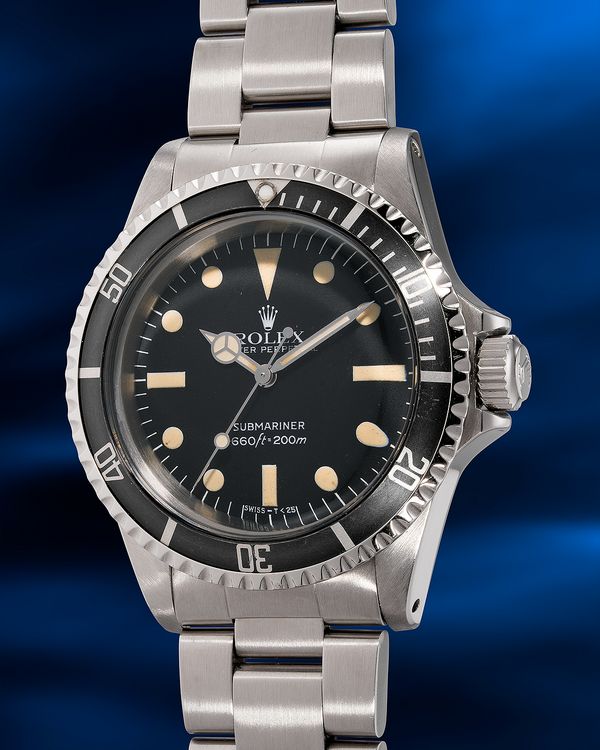
Lot 8074: A circa 1982 Rolex Submariner Ref. 5513 in stainless steel with 'Maxi, MK IV' dial that’s included in the Phillips Hong Kong Sessions, Spring 2026, Online Auction. Estimate: HKD $75,000 - 120,000
This example features the matte black “Maxi, MK IV” dial, a configuration typically associated with serial numbers in the six- to late-seven-million range and generally introduced around 1981. By this point, the glossy-gilt era was long gone.
In its place, Rolex embraced a more utilitarian matte surface paired with larger luminous plots, giving rise to the “Maxi” nickname. On the MK IV, the layout is precise: “SUBMARINER” sits above the depth rating and appears shorter in length, creating a subtle but deliberate visual tension across the lower half of the dial.
Collectors pay close attention to the typography. The Mark IV is especially prized for its distinctive zig-zag “S” in “SUBMARINER,” a detail that feels minor until you see it. Then you cannot unsee it. It is one of those small quirks that transforms a standard production watch into a defined variant.
Here, the dial remains in exceptional condition, free from notable flaws, with tritium hour markers that have aged to a warm, buttery tone. The color is even and stable, complementing the hands and reinforcing the watch's overall harmony.

Lot 8074: A circa 1982 Rolex Submariner Ref. 5513 in stainless steel with 'Maxi, MK IV' dial that’s included in the Phillips Hong Kong Sessions, Spring 2026, Online Auction. Estimate: HKD $75,000 - 120,000
The 40mm case has been carefully preserved, with thick lugs and strong bevels still intact. The architecture remains sharp, giving the watch the presence you want from a vintage Submariner.
Adding to the appeal, this Ref. 5513 comes complete with its original accessories from 1983. It was purchased from a Japanese retailer and underwent a service in 2007, details that round out its documented life.
Lot 8068: A Circa 1974 Breitling Navitimer Ref. 7806 in Stainless Steel
Estimate: HKD $30,000 - 50,000
Breitling built its name on the chronograph.
Long before the complication became a lifestyle accessory, the brand was refining it as a working instrument. It was among the earliest manufacturers to produce a chronograph wristwatch and the first to patent a two-pusher chronograph, a layout that now feels standard but was once a technical leap.
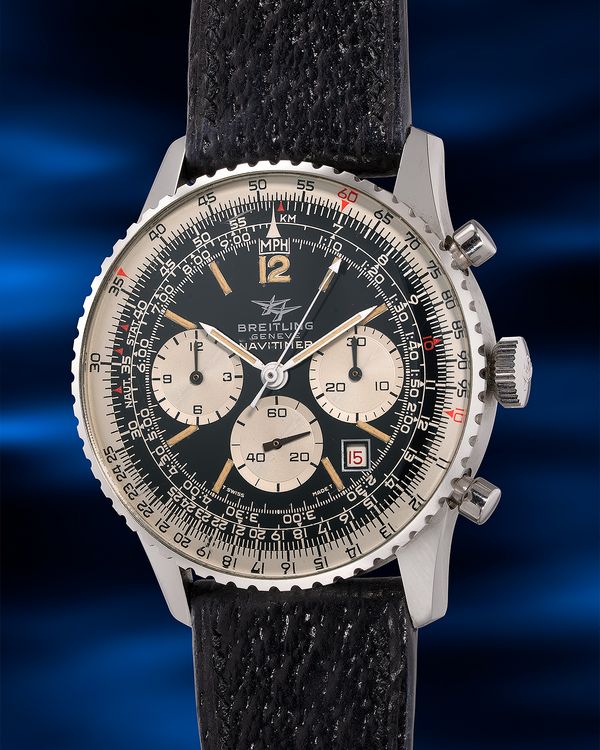
Lot 8068: A circa 1974 Breitling Navitimer Ref. 7806 in stainless steel that’s included in the Phillips Hong Kong Sessions, Spring 2026, Online Auction. Estimate: HKD $30,000 - 50,000
Beginning in 1955, Breitling released the Navitimer Ref. 806 to the public, retaining the winged identity but removing the original "AOPA" signature (see lot 8067). By the 1960s, the dial evolved again. Contrasting white subdials appeared, along with the newly introduced “twin-jet” logo, reflecting the jet age that was reshaping commercial and military aviation alike.
This example features the twin-jet emblem and a serrated bezel, replacing the earlier beaded style and offering a more secure grip when manipulating the slide rule. The luminous material on this example remains notably reactive, with hour markers and the handset glowing clearly and sharply under UV light.
The twin-jet Navitimer captures a specific moment in aviation history, when analog instruments still ruled the cockpit and jet travel felt like the future arriving in real time. Many Navitimers from the period show heavy wear from cockpit use, with polished cases and tired dials. Here, the watch remains in excellent condition, preserving both its legibility and its character.
Lot 8091: A Circa 1980s IWC Schaffhausen × Porsche Design Ocean BUND Combat Diver Ref. 3529 in Titanium
Estimate: HKD $40,000 - 80,000
By the late 1970s, IWC had already proven it could build serious instrument watches. Then came a commission that raised the stakes.
The German Federal Armed Forces tasked IWC with developing a series of highly reliable, durable service watches for military divers. Anti-magnetism was non-negotiable. So was robustness under prolonged underwater use. Titanium, still an exotic material in watchmaking at the time, became part of the solution.
The result was a family of six references delivered over time to different units. In 1984, the Ref. 3501 became the first Ocean BUND model supplied to the Bundeswehr. Among the variants, the Ref. 3529 was assigned specifically to combat or attack divers.

Lot 8091: A circa 1980s IWC Schaffhausen × Porsche Design Ocean BUND Combat Diver Ref. 3529 in titanium that’s included in the Phillips Hong Kong Sessions, Spring 2026, Online Auction. Estimate: HKD $40,000 - 80,000
As with the previously discussed Compass Watch (see lot 8092), the Ocean BUND emerged from the collaboration between IWC and Porsche Design.
The partnership brought together IWC’s engineering discipline and Porsche Design’s stripped-back industrial language. The aesthetic is unmistakably modern for its era. Matte surfaces. Functional typography. No excess.
The present Ref. 3529 features an orange minute hand, a detail that distinguishes it from civilian versions. Legibility underwater drove that decision. While some military variants used tritium and carry the “3H” marking on the dial, this example is fitted with Super-LumiNova, and the absence of the tritium designation confirms it.
On the case, the 13-digit engraving represents the NATO Stock Number, indicating the watch’s status as standardized military equipment within the NATO supply system. It is a bureaucratic detail, but it proves that this was not a retail piece adapted for service – it was built for it.
Self-winding Ocean BUND models are particularly scarce, with total production estimated at roughly 150 units. That rarity, combined with documented military specification and strong overall condition, places the Ref. 3529 in a distinct category. It appeals not only to IWC and Porsche Design enthusiasts, but also to collectors drawn to authentic military equipment.
Lot 8021: A Circa 1970 Rolex 'Red' Submariner Ref. 1680 in Stainless Steel with 'Meters First, MK II' Dial
Estimate: HKD $120,000 - 200,000
Few watches have been dissected, debated, and documented as thoroughly as the Submariner.
Since its introduction in 1953, it has set the template for the modern dive watch and inspired a devoted scholarly community that studies its smallest typographic shifts and production nuances. The Submariner is not just a watch, it is a genuine field of study.
When Rolex introduced the Ref. 1680 around 1967, it marked a turning point. For the first time, the Submariner gained a date function, visible through the now-familiar Cyclops lens.
It was a practical evolution, but Rolex paired it with a subtle aesthetic flourish. Early examples printed “Submariner” in red, giving rise to the enduring nickname “Red Sub.” Later examples of the Ref. 1680 would revert to white text, but those early red-script watches hold a distinct place in the Submariner's history.

Lot 8021: A circa 1970 Rolex 'Red' Submariner Ref. 1680 in stainless steel with 'Meters First, MK II' dial that’s included in the Phillips Hong Kong Sessions, Spring 2026, Online Auction. Estimate: HKD $120,000 - 200,000
Within the "Red" Sub family, there are six recognized dial variations, each reflecting incremental graphic changes. The present example features a Mark II dial, one of the early meters-first configurations.
On these dials, the depth rating lists meters before feet, a trait shared with Mark I through Mark III. The Mark II is further distinguished by a longer “F” in “ft” compared to the Mark III, as well as a thinner overall font for the depth rating. These details tend to appear on watches with serial numbers roughly between 2.15 and 2.45 million, as Mark II and Mark III dials were produced concurrently. It is a reminder that Rolex production rarely moves in clean, linear chapters.
"Red" Subs attract attention for obvious reasons. The flash of red text against a matte black dial adds character without sacrificing seriousness. But beyond the color, they represent the first generation of date-equipped Submariners, a bridge between the pure no-date tool watches of the 1950s and early 1960s and the more contemporary dive watches that followed.
What sets this example apart is the dial itself. Over time, the surface has developed an even dark chocolate tone, a subtle tropical transformation that extends uniformly across the dial. The result is warm, cohesive, and visually striking without feeling forced. Combined with the correct Mark II typography and meters-first layout, it captures a precise and desirable moment in the Ref. 1680 story.
Lot 8089: A Circa 2000s Fortis Flieger Alarm Chronograph Ref. 599.10.170 in Stainless Steel, Originally Made by Paul Gerber for the Russian Air Force
Estimate: HKD $10,000 - 20,000
By the late 1990s, the mechanical chronograph had already enjoyed a revival. Brands were looking backward for inspiration, refining familiar complications rather than inventing new ones. Fortis went in a different direction.
Launched in 1997, this model introduced something genuinely uncommon: the first automatic chronograph combined with a mechanical alarm in a single movement.
The calibre F2001, developed in collaboration with watchmaker Paul Gerber, fused two complications that rarely share space. Chronographs measure elapsed time. Alarms demand stored energy and acoustic presence. Bringing both together required more than clever packaging.
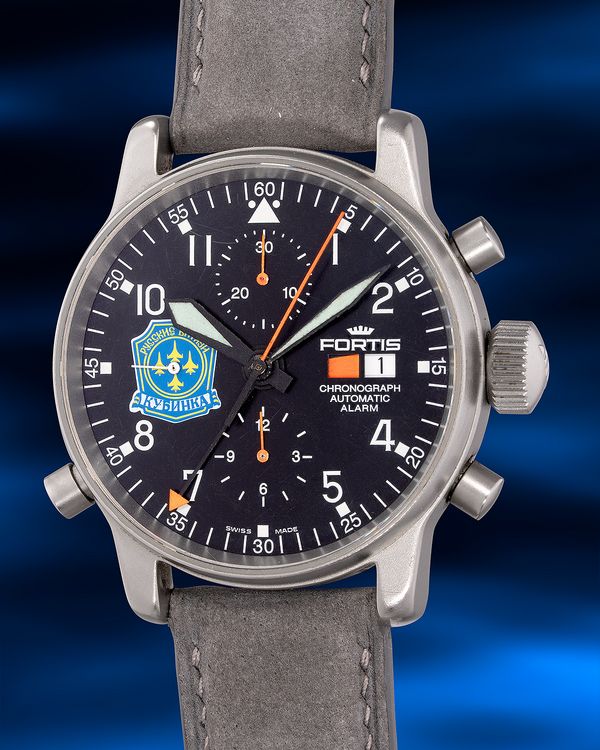
Lot 8089: A circa 2000s Fortis Flieger Alarm Chronograph Ref. 599.10.170 in stainless steel, originally made by Paul Gerber for the Russian Air Force, and that’s included in the Phillips Hong Kong Sessions, Spring 2026, Online Auction. Estimate: HKD $10,000 - 20,000
The solution was a dual-barrel architecture. One barrel powers the timekeeping and chronograph functions. The other drives the alarm. That separation allows the alarm to sound without disrupting the amplitude or accuracy of the base movement. When activated, the alarm emits a clear, resonant tone for roughly 25 seconds, unless stopped earlier via the pusher at eight o’clock.
This watch also reflects a specific moment in Fortis’ history. During this period, the brand served as the official supplier of chronographs to the Russian space program, reinforcing its reputation for building hard-wearing instrument watches. The dial here bears the emblem of the Russian Knights, the Russian Air Force's aerobatic demonstration team.
Examples surface only rarely at international auction, which makes this piece more than an interesting footnote.
It is a reminder that the late 20th century still produced genuine experimentation in tool watch design. A chronograph that can wake you, powered by twin barrels and backed by military insignia, feels very much in keeping with that spirit.
Lot 8073: A Circa 1969 Rolex 'Red' Submariner 'MK I' Ref. 1680 in Stainless Steel
Estimate: HKD $120,000 - 200,000
Few watches invite the level of scrutiny that the Rolex Submariner does.
Since its debut in 1953, the model has evolved through a series of small but meaningful changes that collectors now examine with near-academic precision. The Ref. 1680, introduced around 1967, marked one of the most significant developments in that history.
For the first time, the Submariner featured a date function, visible beneath a Cyclops lens at three o’clock. The change sparked debate among purists that continues to this day, but it also produced one of the most charismatic variants in the entire Submariner family.
Early examples of the Ref. 1680 carried a single line of red “Submariner” text on the dial, a detail that gave rise to the now-famous nickname “Red Sub.” The contrast is subtle yet unmistakable.
Against the matte black dial, the red script adds a flash of color that signals this watch’s transitional place in the Submariner story. These early examples also display the so-called “meters first” depth rating, with the metric measurement appearing before the feet designation, another hallmark of the earliest production runs.
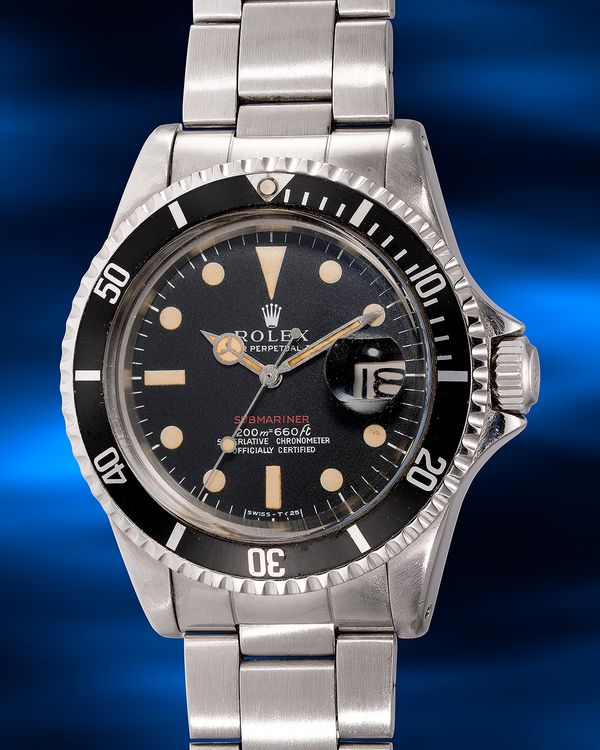
Lot 8073: A circa 1969 Rolex 'Red' Submariner 'MK I' Ref. 1680 in stainless steel that’s included in the Phillips Hong Kong Sessions, Spring 2026, Online Auction. Estimate: HKD $120,000 - 200,000
Within the "Red" Submariner family, collectors recognize several dial variations, each defined by slight differences in typography and layout. The present example is fitted with the rare Mark I dial, associated with watches produced roughly between the 2.07 million and approximately 2.20 million serial range. It is a particularly appealing execution.
The dial features elongated closed 6’s in the depth rating, the distinctive overhanging “f” in “ft,” and the red “Submariner” script printed over a white base layer. These details may appear minor at first glance, but they form the language through which vintage Rolex scholars identify and classify these watches.
Equally compelling is the condition. Both the dial and the luminous material have aged gracefully, giving the watch a cohesive, attractive vintage character. The tritium hour markers and hands have developed a soft, creamy tone, while the dial surface remains even and undisturbed.
The bracelet further reinforces the watch’s originality. It is stamped “9315” with “280” endlinks, identifying it as a desirable “Patent Pending” variant. Early examples of this bracelet feature clasp engravings dated between 1967 and 1970, a detail that aligns neatly with the present watch’s production period.
With its 2.12 million serial number, placing it firmly around 1969, this Submariner represents an early and well-preserved example of the Ref. 1680. As the first date-equipped Submariner and one of the most studied variants in Rolex history, the "Red" Sub remains a cornerstone of vintage sports watch collecting.
Lot 8019: A Circa 1965 Rolex GMT-Master Ref. 1675 in Stainless Steel with 'Gilt-Gloss, MK III' Dial
Estimate: HKD $130,000 - 230,000
When Rolex introduced the GMT-Master in the mid-1950s, it quickly became one of the brand’s most distinctive tool watches.
Designed for pilots navigating multiple time-zones, the watch paired a rotating 24-hour bezel with an additional GMT hand, allowing travelers to track two time-zones at once.
In 1959, Rolex refined the model with the introduction of the Ref. 1675, adding crown guards and a more robust case architecture while retaining the original's defining visual language.
During its early production years, the Ref. 1675 was fitted with glossy black gilt dials, a feature that today represents one of the most beloved chapters in the model’s history. These dials, produced until approximately 1966, combine a reflective lacquer surface with gold-toned printing, creating a depth and warmth that later matte dials would deliberately abandon in favor of greater legibility.
The present example features the Mark III gilt dial, generally considered the final evolution of the glossy gilt style before Rolex fully transitioned to the matte dial era around 1967.
Collectors identify the Mark III by several small but telling characteristics. There is a subtle gap between the “E” and “X” in “ROLEX,” the “OYSTER PERPETUAL” text appears without a hyphen, and the tritium designation “SWISS – T<25” is printed along the lower edge of the dial at six o’clock. These typographic cues place the watch within a specific moment of Rolex’s dial development during the tritium era.

Lot 8019: A circa 1965 Rolex GMT-Master Ref. 1675 in stainless steel with 'Gilt-Gloss, MK III' dial that’s included in the Phillips Hong Kong Sessions, Spring 2026, Online Auction. Estimate: HKD $130,000 - 230,000
The evolution of tritium-marked dials during this period followed a well-documented sequence. Earlier examples include the so-called “Exclamation Point” dials produced between roughly 1961 and 1963, followed by the short-lived “Underline” dials around 1963 through mid-1964. From 1 July 1964 onward, Rolex adopted the “T<25” marking to denote tritium luminous material, a designation that remained in use for decades.
With a serial number of 1,323,448, this GMT-Master falls into the fourth quarter of 1965. The inner caseback is stamped “IV.65,” aligning precisely with the expected production window scholars associate with serial numbers in the 1.311 million to 1.389 million range. The watch is also fitted with the correct “7206” riveted Oyster bracelet, whose clasp is likewise stamped “IV.65,” reinforcing the consistency of the set.
The dial itself remains beautifully preserved, retaining its glossy lacquer surface and gilt printing. The luminous hour markers and hands have aged to a warm yellow tone, complementing the dial’s rich black background.
Completing the look is the period-correct red and blue “Pepsi” bezel insert, which has developed a soft, faded pink tone over time. The result is a watch that captures the charm of the gilt-dial era while preserving the functional spirit that made the GMT-Master such an enduring tool for travelers and pilots alike.
Lot 8062: A Circa 1979 Rolex Sea-Dweller 'Great White, MK III' Ref. 1665 in Stainless Steel
Estimate: HKD $80,000 - 140,000
By the late 1970s, the Sea-Dweller had already established itself as Rolex’s most serious professional dive watch.
Originally developed to meet the demands of saturation divers working in extreme underwater environments, the Ref. 1665 combined a helium escape valve with a robust Oyster case capable of withstanding depths far beyond those required by most recreational divers.
In 1977, around the 5.2 million serial range, Rolex discontinued the famous "Double Red" Sea-Dweller. In its place, a revised version of Ref. 1665 was introduced, removing the two red lines of text from the dial. The result was a cleaner, more restrained design that collectors later nicknamed the “Great White.” Without the splash of red, the dial’s typography appears more balanced and purposeful, emphasizing the Sea-Dweller’s identity as a professional instrument.
Over the following years, Rolex produced several variations of the "Great White" dial, which scholars today categorize into five distinct Mark configurations.
The present example features the Mark III dial, one of the recognized mid-production variants within the "Great White" lineage. While the differences between Marks often come down to subtle shifts in typography and layout, these distinctions play a meaningful role in how collectors understand the reference's production history.
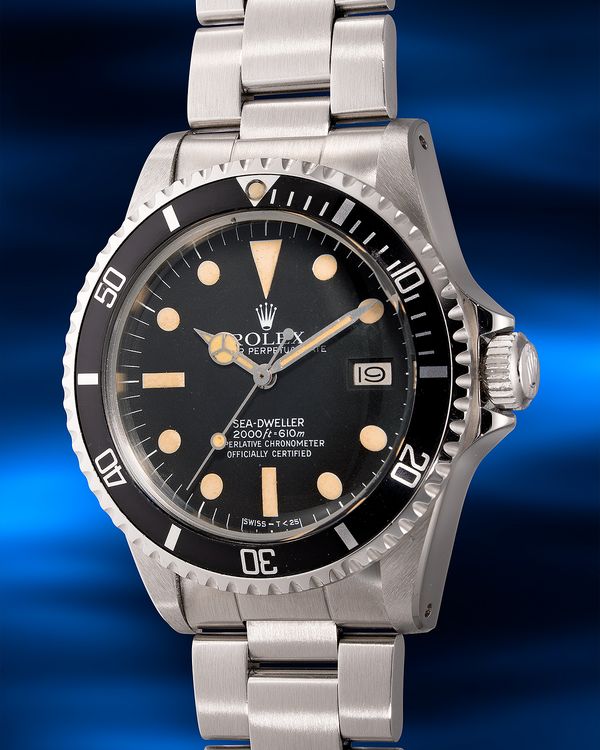
Lot 8062: A circa 1979 Rolex Sea-Dweller 'Great White, MK III' Ref. 1665 in stainless steel that’s included in the Phillips Hong Kong Sessions, Spring 2026, Online Auction. Estimate: HKD $80,000 - 140,000
Condition is equally important with a watch like this, and this example stands out for its preservation.
The stainless-steel case remains notably crisp, with strong lines and well-defined bevels that reinforce the watch's original architecture. The dial has aged attractively as well, developing a warm, even patina that complements the watch’s overall vintage character without compromising legibility.
Beyond the watch itself, the accompanying documentation adds an intriguing layer of historical context.
The watch is offered as a full set, including its original handwritten guarantee dated 1981 and stamped by an Italian retailer. Also included is a copy of an official announcement issued by Rolex in 1991 to Italian retailers outlining a new protocol regarding warranty documentation. Prior to this change, many retailers issued handwritten guarantees for watches sold from stock, each corresponding to the watch's serial number. The 1991 letter introduced the requirement that guarantees be machine-punched going forward, an administrative shift that today helps collectors authenticate earlier handwritten examples.
Within the broader Sea-Dweller lineage, the Great White occupies a compelling middle chapter. It retains the rugged engineering and purposeful design of the earlier Double Red models while presenting a more understated aesthetic.
In Mark III form, with strong case definition and complete period documentation, it represents a particularly appealing example of one of Rolex’s most capable vintage dive watches.
You can view the complete Phillips Hong Kong Sessions, Spring 2026, Online Auction catalogue here.
About Phillips In Association With Bacs & Russo
The team of specialists at PHILLIPS Watches is dedicated to an uncompromised approach to quality, transparency, and client service. Phillips in Association with Bacs & Russo holds the world record for the most successful watch auction, with its Geneva Watch Auction: XIV having realized $74.5 million in 2021. Over the course of 2021 and 2022, the company sold 100% of the watches offered, a first in the industry, resulting in the highest annual total in history across all the auction houses at $227 million.
About Logan Baker
Logan has spent the past ten years covering the watch industry from every angle. He joined Phillips in Association with Bacs & Russo in early 2023 as Senior Editorial Manager, after previous roles at Hodinkee and WatchTime. Originally from Texas, he spent a decade in New York and now calls Geneva home.
Recommended Reading
Specialists' Picks: The Phillips Watches Hong Kong Sessions, Spring 2026, Online Auction
Go Beyond the Royal Oak in the Phillips Watches Hong Kong Sessions, Spring 2026, Online Auction
Twenty-Four Cities, One Dial: The World-Timer is a Complication for the Curious