Article | Round Up World Time Watches In The Phillips Hong Kong Sessions Spring 2026 Online Auction
Twenty-Four Cities, One Dial: The World-Timer is a Complication for the Curious
The history and enduring appeal of the world-time wristwatch, from its Genevan origins to contemporary interpretations.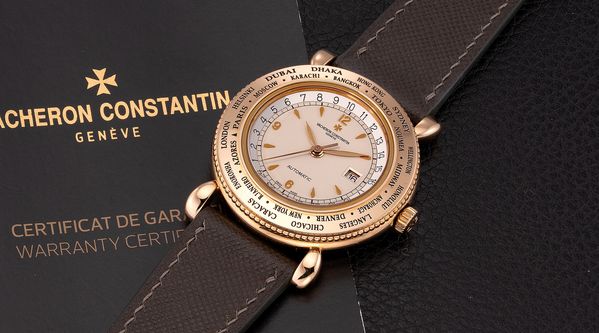
Phillips in Association with Bacs & Russo is thrilled to welcome you to The Hong Kong Sessions, Spring 2026, Online Auction, running from 12:00 PM HKT, Wednesday, 18 March, to 2:00 PM HKT, Wednesday, 25 March. The sale features more than 100 high-end luxury wristwatches, ranging from A. Lange & Söhne and Breguet to Audemars Piguet and Patek Philippe.
– By Logan Baker
The world-time wristwatch occupies a special place in horology because it does something few other complications can manage. It is practical, certainly. But it is also romantic.
The story begins in the 1930s with Louis Cottier, the Geneva watchmaker now widely regarded as the father of the world-time complication. Cottier devised a system of a rotating 24-hour ring paired with a city disc that allowed the wearer to read the time across the globe at a glance. In an era when long-distance travel still felt daring and modern aviation was in its infancy, the idea that a wristwatch could compress the world onto a single dial captured the imagination of both watchmakers and watch wearers.
Brands like Patek Philippe, Vacheron Constantin, and others adopted Cottier’s mechanism, transforming it into some of the most elegant wristwatches of the mid-20th century. A world-timer suggested curiosity. It implied movement, ambition, and a connection to places beyond your immediate horizon. Even when most owners rarely left their home time-zone, the complication offered the possibility of elsewhere.
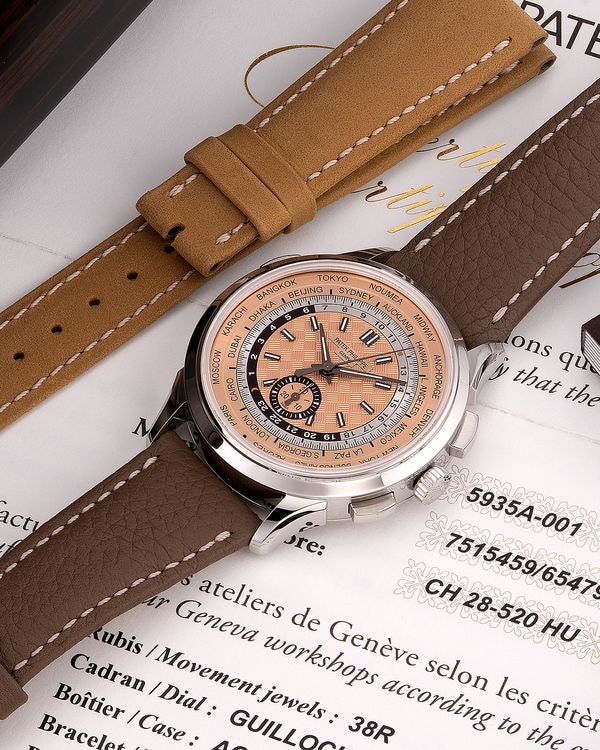
Lot 8008: A circa 2022 Patek Philippe World-Time Chronograph Ref. 5935A-001 in stainless steel that’s included in the Phillips Hong Kong Sessions, Spring 2026, Online Auction. Estimate: HKD $200,000 - 400,000
Collectors still gravitate toward world-timers for that reason. The layout is instantly recognizable: the ring of cities, the shifting day-and-night display, the quiet logic that underpins it all.
Once you learn how to read it, the display feels intuitive and satisfying. There is also an undeniable visual poetry to seeing cities from every continent arranged in a perfect circle, equalized on the dial, even if they are separated by oceans in reality.
In a world where your smartphone can display any time-zone in an instant, the mechanical world-timer feels almost defiantly analogue. It requires gears, cams, and careful calibration rather than software code. That tension between utility and nostalgia gives it staying power.
Above all, the world-time complication endures because it speaks to something larger than timekeeping. It reflects the human impulse to explore, to connect, and to understand our place in a world that is vast yet, somehow, readable at a glance.
Lot 8007: A Circa 2023 Patek Philippe World-Time Ref. 5231G-001 in 18k White Gold
Estimate: HKD $450,000 - 900,000
There are few complications more closely associated with Patek Philippe than the cloisonné enamel world-time. In the 1950s, under the direction of Louis Cottier’s ingenious mechanism, references like the 2523 transformed a practical traveler’s complication into something poetic: a miniature, hand-crafted map framed by a rotating ring of cities. Production slowed and eventually ceased in the 1960s, and for decades these watches existed as legends appearing only in auction catalogues and scholarship.
When Patek Philippe revived the cloisonné world-time in 2008, it did so with surprising confidence.
The formula remained intact: a central enamel disc, individually fired and painstakingly assembled with gold-wire partitions, surrounded by a 24-hour ring and a city disc that allowed the wearer to read the time across the globe at a glance. The new Ref. 5131 carried that torch for more than a decade, becoming the modern standard bearer for the complication.
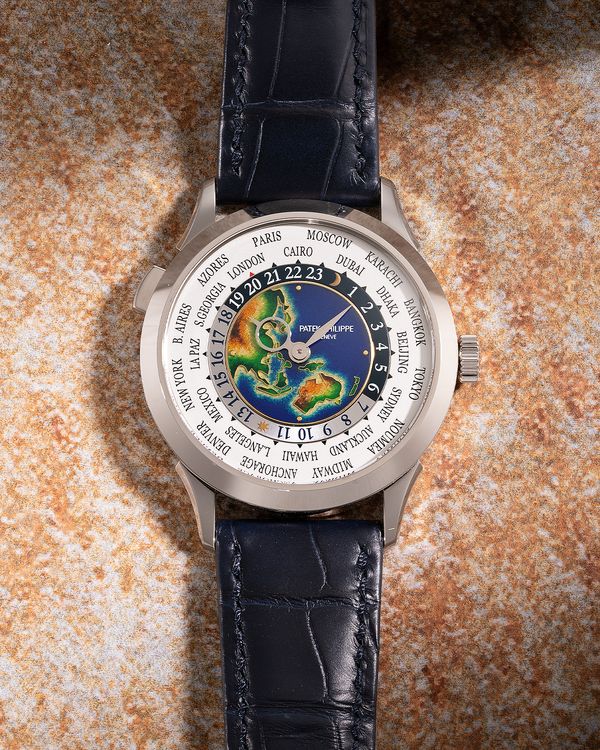
Lot 8007: A circa 2023 Patek Philippe World-Time Ref. 5231G-001 in 18k white gold that’s included in the Phillips Hong Kong Sessions, Spring 2026, Online Auction. Estimate: HKD $450,000 - 900,000
The Ref. 5231 represents a subtle but meaningful evolution of that lineage. The bezel has been slightly flattened, lending the case a more contemporary stance, and the engraved Patek Philippe signature once found on the 5131's bezel has disappeared. Instead, the brand’s name now sits discreetly on the dial itself, allowing the enamel scene to breathe a bit more.
The lugs tell a similar story. Gone is the softer, flowing profile of the previous generation. In its place is a sharper, faceted form that calls to mind the strong lines of the double-crown reference 2523. The effect is subtle yet transformative. The watch feels more architectural, more grounded in the golden age of mid-century Patek Philippe, without tipping into nostalgia.
Then there is the matter of proportion. At 38.5mm, the 5231 hits a sweet spot that few modern watches manage to find. However, the dial remains the focal point, as it should.
By its nature, cloisonné enamel demands attention. Each dial requires hours of patient work, from bending hair-thin gold wires into shape to applying and firing successive layers of enamel powder until the colors achieve their depth and clarity. No two are ever truly identical. Under a loupe, you can see the boundaries of the wires and the slight variations that remind you this is, ultimately, a small painting rendered in glass.
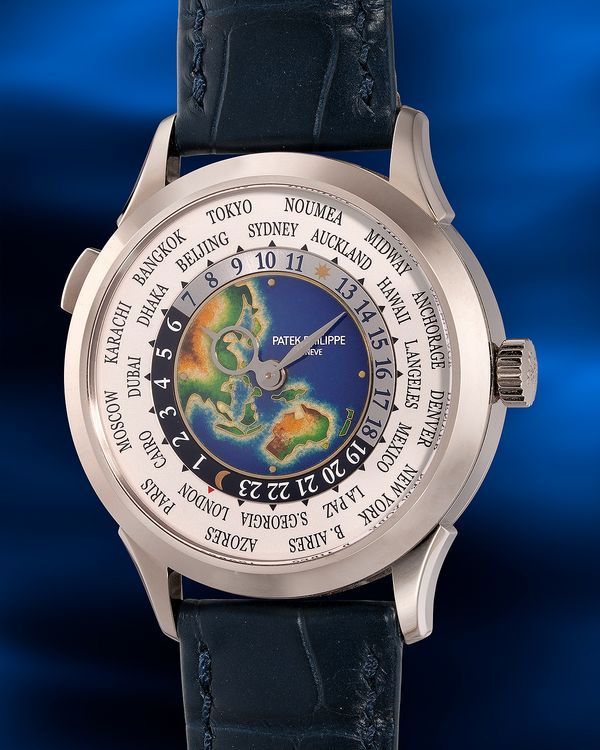
Lot 8007: A circa 2023 Patek Philippe World-Time Ref. 5231G-001 in 18k white gold that’s included in the Phillips Hong Kong Sessions, Spring 2026, Online Auction. Estimate: HKD $450,000 - 900,000
What makes the Ref. 5231 compelling is not just its craftsmanship, but its balance. It respects the template established in the 1950s, refines the design language introduced in 2000, and lands in a place that feels assured rather than overly sentimental.
In like-new condition and accompanied by its full complement of accessories, the watch speaks for itself. For collectors who appreciate both the technical ingenuity of the world-time mechanism and the artistry of cloisonné enamel, the Ref. 5231 continues a story that began more than 70 years ago and shows no sign of losing its relevance.
Lot 8033: A Circa 1992 Andersen Genève World-Time “Christophorus Columbus” in 18k Yellow Gold
Estimate: HKD $70,000 - 120,000
Before the modern independent scene took shape, before “indie” became shorthand for credibility, Svend Andersen was already there.
After nearly a decade inside Patek Philippe’s Atelier des Grandes Complications, Andersen struck out on his own in 1980, carrying with him a deep understanding of classical complications. His first world-timer, the subscription-based Communication 24 was cerebral, mechanically faithful to Louis Cottier's tradition, and unmistakably personal.
Two years later, he introduced the “Christophorus Columbus,” timed to coincide with the 500th anniversary (quincentenary) of Columbus’s first voyage in 1492. It was an ambitious idea. Rather than simply produce another variation on the Cottier template, Andersen embedded narrative into the dial itself.
The present example, numbered 172 of 500 pieces and only the second offered by Phillips, captures that ambition in full.
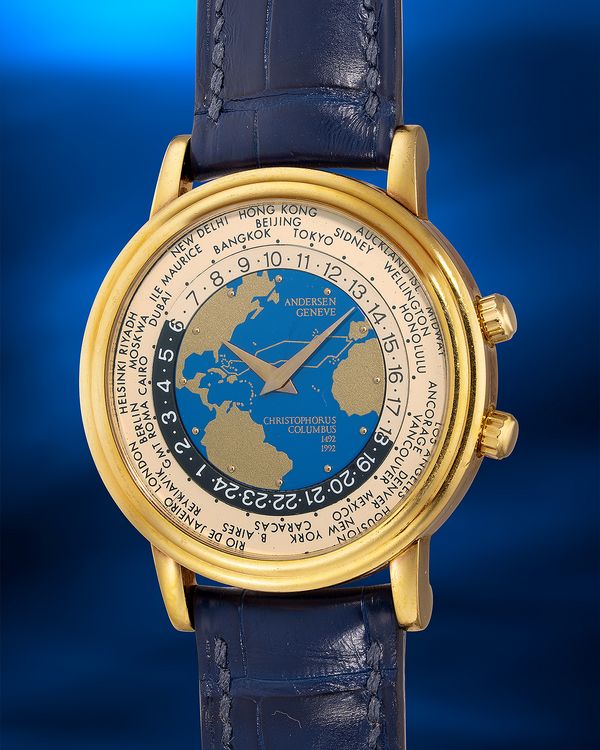
Lot 8033: A circa 1992 Andersen Genève World-Time “Christophorus Columbus” in 18k yellow gold that’s included in the Phillips Hong Kong Sessions, Spring 2026, Online Auction. Estimate: HKD $70,000 - 120,000
At the center of the watch's dial lies a map rendered in Chinese lacquer, deep and lustrous, with 24k yellow gold tracing the sea route of Columbus’s first transatlantic journey. The gold line arcs across a vibrant blue-lacquered ocean, offering both geographic orientation and historical reference.
Encircling the map is the familiar 24-hour ring, divided into diurnal and nocturnal segments in cream and black. The alternating tones give immediate clarity, allowing you to distinguish day from night across the globe with a glance. Beyond that sits the rotating city ring, marked with 30 (!) different global cities. The layout adheres to the logic established by Cottier decades earlier, but the execution feels distinctly Andersen.
The 18k yellow gold case frames the display without overwhelming it. Inside beats the ultra-thin Frédéric Piguet calibre 951, a movement prized for its slim profile and reliability. Its inclusion keeps the overall thickness in check, preserving the watch's elegance. Despite the layered dial and rotating rings, the piece wears comfortably and with restraint.
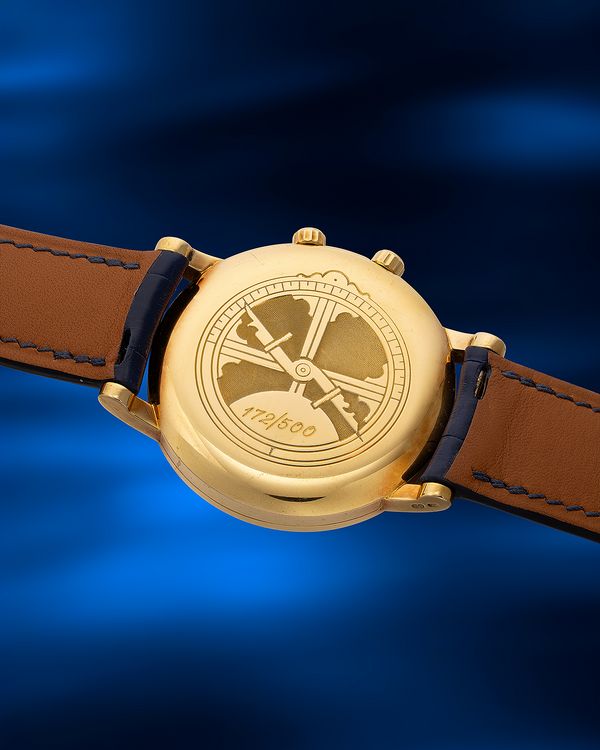
Lot 8033: A circa 1992 Andersen Genève World-Time “Christophorus Columbus” in 18k yellow gold that’s included in the Phillips Hong Kong Sessions, Spring 2026, Online Auction. Estimate: HKD $70,000 - 120,000
What makes the “Christophorus Columbus” compelling is not simply that it is a world-timer, but that it represents a moment in watchmaking history.
In the early 1980s, mechanical watchmaking was still fighting for relevance. Andersen, fresh from Patek Philippe, chose to focus not on quartz competition or modern minimalism, but on reviving and personalizing one of the most poetic complications ever devised.
The watch bridges the old guard of Geneva craftsmanship with the nascent independent movement that would flourish in the decades to come.
Lot 8008: A Circa 2022 Patek Philippe World-Time Chronograph Ref. 5935A-001 in Stainless Steel
Estimate: HKD $200,000 - 400,000
When Patek Philippe unveiled the Ref. 5930 in 2016, it combined two of the brand's most emblematic complications into a single, cohesive wristwatch. The world-time, rooted in the Louis Cottier system and long a Patek signature, met a flyback chronograph for the first time in the company's history.
The original Ref. 5930 arrived in 18k white gold and platinum, dressed in deep green or blue, clearly positioned as a refined traveler’s watch. You could track elapsed time while simultaneously reading the hour across 24 time-zones.
In 2022, the brand pushed the idea further with the all-new Ref. 5935. The case grew slightly to 41mm and, more significantly, was made of stainless steel. That material choice alone changed the tone. Steel world-timers from Patek have historically carried a certain significance, and the Ref. 5935A-001 leans into that energy without losing composure.
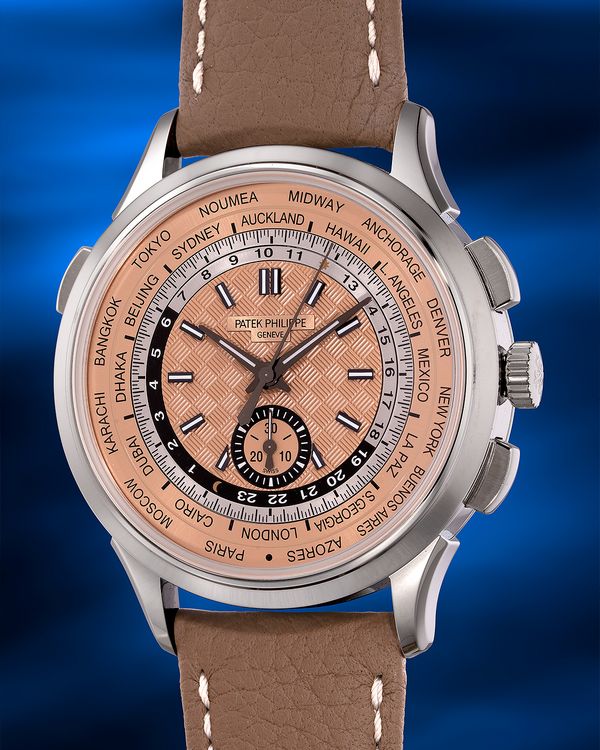
Lot 8008: A circa 2022 Patek Philippe World-Time Chronograph Ref. 5935A-001 in stainless steel that’s included in the Phillips Hong Kong Sessions, Spring 2026, Online Auction. Estimate: HKD $200,000 - 400,000
Visually, it departs from the classical enamel maps and guilloché centers of earlier world-timers. Instead, the opaline rose-gilt dial is animated by a carbon-style motif at its center, a crisscross pattern that adds texture and a subtle sense of motion. It feels contemporary, even a touch sporty, yet it avoids excess.
The charcoal grey gold hour markers and faceted white-gold dauphine hands, both treated with luminescent material, underscore the watch’s practical intent. This is a world-time you can read in an airport lounge at midnight without squinting.
The outer city ring, printed in black against a salmon-toned background, provides contrast and clarity. Twenty-four cities encircle the dial, corresponding to the world’s primary time-zones, while the two-tone 24-hour center ring allows you to distinguish day from night at a glance. The chronograph registers integrate cleanly into the layout, never overwhelming the world-time display.
What makes the Ref. 5935A particularly compelling is its balance of disparate eras. The architecture of the world-time mechanism remains faithful to mid-century principles. The flyback chronograph, with its single-push reset-and-restart capability, adds genuine functionality for modern life. And the aesthetic, with its steel case and textured dial, nods to contemporary tastes without abandoning Patek’s core identity. The result is a watch that feels ready for today. It suits the collector who boards long-haul flights as often as he attends formal dinners.
Lot 8031: A Circa 2000s Vacheron Constantin Evasion World-Time Ref. 48250 in 18k Pink Gold
Estimate: HKD $80,000 - 160,000
The world-time complication has always carried a certain romance. When Louis Cottier devised the system in the 1930s, commercial aviation was still in its infancy, and international travel retained an air of adventure.
His rotating 24-hour ring and city disc transformed a wristwatch into a miniature globe, compressing geography into something you could read at a glance.
By the mid-1990s, that romance had not faded, but the complication had become relatively uncommon. In 1996, Vacheron Constantin introduced the Ref. 48250 “Evasion” World-Time, a suitably confident revival aimed at the Japanese market. Production numbers were modest and deliberate: 100 pieces in 18k white gold, 100 in 18k yellow gold, and later 100 in 18k pink gold.
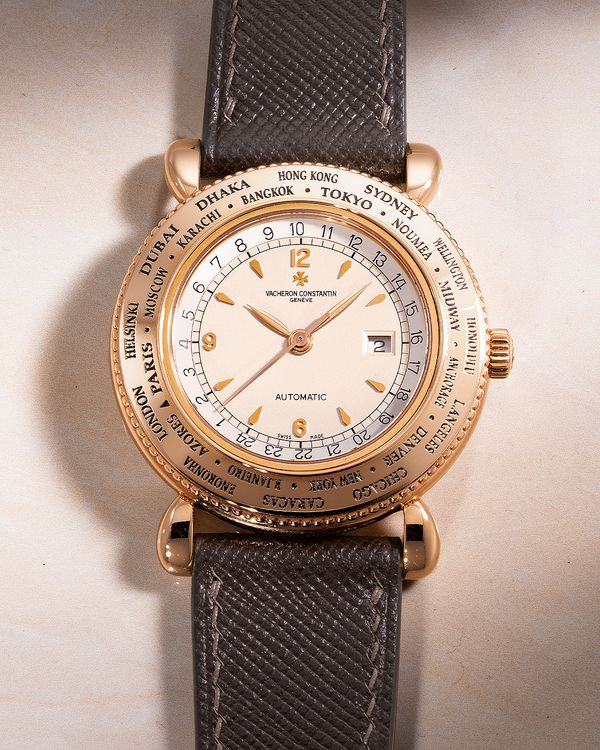
Lot 8031: A circa 2000s Vacheron Constantin Evasion World-Time Ref. 48250 in 18k pink gold that’s included in the Phillips Hong Kong Sessions, Spring 2026, Online Auction. Estimate: HKD $80,000 - 160,000
This pink-gold example, numbered 36 of 100, sits at the intersection of vintage inspiration and 1990s restraint.
At 37mm, the case feels close to the proportions of early world-timers from the 1920s and 30s. The design inevitably recalls watches like the Patek Philippe REf. 1415, with its classical layout and emphasis on legibility. But Vacheron's 48250 stops short of pastiche. The bezel is sleek and polished rather than ornate, giving the watch a clean, contemporary edge that anchors it firmly in its own era.
The dial is where the watch reveals its careful balancing act. An off-white, two-tone 24-hour ring enhances clarity, separating day and night hours in a way that makes practical sense. The layout remains intuitive. You read local time conventionally, then glance outward to understand the hour across the globe. It is Cottier's logic, preserved.
Interestingly, Vacheron opted to engrave the 24 cities directly on the bezel rather than house them on a rotating dial disc. At three o’clock, a discreet date window adds everyday utility. Purists might debate the presence of a date on a historically inspired world-timer, but here it integrates cleanly and underscores the watch’s practicality.
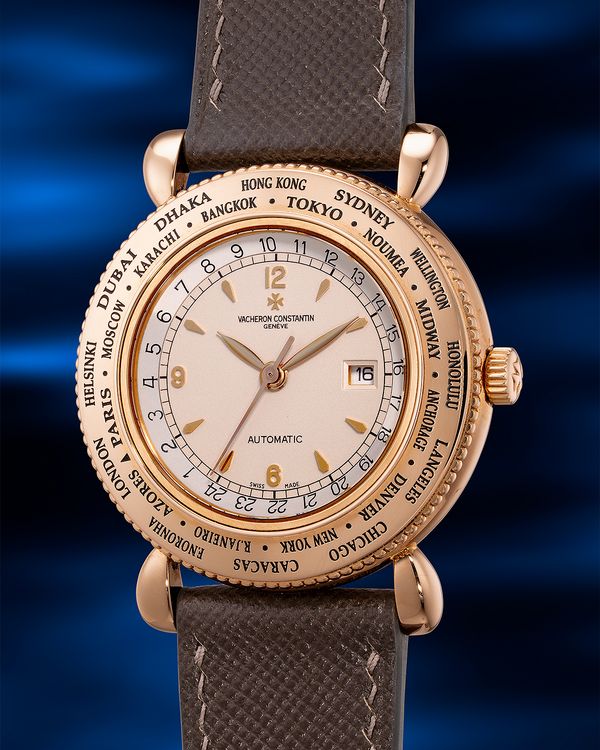
Lot 8031: A circa 2000s Vacheron Constantin Evasion World-Time Ref. 48250 in 18k pink gold that’s included in the Phillips Hong Kong Sessions, Spring 2026, Online Auction. Estimate: HKD $80,000 - 160,000
The teardrop lugs deserve a mention. They add a subtle flourish that enhances the vintage character without overwhelming the design. On the wrist, they soften the profile and give the watch a sense of continuity with earlier mid-century dress pieces.
What makes the Ref. 48250 “Evasion” compelling today is its position in the broader narrative of world-time watches. It arrived before the current wave of enthusiasm for travel-themed complications, before steel sport world-timers became the center of attention. It reflects a moment when Vacheron Constantin revisited one of watchmaking’s most poetic complications with restraint and respect for tradition.
For collectors who appreciate classical proportions, limited production, and a thoughtful reinterpretation of Cottier’s invention, the Ref. 48250 offers something quietly persuasive. It reminds you why the world-time complication captured imaginations in the first place.
Lot 8009: A Circa 2007 Patek Philippe World-Time Ref. 5110J-001 in 18k Yellow Gold
Estimate: HKD $150,000 - 300,000
Few watches define a watchmaker the way the World-Time defines Patek Philippe. The story begins in the 1930s, when Geneva watchmaker Louis Cottier devised a mechanism that could display all 24 time-zones simultaneously. Patek Philippe adopted the system and, in 1939, introduced the now-legendary Ref. 1415. It was elegant, compact, and intellectually satisfying in a way few complications are.
Its successor, the reference 2523, pushed the concept further with bolder case architecture and, in some examples, cloisonné enamel dials that elevated the watch into the realm of portable art. Production was brief, ending in the 1950s, but the 2523’s reputation only grew with time. Decades later, it would cement its place in auction history, with record-breaking results that underscored just how deeply collectors value Patek’s mid-century world-timers.
And then, for a long stretch, silence.
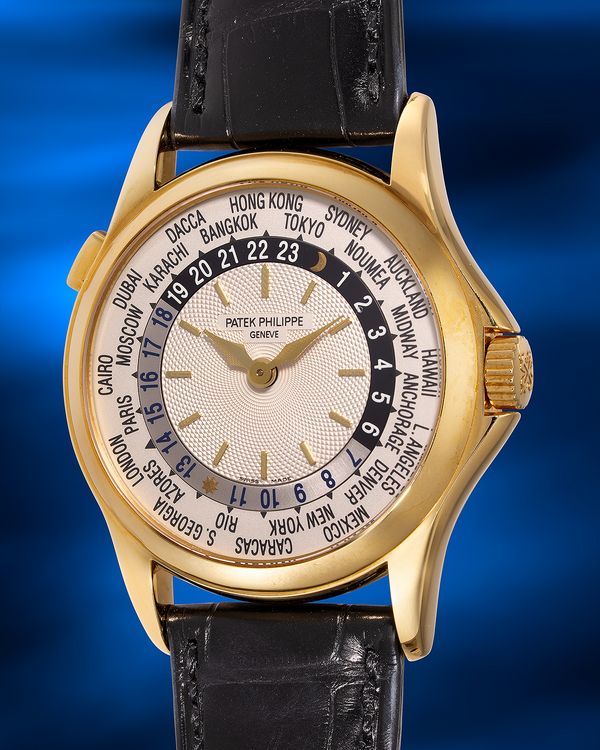
Lot 8009: A circa 2007 Patek Philippe World-Time Ref. 5110J-001 in 18k yellow gold that’s included in the Phillips Hong Kong Sessions, Spring 2026, Online Auction. Estimate: HKD $150,000 - 300,000
It was not until 2000 that Patek Philippe reintroduced a serially produced world-time wristwatch. The new Ref. 5110 marked the true modern revival of the complication. Importantly, it was not a nostalgic reissue. The Ref. 5110 incorporated a patented mechanism that simplified operation in a meaningful way. Instead of relying on an additional crown to adjust the local time, the wearer could advance the time-zone with a push, an intuitive gesture that felt entirely contemporary while preserving the logic of Cottier’s original system.
Visually, the Ref. 5110 established a new design language for the 21st-century World-Time. The dial’s guilloché center adds texture and depth, catching the light in a way that draws your eye inward before it moves outward to the 24-hour ring and city disc. The layout remains legible and balanced, a testament to Cottier’s architecture's adaptability across eras.
Patek Philippe offered the Ref. 5110 in 18k yellow, pink, and white gold, as well as platinum, reinforcing its position as a core complication rather than a one-off experimental run. At 37mm, the case feels almost restrained by modern standards, yet on the wrist, it reads perfectly. The proportions echo vintage references like the Ref. 1415, while the crisp finishing and updated mechanics firmly place it in the contemporary period.
Another detail situates this example in time. Early Ref. 5110 examples listed Hong Kong as one of the East Asian cities on the dial, before later generations of Patek’s World-Time would adopt Beijing instead. It is a small but telling distinction, one that collectors notice and appreciate.
Preserved in excellent condition after remaining unworn in a private Hong Kong collection since 2007, this Ref. 5110 represents a pivotal chapter in Patek Philippe’s World-Time story. It is the bridge between mid-century legend and modern production, between the romance of the 1940s and the practicality demanded by today’s traveler.
For anyone drawn to the intellectual elegance of the world-time complication, the Ref. 5110 is an excellent entry point. It is the watch that brought the complication back into daily life at Patek Philippe, proving that a design conceived in the golden age of travel still makes perfect sense in a world that moves even faster.
You can view the complete Phillips Hong Kong Sessions, Spring 2026, Online Auction catalogue here.
About Phillips In Association With Bacs & Russo
The team of specialists at PHILLIPS Watches is dedicated to an uncompromised approach to quality, transparency, and client service. Phillips in Association with Bacs & Russo holds the world record for the most successful watch auction, with its Geneva Watch Auction: XIV having realized $74.5 million in 2021. Over the course of 2021 and 2022, the company sold 100% of the watches offered, a first in the industry, resulting in the highest annual total in history across all the auction houses at $227 million.
About Logan Baker
Logan has spent the past ten years covering the watch industry from every angle. He joined Phillips in Association with Bacs & Russo in early 2023 as Senior Editorial Manager, after previous roles at Hodinkee and WatchTime. Originally from Texas, he spent a decade in New York and now calls Geneva home.
Recommended Reading
Specialists' Picks: The Phillips Watches Hong Kong Sessions, Spring 2026, Online Auction