Article | Irving Penns Lasting Influence
Irving Penn's Lasting Influence
Penn inspired veneration in everyone from the fashion editors and collaborators who worked with him to younger generations who only know his echo.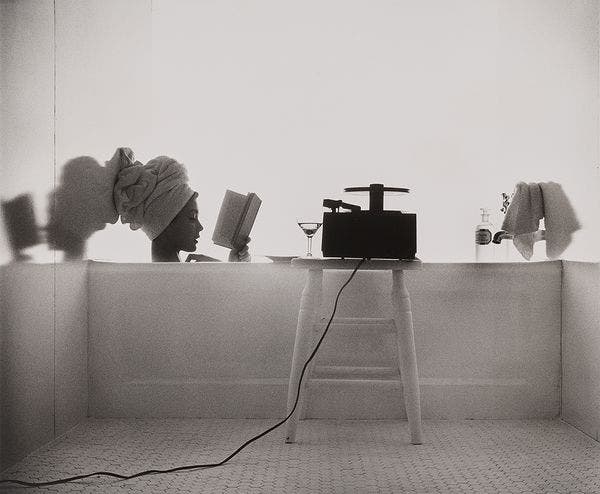
Irving Penn, Girl in Bath (Jean Patchett), New York, 1950. Visual Language: The Art of Irving Penn.
Mention the name Irving Penn to anyone who worked with him, and their eyes simply light up. The feeling is so strong that it's also reflected in the eyes of those who never met him, but were mentored by his collaborators.
So, as Phillips presents the auction ‘Visual Language: The Art of Irving Penn’ in collaboration with The Irving Penn Foundation, it only made sense that we speak with several people who knew or worked with Penn to hear some of these stories firsthand. Visit the preview at 432 Park Avenue, opening on 30 September, and you too will leave our gallery with that same spark in your eye.
“He challenged all of us who worked with him,” says Phyllis Posnick, Vogue’s Executive Fashion Editor for nearly three decades. “Sometimes he’d say, ‘I don’t think you believe in this picture.’ And I would have to prove that I did. He liked testing us.”
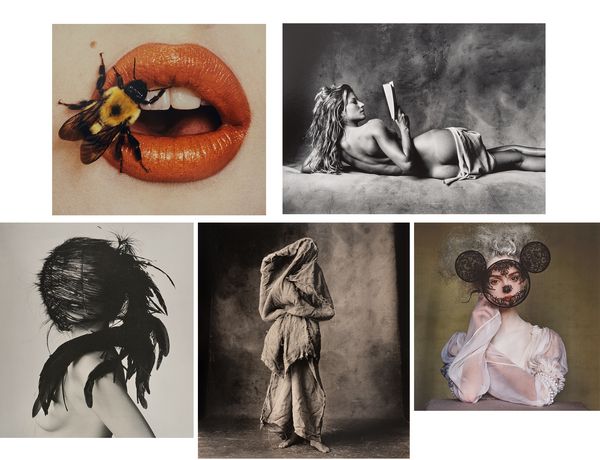
Photographs by Irving Penn that Phyllis Posnick worked on as Fashion Editor at Vogue. Clockwise from top left: Bee (A), New York, 1995; Gisele Reading (A), New York, 2006; Yves Saint Laurent Blouse, New York, 2005; Woman in a Burlap Sack, New York, 2007; Chanel Feather Headdress, New York, 1994. Visual Language: The Art of Irving Penn.
Posnick tells Phillips that when working together, she and Penn were in close contact. “We talked almost every day. I learned to speak in a visual language that could inspire him. When we met in his studio, he sat across from me and often drew as we talked.” She recalls how meticulous he was and how he taught her and her colleagues to consider every detail. She explains, “He would say to me, ‘How do you see her hair? What will be on her feet? Will she wear gloves? Is there any jewelry? How do you see the makeup?’ The hairdresser would have to think about the hair in the context of the whole picture, not just think about doing an interesting hairstyle. And he liked bold strokes, ‘Nothing bitsy!’ Those were his words.”
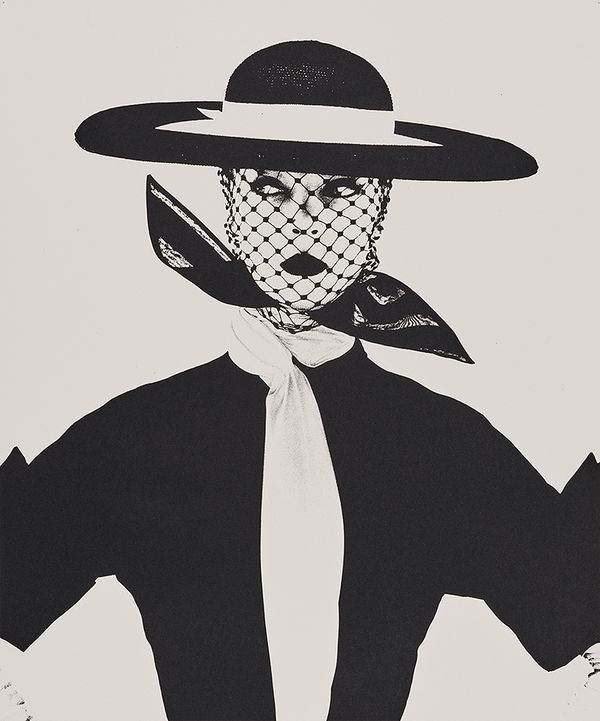
Irving Penn, Black and White Vogue Cover, New York, 1950. Visual Language: The Art of Irving Penn.
Roger Krueger, Penn’s longtime Assistant and now the Assistant Director of Archives & Visual Services at The Irving Penn Foundation, echoes Posnick’s remarks, noting that his exacting focus was carefully attuned to producing the finest images and prints achievable. “At the studio, the goal was always to serve the picture. Everyone was there to make the picture happen and assist Mr. Penn in any way possible,” Krueger says. Furthering this mission has become the focus of his work at the foundation. “We’re continuing the legacy that we started with Mr. Penn, trying to service the images and get them out into the world to make sure that people get to appreciate them,” he says.
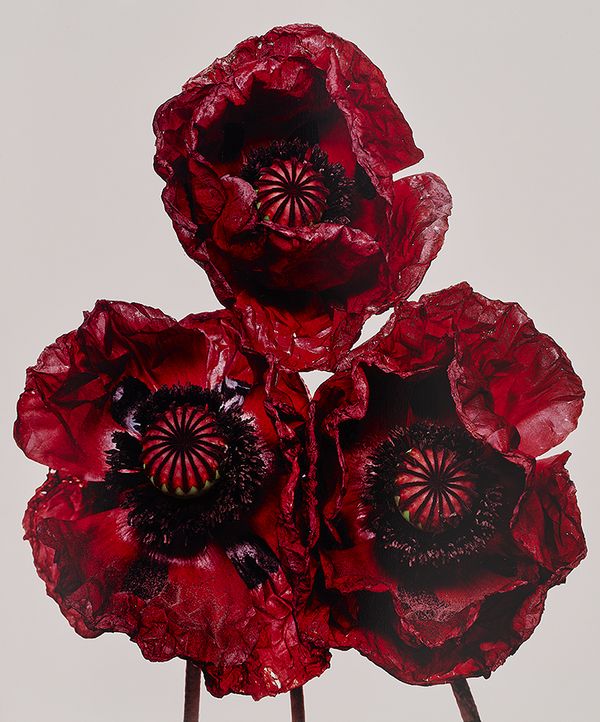
Irving Penn, Three Poppies 'Arab Chief', New York, 1969. Visual Language: The Art of Irving Penn.
When Posnick produced her book, ‘Stoppers: Photographs from My Life at Vogue’, she invited collaborators to remark on working with Penn. She explains, “The hairdresser Orlando Pita said that Penn opened his mind and his world. Nicolas Ghesquière, who is the director at Vuitton now, talked about it being an almost religious feeling, and Marc Jacobs said that the beauty of what made an Irving Penn photograph was quite literally Irving Penn. John Galliano also said he was bewitched by the sparkle in Penn’s eye.”
“Everybody had the same reaction to the atmosphere in the studio, and to him,” Posnick says.
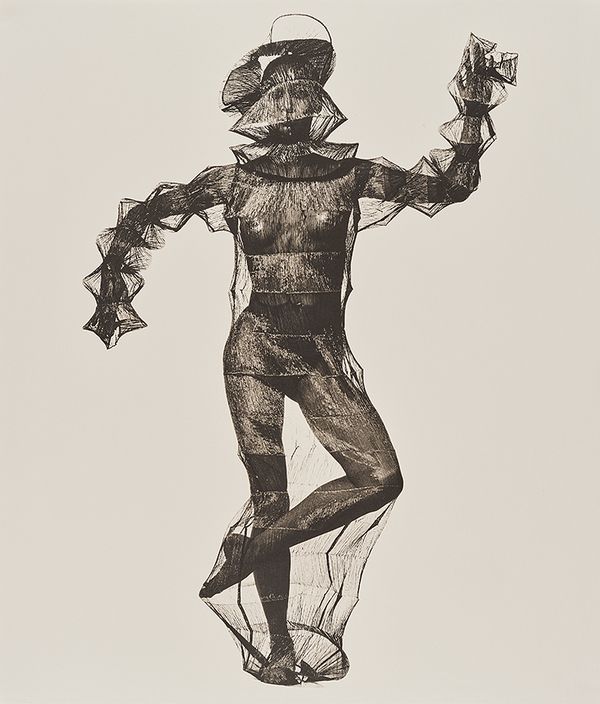
Irving Penn, Young Woman in a Net (Miyake Design), New York, 1993. Visual Language: The Art of Irving Penn.
A common refrain from those who worked with Penn is just how quiet and focused his studio and working methods were. In the 1988 book, Issey Miyake, Photographs by Irving Penn, Miyake recounts, “There is in Japanese a word, A ŪN. It describes a form of communication established when one person throws a voiceless message to another. I anticipated that our collaboration would have such sympathy. It would be our unspoken understanding.”
“There was no music, no loud voices,” says Posnick. “You felt the silence and the peace. The old squeaky floor was the only sound you heard. He whispered his instructions from behind the camera to his subjects. Many of the subjects of his portraits talked about the overwhelming feeling of perfection, precision, and the vision that came from him.”
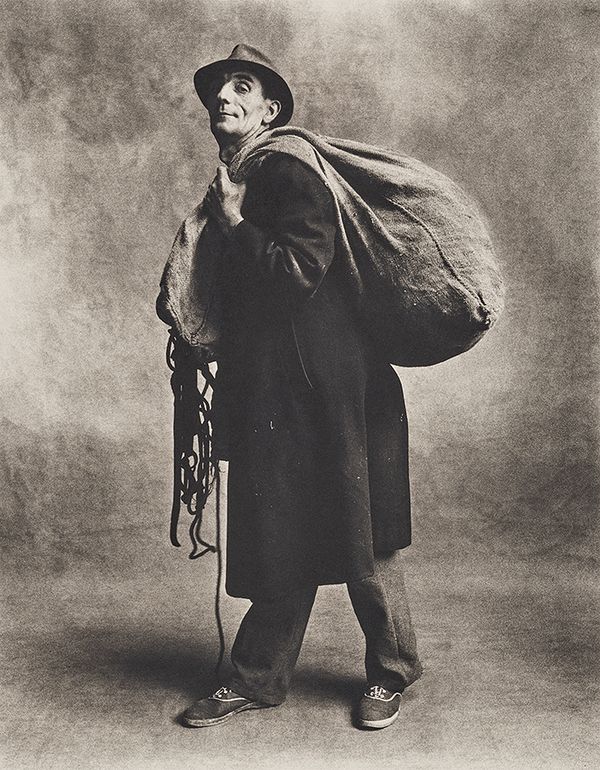
Irving Penn, Rag and Bone Man (A), London, 1950. Visual Language: The Art of Irving Penn.
In a sense, Penn’s working methods allowed for the removal of all distractions in the pursuit of artistic excellence, which is also seen in the distilled nature of Penn’s imagery. This idea rings true in the remarks of the artist’s son, Tom Penn, when speaking to Phillips from his family home — a sprawling farm on Long Island where Penn’s studio is carefully maintained by The Irving Penn Foundation, of which Tom Penn is now Executive Director. “My father’s inspiration came from trying to isolate a specific challenge and to remove all of the things that were extraneous, and to focus entirely on coming up with something that was absolutely unique from a completely different perspective,” Penn says.
Krueger echoes this as well, remarking that “it’s not an easy thing to do, to make a simple photograph. And Mr. Penn was a master at it. Everything that is there is meant to be there — everything else is gone.”
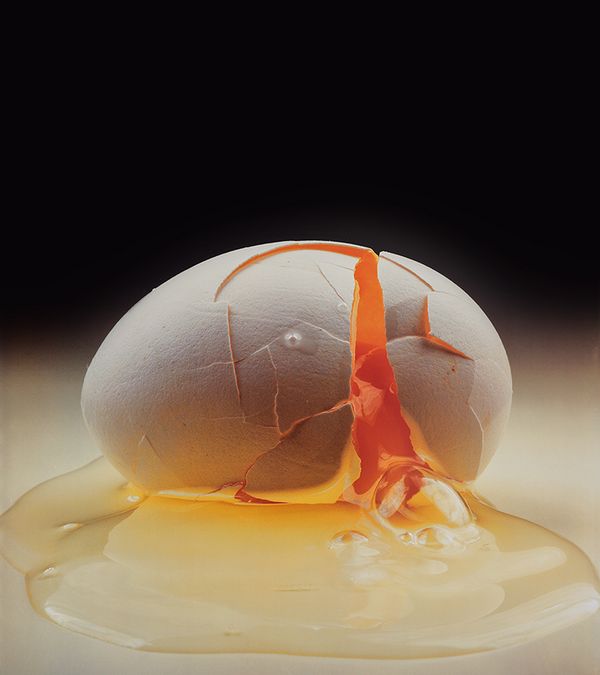
Irving Penn, Cracked Egg, New York, 1958. Visual Language: The Art of Irving Penn.
A sense of reverence was inspired in Penn’s sitters, too. “My father was a person of enormous humility. There was a tenderness and a silence that was like an aura around him,” Tom Penn remarks. He notes that when his father encountered language barriers with sitters in his ethnographic works, the sitters could sense his father’s respect for them and that they “understood that something very, very important was happening.”
Vasilios Zatse, Irving Penn’s Assistant and now Deputy Director at The Irving Penn Foundation, also gives us insight into how the artist worked with his sitters: “Penn would invite the subject to sit and share a coffee or tea and have a conversation in anticipation of the portrait sitting. The aim was for Penn to study the subject and perhaps begin to assemble the picture in his mind. But it was also a time to allow the sitter to be at ease, to become relaxed, to drop their defenses, this preconceived idea that they might have of themselves and how they must look in front of the camera.”
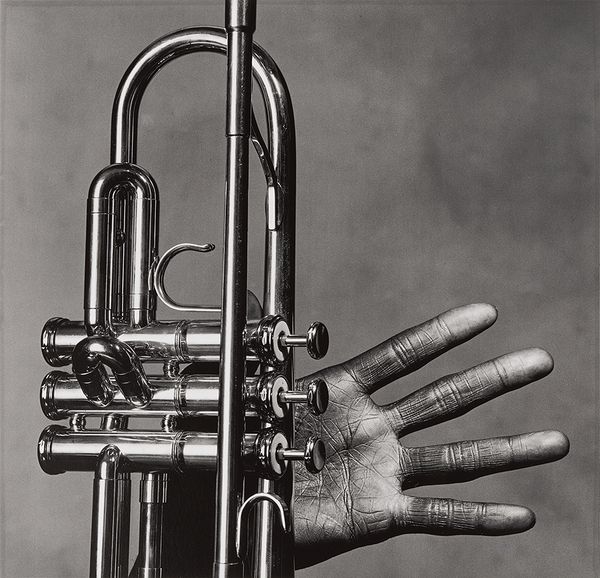
Irving Penn, Miles Davis Hand on Trumpet, New York, 1986. Visual Language: The Art of Irving Penn.
Zatse tells us this approach was particularly effective with Miles Davis, recalling the extraordinary occurrence of two artistic giants collaborating in one room. “This photograph tells us that Miles relinquished a lot of that control to Penn, which I think was a surprise, very much to the art director,” Zatse says. He adds that when the sitting was concluded, Miles Davis kissed the artist without saying a word. “He just kissed Penn on the lips and left the studio. I think that was a gesture of acceptance and that he was pleased with the experience of being photographed by Penn.”
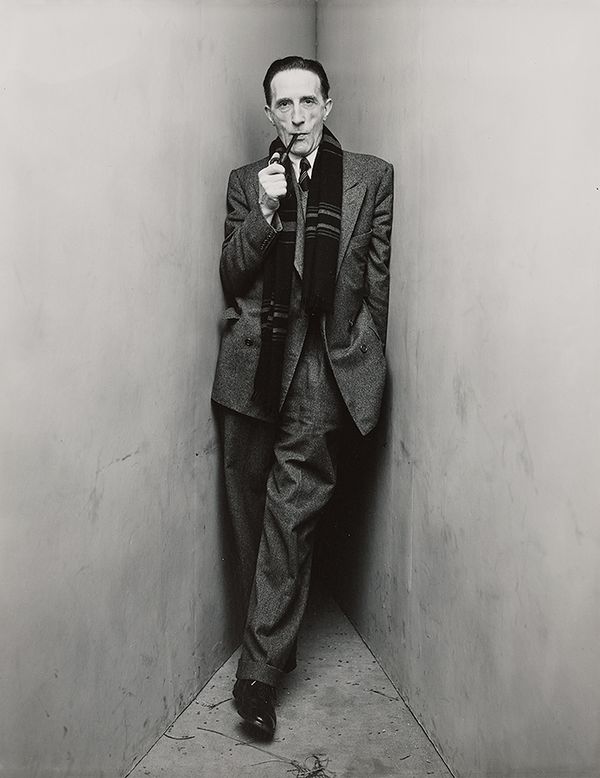
Irving Penn, Marcel Duchamp (1 of 2), New York, 1948. Visual Language: The Art of Irving Penn.
Though Penn was exacting and meticulous, he was also an open collaborator. Posnick, who encouraged Penn to resume photographing in daylight in his later years, as she so admired his earlier works made before the prevalence of studio lighting, tells us, “As I came to know Penn better, we would sometimes disagree. He wanted to push the boundaries. He wanted to provoke. One day, we were arguing about the look of a model. I was fighting him because I thought it was too extreme and that the picture would be killed. When I told him, his response was: ‘I’d rather have a good picture killed than a mediocre picture run.’ And after that, we began to take more chances and do our best work.”
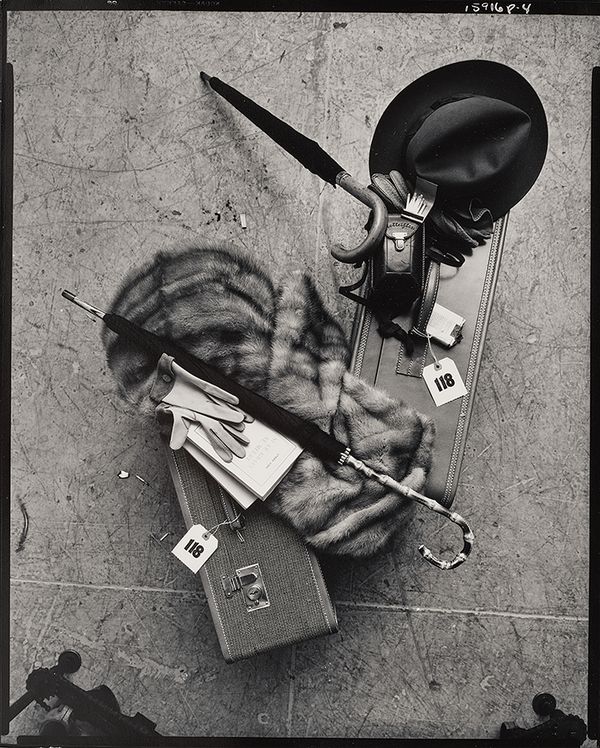
Irving Penn, Vogue Editorial Still Life, Luggage, New York, 1948. Visual Language: The Art of Irving Penn.
These stories aren’t just anecdotes; they are living proof of the legacy of an artist who, as Anna Wintour put it, changed “the way we saw the world and our perception of what is beautiful.” It’s also why exhibitions like the auction preview at Phillips are so important today. “Penn’s vision and skill remain unequaled,” says Vanessa Hallett, Phillips’ Deputy Chairwoman and Worldwide Head of Photographs. “Phillips is honored to work with the foundation in its 20th-anniversary year, shining a spotlight on Penn’s technical genius, creative process, and extraordinary output while presenting this groundbreaking work to a new audience.”
“People ask me what it means to carry his legacy,” says Tom Penn. “For me, it’s about how we care for the work, how we hold things. He left behind his tools, his darkroom, and this farm. My father had a way of noticing details others overlooked. I tried to honor that in the way we care for his work and how we carry it forward. Not by holding it still, but by letting it live.”
Discover more from Visual Language: The Art of Irving Penn >
Recommended Reading