Article | Around The House Our Favorite Irving Penn Works
Around the House: Our Favorite Irving Penn Works
Experts across Phillips write about the works they love the most in the auction 'Visual Language: The Art of Irving Penn.'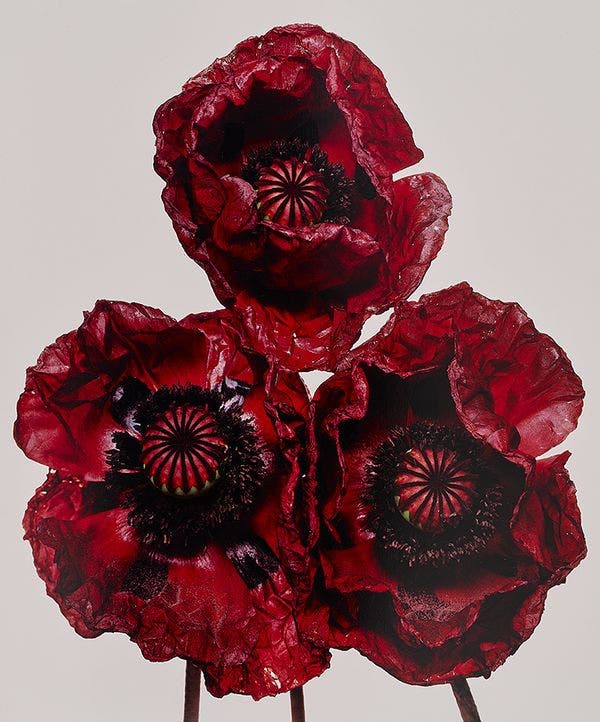
Irving Penn, Three Poppies 'Arab Chief', New York, 1969. Visual Language: The Art of Irving Penn.
Robert Manley, Chairman and Worldwide Head, Modern and Contemporary Art
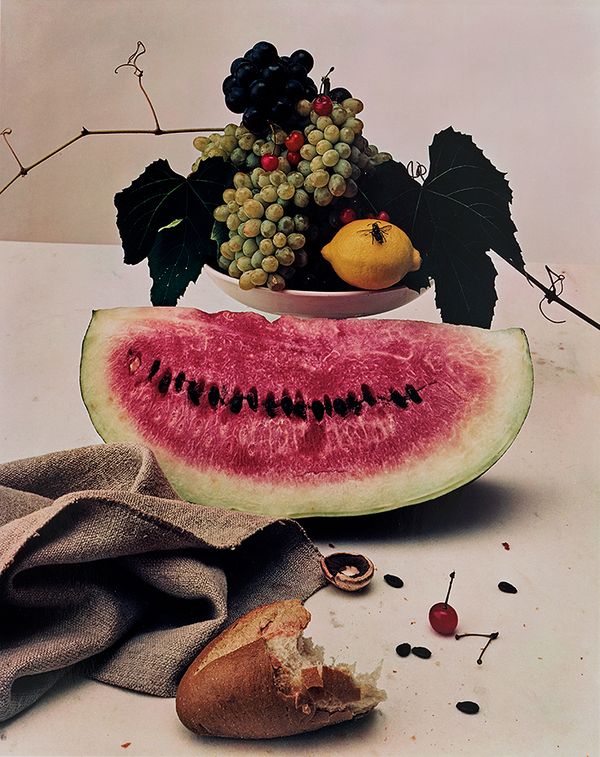
Irving Penn, Still Life with Watermelon, New York, 1947. Visual Language: The Art of Irving Penn.
Some of my favorite photographs by Penn are his still life images, which showcase his unerring sense of composition and color. The visceral Three Poppies or the playful Salad Ingredients would very much bring me joy, but if I had to choose one, it would be the exquisite Still Life with Watermelon, which has the strength and gravitas of a 17th-century Dutch still life. I can’t help but think of the paintings of Jan Davidsz. de Heem and Caravaggio’s early works that incorporate still-life elements. His still life photographs also have an interesting dialogue with another great photographer, Wolfgang Tillmans, in their color sense and how the images are framed.
Cary Leibowitz, Deputy Chairman and Worldwide Co-Head of Editions
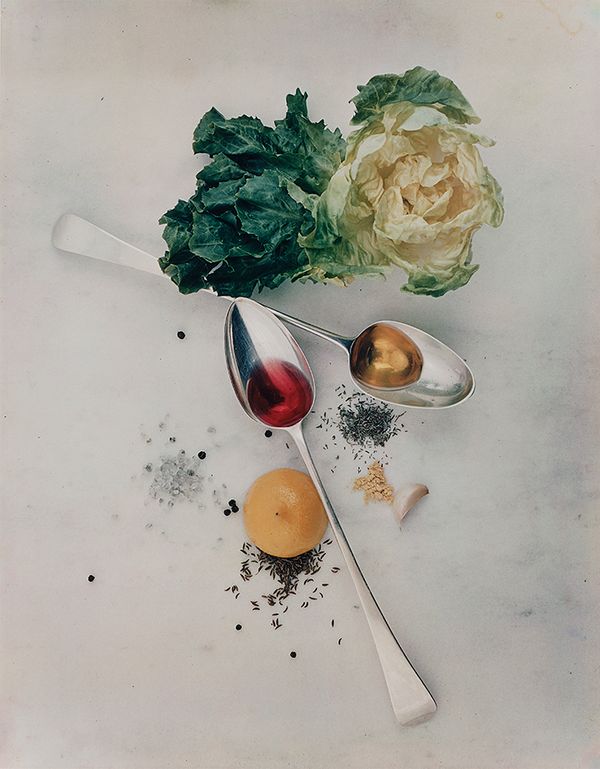
Irving Penn, Salad Ingredients, New York, 1947. Visual Language: The Art of Irving Penn.
I must confess, I am surprised I chose to write about this image, but the more I type, the more it makes sense.
This photo was created in 1947. Lately, I’ve been drawn to this period of American literature, art, and music. I am not sure if it is officially acknowledged or named, but it seems to me to be a golden age of American purity and honesty in the arts — the talent was set free, and so much came out of it. I would include Irving Penn in the list of greats from this era. I've also been thinking about Aaron Copland, Richard Bernstein, Carson McCullers, Truman Capote, Flannery O'Connor, Jackson Pollock, Ben Shahn, and on and on — the list is endless!
I was not there, but I am jealous of this age in New York City: the elegance and sophistication, the cultures and lifestyles that were explored and celebrated. Did people have salads in the United States before WWII? Probably, but this is a new salad. It’s about the bare minimum, telling your taste buds that this is all you need to appreciate art and life.
Kirsten MacDonald, Regional Director, Scandinavia
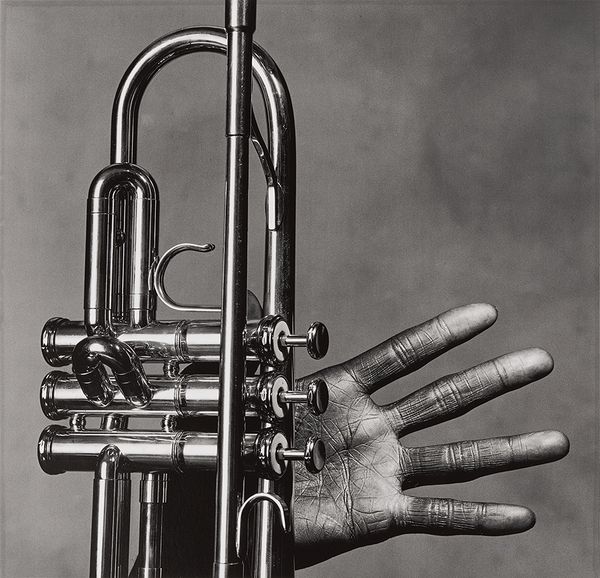
Irving Penn, Miles Davis Hand on Trumpet, New York, 1986. Visual Language: The Art of Irving Penn.
There are a range of reasons why this work speaks to me: I love jazz and particularly Miles Davis. When I lived in the US, I loved going to clubs in New York like the Blue Note downtown and Dizzy’s Club at Lincoln Center. Miles Davis’ hand is the hero of this picture. The beautiful, long fingers and the lines of the skin tell a special story about a genius who masters his instrument to perfection, sweeping people off their feet with the gentle motion of his fingers on the valves of the trumpet. Irving Penn was as much a master of the camera as Miles was of the trumpet, and the way Penn captures his hand mesmerizes me!
Annie Dolan, New York Head of Auctions and Specialist, Head of Day Sale, Morning Session, Modern & Contemporary Art
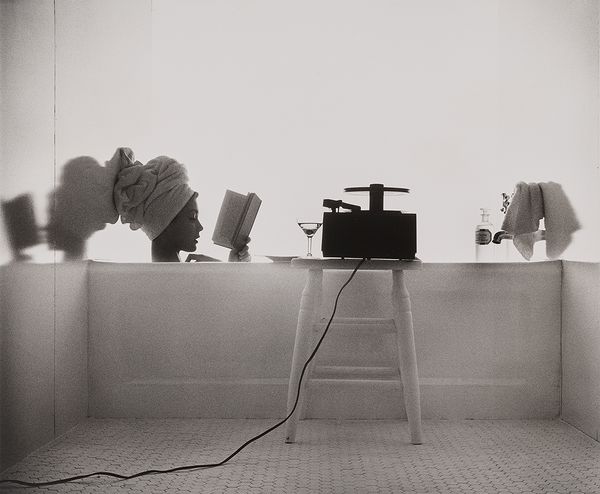
Irving Penn, Girl in Bath (Jean Patchett), New York, 1950. Visual Language: The Art of Irving Penn.
This epitomizes my definition of “self-care Sundays.” I love that this image from 1950 is so timeless. Replace the gramophone with a portable speaker and you have a 2025 mise-en-scène.
I especially love the lighting and how the figure is bathed (literally and figuratively) in shadow, despite her being the subject of the image itself. Her background, awash in bright white light, adds to the sense that this scene could be anywhere — any time or place — making it relatable for all.
Benoît Repellin, Worldwide Head of Jewellery
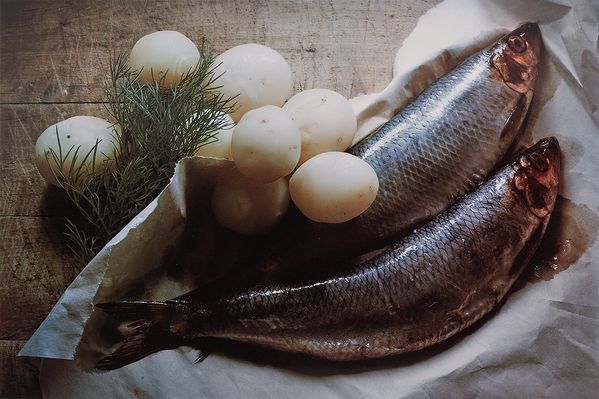
Irving Penn, Potatoes and Baltic Herring, Sweden, 1964. Visual Language: The Art of Irving Penn.
I find the composition of this image very interesting — minimalist and detailed at the same time. It reminds me of 17th-century still life paintings, with the very tempting objects and food that one almost wants to pick out of the painting. Irving Penn uses a different medium, photography, but with a nod to the past without a doubt.
At first, I thought it might be five loaves and two fish, in reference to the Gospel and the miracle of the Feeding of the 5,000. But then I realized there were eight potatoes and two fish, with some herbs to cook. It still reminds me how symbols in 16th and 17th century still lifes, especially after the Reformation, were used to illustrate the Gospel or specific religious themes.
There is probably no religious meaning behind Irving Penn’s photograph, but it clearly references works by artists of previous centuries. He managed to give a contemporary twist to an antique genre: the still life.
Mark Mayer, International Head of Video and Multimedia
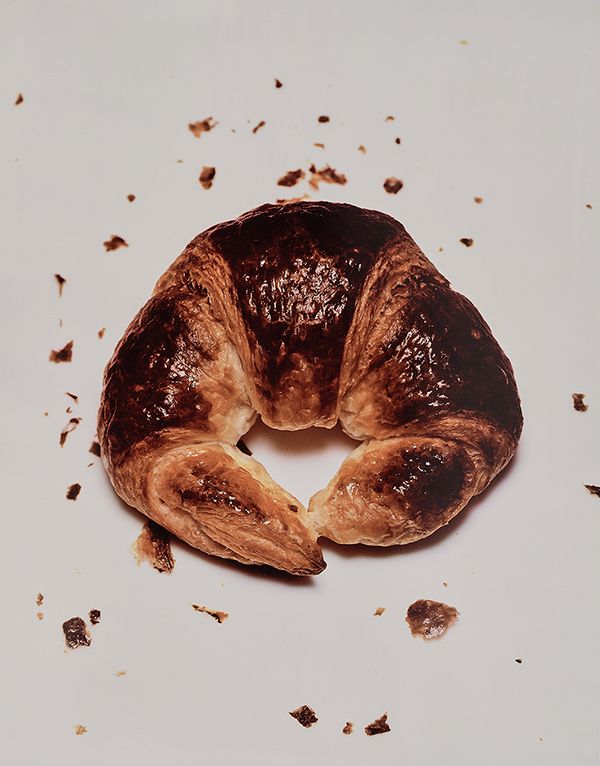
Irving Penn, Croissant, New York, 1982. Visual Language: The Art of Irving Penn.
With a background in art history and fashion, I’ve long admired Penn’s refined aesthetic and his ability to elevate the everyday. Like the Dadaists before him, he recognized that beauty could be found in the most ordinary objects.
In Croissant, his treatment transforms a simple pastry into something monumental. Penn wasn’t a provocateur like Duchamp, but for me, he shared that instinct to isolate the mundane and present it with such powerful clarity that it became extraordinary.
That fine balance, where (fashion’s) elegance meets the avant-garde’s embrace of the commonplace, continues to shape how I view the day-to-day world, and especially how I think about my own creative work.
Discover more from Visual Language: The Art of Irving Penn >
Recommended Reading