Article | Pontis Programmatic Versatility At Casa Ceccato
Animated Forms and Fantasy
Gio Ponti's programmatic versatility at Casa Ceccato.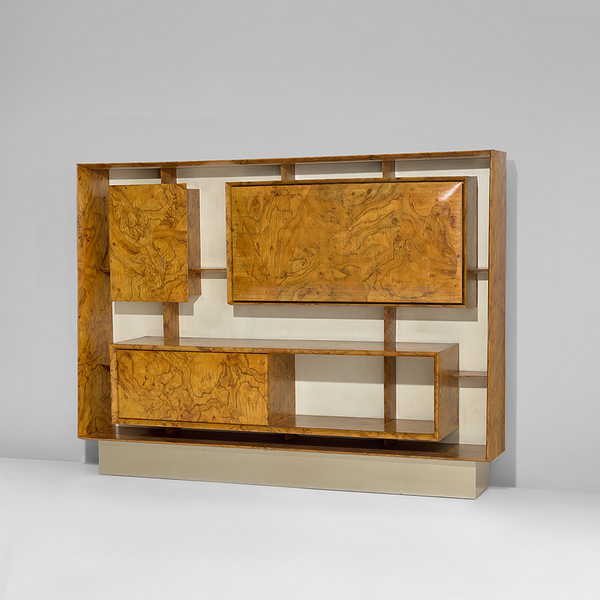
Gio Ponti, Illuminated cabinet, from Casa Ceccato, Milan, circa 1950. Design London.
– By Brian Kish, art historian, curator, specialist in 20th Century Italian Architecture and Design, and senior consultant to the Gio Ponti Archives, since 2006.
From 1949 to 1950, Gio Ponti received three consecutive commissions from Signor Ceccato The first was the famous sweet shop "Dulciora" located just off the Piazza Duomo. This was followed almost immediately by the refurbishment of his company’s executive offices, and finally in late 1950 by the new arrangement of his family home situated on the smart via Monferrato at No.14. The villa still stands, and it is a great achievement of Milanese fin de siècle eclecticism, circa 1900. Although Ponti's interior designs dispensed with any ornate plaster works in creating a sequence of pared-down volumetric rooms, he had an ample budget to create one of his most important interiors in the same league as the nearby Lucano residence, also known as Casa di fantasia.
The fixtures, fittings, and furniture of this important Ponti commission were dispersed more than twenty years ago. Fortunately, these two particular lots, the large, illuminated wall cabinet and study table, are key examples of these commissions; they clearly demonstrate his multilinear methods to achieve maximum visual results and reflect his trajectory from the mid-1930s to early 1950s. Ponti’s interiors over this period are characterized by a high degree of programmatic versatility, poetic invention, and formal lucidity.
The cabinet presented in this auction evolved from Ponti's 1930s experiments in concert with Italian Rationalists; it stands out as an early example of his "Furnished Walls.” It is emblematic of one of Ponti’s recurring design concepts, the "positivo e negativo," as evident in the juxtaposition of the darker walnut root wood encasing the three cabinets and the large outward tapering frame, in stark contrast to the white enamelled back panelling and interior cabinet spaces. The alignment of these elements into a suspended grid of vertical and horizontal wood trusses lends a pictorial emphasis to the tectonics of the object.
Originally Ponti designed the rectangular center table as a desk. It was installed in a multi-levelled reception room as stand-alone piece. The piece in burr walnut exhibits a striking sensuality in its undulating vertical supports and splayed legs that terminate in exaggerated elongated brass sabots; it calls to mind the sophisticated conceits of 16th century Italian Mannerism when there were elaborate guidelines to correctly use such effects, something that was familiar to his preferred collaborator and fabricator, the ebanista Giordano Chiesa.
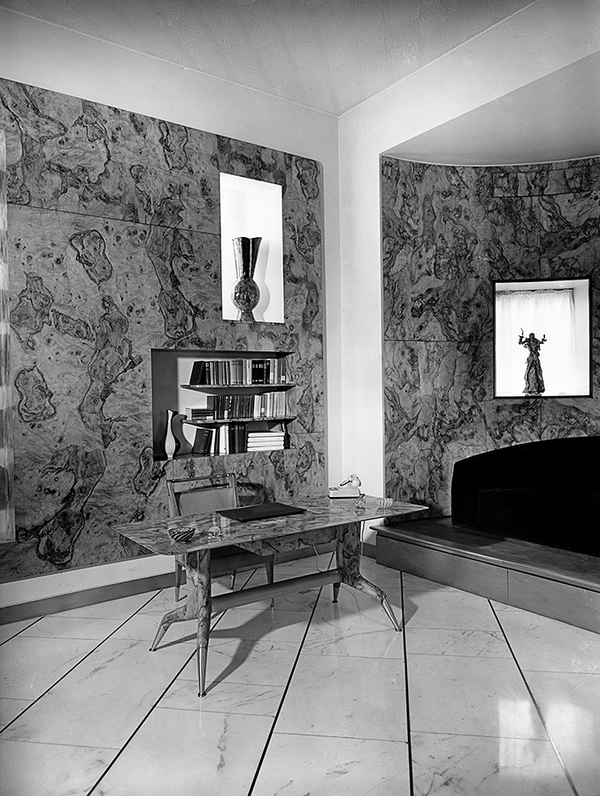
The present unique desk in Casa Ceccato, Milan. © Gio Ponti Archives / archivio storico Eredi Gio Ponti. Design London.
In these designs Ponti invites surrealist zoomorphic readings, often juxtaposing animated forms against the rationalist geometries of his sofas and shelving systems. This method first evolved from both the 1935 Marmont and 1938 Vanzetti commissions.
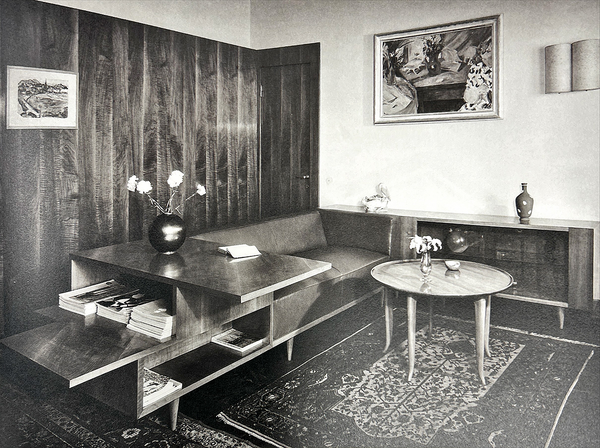
The geometric sofa and shelving system in Ponti’s 1935 Marmont commission. © Gio Ponti Archives / archivio storico Eredi Gio Ponti. Design London.
Of particular note here is the attention Ponti devoted to the amusing and fantastical design delicacies in Signor Ceccato's daughter's bedroom, especially the brass bed revealing twelve stars, four planets, in addition to a sun and crescent moon, no doubt indexed to her zodiac sign.
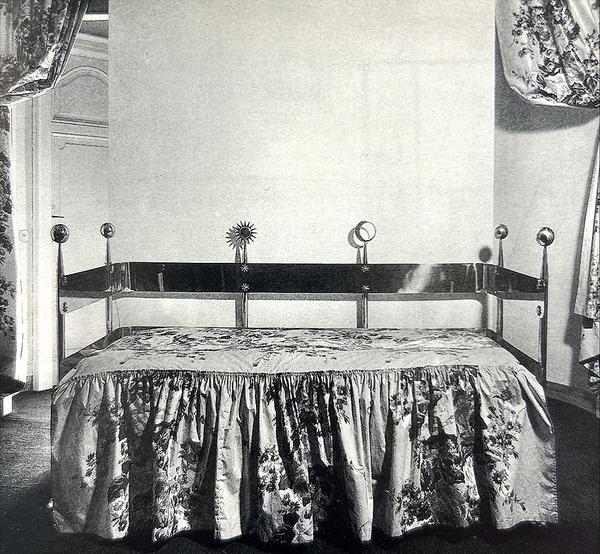
The bed Ponti designed for Signor Ceccato’s daughter in Casa Ceccato, Milan. © Gio Ponti Archives / archivio storico Eredi Gio Ponti. Design London.
Ponti’s galaxy of designs was steadily evolving while he invented reiterations of trusted furniture forms, embracing new aesthetic currents as they emerged and configuring them through his own mercurial imagination. Indeed, they are essential components of the “Ponti look” that came to define this prolific period in his career, and is spelled out in his theoretical manifestos on design, such as his concept of the “fitted house.”
Such features and methods lent his interiors a dynamic quality. With a seemingly effortless humorous distance, they were cued to an idiosyncratic mix of avant-garde art currents, which evolved into his own highly recognizable style.
Recommended Reading
Collecting Guide: Postmodern and Contemporary Design 101 >
Spotlight on Women Designers >
Five Things to Know: Ettore Sottsass’ Early Enameled Copper Plates >