Article | Exploring Breguet In The Daniel Roth Era
The Fine Print: Exploring Breguet in the Daniel Roth Era and Beyond
Welcome to The Fine Print, our column dedicated to deep dives and detailed guides on watch collecting. – By Logan Baker Daniel Roth is one of the most influential watchmakers of the post-Quartz Revolution era, often referred to as a "watchmaker’s watchmaker." His impact on the industry is undeniable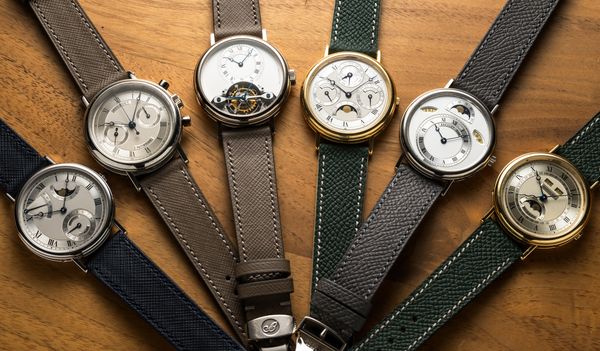
Welcome to The Fine Print, our column dedicated to deep dives and detailed guides on watch collecting.
– By Logan Baker
Daniel Roth is one of the most influential watchmakers of the post-Quartz Revolution era, often referred to as a "watchmaker’s watchmaker." His impact on the industry is undeniable, particularly during his 14-year tenure at Breguet in the 1970s and ’80s, where he played a key role in redefining the brand for the modern era.
Recently, I had the chance to examine several neo-vintage Breguet Classique timepieces from Alfredo Paramico’s collection that date to Roth’s time at the helm.
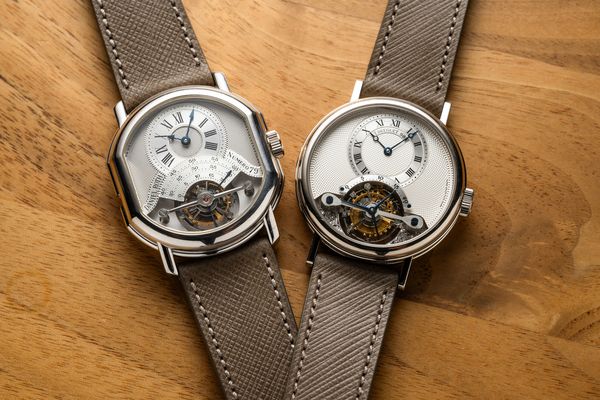
A Breguet tourbillon developed by Daniel Roth (right) next to a Daniel Roth-brand tourbillon. Both use the same ebauche. Image by James K./@waitlisted.
Inspired by this experience, I’ve put together a concise guide to highlight standout watches from this period, as well as those produced shortly after his 1988 departure, when his influence remained strong. While not an exhaustive catalogue of Breguet’s creations from the 1970s through the 1990s, this guide offers a curated selection of a dozen or so remarkable pieces from this transformative era.
Early Career and Breguet Revival
Daniel Roth began his career at Jaeger-LeCoultre and Audemars Piguet, spending seven years refining his skills in Le Brassus. Though an outsider among AP’s traditionally trained watchmakers, his talent quickly earned him recognition. His next pivotal opportunity came when Jacques and Pierre Chaumet, the owners of Breguet, sought a watchmaker to restore the brand’s prestige. Roth’s application stood out — alongside a page detailing his expertise, he included another outlining what he still wished to learn. This honesty impressed the Chaumet brothers and Breguet’s director, François Bodet, securing him the role.
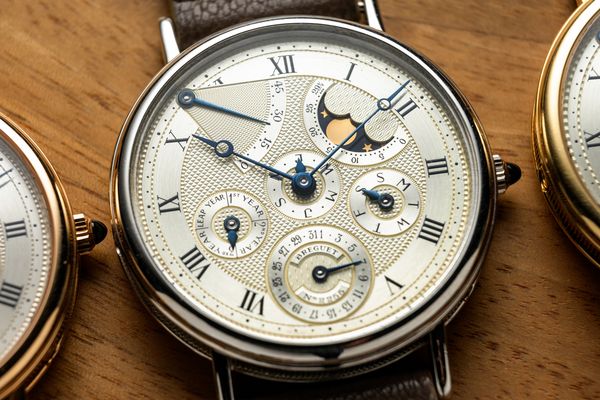
A close-up on the dial of a Breguet Classique Perpetual Calendar ref. 3310 in 18k white gold, part of Alfredo Paramico's collection. Image by James K./@waitlisted.
Determined to immerse himself in Breguet’s heritage, Roth embarked on a year of self-study, meticulously researching Abraham-Louis Breguet’s techniques and archives. His efforts culminated in the creation of a perpetual calendar pocket watch, which was sold to fund his research. By 1973, Roth was ready to lead Breguet’s revival. Recognizing that the heart of fine watchmaking had shifted from France to Switzerland, he relocated Breguet’s operations to the Vallée de Joux by 1976.
Over the next fourteen years, Roth and Bodet redefined Breguet’s wristwatch aesthetic, introducing iconic elements such as engine-turned dials, coin-edge cases, and Breguet hands. They leaned on Lemania and Frédéric Piguet base movements, ensuring the mechanical integrity of their creations.
Breguet Classique Perpetual Calendar Ref. 3050 / Ref. 3057
The ref. 3050 was Daniel Roth’s first major release at Breguet in 1976, marking a pivotal moment in the brand’s revival.
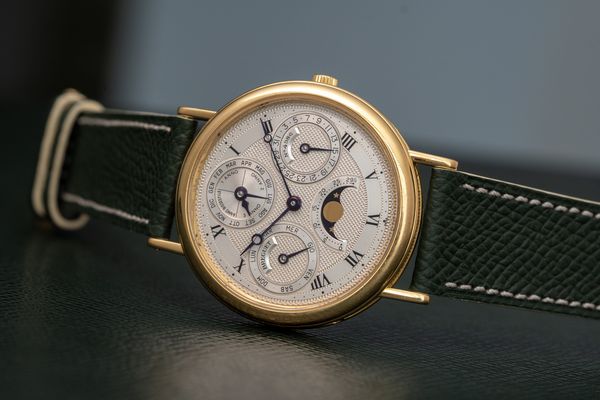
A Breguet Classique Perpetual Calendar ref. 3050 in 18k yellow gold, part of Alfredo Paramico's collection. Image by Logan Baker.
Inspired by a Breguet pocket watch he previously studied, Roth reimagined its perpetual calendar design as an automatic wristwatch, giving rise to the Breguet ref. 3050. Its successor, the ref. 3057, followed the same blueprint but introduced an exhibition caseback.
With perfect proportions — 36mm in diameter and just 8mm thin — the watch exudes elegance. Its solid gold dial features a galvanized silver finish and a full Clous de Paris guilloché pattern, exemplifying Breguet’s signature aesthetic.
Breguet Classique Perpetual Calendar Ref. 3310
The ref. 3050 perpetual calendar wristwatch was joined by the ref. 3310 in 1986.
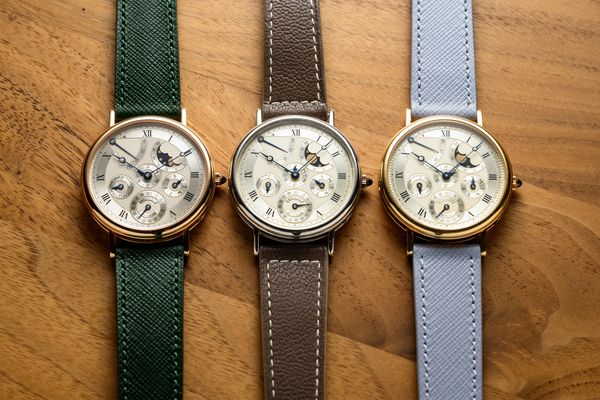
A trio of Breguet Classique Perpetual Calendar ref. 3310s in various precious metals, part of Alfredo Paramico's collection. Image by James K./@waitlisted.
The key distinction between the two models was the addition of a power reserve indicator in the ref. 3310. Both models shared the same signature elements: guilloché patterns on the solid gold dial, a 36mm slim coin-edge case, and an automatic caliber 502 base movement.
Breguet Classique Power Reserve Ref. 3130 / Ref. 3137
Working alongside prototypist Louis-Maurice Caillet, Daniel Roth crafted a collection deeply rooted in Abraham-Louis Breguet’s original designs. Among their earliest creations was the 36mm ref. 3130, which was later refined into the ref. 3137 around 1990 with the addition of an exhibition caseback.
Powered by the ultra-thin caliber 502 — derived from the F. Piguet caliber 71 — the ref. 3137 features intricate hand-engraving, making it one of the most visually striking movements of its time. The reference remained in production until it was succeeded by the slightly larger ref. 7137.
The ref. 3130/3137 takes direct inspiration from Breguet’s No. 5, an 18th-century masterpiece that pioneered self-winding mechanics, a 60-hour power reserve, a moonphase, and an à toc quarter repeater. While the wristwatch omits the repeater, its dial preserves the original’s graceful asymmetry.
Breguet Classique Chronograph Ref. 3230 / Ref. 3237
Neo-vintage Breguet is a testament to the brand’s true potential, and few models exemplify this more than the ref. 3230 and ref. 3237 chronographs. These watches pay homage to Abraham-Louis Breguet while showcasing the early hallmarks of Roth’s distinctive style.
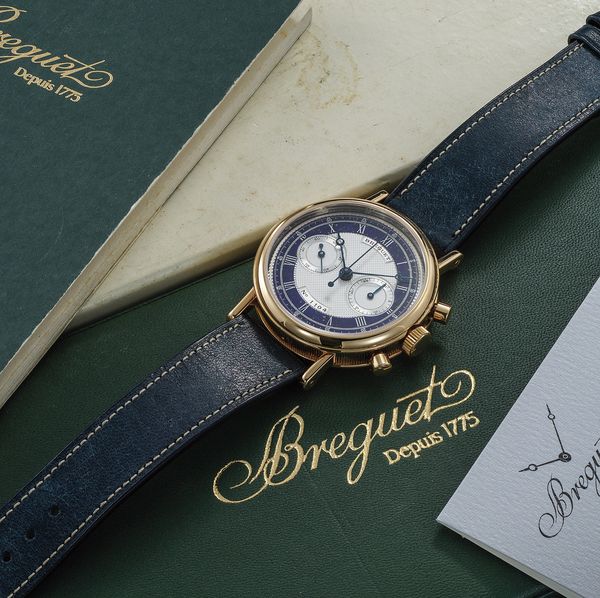
A circa 1995 Breguet Classique Chronograph ref. 3237 in 18k yellow gold with lapis lazuli hour and minute track that sold for CHF 146,050 during the Phillips Geneva Watch Auction: XVIII, in November 2023.
The ref. 3230’s dial is classic Breguet: an engine-turned guilloché center, contrasting sub-dials, and an outer numeral track — all complemented by elegant heat-blued "Breguet" hands. While vintage-inspired, its case features a slightly wider bezel than earlier Breguet designs, featuring a 36mm fluted-edge case, straight lugs, and a solid gold Clous de Paris dial. The ref. 3237 added an exhibition caseback. Both references are powered by the Lemania 2310.
Breguet Classique Tourbillon Ref. 3350 / Ref. 3357 / Ref. 3450 / Ref. 3355
In 1801, Abraham-Louis Breguet patented the tourbillon, a groundbreaking mechanism designed to counteract gravity’s effect on timekeeping. While the complication had remained largely unchanged for nearly two centuries, the references 3350 and 3357 brought a modern interpretation infused with Daniel Roth’s distinctive craftsmanship.
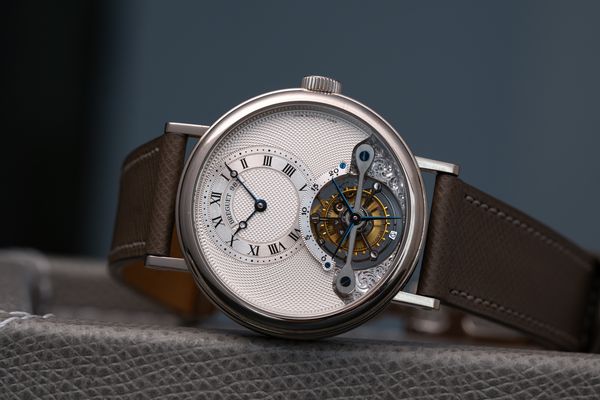
A Breguet Classique Tourbillon ref. 3357, part of Alfredo Paramico's collection. Image by Logan Baker.
Breguet introduced its first wrist-worn tourbillon in 1988 with the 36mm ref. 3350. It was only the second wristwatch tourbillon ever produced, following Audemars Piguet’s ref. 25643 ‘Sun-Ray.’ A standout feature of the 3350 was its trio of blued steel seconds hands, which swept across a 20-second scale in perfect thirds.
At its heart was the Lemania-based caliber 558, refined under Roth’s direction. When Investcorp acquired Breguet, they wisely preserved the model, introducing the subtly updated ref. 3357.
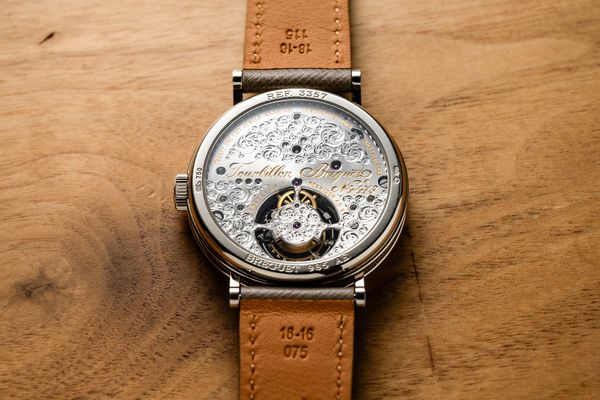
A Breguet Classique Tourbillon ref. 3357, part of Alfredo Paramico's collection. Image by James K./@waitlisted.
The ref. 3450 followed in the early 1990s, featuring a larger tourbillon aperture and an offset time display, with intricate hand-engraving adorning the movement. Then, in 1993, Breguet unveiled the ref. 3355, a skeletonized tourbillon closely related to the ref. 3350.
Breguet Classique Retrograde Perpetual Calendar Ref. 3787
Introduced in the late 1980s and produced until the late 1990s, the ref. 3787 stands as one of the final designs attributed to Daniel Roth before his departure from Breguet.
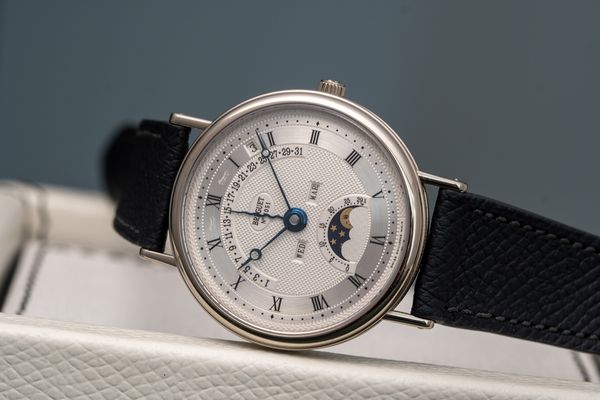
A Breguet Classique Retrograde Perpetual Calendar Ref. 3787, part of Alfredo Paramico's collection. Image by Logan Baker.
Housed in a 36mm case of 18K yellow or white gold, it features Breguet’s signature coin-edge design. The silvered dial is adorned with intricate hand-guilloché, including a Clous de Paris motif at its center, while black Roman numerals and heat-blued Breguet hands complete the elegant presentation.
The watch features a perpetual calendar with a retrograde date display, day and month windows, a moon-phase indicator at 6 o’clock, and a leap year indicator positioned between 1 and 2 o’clock. At its heart is the automatic caliber 591.
Breguet Classique Perpetual Calendar Equation of Time Ref. 3470 / Ref. 3477
The Breguet Classique Grande Complication collection pays tribute to the genius of Abraham-Louis Breguet, with references 3470 and 3477 showcasing some of horology’s most sophisticated complications — including the perpetual calendar and equation of time. This rare function seamlessly integrates a perpetual calendar with Breguet’s 1991 patent for the equation of time.
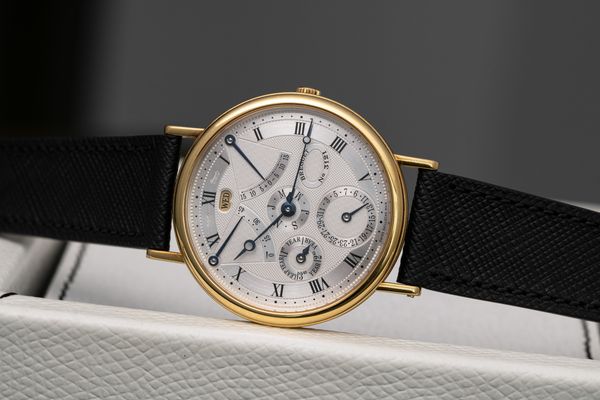
A Breguet Classique Perpetual Calendar Equation of Time ref. 3470, part of Alfredo Paramico's collection. Image by Logan Baker.
A fascinating complication, the equation of time displays the difference between mean solar time (civil time) and true solar time, which fluctuates due to the Earth’s elliptical orbit. Powering this intricate mechanism is the ultra-thin caliber 502, derived from the Frédéric Piguet caliber 70, all housed in a solid gold 36mm case.
The dial embodies Breguet’s signature aesthetics, featuring a hand-crafted engine-turned silvered surface, iconic heat-blued Breguet hands, and a satin-finished chapter ring adorned with the brand’s secret signature.
Breguet Classique 'Serpentine' Day and Date Ref. 3040
Produced throughout the 1990s, the Breguet Serpentine ref. 3040 is distinguished by its elegant complications and signature serpentine date hand, which lends the watch its distinctive nickname. The dial features a day and date display via apertures at the top, a moon-phase indicator at six o’clock, and an inner track for the serpentine hand to track the date.
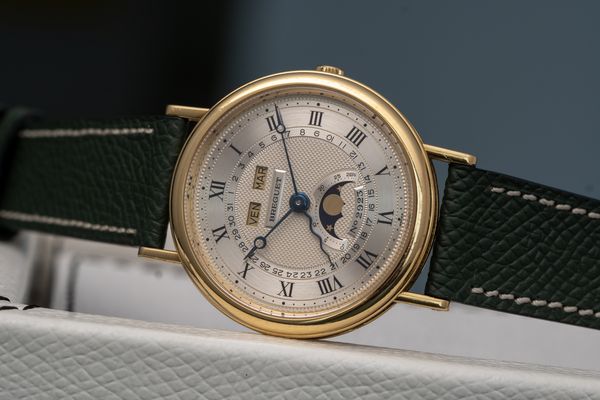
A Breguet Classique 'Serpentine' Day and Date ref. 3040, part of Alfredo Paramico's collection. Image by Logan Baker.
Available in yellow, white, and pink gold, the 36mm case showcases Breguet’s iconic coin-edge design. The finely crafted guilloché dial was offered in either silver or gold, with silvered satin-finished Roman numeral tracks enhancing its aesthetic. Heat-blued Breguet hands complete the look, with the whimsical serpentine date hand adding a playful yet sophisticated touch.
Breguet Classique Minute Repeater Ref. 3637
Launched in 1993, the 37mm Classique Minute Repeater ref. 3637 showcases Breguet's classic design elements, encased in a signature yellow gold case with a coin-edged caseband. Its guilloché dial features four distinct patterns: "Clou de Paris" on the main dial, "Damier croisé" on the 9 o’clock register, "Vieux paniers" on the upper half of the 3 o’clock register, and "Décor flammé" on the lower half.
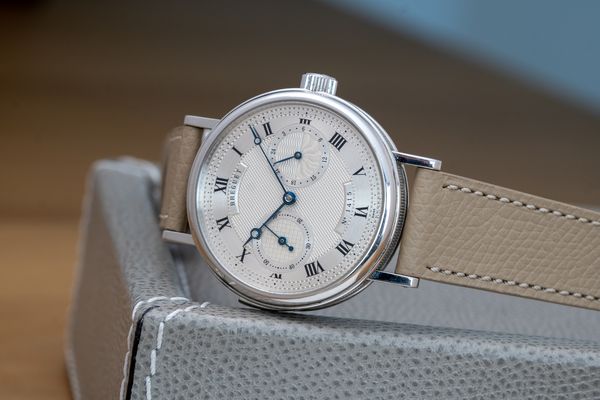
A Breguet Classique Minute Repeater ref. 3637, part of Alfredo Paramico's collection. Image by Logan Baker.
Powered by the caliber 567, based on a Lemania ebauche and inspired by traditional repeaters from the Vallée de Joux, it delivers a crisp, resonant chime.
Breguet Classique Calendrier Ref. 3330
The Breguet ref. 3330, known among collectors as the “Chinoise,” draws inspiration from pocket watches, particularly the Breguet 4579.
The 4579 was a complex timepiece, featuring the “montre à tact,” an invention by Abraham-Louis Breguet that allowed the wearer to tell time without removing the watch from a pocket. It also featured multiple dial indications, including a day display at 10 o’clock, moon-phase at 12, date at 2 o'clock, and hours and minutes below — elements that carried over to the 3330.
The 36mm ref. 3330 stands out for its refined aesthetics, clean dial arrangement, and meticulous finishing.
Breguet Classique Rattrapante Chronograph Ref. 3947
Only a few manufacturers have successfully adapted the Lemania 2310 to incorporate a rattrapante mechanism. While Patek Philippe’s iconic reference 5004 is widely celebrated, Breguet’s achievement with the ref. 3947 — later renamed ref. 5947 — remains relatively underappreciated.
Both Patek Philippe and Breguet faced the same challenge when modifying the 2310: rattrapante drag, which, if left unaddressed, would slow the chronograph upon split-second engagement. Patek resolved this with an octopus-shaped isolator mechanism, while Breguet took a different approach, thanks to the innovative work of Frédéric Piguet. Piguet introduced the first-ever isolator in a rattrapante movement with the caliber 1181, in 1988.
The ref. 3947 embodies classic Breguet design, featuring a Clous de Paris guilloché gold dial, a 38mm straight-lug case, blued steel hands, and individual numbering for each piece.
Breguet Classique Perpetual Calendar Chronograph Ref. 3617
Launched in the early 1990s, the Breguet Classique ref. 3617 seamlessly combines a perpetual calendar and chronograph in a refined, highly legible design.
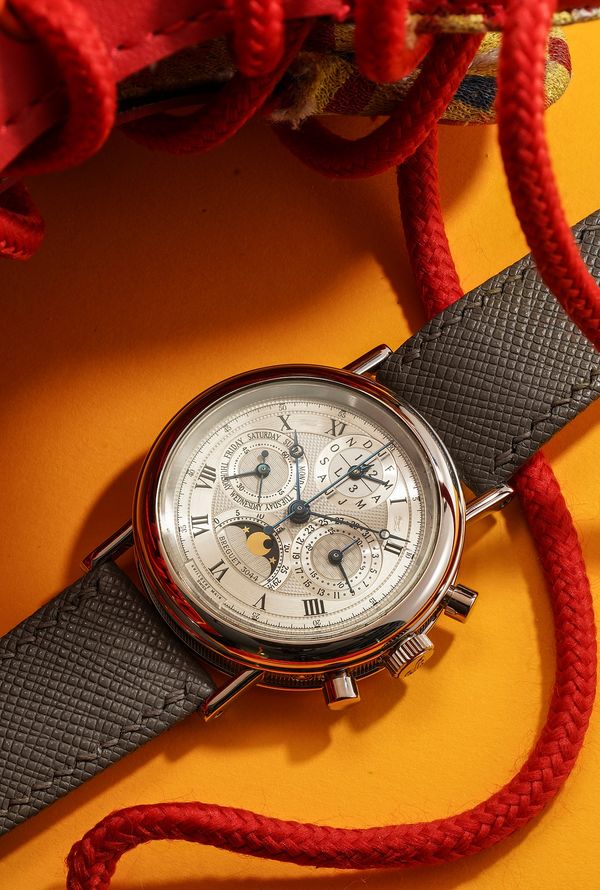
A circa 1990 Breguet Classique Perpetual Calendar Chronograph Ref. 3617 in platinum that sold for CHF 62,230 during Phillips RELOADED, in November 2024.
The dial is thoughtfully arranged, with the day of the week at 9 o’clock, the date at 3 o’clock, and the month and leap year indicators at 12 o’clock. True to Breguet’s craftsmanship, the dial is hand-guilloché with intricate patterns: Clous de Paris at the center, a basket weave for the chronograph subdials, and a wave motif for the moon-phase display.
Powering the watch is the same Lemania caliber 2310, a manual-wind chronograph movement also found in the iconic Patek Philippe reference 3970. It comes in a 40mm precious metal case.
The Fall of Chaumet and Roth’s Departure
Roth’s tenure at Breguet came to an end in 1988 following the financial collapse of the Chaumet brothers. Their overleveraged investments in diamonds led to bankruptcy, and Breguet was sold to Investcorp. With the management that had supported him no longer in place, Roth decided to leave and follow his own independent path.
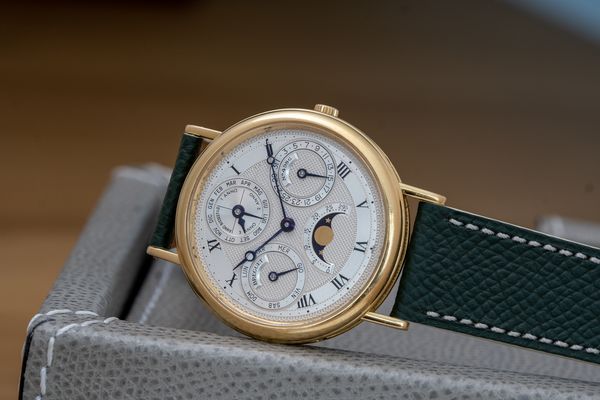
A Breguet Classique Perpetual Calendar ref. 3050 in 18k yellow gold, part of Alfredo Paramico's collection. Image by Logan Baker.
Daniel Roth’s impact on haute horlogerie extends far beyond his own brand.
His meticulous craftsmanship and the revival of Breguet’s legacy solidified his reputation as a master watchmaker. While his company was eventually acquired (and is currently being relaunched under the aegis of La Fabrique du Temps at LVMH), his work continues to inspire both independent watchmakers and major brands.
About Phillips In Association With Bacs & Russo
The team of specialists at PHILLIPS Watches is dedicated to an uncompromised approach to quality, transparency, and client service. Phillips in Association with Bacs & Russo holds the world record for the most successful watch auction, with its Geneva Watch Auction: XIV having realized $74.5 million in 2021. Over the course of 2021 and 2022, the company sold 100% of the watches offered, a first in the industry, resulting in the highest annual total in history across all the auction houses at $227 million.
About Logan Baker
Logan has spent the past decade reporting on every aspect of the watch business. He joined Phillips in Association with Bacs & Russo at the start of 2023 as the department's Senior Editorial Manager. He's based in Geneva, Switzerland.
Recommended Reading
The Fine Print: A Guide to the Universal Genève Polerouter
The Fine Print: An In-Depth Collectors’ Guide To The Patek Philippe Chronograph Ref. 5070