Article | Iwc History Neo Vintage Gunter Blumlein
In-Depth: A Review of IWC's Pioneering Neo-Vintage Influence
Our first live auctions of fall 2024 season, PHILLIPS RELOADED: The Rebirth of Mechanical Watchmaking, 1980-1999, and the Geneva Watch Auction: XX, take place on November 8, 9, and 10, at the Hotel President, at Quai Wilson 47, in central Geneva. The auctions include more than 195 of the world's fin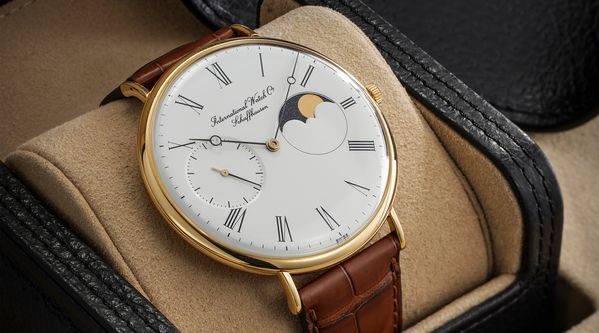
Our first live auctions of fall 2024 season, PHILLIPS RELOADED: The Rebirth of Mechanical Watchmaking, 1980-1999, and the Geneva Watch Auction: XX, take place on November 8, 9, and 10, at the Hotel President, at Quai Wilson 47, in central Geneva. The auctions include more than 195 of the world's finest watches – and though we are loath to boast, we truly think they're some of the best catalogs we've ever put together. We'll be highlighting a number of the most interesting lots and stories featured in the sales over the next month, including the watches highlighted in this article.
– By Logan Baker
In the mid-20th century, the Swiss watch industry stood tall, its reputation synonymous with timeless elegance and precision engineering. But by the early 1970s, storm clouds loomed on the horizon as the advent of inexpensive quartz technology, a seismic shift in currency exchange rates, and a surging gold price forced the industry into what would later be known as the "Quartz Revolution."
Few Swiss brands emerged unscathed, and for IWC Schaffhausen, it was a near-death experience that forced the company to reconsider everything about its identity, market, and future.
Guiding IWC through this turbulent time were pivotal figures like Mr. Hannes Pantli, a longtime IWC executive, and the legendary Günter Blümlein, whose vision and determination would rescue the brand from the brink of obsolescence and transform it into a powerhouse of modern watchmaking.
I spoke with Mr. Pantli earlier this year in an effort to better understand this period of dramatic change at IWC Schaffhausen.

Mr. Hannes Pantli, a former IWC executive, pictured in August 2024, at his home in Schaffhausen. Image by author.
For three decades following World War II, the Bretton-Woods Agreement maintained a stable, gold-standard-driven exchange rate between European currencies and the U.S. dollar. This stability underpinned the Swiss watch industry's steady growth; timepieces were affordable, and demand was strong.
But in 1973, Bretton-Woods unraveled, and with it went the fixed gold price that had allowed brands like IWC to confidently produce gold watches without fear of price volatility. Within six months, gold prices increased from approx CHF 5,000 up to briefly over CHF 40,000, and the U.S. dollar fell against the Swiss franc from 4.30 to less than SFR. 2, rendering IWC’s signature gold models prohibitively expensive, even for affluent buyers.
IWC responded to the crisis with resilience and innovation. Recognizing the European market's saturation and shifting economic landscape, Pantli set out to explore new, untapped territories. He went to the Middle East, to places like Dubai, Abu Dhabi, and Oman.
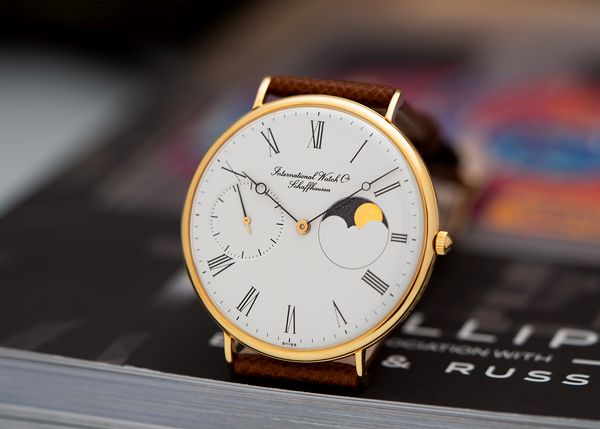
Lot 1: A 1991 IWC Schaffhausen Portofino ref. 5251, previously owned by Mr. Günter Blümlein, that's included in the upcoming Phillips RELOADED thematic auction. Estimate: CHF 8,000 - 16,000. Image by author.
Over the years, he made direct sales to the region’s elite, selling not just watches but entire collections, complete with rings, cufflinks, and fountain pens tailored to their tastes. This pivot sustained IWC through lean years, creating critical revenue streams outside of Europe.
Still, this was only a temporary fix; IWC needed a more sustainable strategy if it hoped to survive.
By the mid-1970s, the brand was on the verge of collapsing. At one point, the thought of downsizing to just 150 employees in 1978 crossed their minds. With Swiss investors skeptical of watchmaking’s future, IWC found salvation with the German company VDO, which recognized the potential in IWC’s craftsmanship and unique position. This set the stage for the arrival of the man who would help to redefine the brand.
On January 1, 1982, a German engineer named Günter Blümlein was appointed CEO of IWC, a non-watchmaker with an extraordinary grasp of engineering, production, and marketing. Blümlein brought a blend of technical expertise and an unerring vision for modern, accessible luxury – qualities that would become instrumental in reshaping IWC’s identity.
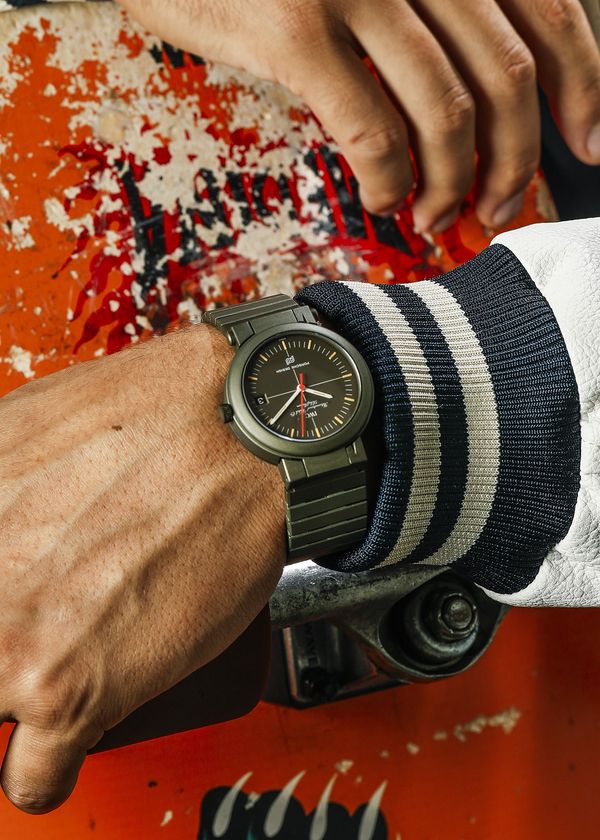
Lot 20: A circa 1981 IWC Schaffhausen Compass Watch, made in collaboration with Porsche Design, in green PVD. Estimate: CHF 3,000 - 5,000
Blümlein believed that survival lay not in battling the quartz giants but in returning to the fundamentals that made Swiss watchmaking special. He consistently implemented the VDO strategy initiated at the end of the 1970s to reinvigorate the European watch industry in France, Germany and Switzerland. His main focus was on the VDO companies that produced watches in the high-price segment, namely IWC and Jäger LeCoultre.
Under his leadership, IWC refocused on mechanical timepieces, reorienting itself as a brand for connoisseurs rather than mass-market consumers. Initiated in 1977 by Hannes Pantli he succesfully expanded the collaborations with Porsche Design, a partnership initiated shortly before his tenure, launching groundbreaking models like the Ocean 2000 a divers watch for military and civil use launched 1982, the first mechanical titanium chronograph launched in 1981 when the entire Swiss watch industry abandoned mechanical chronographs so saved the mechanical chronograph, the highly functional compass watch that was the first IWC Porsche Design launched ever 1978. These models struck a balance between innovation and tradition, appealing to a new generation.
IWC had one distinct advantage in those days: its mechanical expertise. Where others abandoned watchmaking training programs, the IWC Board ensured in the mid 1970s that IWC continued training young watchmakers ,and was for years the only watch brand that trained young watchmakers securing a lineage of skill and craftsmanship that would pay dividends in decades to come.
Among Blümlein’s notable initiatives was the revival of IWC’s mechanical watch lines, beginning with the Ingenieur. Originally designed by Gérald Genta in 1976, the jumbo Ingenieur (Ref. 1832) was ahead of its time – a statement piece for a clientele not yet ready to embrace bold, luxury sport watches. The initiative was introduced by Alexandre Ott, a member of the IWC Board and PR expert. Following that vision Hannes Pantli launched the so called SL Collection which included iconic stainless steel watches like the Golf Club, Polo Club or the Da Vinci SL. Analyzing the steps already taking by his fellow IWC managers Blümlein saw potential where others saw failure, and he began to reshape IWC’s catalog to reflect the brand’s engineering prowess and daring design ethos.
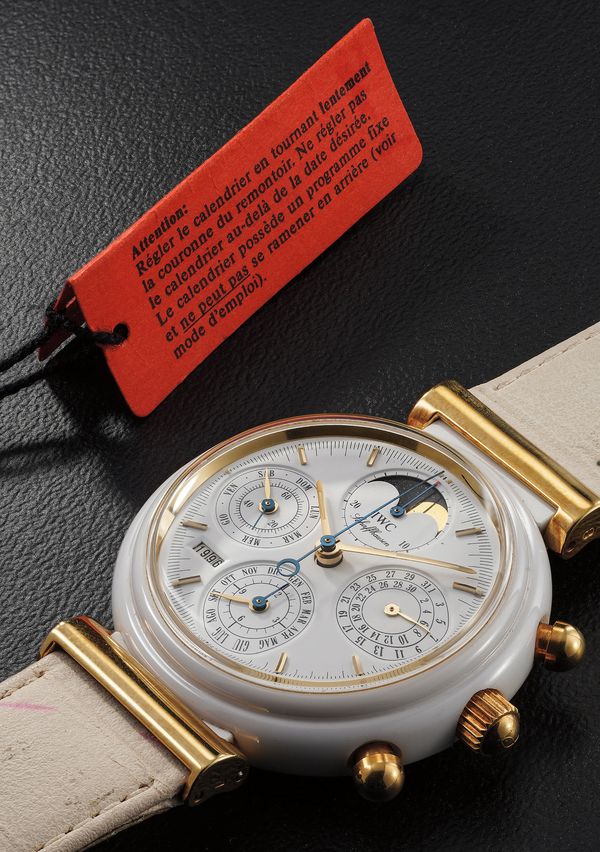
Lot 29: A circa 1990 IWC Schaffhausen Da Vinci Perpetual Calendar Chronograph in white ceramic. Estimate: CHF 8,000 - 16,000
The Da Vinci collection was another hallmark of Blümlein’s leadership. With the encouragement of famed watchmaker Kurt Klaus, IWC released a perpetual calendar model in 1985 with a 18 ct golden case. In 1986 for the first time in watchmaking history a case made of Zirconium dioxide was introduced with the Da Vinci. Though initially met with tepid reception, it later gained a devoted following, with Klaus’ ingenious perpetual calendar module transforming it into a quintessential neo-vintage timepiece. This module, built to sit atop a Valjoux 7750 movement, simplified one of horology’s most complex mechanisms, making high complications accessible to a broader audience – a feat rarely attempted, let alone accomplished.
The Reference 5251 appeared in IWC catalogs as early as 1981. The interesting thing about the watch is not only the unusual position of the moon phase, but also the fact that Hannes Pantli aimed this watch for watch connoisseurs who loved classic mechanical movements. Kurt Klaus created a wristwatch using the historic 9251 pocket watch caliber. The result was incredibly avant-garde for the time with a 46mm timepiece featuring a definitive vintage vibe but unheard of proportions and an elegant and subtle dial layout. The watch was designed as a wristwatch for these watch collectors. Therefore it was the first "wrist pocket watch". In 1984, the watch was then chosen as the "inspiration" and "leader model" for the Portofino family that was created by Hannes Pantli. We have an example included in the Phillips RELOADED thematic auction that was previously owned by Mr. Blümlein himself.
During this period, IWC was a hive of innovation. Kurt Klaus’ perpetual calendar module had democratized a feature once reserved for elite watchmakers, and soon after, watchmakers like Richard Habring, Matthias Oppold, and Kurt Klaus developed a split-seconds chronograph (or “doppelchronograph”) that could also be incorporated into the reliable Valjoux 7750. This pioneering move made another rare complication attainable and cemented IWC’s reputation as a leader in engineering-driven watchmaking.
Not content with these technical achievements, Blümlein pushed IWC to experiment further. For its 125th anniversary in 1993 Günter Blümlein asked the team for typical watches representing the history of IWC. Initiated by Hannes Pantli, IWC released the Portugieser Jubilee (Ref. 5441), a celebration of its heritage with an eye toward the future. Inspired by the original Portugieser watches of the late 1930s, the 42mm time-only Jubilee would become the cornerstone of the Portugieser line, setting the stage for the oversized watch trend that would come to dominate the following decade.
Being fascinated by watchmaking, Günter Blümlein pushed his team to go for the boundaries of mechanical watchmaking: the result was the Ref. 1868 “Il Destriero Scafusia” – back then the most complicated wristwatch.
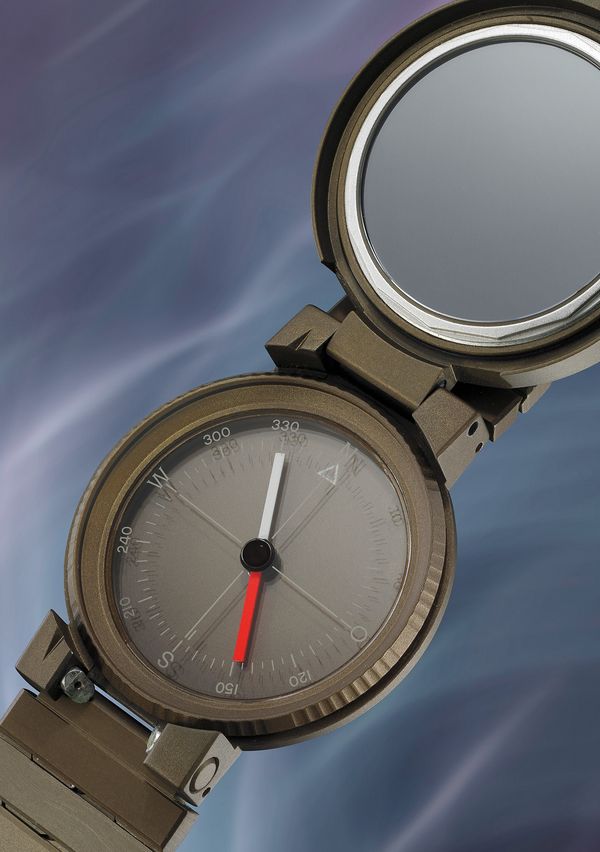
Lot 20: A circa 1981 IWC Schaffhausen Compass Watch, made in collaboration with Porsche Design, in green PVD. Estimate: CHF 3,000 - 5,000
IWC’s neo-vintage era – from the 1970s through the 1990s – is a testament to the brand’s resilience, adaptability, and innovation. With figures like Pantli and Klaus at the helm, and Blümlein’s strategic foresight guiding the way, IWC redefined what it meant to be a luxury watchmaker in a rapidly changing world. From pioneering the use of titanium with Porsche Design to championing complications once deemed inaccessible, IWC’s journey during these years has left a lasting imprint on Swiss watchmaking.
Today, these neo-vintage pieces are highly sought after by collectors, embodying an era of mechanical creativity and bold vision.
IWC didn’t merely survive the Quartz Revolution; it transformed into a brand that contemporary watch collectors adore, helping bring the crafstmanship of traditional Swiss watchmaking into the modern age. As neo-vintage models from this period become increasingly scarce, they serve as a reminder of IWC’s indomitable spirit, and of the visionary leadership that guided it from the brink of disaster to the pinnacle of horological innovation.
You can learn more, place a bid, and view the entire Phillips Reloaded catalog right here.
About Phillips In Association With Bacs & Russo
The team of specialists at PHILLIPS Watches is dedicated to an uncompromised approach to quality, transparency, and client service. Phillips in Association with Bacs & Russo holds the world record for the most successful watch auction, with its Geneva Watch Auction: XIV having realized $74.5 million in 2021. Over the course of 2021 and 2022, the company sold 100% of the watches offered, a first in the industry, resulting in the highest annual total in history across all the auction houses at $227 million.
Recommended Reading
Up-and-Coming Independent Watchmakers To Know in the Geneva Watch Auction: XX
Specialists' Picks: The Geneva Watch Auction: XX
A Round-Up of 14 Manual-Wind Rolex Daytonas in the Geneva Watch Auction: XX