Article | Manual Wind Rolex Daytonas Phillips November 2024
A Round-Up of 14 Manual-Wind Rolex Daytonas in the Geneva Watch Auction: XX
The allure of the manual-wind Rolex Daytona chronograph lies in its remarkable combination of scarcity, historical significance, and timeless design.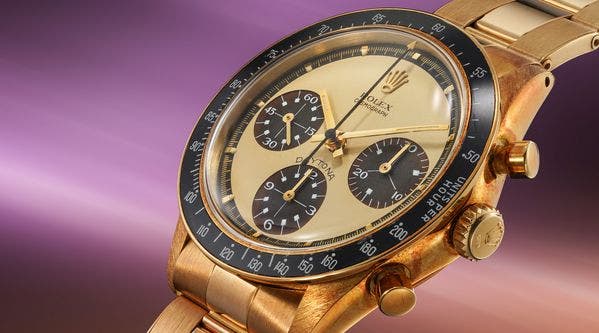
Our first live auctions of fall 2024 season, PHILLIPS RELOADED: The Rebirth of Mechanical Watchmaking, 1980-1999, and the Geneva Watch Auction: XX, take place on November 8, 9, and 10, at the Hotel President, at Quai Wilson 47, in central Geneva. The auctions include more than 195 of the world's finest watches – and though we are loath to boast, we truly think they're some of the best catalogs we've ever put together. We'll be highlighting a number of the most interesting lots and stories featured in the sales over the next month, including the watches highlighted in this article.
– By Logan Baker
First introduced in 1963, the early manual-wind Daytonas were powered by manual-wind Valjoux calibers, a stark contrast to the automatic movements that dominate modern watchmaking. The manual-wind Daytona, distinguisged by various references including the 6239, 6241, 6263, and 6265, remained in production until 1988, marking the end of an era when Rolex pivoted to the Zenith El Primero-based automatic caliber in the now-iconic reference 16520.
This shift from manual to automatic winding represents a watershed moment in Rolex's storied history, making the manual-wind Daytona not only a symbol of craftsmanship but a time capsule from an era when mechanical mastery required interaction between the wearer and the timepiece.
Collectors are drawn to these manually wound Daytonas for reasons that extend far beyond their scarcity. The tactile experience of winding the watch daily fosters a deeper connection between the owner and the object, enhancing the emotional appeal. With its tri-compax sub-dial layout, tachymeter scale, and distinctive pump or screw-down pushers, the Daytona's design has proven to be both utilitarian and iconic.
The design purity of these early Daytonas, especially in models like the coveted "Paul Newman" dial, with its art-deco-inspired font and contrasting colors, further elevates their status among horological enthusiasts.
What truly cements the manual-wind Daytona’s status as a grail watch is its profound intersection of heritage, scarcity, and mythology. Production numbers were comparatively low, as the Daytona was not an immediate commercial success upon release. It wasn’t until the late 1980s and 1990s that these timepieces gained significant traction, propelled in no small part by their association with celebrities like Paul Newman, whose personal Daytona set records at auction, fetching over $17 million at a Phillips auction in 2017.
In today’s collector market, vintage manual-wind Daytonas stand at the pinnacle of horological desirability, representing the sweet spot between rarity, aesthetic appeal, and historical significance. These watches have become touchstones in the history of both Rolex and chronograph design, ensuring their place as icons in the realm of collectible timepieces. Whether it's the romanticism of winding the movement or the thrill of owning a piece of horological history, the manual-wind Daytona's charm endures, firmly cementing its position as one of the most sought-after watches in the world.
The Phillips Geneva Watch Auction: XX, taking place on November 9 and 10, 2024, includes 14 examples of incredible manual-wind Rolex Daytonas worth knowing about – here's the complete list with lot descriptions for your browsing pleasure.
Lot 114
With an impressive provenance having been sold at the historical Rolex Daytona Lesson One auction, this tri-color reference 6262 with "Paul Newman" dial is preserved in very impressive condition. Reference 6262, along with its acrylic bezel sibling reference 6264, was produced for a few years only during the early 1970s. They were the last Daytona references to be fitted with pump pushers and were fitted with an upgraded caliber 727.
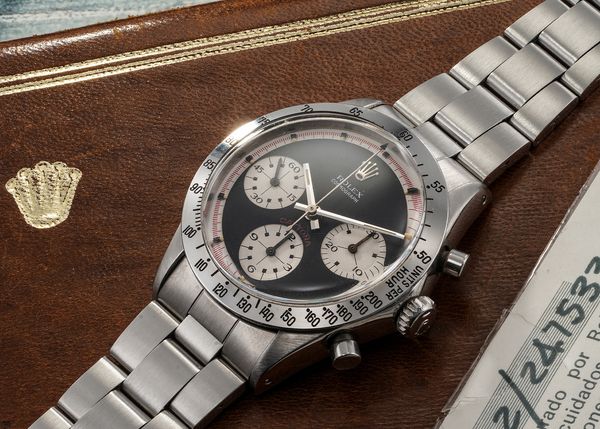
Displaying a very rare variant of the “Paul Newman” dial, this tri-color reference 6262 is fitted with the so-called “Musketeer” variation. Usually, Paul Newman dials have a concentric circle pattern (azurage) on the flat subdials. However, on Musketeer dials the azurage covers only two-third of the surface; the remaining outer sector not only is smooth, but it is also sloped: a completely different subdial design than the standard one. The present dial is preserved in outstanding condition with round luminous dots that are intact and have aged with light patina. The outer track has barely any signs of ageing as well which is very rare for this dial variant. Furthermore, the case condition is extremely noteworthy. Featuring sharp edges and satin finishes on the top of the lugs, its state of preservation is truly remarkable. The case and reference numbers between the lugs are crisp.
As an even nicer touch, the watch retains its presentation box and guarantee, confirming the present timepiece was sold in Mexico. The Rolex box itself is a collectible item as it was made in Mexico, and is stamped "Marroquineria Fina S.A." with a brown antelope exterior.
Lot 115
While any vintage Rolex Cosmograph Daytona with a “Paul Newman” dial can be considered a trophy watch for a collector, when one is found bearing a “Paul Newman Lemon” dial, it becomes an ultimate trophy due to its utmost rarity and attractiveness.
To be considered a “Lemon” Paul Newman, the main dial must have a matte-finished, grené texture with an almost powdery effect with a more cream yellow color than a metallic gold or champagne. Compared with the dial on the champagne Paul Newman Daytonas, the “Lemon” dials feature an intense and creamy shade of yellow that sets them apart. Furthermore, instead of the more commonly-found champagne text within the subsidiary registers, they have vivid, white-printed Art Deco numerals – a coveted characteristic immediately spotted by those who know. Overall, the combination of the creamy yellow dial and stark, white sub-dial numerals is quite striking – especially when paired with a black outer track.
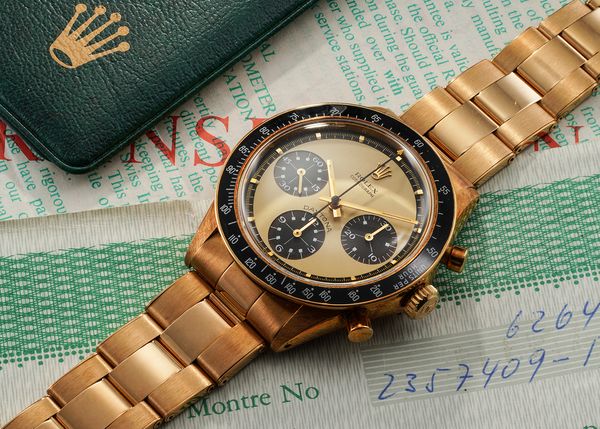
The present timepiece is possibly one of the best preserved reference 6264s with “Lemon Paul Newman” dial to come to the market. Not only is the case incredibly well preserved, with a very thick case displaying sharp facets and edges throughout, the dial is a sight to behold. The dial is striking not just thanks to its excellent state of preservation but especially thanks to the fact that the subdials are turning to a dark brown and the outer track has turned to a seductive light brown giving the watch incredible charisma. The luminous dots remain round, intact and have aged with warm patina, perfectly complementing the striking dial.
Making the present timepiece even more desirable is the presence of its original guarantee, stating the watch was sold on February 18, 1974, and stamped Brunati - a retailer at Zurich that does not exist anymore today. The present watch is thus one of probably less than a handful of examples that still retain original guarantee, making it even more collectible than its peers.
Most of the existing 18K yellow gold “Paul Newman” Daytonas with “Lemon” dial fall within a known serial range, meaning that they were produced within a special batch. To date, the list of Reference 6264 Paul Newmans with Lemon dials include the following serial numbers (please note this is not an exhaustive list):
2'357'384
2'357'385
2’357’409 (the present watch)
2'357'419
2'357'421
2’357’442
2'357'452
2’357’455
2'357'468
2’357’479
Given the fact that the Cosmograph Daytona was originally a commercially produced “tool watch” made for everyday use, the fact that less than a dozen of examples are known with this dial speaks volumes about the rarity of the model.
A grail among grails, the present reference 6264 “Paul Newman Lemon” with tropical dial offers a perfect storm of highly appealing traits which propels the present timepiece to the pinnacle of desirability for the connoisseur of highly important and attractive timepieces. It presents a rare opportunity to acquire not only a trophy piece, but one of the very best examples in that category.
Lot 118
An extremely early version of the reference 6240, the present watch is a precursor to what we would become the extremely well-known Oyster Cosmograph. Reference 6240 is one of the most historical Daytona models. At the time of its launch in 1965, it was the first Daytona wristwatch to be fitted with water resistant screw down pushers. As such, the dials were now available with the script "Oyster" to reflect the model's new technical ability. Manufactured exclusively in stainless steel, the reference featured a bezel with black acrylic insert rather than the metal bezel found on its contemporary pump-pusher brethren ref. 6239. A 'foundational' watch for all intents and purposes, the model remained in production for only 4 years before evolving into the reference 6263 (and 6265).
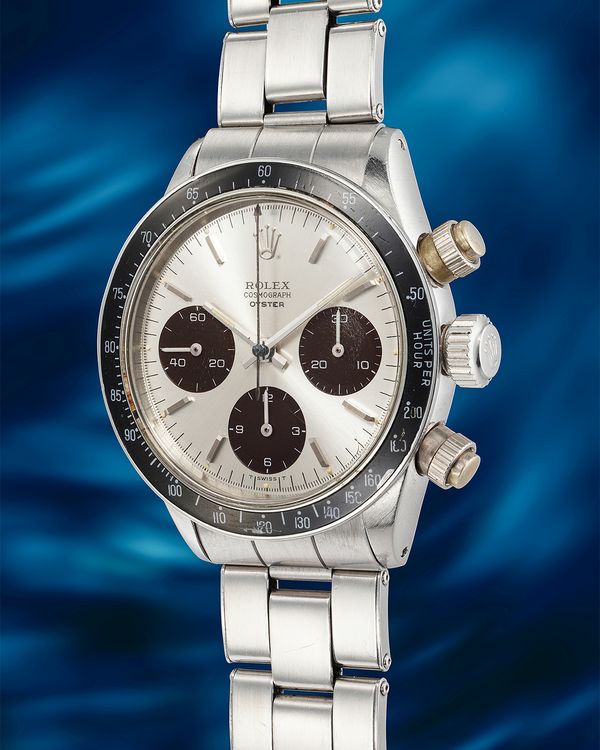
As such, the present watch is a most horologically interesting model as the dial displays the text “Rolex Cosmograph Oyster”, acknowledging the new and innovative water resistant screw-down pushers. This concept is forerunner to the better-known “Oyster Sotto Paul Newman” as both variants feature the word “Oyster” below “Rolex Cosmograph” turning the typical dial layout upside down. Exceedingly rare, research shows that a handful of these watches are known. As a nice touch, the subsidiary registers are now slowly turning a dark espresso "tropical" tone, giving it a charming appearance.
Other particulars are the correct first generation pushers with the brass peeking through, which have aged with patina. This Cosmograph furthermore retains its MK 1 bezel and original twinlock 700 series winding crown, characterized by the large Rolex coronet. Most importantly, the consignor of the watch had acquired this piece through the original owner, which is important for scholarship as it shows that these dials were available on the commercial market.
Lot 130
Reference 6263 can be arguably considered the most iconic of the manually-wound Daytona models. Launched in the early 1970s and in production until 1987, it is defined by the screw pushers and the bezel with black acrylic insert.
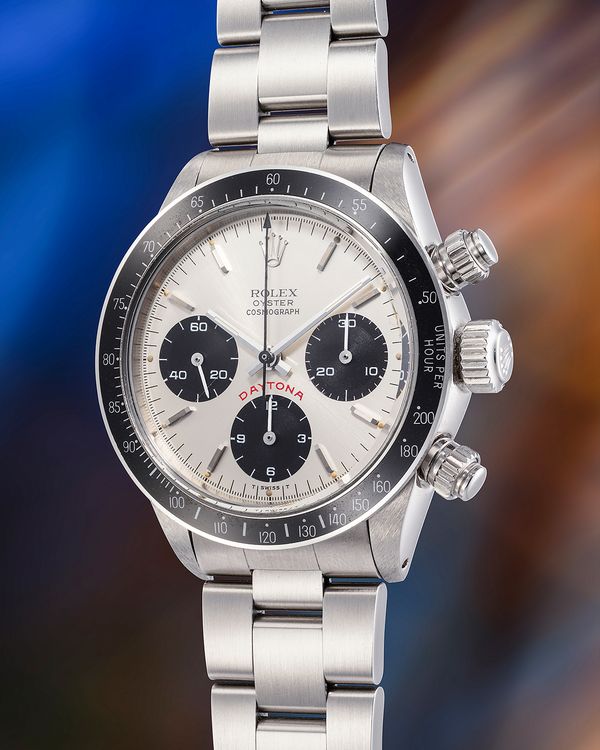
The present specimen is defined by its “Big Red” dial. The final evolution of the manual Daytona dial, it is found on the last specimen of reference 6263 (and its metal-bezel brethren 6265) and is characterized by a very prominent Daytona designation above the six o’clock subsidiary dial in bright red ink.
The present specimen is blessed with a beautiful dial and the condition of the case perfectly matches that of the face: extremely sharp and retaining good proportions throughout.
Lot 132
Reference 6239 was the very first model of the iconic Cosmograph Daytona family, and was produced from approximately 1963 until 1976. Available in stainless steel, 14K and 18K gold, reference 6239 was the firm’s first chronograph with the tachymeter scale engraved on the bezel: the trademark of what would become one of the most successful, desired and recognisable line of timepieces ever created. The model was originally announced as the "Le Mans". Yet, it was eventually named the "Daytona” after the 24 Hours of Daytona automobile race.
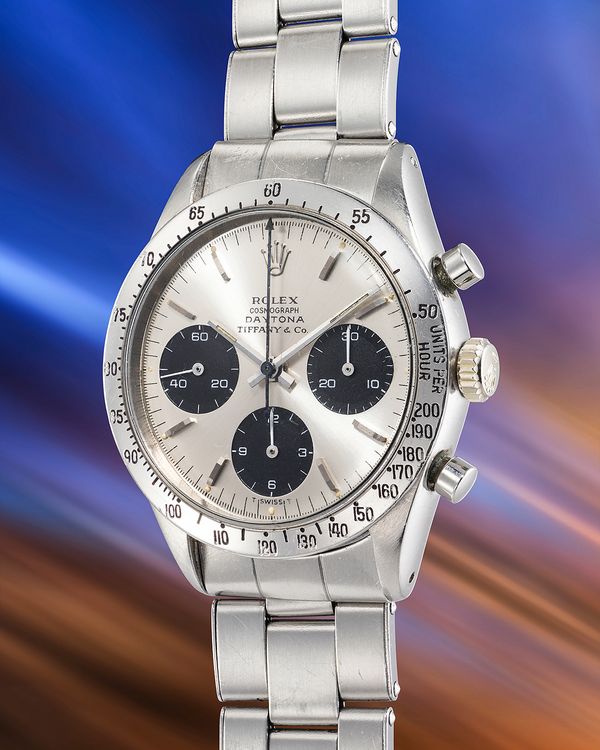
Having already appeared once at auction and surpassing its original estimate by almost three times, the present watch is an impressive specimen. It not only displays a "Big Daytona" script below "Cosmograph Daytona", it also bears the signature of storied retailer "Tiffany & Co." Few retailers have had a relationship with Rolex like Tiffany & Co. has. The jeweler has proudly emblazoned its logo on a variety of Rolex wristwatches, ranging from the GMT-Master to the Cosmograph Daytona. Notably it features a larger and longer "Daytona" text below "Rolex Cosmograph". This signature, coupled with the Tiffany & Co. script, makes for the pleasing effect of the text being in the shape of the pyramid.
Presented in impressive and original condition, this watch boasts thick, full lugs and crisp numbers between the lugs. The luminous dots on the dial are also round, intact and display warm patina. This watch also features the "ROW" stamp on the movement, indicating that it was made for the American market - an attribute that is correct for this dial configuration. As an interesting note, research shows that the original owner was a Japanese gentleman, who purchased this timepiece while on his honeymoon. Most notably, there is a code engraved underneath one lug, which is most probably an internal Tiffany & Co. code, similar examples of which can also be found on other Tiffany & Co. signed Rolex wristwatches.
Lot 133
Superbly iconic and highly sought-after, Rolex Cosmograph Daytona “Paul Newman” dials are one of the most well-designed chronograph dials of the past century. They are also one of the scarcest horological resources on the planet. A quintessential “Paul Newman” Daytona, this reference 6239 perfectly embodies the Hollywood legend. It was during the filming of “Winning” that Paul Newman fell in love with racing. His wife, Joanne Woodward, consequently gifted this exact Daytona variant to her husband, inscribed with phrase “DRIVE CAREFULLY ME”. It is thanks to this particular design that exotic-dialed Cosmographs are now synonymous with the philanthropic icon.
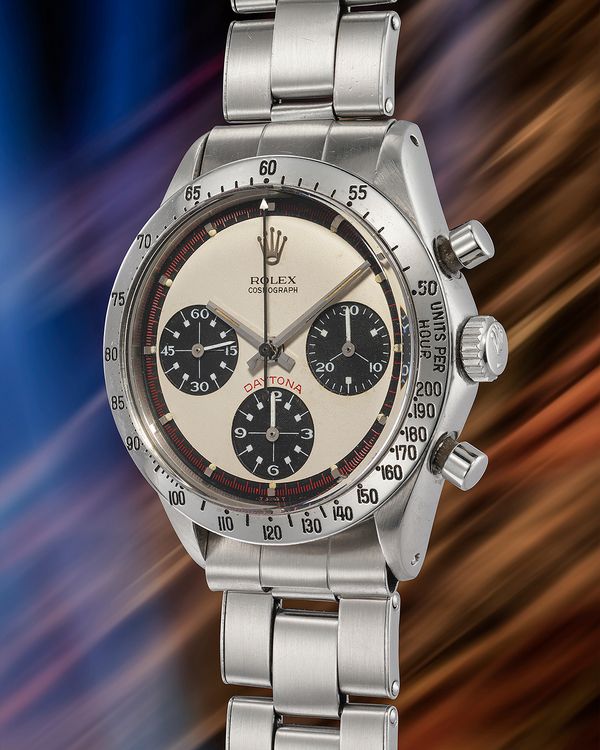
The dial is remarkable and impressive. While almost sixty years in age, it is preserved in immaculate condition, showing how exotic dials originally left the Rolex factory. The ivory portion of the dial is preserved in excellent condition, and the concentric circles within the contrasting subsidiary registers are defined and delicate. Of particular note is the superb case. Showcasing full lugs, the satin finishes are crisp. The lug-holes remain a considerable distance from the edge of the case. Sparking memories of Paul Newman’s “Paul Newman”, this model is one of the most iconic Daytonas ever produced, representing the high-octane world of auto racing, speed and glamour.
The first Cosmograph Daytona, known as the reference 6239, marked Rolex's entry into the chronograph realm when it debuted in 1963, remaining in production until approximately 1976. Offered in stainless steel and 18K yellow gold, this model boasted a groundbreaking feature: the tachymeter scale engraved on its bezel, a first for the brand. Originally marketed as the "Le Mans," it gained its enduring moniker, the "Daytona," after Rolex became a sponsor of the 24 Hours of Daytona race.
Lot 163
Reference 6265 was introduced to the market in 1969, and ceased production in 1987. While the reference was mainly cased in stainless steel, limited amounts were also cased in 18K or 14K yellow gold. As the Daytona was first and foremost a tool watch for professional drivers, the public mostly looked for the light and resistant steel version; the heavy, outlandish and more delicate gold variation made little sense at the time. Thus, notwithstanding its near 2 decades of production run, it is estimated that no more than 2000 examples were cased in gold.
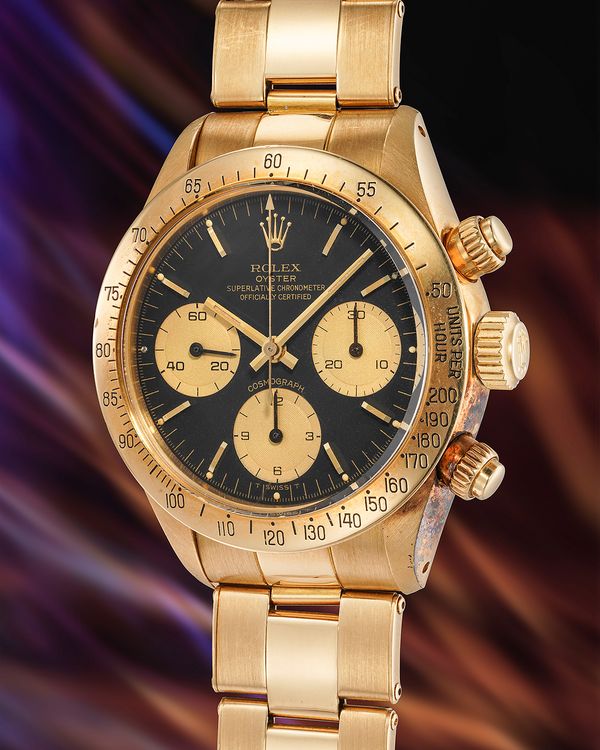
One of the peculiarities of the new calibre 727 (found on ref. 6262, 6263, 6264 and 6265) is that it had chronometer capabilities. While, however, steel Daytonas were not certified by COSC, the gold versions, doubtlessly due to their higher prestige, were indeed sent to COSC for certification. Thus, with some very early exceptions, they bear already the script now ubiquitous on all Daytonas: Rolex / Oyster / Superlative Chronometer / Officially Certified. The present watch is fitted with a superlatively well-preserved black dial, providing beautiful contrast against the yellow gold case.
Lot 165
The first Cosmograph Daytona, known as the reference 6239, marked Rolex's entry into the chronograph realm when it debuted in 1963, remaining in production until approximately 1976. Offered in stainless steel and 18K yellow gold, this model boasted a groundbreaking feature: the tachymeter scale engraved on its bezel, a first for the brand. Originally marketed as the "Le Mans," it gained its enduring moniker, the "Daytona," after Rolex became a sponsor of the 24 Hours of Daytona race. The present watch is a classic example of the reference 6239 and stamped "Daytona" above the subsidiary register at 6 o'clock.
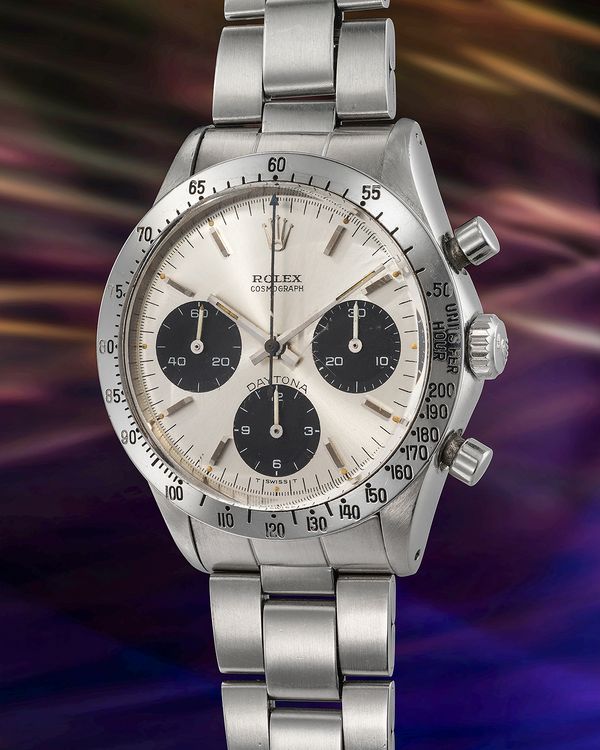
Yet, a small detail on the inside caseback, which may not be obvious to the casual observer, sets this watch apart from its peers. One would usually expect to find "6239" or even possibly "6238" punched on the inside case back of this watch. Yet, this one bears the reference 6242. A cursory search of this reference number hardly yields results. Yet, investigative research shows that these four digits are stamped on the inside case back of the one and only, reference 6262 Yacht-Master prototype.
One can thus conclude, that Rolex had originally intended to introduce reference 6242 in their line of production, only to scrap the project later. It is even possible that the reference was intended to be made for the mythical Yacht-Master line. Today, only a handful of these "prototype" watches are known on the market, one having resided in the collection of Eric Clapton. Having already produced the case backs, Rolex decided to use the existing ones in their regular line of production. The present watch was thus fortuitously fitted with a 6242 case back.
Lot 185
Daytona chronographs with the coveted “Paul Newman” dials are rare, but the reference 6241 is amongst the rarest. In production for only 3 short years from approximately 1966 to 1969, we estimate that roughly 2000 pieces were produced in stainless steel, with around 1/3 of produced examples cased in yellow gold. The present watch is part of the mega-rare 14k yellow gold models mostly destined for the American market. Many of them were manufactured in one batch, fitted with either black or champagne exotic or non-exotic dials.
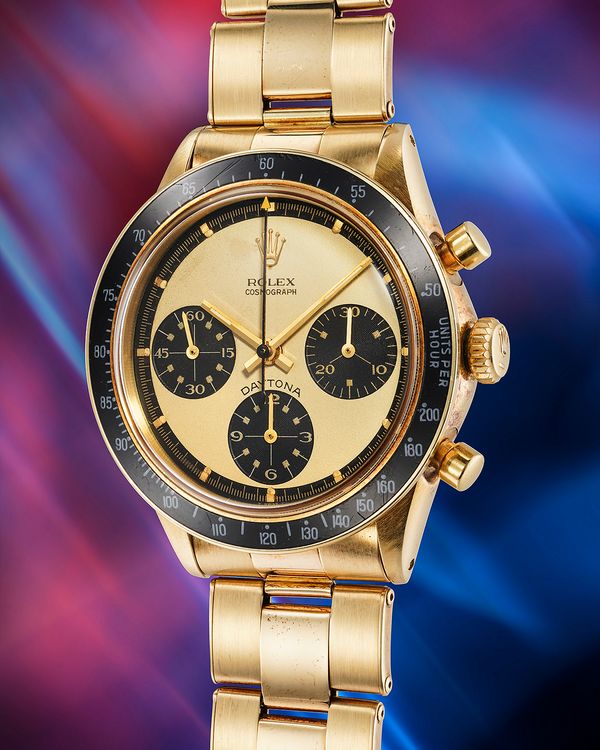
This reference differed from other Daytona models with a new case design that introduced a small protrusion under the crown, which allowed easier winding of the Valjoux caliber 722. It also featured a new bezel composed of a metal support fitted with a black acrylic insert featuring a tachymeter scale printed in white. The “T SWISS T” designation at the lower edge of the dial by 6 o’clock indicates the use of tritium for the hands and luminous hour markers. It is also from this reference on that the word ‘Daytona’ would be officially printed on the dial.
This bi-color "Paul Newman" dial is correct for a Cosmograph bearing a serial number of 2.112 million, which is completely within a batch of other known examples with this dial configuration. Other known examples of the reference 6241 with the same dial configuration include:
1) 2'112'911
2) 2'112'936
3) 2'112'949
4) 2'112'960
The warmth of the 14k yellow gold case perfectly matches the gorgeous cream-colored grené dial, framed and set apart by the black acrylic bezel – the true protagonist of the watch. Displaying crisp graphics and eye-catching details, the dial is presented in a noteworthy state of preservation. The luminous dots are all intact and round, making for an extraordinarily good-looking dial. The case is equally impressive, as the lug holes have a distance between the edge of the case, and two crisp hallmarks beneath the lugs are present.
Such original, and beautifully well-preserved Paul Newmans hardly ever appear on the market, marking an extraordinarily rare opportunity to acquire a trophy exotic-dialed Cosmograph Daytona. Given the amount of interest which has been circling the Daytona model over the past years, it is not a stretch to say that the discovery of another such piece with a dial as appealing as this one is a highly improbable occurrence.
Lot 187
Every legend has a beginning, and the present example represents the beginning of what is unarguably one of the most legendary and well-known watch models of all times: the Rolex Cosmograph Daytona, reference 6239. The present specimen, however, not only represents the reference in one of its earliest incarnations, but also features a detail which makes it potentially unique and is a very important Daytona that rewrites the history books: a “Double T Swiss T” dial.
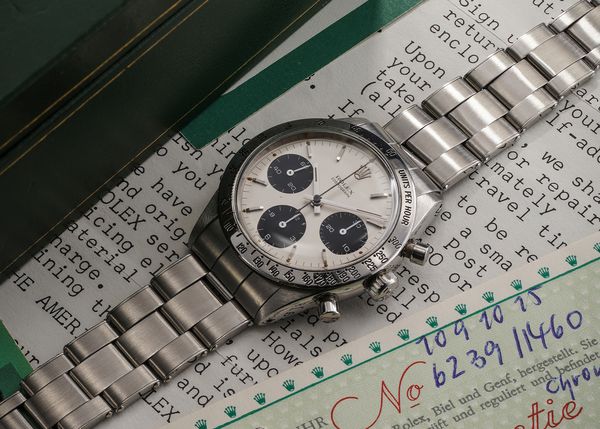
Lot 187: A Circa 1963 Rolex Cosmograph Daytona 'Double T Swiss T' Ref. 6239 in stainless steel. Estimate: CHF 100,000 - 200,000
While the "Double Swiss" dial, is well known (Double Swiss dials are identified by having two "Swiss" designations at 6 o'clock, one visible and the other hidden by the case), the present specimen however features the a double "T Swiss T designation" (indicating the adoption of tritium rather than radium). Introduced around 1963, the year of production of this watch, it is virtually unheard of to find a dial with this later designation repeated twice. It seems that for a short period, Rolex changed the placement of the "Swiss" designation, only to have to alter it to accommodate the introduction of tritium luminous material and the introduction of the "T". Beyond its unicity, the quality of the dial as well is stunning, featuring a virtually unmarred grené finish with black serifed graphics which grants the watch an incredible vintage appearance.
The bezel as well is a very early MKII specimen, featuring a dot for the 275 mark, and also the movement impresses the connoisseur with its caliber 72B, the earliest calibre employed in the Daytona, only found in very early specimens and soon abandoned for cal 722, 722-1 and later 727.
A final detail for the most completist of the collectors is not only the presence of the original Warranty, but also the papers (quote, report and Service Warranty) from a 1968 overhaul. Beyond the historical pleasure of having such documents, their presence underline the utmost care the original owner had for this watch, preserving for decades every piece of documentation regarding it - an unusual occurrence today, imagine back in the 1960s when watch collecting was nonexistant.
Lot 190
Undeniably the Rolex Daytona is not only the world’s most famed sports chronograph but also one of the most coveted. The fact that the present reference 6265 bears the prestigious Tiffany & Co. signatures adds a new level of attractivity and desirability. Some of the rarest, most historically important and valuable Rolex wristwatches have been sold through the American retailer Tiffany & Co. Few retailers have had a relationship with Rolex like Tiffany & Co. has. The jeweler has proudly emblazoned its logo on a variety of Rolex wristwatches, ranging from the GMT-Master to the Cosmograph Daytona.
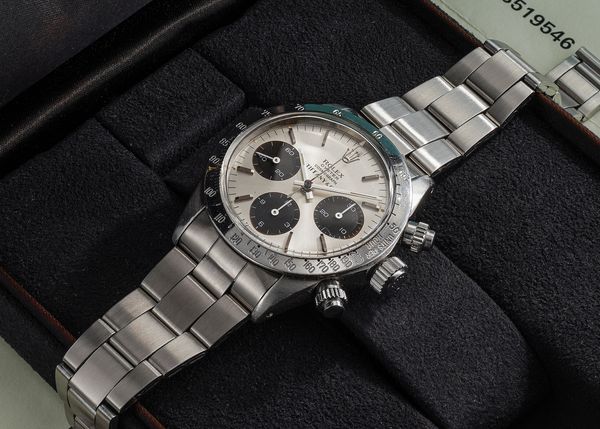
The present piece is not only one of the very rare Cosmographs blessed with a Tiffany & Co. signature, but also boasts an incredibly charismatic dial. The subsidiary counters have tropicalized to a subtle espresso tonality giving the watch incredible charisma. Pending on the light, it turns from a rich brown to almost chestnut tone, exuding much charm. Most notably, there is a code engraved underneath one lug, which is most probably an internal Tiffany & Co. code, similar examples of which can also be found on other Tiffany & Co. signed Rolex wristwatches.
Adding to its ultimate desirability is the wonderful condition of this timepiece. The lugs are thick, the bevels crisp and the combination of brushed and polished surfaces intact. It is also accompanied by Rolex service documents and a Tiffany & Co. presentation box.
Lot 196
Reference 6240 is one of the most historical Daytona models. At the time of its launch in 1965, it was the first Daytona wristwatch to be fitted with water resistant screw down pushers. As such, the dials were now available with the script "Oyster" to reflect the model's new technical ability. Manufactured exclusively in stainless steel, the reference featured a bezel with black acrylic insert rather than the metal bezel found on its contemporary pump-pusher brethren ref. 6239. A 'foundational' watch for all intents and purposes, the model remained in production for only 4 years before evolving into the reference 6263 (and 6265).
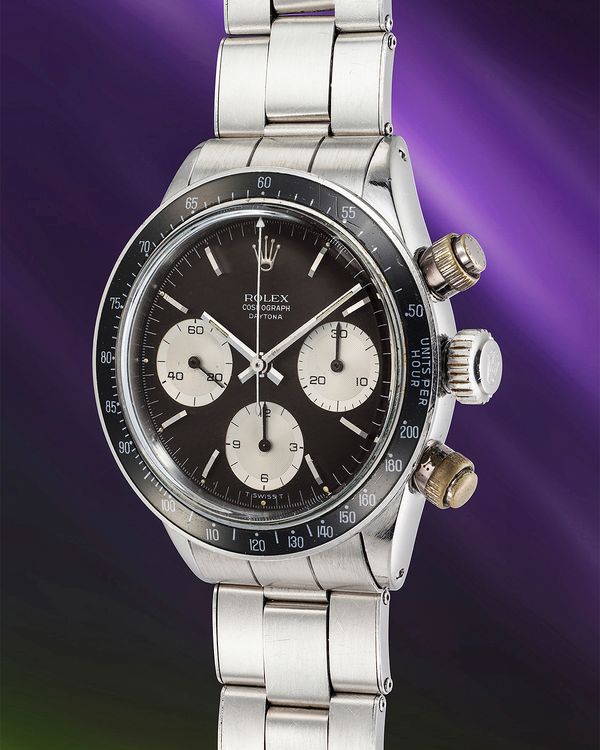
This reference 6240 is yet another variant of the diverse model. Instead of bearing the "Oyster" designation, the dial displays "Rolex Cosmograph" with "Daytona" below in a smaller size. Furthermore, the dial has toned down from black, to a beautiful and rich brown "espresso" tone. The case is preserved in equally impressive condition, with crisp finishes to the top of the lugs and very sharp numbers between the lugs.
It furthermore retains all the correct attributes such as the Mk 1 bezel and early "Millerighe" pushers, which this reference is particularly known for.
Lot 201
In 1969, Rolex simultaneously launched references 6263 and 6265, replacing the first Oyster Cosmograph, the reference 6240. The Cosmograph Daytona with screw-down pushers was in production for almost 20 years and was offered in either stainless steel or gold.
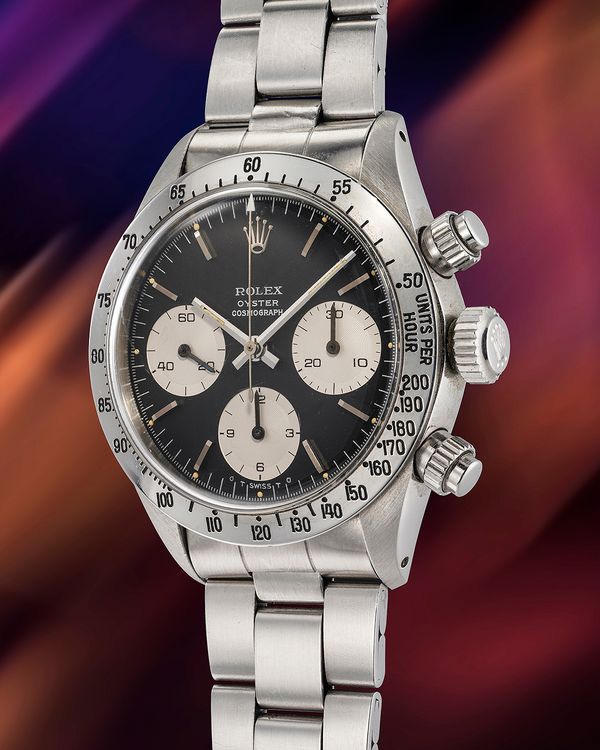
Showcasing a "Sigma" dial, correct for the serial number, it is further preserved in excellent overall condition. The watch further retains its original pushers, a particularly sought after detail. The dial is also preserved in excellent condition with barely any signs of aging and reactive lume plots. It is incredible how 50 years after its original launch, the manual wind Rolex Cosmograph Daytona still retains modernity, with its design codes perfectly capturing the zeitgeist of the late 1960s and remaining ever relevant today.
Lot 210
At Rolex, the year 1970 was marked by the launch of two Cosmograph references. While the reference 6262 was released with a metal bezel, the 6264 was released with an acrylic bezel. Compared to its predecessors, these two references were fitted with the upgraded caliber 727. As often in production, the new reference was launched when spare parts from the precedent was still available hence some of the first models produced, like the present one, using a caseback with the previous reference 6239 written inside. Both references were produced for a few years only and were the last Daytona references to be fitted with pump pushers, their screw-pusher counterparts (ref 6263 and 6265) soon overtaking them in popularity.
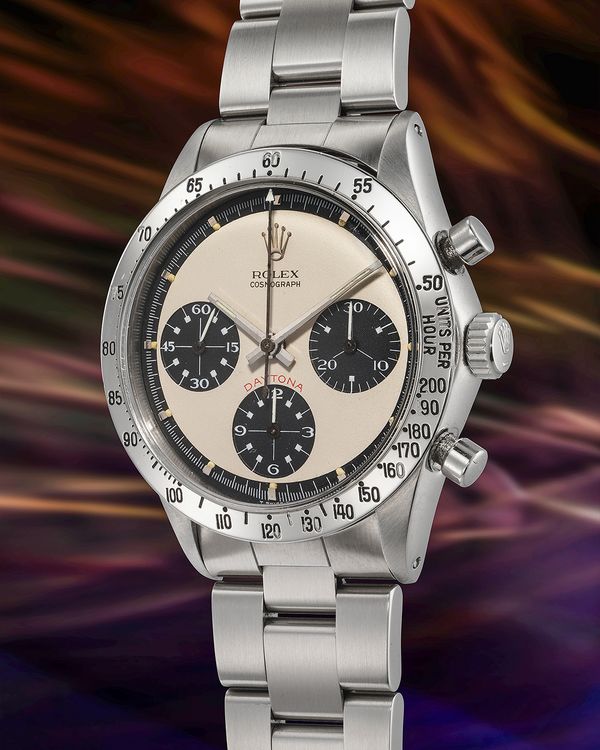
Thus, reference 6262 represents a very unusual, transitional model with pump pushers and the new caliber 727. Its discontinuation not only represents Rolex’s ability to admit a miscalculation and swiftly correct it, but it furthermore makes it one of the rarest Daytona models, with a production run of 4 short years.
The present example not only encapsulates this historical importance and rarity, but furthermore boosts them to the next level with the addition of an incredibly well-preserved white Paul Newman dial. With its luminous dots aged to a charming vanilla tonality and a beautifully well-preserved surface, it is a very attractive example. Exactly what one would expect to find on this 2.5 million serial watch, the dial features a white outer scale with white flat "T Swiss T" designation, an evolution from the previously seen red scales with sing-a-song T Swiss T designation.
You can learn more, place a bid, and view the entire Phillips Geneva Watch Auction: XX catalog right here.
About Phillips In Association With Bacs & Russo
The team of specialists at PHILLIPS Watches is dedicated to an uncompromised approach to quality, transparency, and client service. Phillips in Association with Bacs & Russo holds the world record for the most successful watch auction, with its Geneva Watch Auction: XIV having realized $74.5 million in 2021. Over the course of 2021 and 2022, the company sold 100% of the watches offered, a first in the industry, resulting in the highest annual total in history across all the auction houses at $227 million.
About Logan Baker
Logan has spent the past decade reporting on every aspect of the watch business. He joined Phillips in Association with Bacs & Russo at the start of 2023 as the department's Senior Editorial Manager. He splits his time between New York and Geneva.
Recommended Reading
An In-Depth Collectors’ Guide To The Patek Philippe Chronograph Ref. 5070
Patek Philippe’s TV-Shaped Ref. 5020 Is A Genuine ‘90s Deep-Cut