7
Henri Matisse
Jeune fille dormant à la blouse roumaine
完整圖錄內容
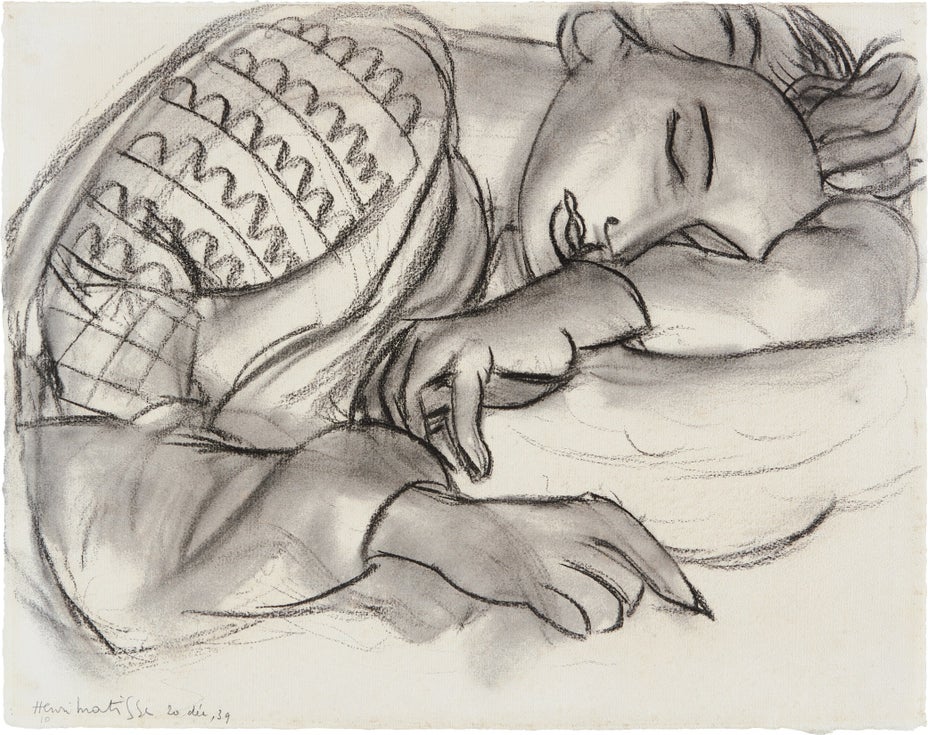
The sleeping woman in Jeune fille dormant à la blouse roumaine appears to resemble Matisse’s studio assistant, secretary and muse Lydia Delektorskaya, one of the few people in the artist’s immediate universe when he executed the present drawing in late 1939. Matisse’s wife Amélie had separated from him by this time, amongst other reasons because of his increasing dependence on Lydia. While Lydia had initially left the household, partly as a result of the tumult that her presence had caused, she was later reunited with Matisse. By the time he created Jeune fille dormant à la blouse roumaine, Matisse and Lydia had returned to Nice, a city that was increasingly abandoned due to the threat of an Italian invasion with the start of World War II in September of that year. At the time, Matisse was one of the only residents of the Hôtel Régina, the grande dame hotel that had been built largely to accommodate Queen Victoria and her retinue but had since then been divided into apartments. Despite the continued tensions with his family, the sense of restored balance in his studio arrangements percolated into works from this time such as this drawing.
Jeune fille dormant à la blouse roumaine relates to the inspirational inception of Matisse’s 1940 masterpiece Le rêve, a work that remained in his personal collection for a long time and which he revered so much that when he was about to undergo an operation, he considered bequeathing it to Paris. That painting was completed towards the end of 1940, the culmination of a long artistic journey in which Jeune fille dormant à la blouse roumaine was one of the first exciting steps. The vivid sense of restfulness emanating from the work cuts to the heart of the world of sensuous illusion that Matisse conjured in his pictures. For, as well as putting forth a brief, intimate moment captured for posterity, this also served as a stepping stone within a sustained, almost single-minded artistic exercise. “It was a big adventure,” Matisse would write to his son Pierre after the completion of Le rêve, “All my paintings are adventures, which is what makes them interesting. As I never let them out till they are finished and successful, I am the only one who has lived through the risks. When I began it, months ago, The Dream was a very realistic picture, with a beautiful dark young woman asleep on my marble table among some fruits” (Henri Matisse, quoted in John Russell, Matisse: Father & Son, New York, 1999, p. 195).
By its end, Le rêve had travelled a long way and become a vertical composition with a rigorous abstraction whose style has been compared to Pablo Picasso’s depictions of Marie-Thérèse Walter in the early 1930s.While the contours and shading are reduced to a bare minimum as the girl faces in the opposite direction, photographs of an early state of Le rêve reveal that the inception was, as Matisse himself had explained, more realistic and stylistically in tune with Jeune fille dormant à la blouse roumaine. In this sense, the present drawing relates more closely to the 1940 Nature morte à la dormeuse, now in the National Gallery of Art, Washington, D.C. Meanwhile, in terms of its composition and even orientation, Jeune fille dormant à la blouse roumaine recalls Matisse’s earlier painting of 1935, also entitled Le rêve, in the Centre Georges Pompidou, Musée National d’Art Moderne, Paris. In that work, Matisse had shown his model and secretary Lydia Delektorskaya lying naked, her head resting on her crossed arms. Drawings relating to that earlier work bare a strong similarity to Jeune fille dormant à la blouse roumaine, for instance the 1935 study also held in the Centre Georges Pompidou, Paris.
Writing of Le rêve on its completion, Matisse would tell his son, “I won’t say that this painting made me forget everything else, but at least it brought me some relief” (Henri Matisse, quoted in John Russell, Matisse: Father & Son, New York, 1999, p. 195). This was a reference both to the turbulent events in his own family and the political climate in France as a whole. It was against the backdrop of conflict, worry and hardship in the early stages of World War II that poetic works such as Jeune fille dormant à la blouse roumaine were created. When Matisse returned to Nice towards the end of 1939, he had found reminders of the war ever-present, with even the hotel having become an impromptu garrison. Matisse’s decision to remain in France was notably a concerted one. As he explained to his son, “When I was at the frontier and saw the endless march of those escaping I did not feel the slightest inclination to leave. Yet I had a passport with a visa in my pocket for Brazil. I was to leave on June 8th via Modane and Genoa, to stay a month in Rio de Janeiro. When I saw everything in such a mess I had them reimburse my ticket. It seemed to me as if I would be deserting. If everyone who has any value leaves France, what remains of France?” (Henri Matisse, letter to Pierre, 1 September 1940, quoted in Alfred H. Barr, Jr., Matisse: His Art and His Public, New York, 1951, p. 256).
The decision to stay in France was a bold choice—one echoed by his friend and rival Picasso, who remained ensconced in Paris. While Picasso’s pictures often channeled the atmosphere of those dark days, Matisse fought to vanquish it, creating masterworks such as Le rêve and Jeune fille dormant à la blouse roumaine. He became a beacon of hope and quiet resistance, as the poet Louis Aragon would declare: “In those days, people will say, they did at least have Matisse, in France... At the darkest point in our night, they will say, he made those luminous drawings” (Louis Aragon, Henri Matisse: A Novel, vol. 1, trans. J. Stewart, London, 1971, pp. 143-44).
Henri Matisse
French | B. 1869 D. 1954The leading figure of the Fauvist movement at the turn of the 20th century, Henri Matisse is widely regarded as the giant of modern art alongside friend and rival Pablo Picasso. Working as a painter, draughtsman, printmaker and sculptor for over five decades, he radically challenged traditional conventions in art by experimenting with vivid colors, flat shapes and distilled line. Rather than modeling or shading to lend volume to his pictures, the French artist employed contrasting areas of unmodulated color. Heavily influenced by the art and visual culture of non-Western cultures, his subjects ranged from nudes, dancers, odalisques, still lifes and interior scenes and later evolved into the graphic semi-abstractions of his cut-outs of his late career.