49
Damien Hirst
Phenylpropiolic Acid
完整圖錄內容
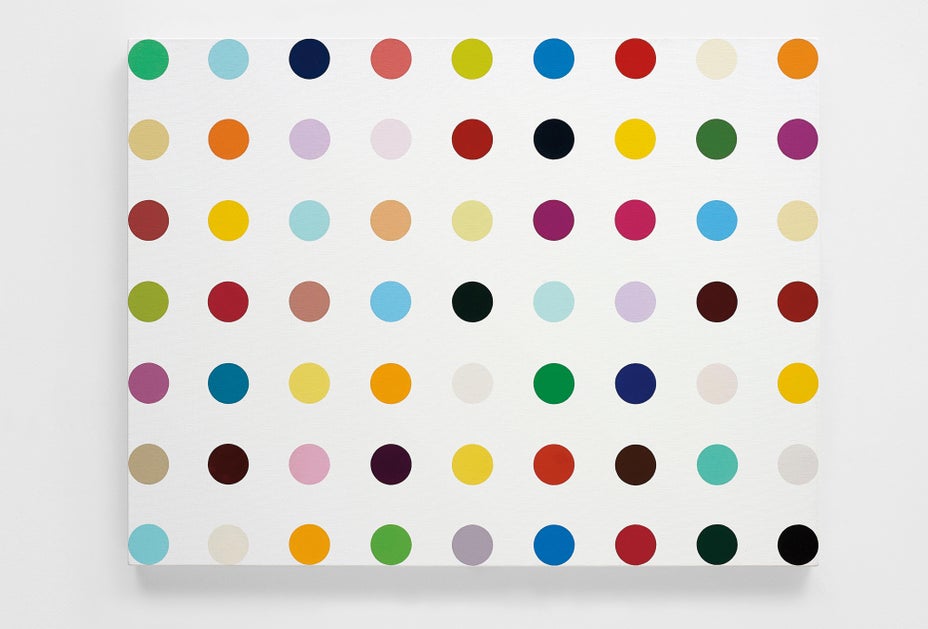
As with the rest of the series, Phenylpropiolic Acid derives its title from the company catalogue of life sciences corporation Sigma-Aldrich. The 'Pharmaceutical Paintings' are blueprints, each a schematic document of the titular chemical’s atomic structure. Though the arrangements may appear random, they result from an exacting process, and each unique colour is born from a meticulous procedure of mixing household gloss paints. This disconnect between product and method creates a resonant conceptual tension, while the spots buzz with an unbridled visual delight. ‘If you look closely at any one of these paintings a strange thing happens: because of the lack of repeated colours, there is no harmony … So in every painting there is a subliminal sense of unease; yet the colours project so much joy it’s hard to feel it, but it’s there.’ (Damien Hirst, I want to spend the rest of my life everywhere, with everyone, one to one, always, forever, now, London: Booth-Clibborn Editions, 1997, p. 246). Brightly clinical and deceptively simple, Phenylpropiolic Acid is a triumph of design and spectacle that displays Hirst’s mastery of the human eye to thrilling effect.
Damien Hirst
British | 1965There is no other contemporary artist as maverick to the art market as Damien Hirst. Foremost among the Young British Artists (YBAs), a group of provocative artists who graduated from Goldsmiths, University of London in the late 1980s, Hirst ascended to stardom by making objects that shocked and appalled, and that possessed conceptual depth in both profound and prankish ways.
Regarded as Britain's most notorious living artist, Hirst has studded human skulls in diamonds and submerged sharks, sheep and other dead animals in custom vitrines of formaldehyde. In tandem with Cheyenne Westphal, former Chairman of Phillips, Hirst controversially staged an entire exhibition directly for auction with 2008's "Beautiful Inside My Head Forever," which collectively totalled £111 million ($198 million).
Hirst remains genre-defying and creates everything from sculpture, prints, works on paper and paintings to installation and objects. Another of his most celebrated series, the 'Pill Cabinets' present rows of intricate pills, cast individually in metal, plaster and resin, in sterilized glass and steel containers; Phillips New York showed the largest of these pieces ever exhibited in the United States, The Void, 2000, in May 2017.