8
Alejandro Otero
Untitled
Full-Cataloguing
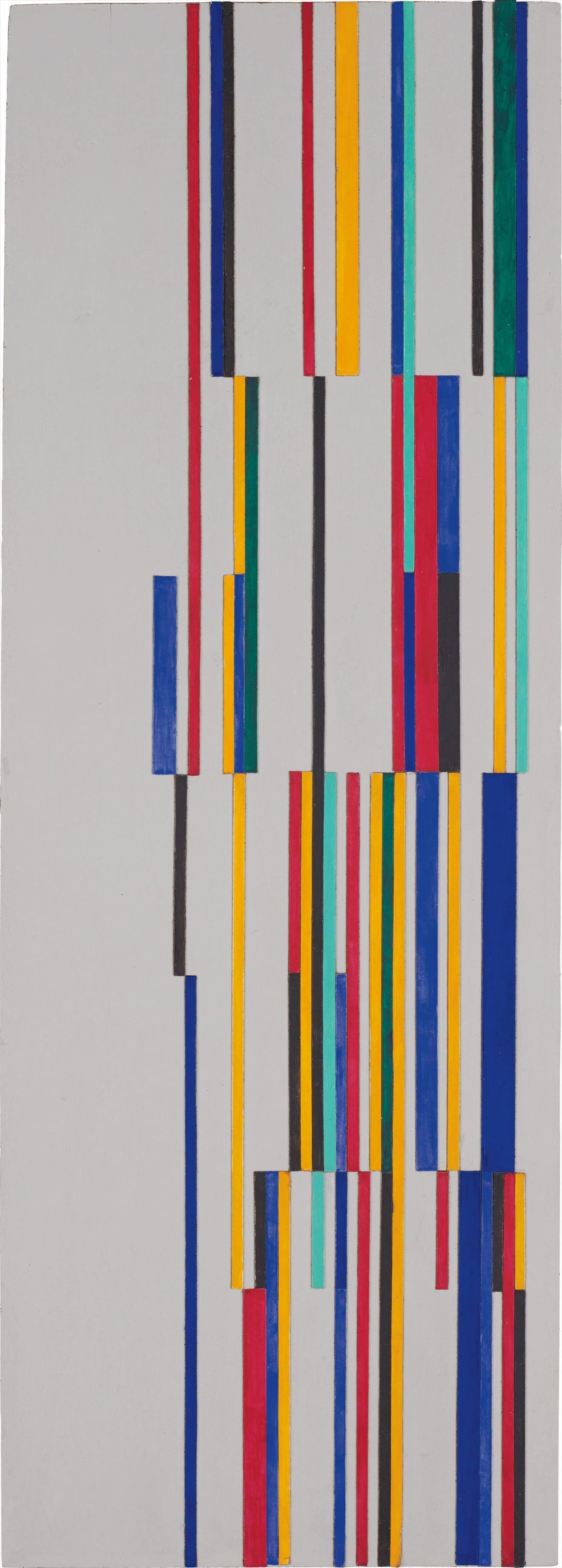
One cannot fully comprehend Otero’s oeuvre without understanding his masterpieces, the Coloritmos, which were some of his most ambitious works, created from 1955-1970. It was in this series that Otero first began using duco, a shiny industrial lacquer that is applied with spray guns or rollers onto supports of wood or Plexiglas. Looking at early panels from this series, the viewer can see how they inform the present lot, where the structure has evenly spaced vertical bands on a white ground and color markings that are interspersed thereby activating the entire structure of the plane. The primordial aspect of these elongated compositional modules is a promotion of rhythm and color over form, suggesting a spatial ambiguity and a rhythm that expands beyond the edges. It is this constructive sensibility that Otero obtained from his architectural training and that would eventually recover the relation between architecture and art. The present lot, very much like the Coloritmos, “overflows the plane, reaches for and embraces architectural space,” as Otero aptly described it, and moves perceptually towards the viewer. Picasso was also a great influence for Otero as the few encounters with the great master made Otero turn to Cubism, such that “Otero experimented with the way lines, colors and planes articulate painting’s abstract spatiality.” (Rina Carvajal, Resonance Space – The Colorhythms of Otero, 2014, p. 64). Additionally, Mondrian inspired Otero as his art taught the younger artist to further experiment with the colored blocks on panels.
At first glance, these works seem simple but ambiguity disrupts the contemplative viewing. Ultimately, “with this constitutive ambivalence or doubt at the heart of the series, Otero breaks with the disciplinary order of modernist aesthetics, in which each medium is understood through qualities specific to it, in a way that also points to the return of another modernist dream, that of the integration of art and architecture” (Carvajal, Resonance Space – The Colorhythms of Otero, 2014, p. 71) This work is a celebration of vision, a gratifying disconnect between what the viewer sees and what Otero actually paints on the canvas. This stunning rendering of geometric abstraction is imbedded within a larger visual experience that is both personal and universal.
Alejandro Otero
Venezuelan | B. 1921 D. 1990Alejandro Otero is an important figure in Venezuelan abstract and kinetic art. He studied and lived in France and returned to Venezuela during a significant moment when his country was undergoing modernization. During this time he participated in a large scale architectural project with renowned Venezuelan architect Raúl Villanueva that significantly informed his works. Primarily influenced by Piet Mondrian, his art denotes the notions of integration and architecture, as well as the continual experimentation with spatial and optical effects of line and color. His most important contribution to the field of painting is his series of Coloritmos (Colorythms), where he applies rhythm to color form, suggesting a subtle spatial ambiguity and insinuating a complex visual dance.