Article | Patek Philippe 1970s Jewelry Watches 4119 4291 Bracelets Phillips Hong Kong May 2026
Hidden Gems of the 1970s: Experimental Ladies’ Watches by Patek Philippe
During the 1970s, Patek Philippe responded to the Quartz Revolution by embracing bold design and jewelry-like creativity. Two rare ladies' watches in the Phillips Hong Kong Watch Auction: XXII capture the manufacture at its most experimental.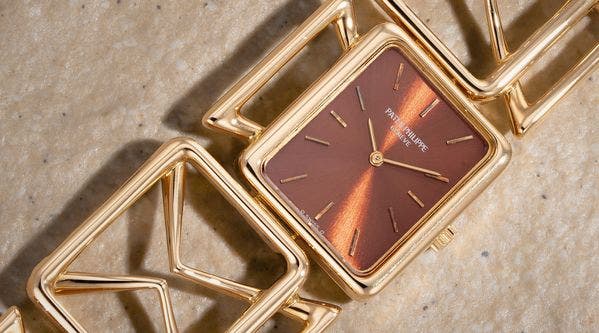
The Phillips Hong Kong Watch Auction: XXII takes place on 30 & 31 May 2026, at our West Kowloon headquarters. The auction includes more than 250 of the world's finest watches – and though we are loath to boast, we truly think it's one of the best catalogues we've ever put together. We'll be highlighting a number of the most interesting lots and stories from the sale over the next month, including the two incredible 1970s Patek Philippe jewelry watches featured below.
– By Logan Baker
The 1970s were a turbulent decade for the Swiss watch industry.
Quartz technology arrived from Japan with astonishing precision and far lower production costs, forcing even the most traditional manufactures to confront an uncomfortable question: what role did a mechanical watch still play in a modern world?
For a house like Patek Philippe, the answer was not simply technical. It was creative.
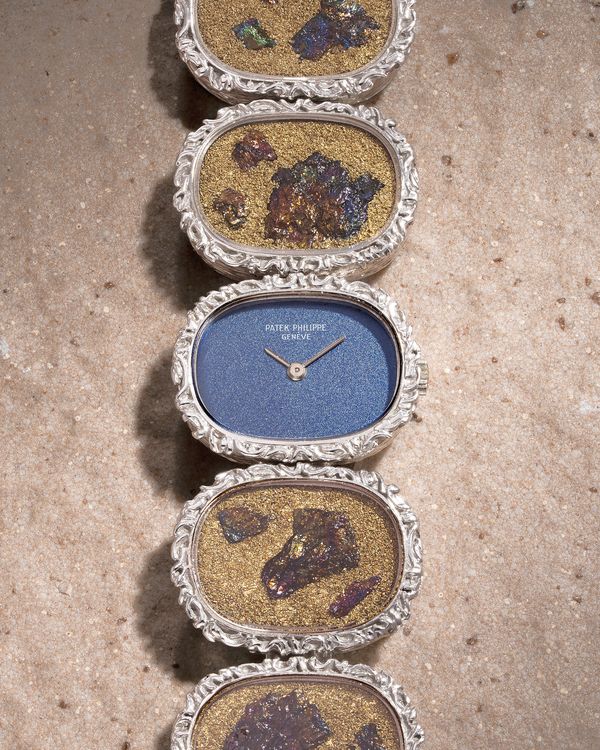
Lot 835: A 1971 Patek Philippe Ref. 4119/1 in 18K white gold, bronze powder and chalcopyrite, included in the Phillips Hong Kong Watch Auction: XXII. Estimate: HKD $150,000–300,000
Rather than abandon mechanical watchmaking, Patek leaned into the qualities quartz could never replicate: craftsmanship, artistry, and the tactile beauty of precious materials. Nowhere is this philosophy clearer than in the remarkable ladies’ watches the brand produced throughout the 1970s.
Freed from rigid expectations of traditional wristwatch design, Patek Philippe experimented boldly with form, materials, and decorative techniques, producing pieces that sit somewhere between horology and high jewelry.
Two exceptional examples appearing in the upcoming Phillips Hong Kong Watch Auction: XXII offer a vivid glimpse into this experimental moment.
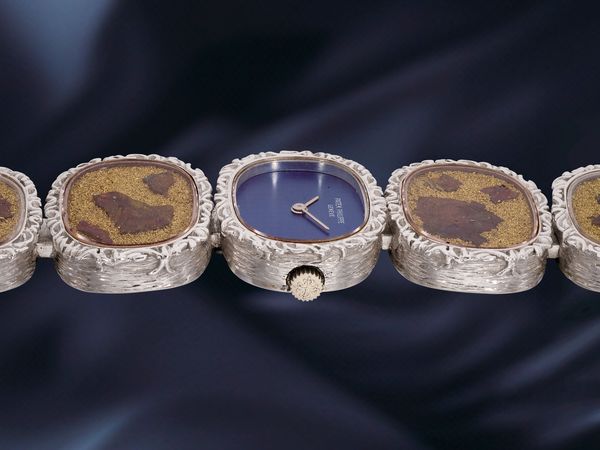
Lot 835: A 1971 Patek Philippe Ref. 4119/1 in 18K white gold, bronze powder and chalcopyrite, included in the Phillips Hong Kong Watch Auction: XXII. Estimate: HKD $150,000–300,000
The first, a 1971 Ref. 4119/1 in 18k white gold, is one of those creations that could only have emerged during this creative high point. Its architecture is built around a sequence of engraved medallions that form the bracelet, framing a vivid cobalt-blue dial at the center. Each medallion contains fragments of chalcopyrite and shimmering bronze powder, materials rarely encountered in watchmaking but prized for their natural iridescence.
Chalcopyrite, sometimes called “peacock ore,” displays shifting hues of gold, purple, and blue as light plays across its surface. Working with such mineral fragments presents real challenges for jewelers, which helps explain why the reference appears to have been produced in extremely small numbers.
Only three 18k yellow-gold examples of the Ref. 4119 are currently known. The present watch, confirmed by its Extract from the Archives and believed to be the only 18k white-gold example to surface publicly, represents a strikingly rare variation. It also reflects the spirit of the era.
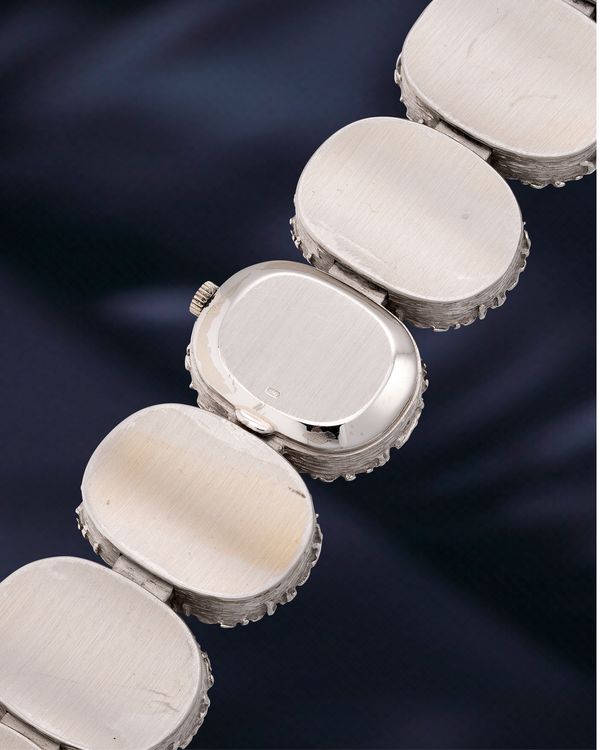
Lot 835: A 1971 Patek Philippe Ref. 4119/1 in 18K white gold, bronze powder and chalcopyrite, included in the Phillips Hong Kong Watch Auction: XXII. Estimate: HKD $150,000–300,000
During the early 1970s, designers and jewelers working with Patek Philippe, including figures such as Gilbert Albert and bracelet makers like Georges L’Enfant, explored organic textures and unconventional materials with remarkable freedom. The results often resembled miniature wearable sculptures as much as traditional watches.
If the Ref. 4119/1 represents the decade's experimental, almost psychedelic side, the circa-1976 Ref. 4291/1 demonstrates that Patek Philippe also pursued a different aesthetic direction: sculptural restraint.
This elegant square wristwatch embraces the idea of “continuous design,” a defining concept of the period in which the bracelet and case flow seamlessly together as a single architectural object.
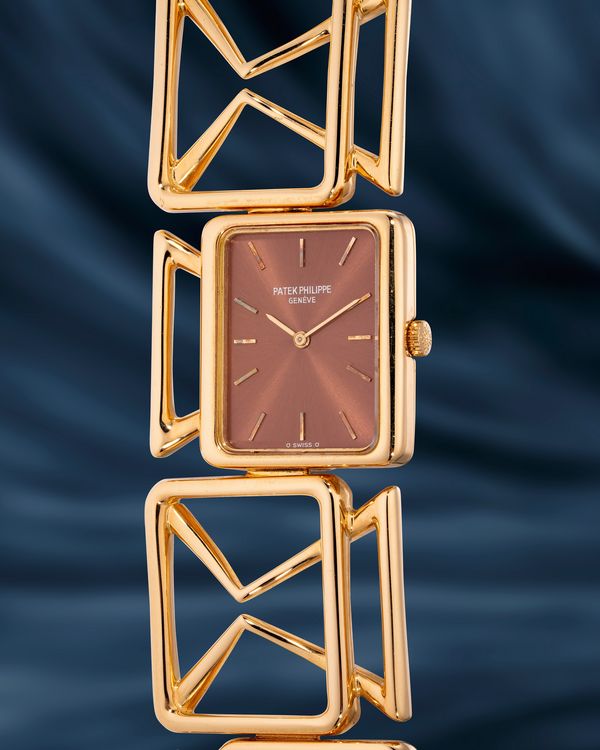
Lot 1015: A circa 1976 Patek Philippe Ref. 4239/1 in 18k yellow gold, included in the Phillips Hong Kong Watch Auction: XXII. Estimate: HKD $150,000–300,000
Here, a distinctive 18k yellow-gold bracelet composed of linked frames extends directly from the case, creating a cohesive visual structure around the dial.
The dial itself is equally evocative. Known among collectors as a “Vermeer” dial, its sunburst surface shifts between deep burgundy and warm brown tones, occasionally revealing hints of purple depending on the light. Over time, the slender applied indices have developed a subtle patina that complements the warmth of the gold case.
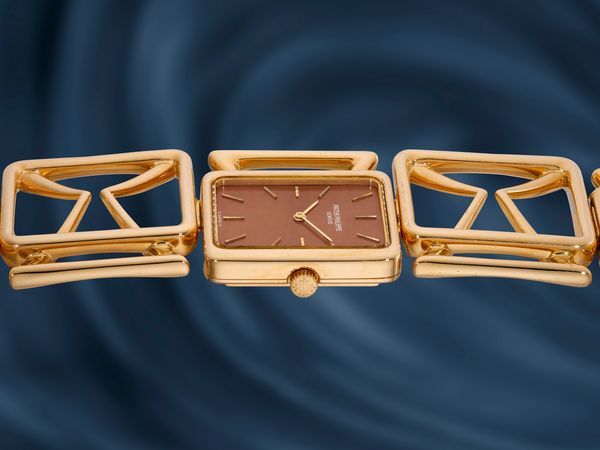
Lot 1015: A circa 1976 Patek Philippe Ref. 4239/1 in 18k yellow gold, included in the Phillips Hong Kong Watch Auction: XXII. Estimate: HKD $150,000–300,000
Adding another layer of historical interest, the case was produced by the renowned casemaker Georges Croisier, whose work appears on some of the most important vintage Patek Philippe watches ever made.
Inside, the watch houses one of the brand’s ultra-thin mechanical movements, a reminder that even in a decade defined by experimentation, Patek Philippe never abandoned its commitment to traditional watchmaking.
Together, these two watches capture the remarkable creative freedom Patek Philippe embraced during the 1970s. In an era when mechanical watchmaking seemed under existential threat, the manufacture responded not by retreating into conservatism but by exploring new territory.
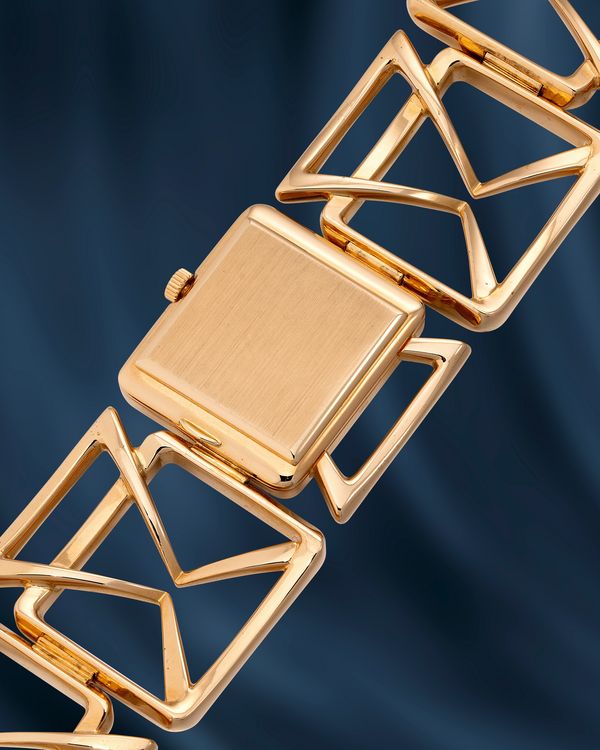
Lot 1015: A circa 1976 Patek Philippe Ref. 4239/1 in 18k yellow gold, included in the Phillips Hong Kong Watch Auction: XXII. Estimate: HKD $150,000–300,000
This period deserves increased recognition as one of the most imaginative chapters in Patek Philippe's history. Pieces like the Ref. 4119/1 and Ref. 4291/1 are reminders that sometimes the most daring creativity emerges precisely when tradition is forced to reinvent itself.
You can learn more, place a bid, and view the entire Hong Kong Watch Auction: XXII catalogue right here.
About Phillips In Association With Bacs & Russo
The team of specialists at PHILLIPS Watches is dedicated to an uncompromised approach to quality, transparency, and client service. Phillips in Association with Bacs & Russo holds the world record for the most successful watch auction, with its Geneva Watch Auction: XIV having realized $74.5 million in 2021. Over the course of 2021 and 2022, the company sold 100% of the watches offered, a first in the industry, resulting in the highest annual total in history across all the auction houses at $227 million.
About Logan Baker
Logan has spent the past ten years covering the watch industry from every angle. He joined Phillips in Association with Bacs & Russo in early 2023 as Senior Editorial Manager, after previous roles at Hodinkee and WatchTime. Originally from Texas, he spent a decade in New York and now calls Geneva home.