Article | Swim Free And Look Fearlessly Photographs Auction New York April 2026
Swim Free and Look Fearlessly
How Wolfgang Tillmans captures the essential — without a camera — in 'Freischwimmer 123'.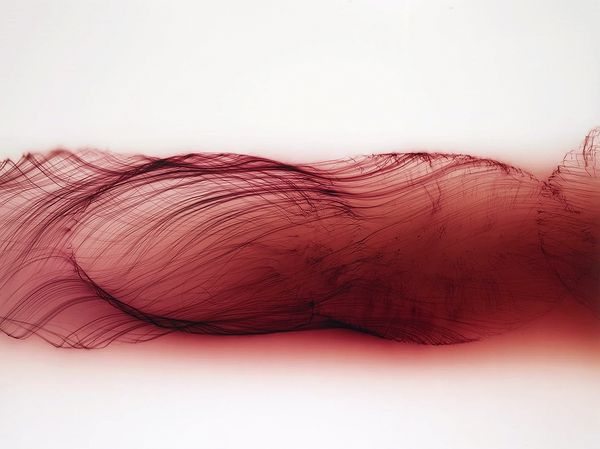
Wolfgang Tillmans, Freischwimmer 123, 2004. Photographs New York.
“I see my practice as picture-making,” explains Wolfgang Tillmans. “Whatever is available, I use.” But often his most profound statements stem from what the artist chooses not to use, and this April at Phillips, a remarkable abstract Tillmans work comes to auction that explores just that.
Upon encountering Freischwimmer 123, we immediately notice that nearly every constituent element commonly considered to define photography is nowhere to be found. Absent from Tillmans’ process here are the camera, the subject, and the negative. Gone is any overt attempt to document objective reality — our eyes the only lens. The artist distills his process to the very core elements of the medium, exploring how photo-chemicals react to light in a darkroom. In a term, this work is a luminogram, but speaking figuratively, we could just as easily say that Tillmans is painting with photography, playing color like a musical instrument, writing poetry with subtext, or choreographing a dance with bodies of light.
This approach is characteristic of the artist, whose creativity spills over the borders of any photograph, reaches beyond the door to any of his meticulously self-arranged exhibitions, and extends to writing, architecture, video, sound, and, since 2015, music (the artist’s Bandcamp feed is a joyous listen). But no matter how acquainted we are with Tillmans, this work never loses its sense of surprise. Taking the artist’s fearless experimentalism as a starting point, it’s necessary to understand how the Freischwimmer works relate to the rest of his creative world, and, crucially, not to consider them painterly. Using a light pen, Tillmans engages with line and color like a painter, but toys with our perception of reality, understanding we will perceive these works as photography and, thus, as representations of objective truth. Beyond referencing another medium, these works pare down photography to its essence both conceptually and visually.
“Tillmans’ value system revolves around some central questions: What can pictures make visible? What can one know at all? Who deserves attention? How can one connect with other people? How might we foster solidarity? In what do art's political potential and its ethical worth reside? As he notes: ‘For me art was the area where I could oppose. Express difference.’”
—Roxana Marcoci, The Wandering Image
An exceptional example from Tillmans’ most lauded abstract series, Freischwimmer 123 stands out both for its massive scale and its striking composition — the bulk of the visual activity is contained in a horizontal band, just below the mid-point, comprised of pooling, porous, vascular lines. The German term Freischwimmer refers to a level of swimming proficiency typically achieved in youth and is understood to be a stand-in for an important coming-of-age moment. This, coupled with the flowing, liquid nature of the image, brings aquatic associations, but more poignantly, it calls to mind the openness, curiosity, and fluidity that define what we love most about Tillmans’ creative output. For many viewers, the title’s associations also evoke the political and queer nature of the artist’s works, as Tillmans has explained, “I feel that purely abstract works and pictures with non-direct political content are my freedom of expression — they are my resistance to feeling powerless against the falling apart of a world bent on reviving ideologies, erecting borders and barriers and fueling hatred between people.”
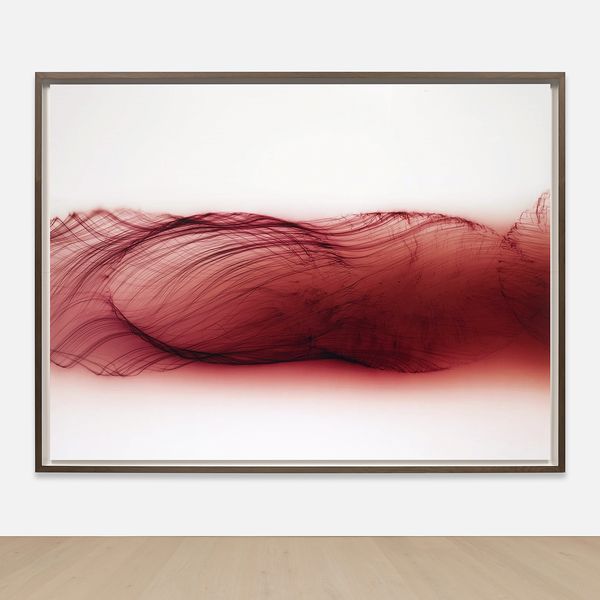
Wolfgang Tillmans, Freischwimmer 123, 2004. Photographs New York.
Tillmans first rose to prominence for his wide-ranging portraits and photographs that documented aspects of alternative culture, ranging from celebrity imagery to queer communities, club scenes, and beyond. The resonant voice across these works seems to put forward the primacy of the image as an object over its value within the hierarchical structure of our image-saturated world, both within the individual images themselves and in how they relate to each other. But critically, the artist achieves these goals in an overwhelmingly positive, celebratory, and empowering way, raising questions about everything from identity, seen in his photographs of close friends Lutz and Alex, to the origin of the cosmos in his astronomical photographs that verge on the abstract.
In this sense, his representational images are as much about questioning reality and objecthood as the abstract works. But for Tillmans, there is no single truth or reality, but many, and the fearless joy of his eye lies in how it investigates layers of objective truths. In an interview with Dominic Eichler published in Frieze magazine, the artist expounded on the relationship between his representational and abstract works: “The human eye has a great desire to recognize things when it looks at a photographic print. I made use of this phenomenon and found I could speak about physicality in new pictures, while the camera-based pictures could be seen in a new light as well.” He goes on to note that, together, his works express “multiple singularities, simultaneously accessible as they share the same space or room.”
The upcoming auction and preview exhibition offer a rare opportunity to engage with the spirit of the Freischwimmer series, stationing us as free swimmers ourselves — pushing boundaries, embracing contradictions, and observing collaboratively, without inhibition. This work represents a celebration of finding one’s own path, both for us as viewers and for Tillmans as artist — and this is an artist who is unquestionably charting a new course in the field of photography. As curator Quentin Bajac notes in the essay Blurring the Perimeter of the Darkroom, published by MoMA in the exhibition catalogue To Look Without Fear, “A political and social history of abstraction in photography has yet to be written; when it appears, Tillmans will occupy a chapter.”
Discover more from Photographs >
Recommended Reading